
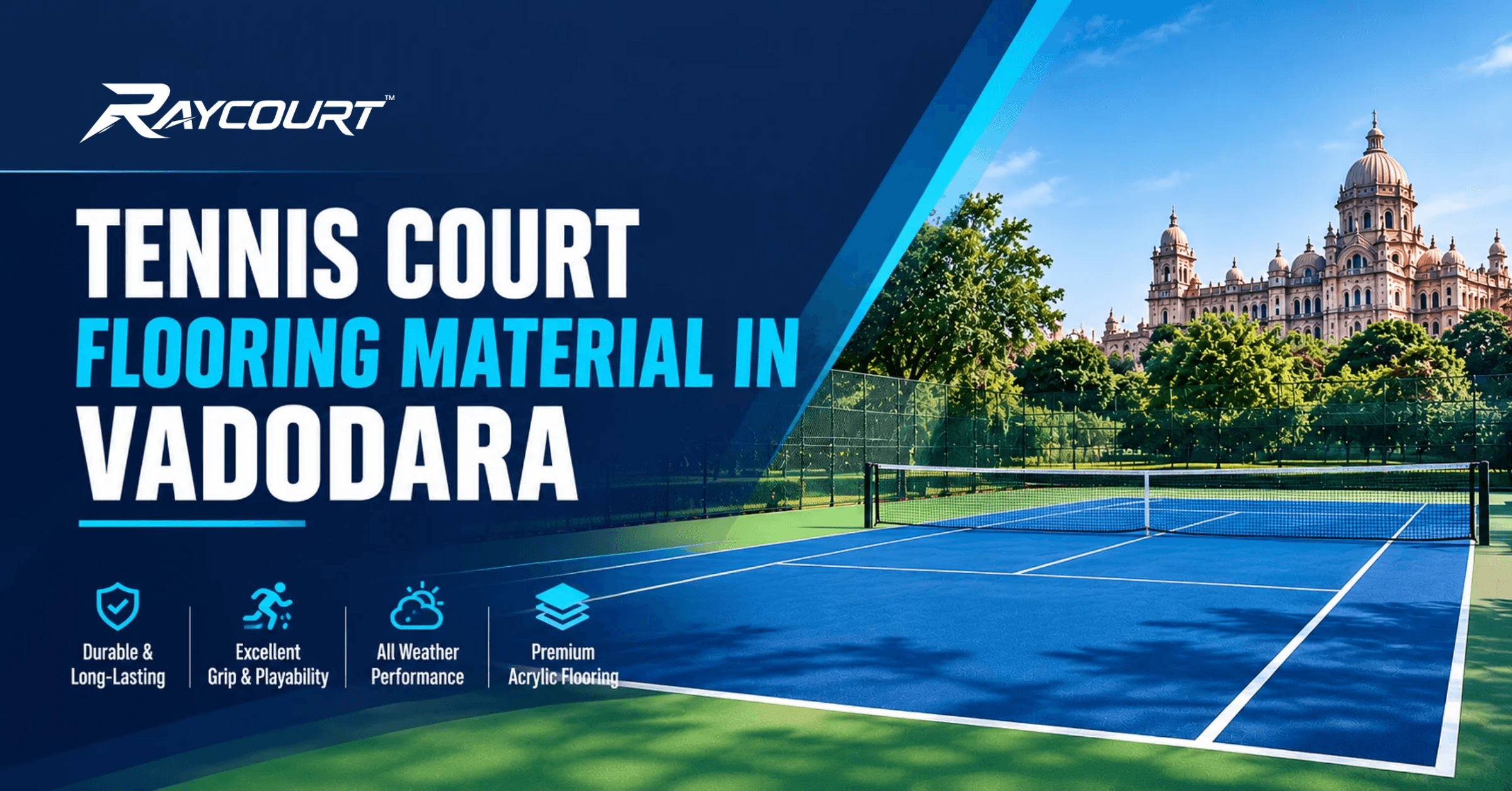
The best tennis court flooring material in Vadodara is a synthetic acrylic system. It suits the city’s heat, its heavy monsoon and its growing appetite for tennis. In short, acrylic gives you a true bounce, firm grip and strong colour in one system.
So, why does acrylic win? First, it bonds firmly to a concrete or asphalt base. Second, it resists the strong ultraviolet light that Vadodara receives for most of the year. Third, it sheds rainwater quickly when the base has the right slope. As a result, players return to the court soon after a shower.
Moreover, an acrylic system lets you choose the speed of the court. You can also add cushion layers for extra comfort underfoot. Therefore, one material family serves a school, a housing society and a competitive academy equally well.
This guide explains everything you need to know about tennis court flooring material in Vadodara. It covers the layers, the climate, the pace ratings and the upkeep. In addition, it explains how Raycourt supports your project as a specialist manufacturer. Please note that Raycourt supplies the material, while trained applicators handle the application on site.
Expert Tip: Decide who will play on the court before you compare materials. The players’ needs should guide every choice that follows.
Key Takeaways at a Glance
- Synthetic acrylic is the leading tennis court flooring material in Vadodara for outdoor courts.
- Layered systems let you select between hard and cushioned courts.
- UV-stable pigments keep colours bright under the Gujarat sun.
- ITF Court Pace Classification helps you match surface speed to your players.
- Simple upkeep keeps the court in play through every season.
What Is Synthetic Acrylic Tennis Court Flooring Material?
Synthetic acrylic flooring is a multi-layer coating system. It combines acrylic resins, mineral fillers, graded silica sand and colour pigments. Together, these ingredients form a tough, textured film over a solid base. Consequently, the court gains a uniform playing surface from baseline to baseline.
Unlike loose surfaces, acrylic does not shift or scatter. Instead, each coat bonds to the coat below it. Therefore, the ball meets the same surface at every point on the court. This consistency explains why most hard courts around the world use acrylic coatings.
Furthermore, acrylic is a water-based material. It carries a low odour, and it dries quickly in warm weather. For Vadodara, that matters a great deal. The city enjoys long dry spells, so applicators can plan their coats with confidence.
Why Acrylic Chemistry Suits Tennis
Tennis demands a lot from a surface. Players sprint, stop, pivot and recover within seconds. Therefore, the floor must grip firmly without grabbing the shoe. Acrylic achieves this balance through its sand-textured finish.
Moreover, the ball needs a clean, predictable rebound. A rigid base with a uniform acrylic film delivers exactly that. The ball leaves the surface at a consistent height and angle. Consequently, players trust their timing and commit to their shots.
Acrylic resins also weather gracefully. They resist water, sunlight and temperature swings far better than ordinary paints. In addition, the water-based formula carries low odour during application. Hence, schools and residential sites can coat their courts with little disruption.
The Layers That Build a Tennis Court
A tennis court flooring system works like a team. Each layer has a clear job, and each one supports the next. Below, we walk through the layers from the base upwards.
Primer
The primer prepares a concrete base for the coats that follow. It soaks into the pores and improves adhesion. As a result, the upper layers grip the base firmly. Asphalt bases often skip this step, because acrylic bonds well with cured asphalt.
Acrylic Resurfacer
Next comes the acrylic resurfacer. This thick, sand-rich coat fills small voids and smooths minor surface variations. In addition, it creates an even texture for the layers above. Think of it as the foundation coat of the whole system.
Cushion Coats
Cushion coats are optional, yet many buyers choose them. These layers contain fine rubber granules within an acrylic binder. Consequently, they absorb part of the impact from every step and landing. Players often notice less strain on their knees and ankles during long sessions.
Colour Coats
The colour coats give the court its look and its playing character. They blend UV-stable pigments with carefully graded silica sand. The sand controls the texture, and the texture controls grip and pace. Therefore, this layer shapes how the ball behaves after the bounce.
Line Marking Paint
Finally, the applicator marks the lines with a textured acrylic line paint. Crisp white lines contrast sharply with the colour coats. Moreover, the texture keeps the lines as grippy as the rest of the court.
| Layer | Key ingredients | Main role |
|---|---|---|
| Primer | Acrylic binder | Improves adhesion on concrete |
| Acrylic resurfacer | Acrylic resin and silica sand | Levels and fills the base |
| Cushion coats | Acrylic binder and rubber granules | Absorb impact and add comfort |
| Colour coats | Pigments and graded silica sand | Set colour, grip and pace |
| Line paint | Textured white acrylic | Defines the playing lines |
Expert Tip: Never judge a system by the colour coat alone. The layers beneath decide how long the surface performs.
How the Layers Work Together
Each layer depends on the one beneath it. The resurfacer cannot hide a poor base, and the colour coat cannot rescue a weak resurfacer. Therefore, smart buyers treat the system as a single unit. They source every layer from one manufacturer, so the chemistry stays compatible.
In addition, the number of coats matters. A hard court system uses fewer layers and delivers a firm, quick response. A cushioned system adds several rubber-rich coats and delivers a softer feel. However, both systems share the same acrylic backbone. Consequently, both offer the same weather resistance and colour stability.
Above all, remember that application quality brings the material to life. Raycourt manufactures the material and shares clear technical guidance. Meanwhile, a trained applicator mixes, spreads and cures each coat on site. This partnership turns good material into a great court.
Benefits You Can Expect
- True bounce: The ball behaves the same way across the whole court.
- Reliable grip: The textured film supports quick stops and turns.
- Weather resistance: The surface withstands heat, rain and humidity.
- Colour retention: UV-stable pigments keep the court vivid.
- Adjustable pace: Texture choices deliver slower or faster play.
- Optional cushioning: Rubber-rich layers add comfort where you need it.
- Easy upkeep: Sweeping and washing cover most of the routine.
- Renewable finish: New colour coats refresh the court without rebuilding it.
Ready to build a court that performs for years to come?
Connect with Raycourt for sports flooring systems built for your project.
Why Vadodara’s Climate Shapes Your Material Choice
Vadodara tests every outdoor surface. The city moves from a scorching summer to a drenching monsoon and then to a mild, dry winter. Therefore, any tennis court flooring material in Vadodara must handle sharp swings in weather. Let us look at each challenge in turn.
Intense Summer Heat
Summer afternoons in Vadodara often climb above 40°C. Meanwhile, the court surface itself grows far hotter than the air. Poor coatings soften, blister or peel under such stress. However, a quality acrylic film stays stable and holds its bond.
Moreover, heat makes a base expand, and cool nights make it contract. This daily movement strains any rigid coating. Acrylic resins offer useful flexibility, so the film moves slightly with the base. As a result, the surface resists the fine cracks that heat cycles can trigger.
Colour choice also helps here. Lighter shades reflect more sunlight and stay cooler underfoot. Consequently, many Vadodara buyers pair a mid-tone playing area with a lighter surround.
Strong Ultraviolet Exposure
Gujarat enjoys clear skies for much of the year. That sunshine delights players, yet it punishes weak pigments. Ordinary paints fade, chalk and lose their texture within a short time. In contrast, UV-stable acrylic pigments hold their shade season after season.
Furthermore, fading affects more than appearance. A chalky surface loses grip, and a patchy court distracts players. Therefore, UV resistance protects both the look and the performance of your court. Always ask the manufacturer about pigment quality before you buy.
The Monsoon Months
From June to September, heavy showers sweep across Vadodara. Some low-lying localities also face waterlogging. So, your court must cope with standing water and constant damp.
Acrylic does not absorb water the way clay does. Instead, rain runs across the film towards the low edge of the court. With a proper slope, the surface drains fast and dries quickly. Consequently, play can resume soon after the clouds clear.
However, the material needs help from the base. A flat or uneven slab traps puddles, and puddles stress any coating. Therefore, discuss slope and drainage with your contractor well before the coating stage.
Humidity, Dust and Daily Grime
After the monsoon, humid air lingers for weeks. Shaded corners may then attract algae or mildew. Fortunately, a smooth acrylic film gives such growth little to hold. A gentle wash usually restores the surface.
In addition, Vadodara’s dry months bring dust from roads and construction sites. Dust acts like fine sandpaper under moving shoes. Hence, regular sweeping protects the texture of the colour coat. Trees add leaves and bird droppings, which can stain if they sit too long. Still, acrylic cleans easily, so a simple routine keeps the court fresh.
| Climate factor | Risk for the court | How acrylic responds |
|---|---|---|
| Summer heat | Softening and cracking | Flexible, heat-stable film |
| UV light | Fading and chalking | UV-stable pigments |
| Monsoon rain | Puddles and slow drying | Non-absorbent, quick-drying surface |
| Humidity | Algae in shaded areas | Smooth, washable film |
| Dust | Abrasion of the texture | Easy sweeping and washing |
The Best Season to Apply the Material
Timing matters as much as material. In Vadodara, the months from October to May usually bring dry, settled weather. Therefore, most applicators schedule coating work in this window. Each coat then dries evenly and bonds well.
However, peak summer afternoons can make the base extremely hot. Fresh acrylic may dry too quickly on such a surface. So, experienced applicators work in the early morning or late afternoon. In addition, they watch the forecast and avoid days with rain or heavy dew.
Expert Tip: Schedule the coating work for the dry months. Acrylic coats need dry weather and a dry base to cure properly.
Comparing Tennis Court Surface Types
Tennis has a rich tradition of varied surfaces. Clay, grass, artificial turf and acrylic all have loyal fans. However, each one behaves differently in a city like Vadodara. Therefore, a fair comparison helps you choose with confidence.
Clay courts offer a slow, high bounce and a soft feel. Yet they demand daily watering, rolling and brushing. During the monsoon, clay turns to mud and needs days to recover. Consequently, clay suits venues with full-time ground staff.
Natural grass delivers a fast, low bounce and a classic look. However, grass needs expert mowing, feeding and irrigation. Vadodara’s summer heat makes that care even harder. As a result, very few local venues attempt grass courts.
Artificial turf with sand infill offers a softer surface and decent drainage. Still, the infill shifts with play and needs regular brushing. The bounce can also vary as the fibres flatten over time.
Synthetic acrylic, in contrast, gives a uniform bounce with modest upkeep. It needs no watering, no rolling and no infill. Moreover, it allows a choice of pace and cushioning.
| Feature | Synthetic acrylic | Clay | Natural grass | Artificial turf |
|---|---|---|---|---|
| Bounce consistency | Very high | Moderate | Variable | Moderate |
| Water needs | None for play | Daily watering | Frequent irrigation | Occasional rinsing |
| Routine upkeep | Low | High | Very high | Moderate |
| Recovery after rain | Fast | Slow | Slow | Moderate |
| Pace options | Wide range | Slow | Fast | Limited |
| Multi-sport marking | Easy | Difficult | Difficult | Possible |
Why Acrylic Leads in Vadodara
Three practical reasons explain acrylic’s lead. First, water is precious in Gujarat, and acrylic courts need none for play. Second, most venues lack dedicated ground staff, so low upkeep matters. Third, the monsoon interrupts play less on a surface that drains and dries quickly.
In addition, coaches value consistency. Young players learn faster when the ball behaves predictably. Similarly, competitive players want conditions that mirror tournament hard courts. Therefore, academies across the region favour acrylic for training.
Finally, acrylic adapts to different sites. It works on ground-level courts, podium courts and suitable terraces. Hence, it fits the mixed real estate of a growing city.
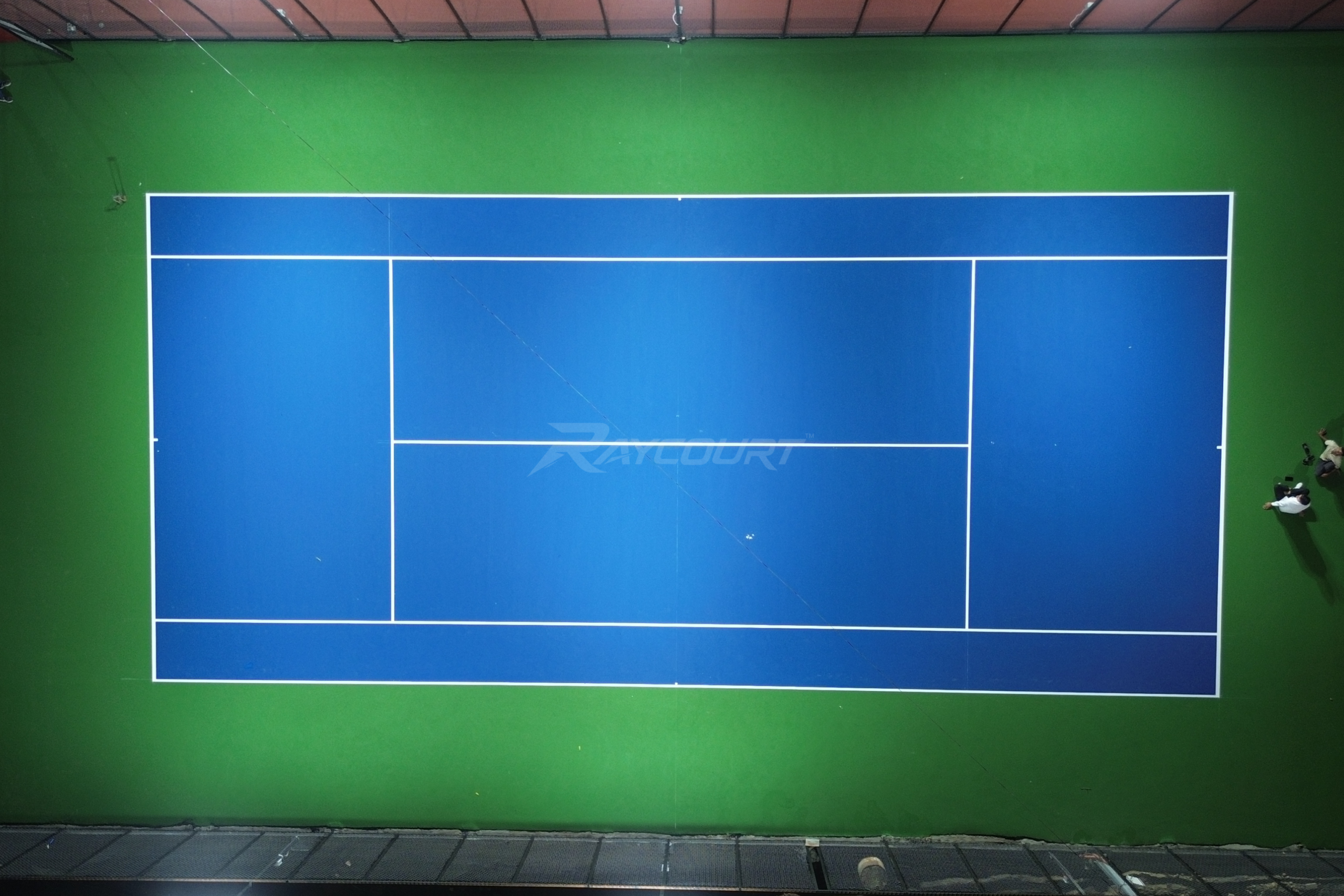
Understanding Court Pace and ITF Classification
Not every acrylic court plays the same. Some feel quick and reward big serves. Others feel slower and reward patient rallies. This quality carries the name court pace, and laboratories can measure it.
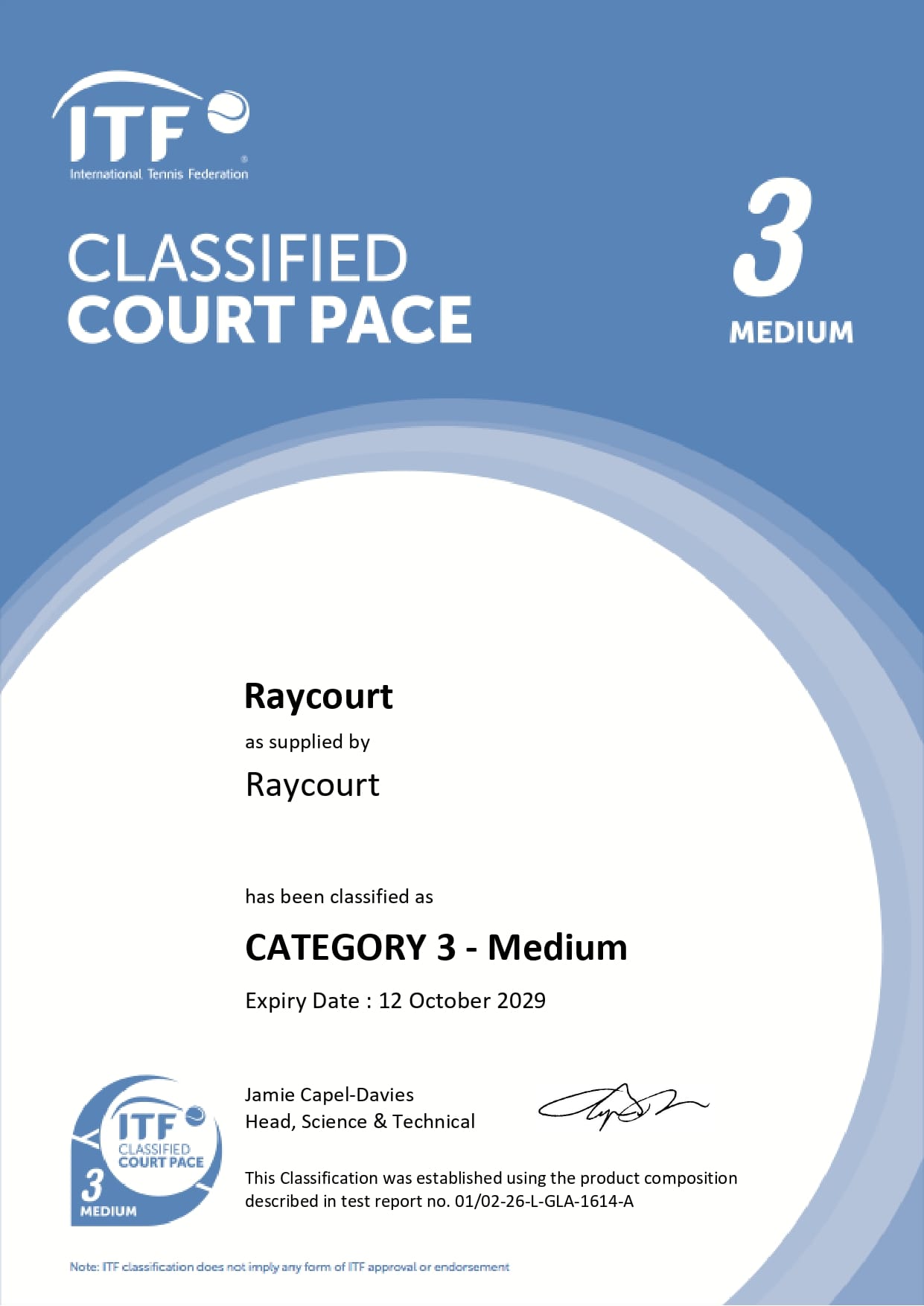
The International Tennis Federation runs a formal programme for this purpose. The ITF Court Pace Classification Programme helps buyers judge the speed of surface products. Accredited laboratories test each product and assign a Court Pace Rating. The ITF then places the product in one of five categories.
| ITF category | Pace description | Court Pace Rating |
|---|---|---|
| Category 1 | Slow | 29 or below |
| Category 2 | Medium-slow | 30 to 34 |
| Category 3 | Medium | 35 to 39 |
| Category 4 | Medium-fast | 40 to 44 |
| Category 5 | Fast | 45 or above |
So, how does a manufacturer adjust pace? The answer lies mainly in the colour coats. More texture creates more friction, so the ball slows after the bounce. Less texture lets the ball skid through faster. Therefore, the grade and quantity of silica sand shape the final pace.
Raycourt offers ITF Classified acrylic surfaces. This classification confirms the tested pace of the product. Consequently, you can select a system with clear, independent data behind it.
Which Pace Suits Your Players?
Your players should decide the pace, not fashion. Beginners and juniors usually benefit from a medium or medium-slow court. The extra time helps them prepare their strokes and build rallies. Likewise, senior players often enjoy a slightly slower, kinder surface.
In contrast, advanced players may prefer a medium-fast court. Such a surface rewards attacking tennis and sharp footwork. However, a multi-purpose venue should aim for the middle. A medium pace serves the widest range of abilities.
Expert Tip: Ask the applicator to follow the manufacturer’s sand specification exactly. Small changes in texture can shift the pace of the finished court.
What Players Notice on a Good Acrylic Court
Statistics matter, but feel matters as well. So, what do players actually notice? First, they notice the bounce. The ball rises to a comfortable, repeatable height, which rewards clean technique.
Next, they notice the grip. Shoes hold during sharp changes of direction, yet they release smoothly. As a result, players move with confidence in every corner. Spin also responds well, because the texture bites the ball on contact.
Finally, players notice comfort over time. A cushioned system leaves legs fresher after a long session. Even a hard court system feels consistent and fair. Therefore, good material quietly improves every rally.
Hard Court or Cushioned Court: Choosing the Right System
Once you settle on acrylic, the next decision arrives. Should you choose a hard court system or a cushioned one? Both use the same tennis court flooring material family. However, they feel different under your feet.
The Hard Court System
A hard court system places the resurfacer and colour coats directly over the base. The result feels firm, responsive and true. Moreover, the system involves fewer layers, so application moves faster.
Hard courts suit schools, housing societies and public facilities. They handle heavy footfall and mixed use with ease. In addition, they deliver the classic hard court experience that most players know. Therefore, this system remains the popular choice for general play.
The Cushioned System
A cushioned system adds several rubber-rich layers beneath the colour coats. These layers compress slightly under load and then recover. Consequently, they reduce the shock that travels through a player’s joints.
Academies and clubs often choose cushioned courts. Their members train for hours, so comfort becomes a real priority. Similarly, venues with many senior players value the softer feel. Furthermore, a cushioned court still offers a consistent bounce and reliable grip.
The number of cushion coats can vary. More coats bring more comfort, and fewer coats keep the surface firmer. So, you can tune the system to your players and your goals.
| Aspect | Hard court system | Cushioned system |
|---|---|---|
| Feel underfoot | Firm and responsive | Softer and forgiving |
| Layer count | Fewer layers | More layers |
| Best for | Schools and societies | Academies and clubs |
| Player comfort | Standard | Enhanced |
| Bounce | Consistent | Consistent |
Expert Tip: Think about weekly playing hours. The longer your members play, the more a cushioned system rewards them.
The Base Beneath Your Tennis Court Flooring Material
Every coating needs a sound base. Even the finest tennis court flooring material in Vadodara cannot fix a failing slab. Therefore, give the base the same attention as the surface.
Concrete or Asphalt?
Acrylic systems work on both concrete and asphalt. Concrete offers strength and a long service life. However, it needs proper joints, a suitable finish and full curing. Fresh concrete usually cures for about 28 days before any coating begins.
Asphalt offers a slightly more flexible base and faster construction. Still, it also needs time to cure before coating. Your civil contractor can advise which base suits your soil and site. Some parts of the region have expansive clay soil, so sound sub-base design matters.
Slope, Drainage and Smoothness
Water must leave the court quickly. For that reason, builders give the base a gentle slope in a single plane. A fall of around one per cent is common for hard courts. Furthermore, perimeter drains carry the water away from the edges.
Smoothness matters too. Humps and hollows create puddles, and puddles shorten the life of any coating. Hence, the base should pass a flatness check before the first coat goes down.
Court Dimensions to Plan For
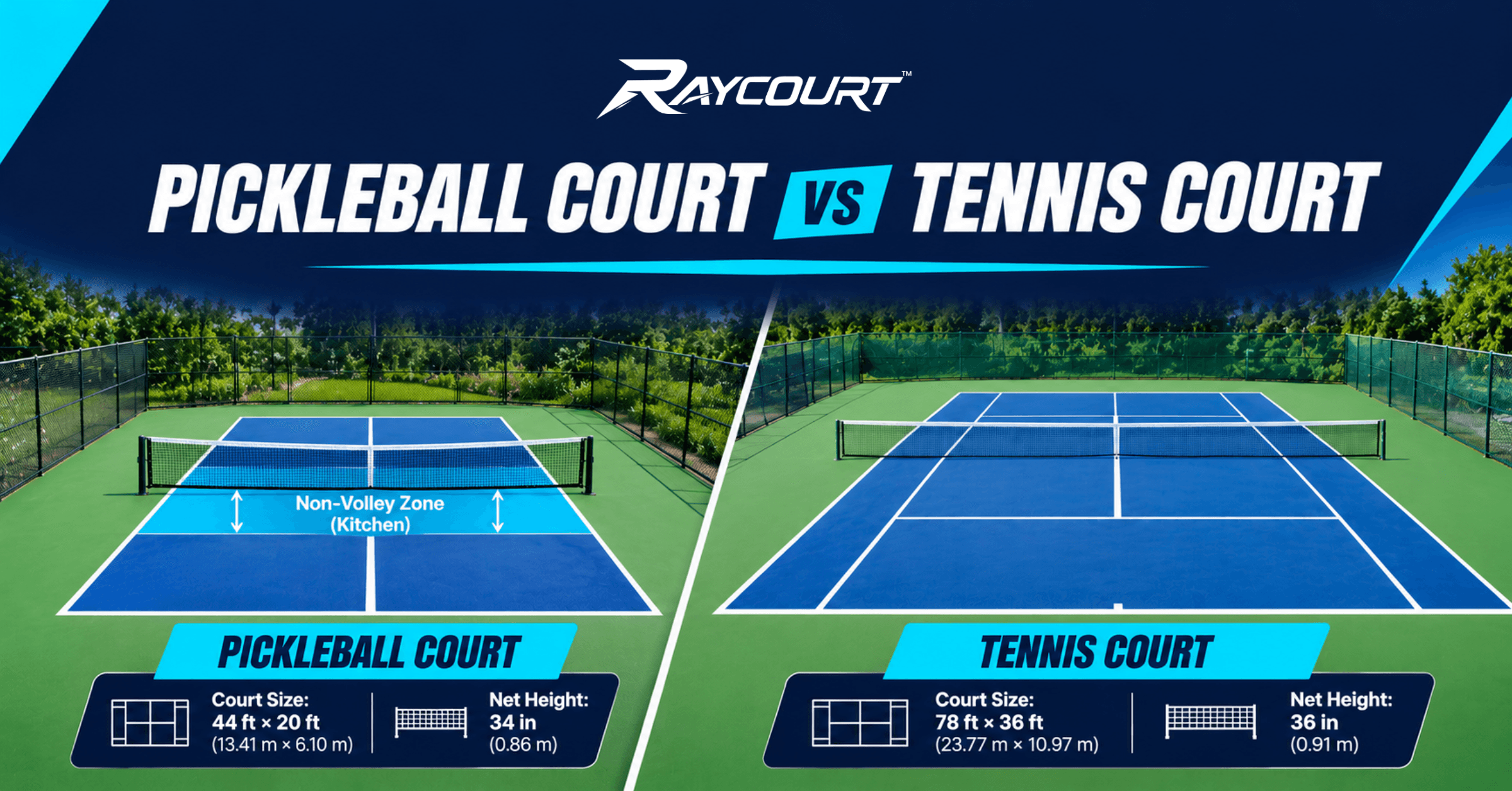
The playing lines of a doubles court measure 23.77 metres by 10.97 metres. The singles width is 8.23 metres. However, players need room beyond the lines to run and swing. Therefore, planners often allow a total area of roughly 36.6 metres by 18.3 metres.
Smaller plots can still host a court with shorter run-offs for recreational play. In that case, discuss safe clearances with your designer. The coating material then covers the full paved area, not only the playing lines.
How to Judge the Quality of Tennis Court Flooring Material
Many products look similar in a bucket. Yet their performance on court can differ widely. So, use this checklist when you compare suppliers.
- Resin quality: Ask about the acrylic content. A rich acrylic binder delivers better adhesion and longer life.
- Pigment stability: Confirm that the pigments resist ultraviolet light. Stable pigments keep the court vivid for longer.
- Sand grading: Check that the manufacturer specifies the silica sand clearly. Consistent sand produces consistent pace.
- Independent testing: Look for ITF Court Pace Classification. Tested products remove guesswork from your decision.
- System completeness: Prefer a manufacturer that supplies every layer. Matching layers bond better with each other.
- Technical documents: Request data sheets and application guides. Clear documents help your applicator deliver the right result.
- Batch consistency: Ask how the manufacturer controls quality between batches. Uniform batches prevent colour variation across the court.
- Local availability: Check how quickly the material can reach your site. Prompt supply keeps your schedule on track.
In addition, speak to the manufacturer directly. A knowledgeable team answers technical questions without hesitation. Their response often tells you as much as the brochure does.
Ready to build a court that performs for years to come?
Connect with Raycourt for sports flooring systems built for your project.
Where Vadodara Uses Tennis Court Flooring Material
Tennis is growing steadily across Vadodara. New courts now appear in schools, townships, clubs and private homes. Each setting has its own priorities, so let us explore them.
Schools and Universities
Educational campuses need surfaces that survive constant use. Students play in every period, and they rarely wear specialist shoes. Therefore, a durable hard court system makes sense here. It tolerates heavy traffic and needs little daily care.
Moreover, campuses often share one court between several sports. Acrylic accepts extra line markings in contrasting colours. As a result, one paved area can serve tennis, basketball and volleyball. This flexibility helps institutions use their space wisely.
Housing Societies and Townships
Residential projects across Gotri, Bhayli, Vasna and Waghodia Road now feature sports amenities. A tennis court adds real value to community life. However, residents’ committees want amenities that stay tidy without constant attention.
Acrylic answers that need well. The surface looks smart, drains fast and cleans easily. Furthermore, bright colour combinations lift the whole landscape. Families of all ages can then enjoy the court safely.
Clubs and Coaching Academies
Clubs and academies ask the most from their courts. Coaches run sessions from early morning until late evening. Consequently, comfort and consistency become essential. Many of these venues therefore choose cushioned acrylic systems.
In addition, serious players care about pace. An academy may select a medium or medium-fast court to prepare players for tournaments. ITF Classified material gives coaches confidence in that choice.
Private Homes and Farmhouses
Private courts are also gaining popularity around the city. Owners want a surface that looks beautiful and plays well for years. Meanwhile, they prefer minimal upkeep. Acrylic delivers on each count, and it suits custom colour schemes too.
Colour Choices and Line Marking
Colour does far more than decorate a court. It affects visibility, heat and the mood of the venue. Therefore, choose your palette with care.
Most tennis courts use two tones. One colour covers the playing area, and another covers the surround. This contrast helps players judge the lines quickly. Popular pairings include blue with green, and green with terracotta red.
Ball visibility deserves special thought. A yellow ball stands out strongly against blue and green shades. Hence, these colours dominate modern courts. Furthermore, mid-tone colours hide dust better than very dark or very pale ones.
In Vadodara, heat adds another factor. Darker colours absorb more sunlight and feel warmer. So, many buyers avoid the deepest shades for the surround. A lighter border keeps the edges cooler for waiting players.
Line marking completes the picture. Textured white acrylic line paint gives sharp, durable lines. Moreover, the texture matches the grip of the court, so players keep their footing on a line. Multi-sport venues can add secondary lines in softer colours. These lines stay visible without distracting tennis players.
Expert Tip: View colour samples outdoors in full sunlight. Shades look quite different under the bright Gujarat sky.
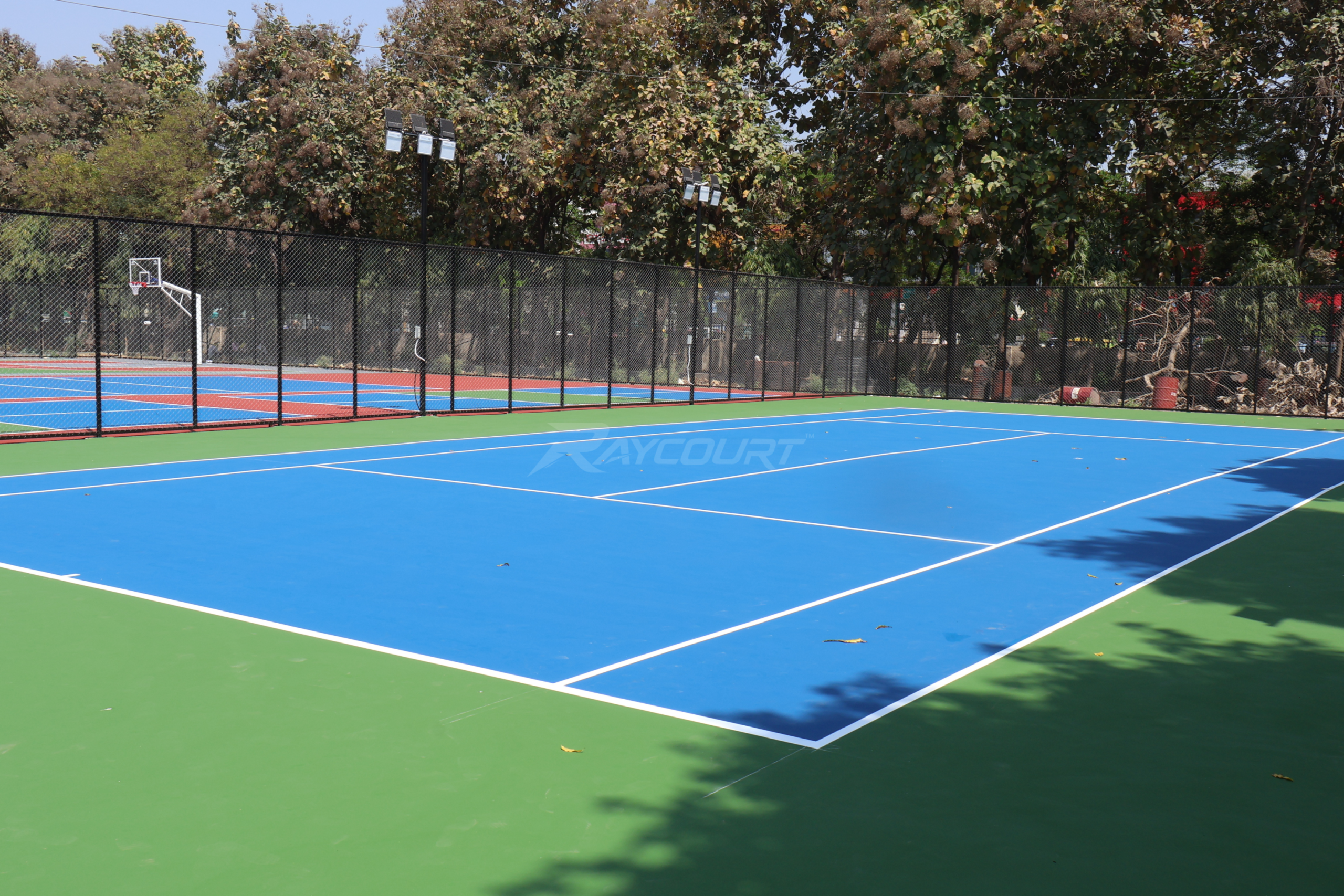
Caring for an Acrylic Tennis Court
An acrylic court asks for very little. Even so, a simple routine extends its life and protects its appearance. Here is what works in Vadodara.
Routine Care
- Sweep regularly: Remove dust, leaves and grit with a soft broom or blower.
- Wash periodically: Rinse the surface with clean water and a soft brush.
- Clear stains early: Clean bird droppings and food spills before they set.
- Check the drains: Keep perimeter drains free of leaves and silt.
- Insist on proper shoes: Allow only non-marking sports shoes on the court.
- Keep sharp objects away: Stop chairs, cycles and skates from scratching the film.
Seasonal Care for Vadodara
Each season brings its own task. Before the monsoon, clear every drain and trim overhanging branches. During the rains, push standing water off the court with a soft squeegee. Afterwards, wash shaded corners to discourage algae.
In the dry months, dust becomes the main concern. Therefore, increase the sweeping frequency, especially near construction activity. Similarly, check the net posts and fence lines for rust that might stain the surface.
When to Refresh the Surface
Even a well-kept court wears gradually. After several years of regular play, the texture smooths and the colour softens. At that stage, a fresh set of colour coats restores both grip and looks. Fortunately, recoating uses the existing system as its foundation. So, the court returns to play quickly with a new lease of life.
Quick Answers on Tennis Court Flooring Material in Vadodara
Buyers often raise the same practical questions. These short answers address the most common ones.
Can Acrylic Handle Vadodara’s Monsoon?
Yes, it can. Acrylic does not absorb rainwater, so the surface stays stable. With the right slope, water drains away within a short time. However, the coating work itself must happen in dry weather.
Can One Court Host Several Sports?
Yes, and many venues do exactly that. Acrylic suits basketball, volleyball, badminton and pickleball as well as tennis. The applicator simply adds extra lines in contrasting colours. Therefore, a single court can serve a whole community.
Does Acrylic Suit Terrace and Podium Courts?
It can, provided the structure and waterproofing are sound. A structural engineer should confirm the slab first. After that, the acrylic system goes over a suitable screed. Consequently, many urban projects now place courts above parking levels.
How Soon Can Play Begin After Coating?
The final coats need time to cure fully. Warm, dry weather speeds this process. Your applicator will follow the curing period in the technical data sheet. Usually, players step onto the court within a few days.
Is Acrylic Safe for Children and Senior Players?
Yes, it is. The textured surface offers steady grip in dry conditions. In addition, a cushioned system softens every step and landing. Like any outdoor court, the surface needs a moment to dry after rain. Then players of all ages can enjoy it comfortably.
Does an Acrylic Court Need Watering?
No, it does not. Unlike clay or grass, acrylic needs no water for play. You only use water for occasional cleaning. Therefore, acrylic suits a region that values every litre.
Raycourt’s Role: A Manufacturer You Can Rely On
Raycourt focuses on one thing: manufacturing high-quality sports court flooring material. The company does not install courts. Instead, it supplies complete acrylic systems to applicators, contractors and project owners. This focus keeps Raycourt’s attention on chemistry, consistency and performance.
What Raycourt Supplies
Raycourt produces every layer of the tennis court system. The range covers primers, resurfacers, cushion coats, colour coats and line paints. Because one team formulates all the layers, they work together reliably. Moreover, Raycourt’s ITF Classified surfaces give buyers independent data on pace.
Years of experience guide each formulation. The team understands Indian weather, from coastal humidity to inland heat. Therefore, the material performs in real conditions, not only in a laboratory.
How Raycourt Supports Your Project
Good material deserves good guidance. So, Raycourt shares technical data sheets and clear application recommendations. Applicators use these documents to plan coverage, mixing and curing. In addition, the Raycourt team answers product questions throughout the project.
This support benefits everyone involved. The applicator works with confidence, and the owner receives a consistent court. However, the roles stay clear. Raycourt manufactures and supplies, while your chosen applicator handles the site work.
Local Supply for Vadodara Projects
Timely supply keeps a project moving. For that reason, Raycourt operates a warehouse in Vadodara. Local stock allows same-day delivery to sites across the city. Consequently, applicators can plan their coats around the weather, not around transport delays.
Furthermore, nearby stock helps during recoating projects. A small top-up order reaches the site without a long wait. As a result, courts spend less time out of play.
A Water-Wise, Long-Life Choice
Sustainability now shapes many building decisions in Gujarat. Fortunately, acrylic courts support that goal in several ways. First, they need no irrigation, unlike clay and grass. Consequently, a venue saves a large volume of water every year.
Second, acrylic coatings use a water-based formula. They carry low odour and suit sites close to homes and classrooms. Third, the system renews itself through recoating. Instead of rebuilding the court, owners simply refresh the top layers. Therefore, the original base keeps serving for a long time.
Finally, a durable surface means fewer repairs and less waste. In short, the right material benefits both the players and the wider community.
Ready to build a court that performs for years to come?
Connect with Raycourt for sports flooring systems built for your project.
Common Mistakes to Avoid
Even good projects stumble on avoidable errors. Watch for these pitfalls as you plan.
- Rushing the base: Coating a damp or uncured slab invites blisters and peeling.
- Ignoring the slope: A flat court holds water and ages faster.
- Mixing brands: Layers from different sources may not bond well.
- Changing the sand: Unspecified sand alters grip and pace.
- Coating in poor weather: Rain, dew or extreme midday heat can spoil a fresh coat.
- Skipping upkeep: Dust and debris slowly grind away the texture.
- Choosing on looks alone: Colour matters, yet performance data matters more.
Above all, involve the manufacturer early. A short conversation at the planning stage prevents most of these problems.
Planning Your Tennis Court Project in Vadodara
A clear sequence keeps the project calm and orderly. Follow these steps from idea to first serve.
- Define the users: List who will play and how often.
- Assess the site: Check the space, the soil, the drainage and the sun path.
- Select the system: Choose between a hard court and a cushioned court.
- Choose the pace: Match the ITF pace category to your players.
- Pick the colours: Balance visibility, heat and the look of the venue.
- Appoint the team: Engage a civil contractor and a trained applicator.
- Order the material: Source the complete system from one manufacturer.
- Time the work: Plan the coating for dry, settled weather.
- Set the routine: Agree a care schedule before the first match.
Orientation deserves a quick mention as well. Where space allows, designers align outdoor courts roughly north to south. This layout keeps the low sun out of players’ eyes. Similarly, good fencing and lighting complete the playing experience.
Frequently Asked Questions
Synthetic acrylic works best for most outdoor courts in the city. It resists heat, strong sunlight and heavy rain. Moreover, it offers a consistent bounce and a choice of pace. It also needs far less upkeep than clay or grass. Therefore, schools, societies, clubs and academies all favour it.
A quality acrylic surface serves players for many years. Its life depends on the base, the application and the upkeep. In addition, playing hours and local conditions play a part. After several years, a fresh set of colour coats renews the court. The base and lower layers usually continue to serve.
A hard court places colour coats directly over the resurfacer. It feels firm and responsive. A cushioned court, in contrast, adds rubber-rich layers below the colour coats. These layers absorb impact and improve comfort. Consequently, cushioned courts suit venues with long daily playing hours.
ITF Classification tells you the tested pace of a surface product. An accredited laboratory measures the Court Pace Rating. The ITF then lists the product in one of five pace categories. As a result, you can compare products on clear data. It also helps you match the court to your players.
Yes, in many cases you can. The existing base must be structurally sound and reasonably level. First, the applicator repairs cracks and low spots. Next, the resurfacer and new coats go over the prepared surface. Therefore, an old court can gain a fresh, modern finish.
Conclusion: Build Your Court on the Right Material
Choosing tennis court flooring material in Vadodara becomes simple once you know the facts. The city’s heat, sunlight and monsoon call for a tough, stable surface. Synthetic acrylic meets that brief better than any alternative. It plays true, drains fast and keeps its colour.
Moreover, acrylic lets you shape the court around your players. You choose the pace, the cushioning and the colours. Then a sound base and a skilled applicator turn the plan into reality. With simple care, the court rewards you for years.
Raycourt stands behind that journey as a dedicated manufacturer. Its ITF Classified systems, years of experience and Vadodara warehouse support every stage of supply. So, your project starts with material you can trust.
Ready to build a court that performs for years to come?
Connect with Raycourt for sports flooring systems built for your project.