
What Are the Standard Basketball Court Dimensions?
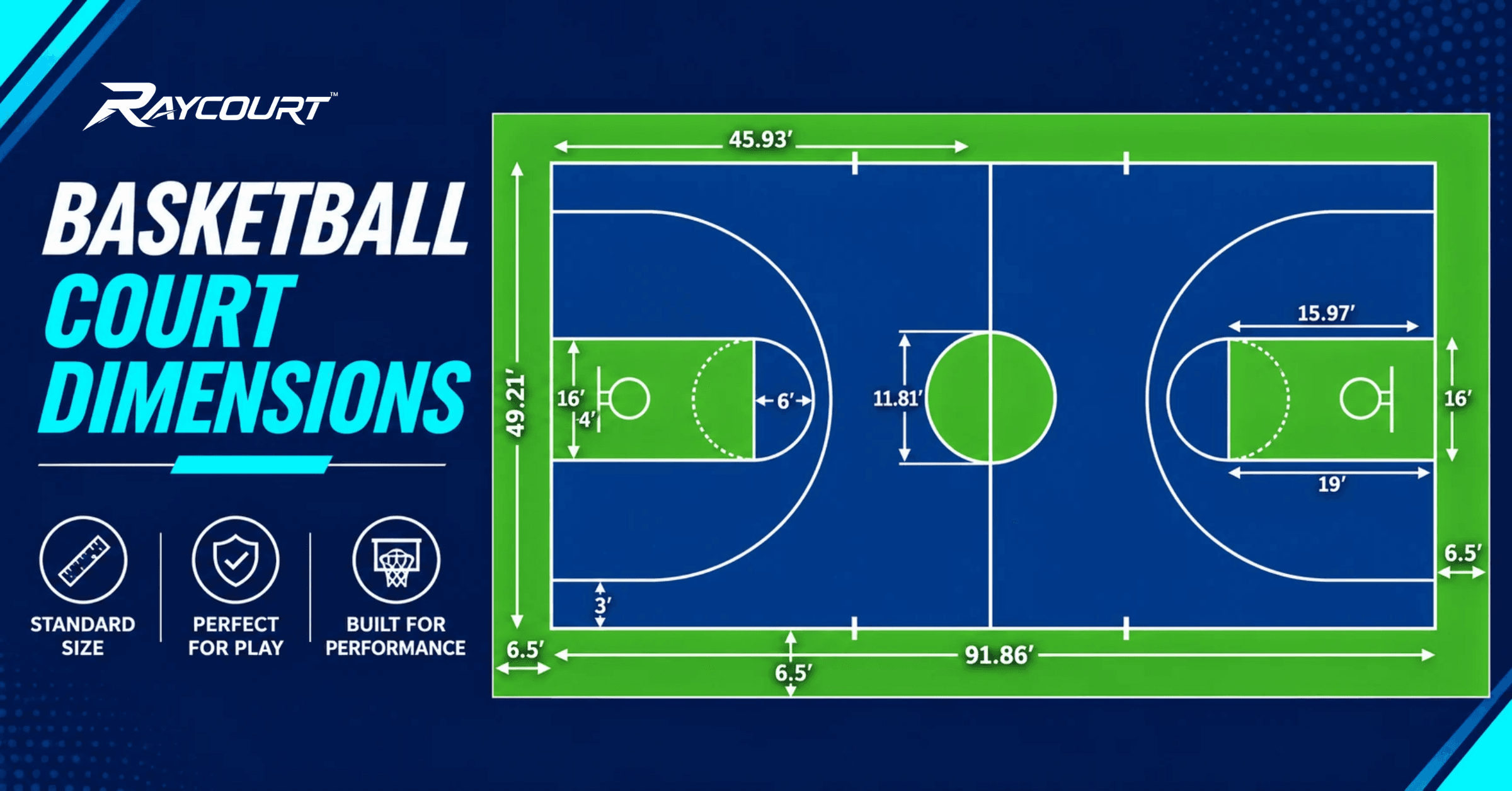
A full-size court under FIBA rules measures 28 metres long and 15 metres wide. FIBA measures both figures from the inner edge of the boundary lines. In comparison, an NBA court measures 94 feet by 50 feet, or roughly 28.65 by 15.24 metres. Therefore, the two professional formats differ by less than a metre in each direction. However, the outline tells only part of the story. Basketball court dimensions also cover the three-point arc, the free-throw line, the restricted area and the centre circle. In addition, they include the ring height, the backboard position and the safety margin around the court. Each of these measurements shapes how the game feels for players, coaches and referees.
So, which numbers matter for your project? That depends on who will play and where you will build. For example, most courts in India follow FIBA dimensions, because national competitions run under FIBA rules. Meanwhile, a housing society may only have room for a half court. This guide explains every format in turn, so you can plan with confidence.
Quick Answer: The Key Numbers
If you need the essentials right now, start with this list:
- Court size (FIBA): 28 m × 15 m
- Court size (NBA): 94 ft × 50 ft
- Ring height: 3.05 m (10 ft) above the floor
- Three-point arc (FIBA): 6.75 m from the point below the basket centre
- Free-throw line (FIBA): 5.80 m from the inner edge of the endline
- Line width (FIBA): 5 cm
- Clear space around the court: at least 2 m on every side
Together, these seven figures answer most first questions about basketball court dimensions. Still, a court that plays well needs every marking in the right place. For that reason, the sections below cover each line in detail.
Who Should Read This Guide?
We wrote this guide for anyone who plans, specifies or approves a basketball court. That group includes school administrators, architects, sports contractors, club owners and residential developers. Coaches and players will also find it useful, because line positions influence training drills and tactics.
Equally, the guide suits readers at different stages. Perhaps you only have a plot and a rough idea. Alternatively, you may already have a slab and need a marking plan. In both cases, accurate basketball court dimensions will save you from avoidable rework later.
How We Present the Measurements
FIBA publishes its rules in metric units, so we give metres and centimetres first. For American formats, we lead with feet and inches and then add the metric conversion. As a result, you can compare the standards without reaching for a calculator.
All FIBA figures in this article follow the FIBA Official Basketball Rules 2026. We recommend that you keep a copy of that rulebook beside your drawings. After all, the governing body has the final word on every measurement.
Expert tip: Confirm which rulebook your league or school board follows before you finalise any drawing. A small difference in the three-point distance can force a complete repaint.
Basketball Court Dimensions at a Glance
Four rulebooks shape most of the courts you will see around the world. FIBA governs international play, while the NBA sets the professional standard in North America. In addition, the NCAA covers American colleges, and the NFHS covers American high schools. The table below places their core basketball court dimensions side by side.
| Measurement | FIBA | NBA | NCAA (US college) | NFHS (US high school) |
|---|---|---|---|---|
| Court length | 28 m | 94 ft (28.65 m) | 94 ft (28.65 m) | 84 ft (25.60 m) |
| Court width | 15 m | 50 ft (15.24 m) | 50 ft (15.24 m) | 50 ft (15.24 m) |
| Three-point arc | 6.75 m | 23 ft 9 in (7.24 m) | 22 ft 1¾ in (6.75 m) | 19 ft 9 in (6.02 m) |
| Key (lane) width | 4.90 m | 16 ft (4.88 m) | 12 ft (3.66 m) | 12 ft (3.66 m) |
| Free-throw line from backboard | 4.60 m | 15 ft (4.57 m) | 15 ft (4.57 m) | 15 ft (4.57 m) |
| Centre circle diameter | 3.60 m | 12 ft (3.66 m) | 12 ft (3.66 m) | 12 ft (3.66 m) |
| Ring height | 3.05 m | 10 ft (3.05 m) | 10 ft (3.05 m) | 10 ft (3.05 m) |
| Line width | 5 cm | 2 in (5.08 cm) | 2 in (5.08 cm) | 2 in (5.08 cm) |
How to Read the Comparison
At first glance, the four standards look almost identical. The ring sits at the same height everywhere, and the free-throw distance barely changes. Similarly, every rulebook keeps the court close to 15 metres wide. These shared numbers explain why players move between leagues so easily.
However, the differences matter once you start marking the floor. The NBA arc sits almost half a metre deeper than the FIBA arc. Meanwhile, the American school court runs about three metres shorter than a FIBA court. Consequently, you cannot repaint one format over another without a fresh layout.
Why Do the Standards Differ?
Each governing body wrote its rules for its own players and venues. The NBA pushed its arc back to reward long-range shooting skill at the elite level. In contrast, school rulebooks keep the arc closer, because younger players have less strength. FIBA sits between the two and balances skill with accessibility.
History also plays a part. American basketball grew up with feet and inches, so its courts use round imperial numbers. FIBA, on the other hand, adopted the metric system for its global membership. As a result, a FIBA court measures a neat 28 by 15 metres.
Which Standard Applies in India?
Indian basketball runs under FIBA rules at national and state level. Therefore, most schools, colleges, clubs and academies in India build to FIBA basketball court dimensions. If your players will compete in recognised tournaments, FIBA markings give them the right preparation.
That said, recreational courts enjoy more freedom. A residential society may shorten the court to fit its plot. Likewise, a primary school may choose a smaller court and a lower ring. Even so, keep the key, the free-throw line and the arc at FIBA distances wherever space allows.
Expert tip: When space runs short, reduce the length before you reduce the width. Players adapt quickly to a shorter court, but a narrow court squeezes the three-point corners.
Ready to build a court that performs for years to come?
Connect with Raycourt for sports flooring systems built for your project.
FIBA Basketball Court Dimensions Explained
FIBA rules give the world its most common court layout. Because Indian competitions follow them, we cover each FIBA marking in depth. Moreover, once you understand the FIBA court, the other formats become easy to follow. Let us walk through the floor from the outside in.
The Playing Court and Boundary Lines
The playing court forms a rectangle of 28 m by 15 m. Two endlines and two sidelines enclose it, and none of those lines belongs to the court. In other words, you measure the 28 and 15 metres between the inner edges. This detail matters, because a painter who measures to the outer edge shrinks the court.
Every line on a FIBA court measures 5 cm wide. In addition, all lines share one colour that contrasts clearly with the surface. White remains the usual choice on blue, green or terracotta acrylic.
Beyond the lines, FIBA asks for a boundary lane at least 2 m wide. As a result, the minimum floor for official play measures 32 m by 19 m. The lane should also carry a colour that contrasts sharply with the court.
The Centre Line and Centre Circle
The centre line runs parallel to the endlines and joins the midpoints of the sidelines. It also extends 15 cm beyond each sideline. Furthermore, the centre line belongs to the backcourt, which affects backcourt violations.
Around the midpoint, the centre circle has a radius of 1.80 m. You measure that radius to the outer edge of the circle line. Every game starts here with the jump ball, so accuracy matters. Many venues also place their logo inside this circle.
The Three-Point Line
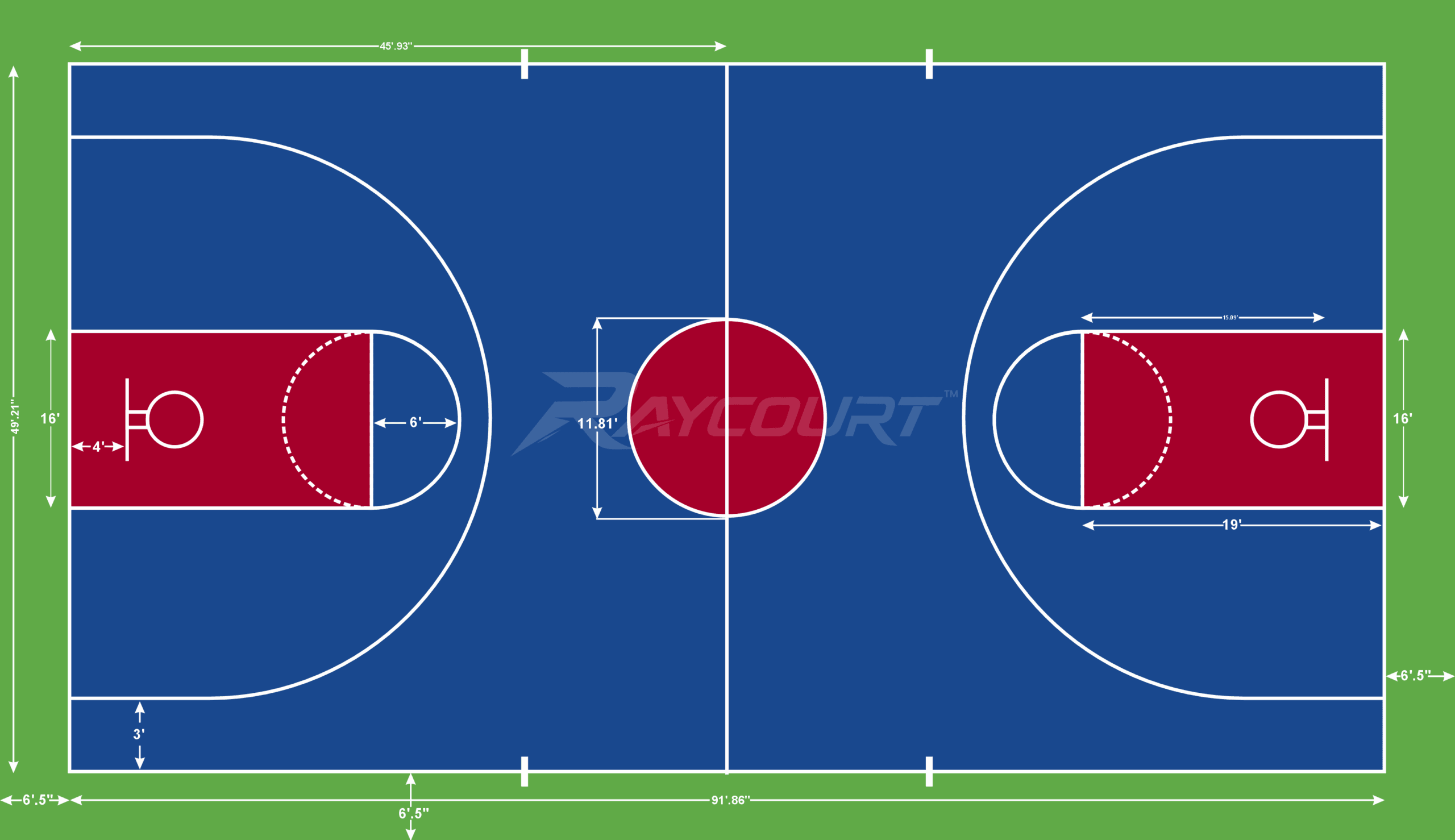
The three-point line has three parts: two straight lines and one arc. First, two parallel lines run from the endline towards the centre. Their outer edges sit 0.90 m from the inner edge of each sideline. Because of this, a corner shooter stands about 6.60 m from the basket.
Next, the arc connects those two lines. It has a radius of 6.75 m, and you measure it to the outer edge. The centre of the arc lies on the floor directly below the basket centre. That point sits 1.575 m from the inner edge of the endline.
Importantly, the line itself does not belong to the three-point area. Therefore, a shooter who touches the line scores only two points. Crisp, accurate line paint helps referees judge these moments fairly.
The Restricted Area and Free-Throw Line
Players call the restricted area the key, the lane or simply the paint. Under FIBA rules, it forms a rectangle 4.90 m wide and 5.80 m deep. Its outer edges sit 2.45 m either side of the endline midpoint. An attacking player may stay inside for only three seconds at a time.
The free-throw line caps the top of this rectangle. It measures 3.60 m long and runs parallel to the endline. Its far edge sits 5.80 m from the inner edge of the endline. Consequently, the shooter stands about 4.60 m from the face of the backboard.
A semi-circle with a radius of 1.80 m completes the area. It curves outward from the free-throw line towards the centre of the court. In addition, short marks along the lane show where rebounders stand during free throws.
The No-Charge Semi-Circle
Directly under each basket, FIBA marks a small semi-circle. Its radius measures 1.30 m to the outer edge of the line. The arc starts from the point on the floor below the basket centre. Two short parallel lines then connect the arc towards the endline.
Why does this small marking matter? Inside it, a defender cannot draw a charging foul against an airborne attacker. Hence, the semi-circle protects players who drive hard to the ring. It also asks for careful marking, because the curve sits in the busiest part of the court.
Throw-In Lines and Team Bench Areas
FIBA also specifies two small throw-in lines outside the court. Each measures 15 cm long and sits on the sideline opposite the scorer’s table. Their outer edges lie 8.325 m from the inner edge of the nearest endline. Teams use these marks for certain throw-ins late in the game.
Finally, the team bench areas sit outside the court on the scorer’s table side. Short lines mark the limits of each bench area. Although these markings look minor, tournament inspectors check them along with everything else.
FIBA Markings: Summary Table
The table below gathers the FIBA figures from this section for quick reference.
| Marking | FIBA dimension | Measurement note |
|---|---|---|
| Playing court | 28 m × 15 m | Inner edge to inner edge |
| All lines | 5 cm wide | One contrasting colour |
| Centre circle | 1.80 m radius | To the outer edge |
| Three-point arc | 6.75 m radius | From the point below the basket centre |
| Three-point straight lines | 0.90 m from the sideline | Outer edge to the sideline’s inner edge |
| Restricted area | 4.90 m × 5.80 m | Rectangle from the endline |
| Free-throw line | 3.60 m long | Far edge 5.80 m from the endline |
| No-charge semi-circle | 1.30 m radius | To the outer edge |
| Throw-in lines | 15 cm long | 8.325 m from the nearest endline |
Expert tip: Ask your marking team to set out every arc from the point below the basket centre. Arcs that start from the endline drift out of position.
NBA and American Basketball Court Dimensions
Many readers ask about American court sizes, because they watch the NBA on television. Although Indian projects rarely need these layouts, the comparison helps you understand design choices. Besides, some private academies prefer NBA markings for players who aim to train abroad.
NBA Court Dimensions
An NBA court measures 94 ft long and 50 ft wide. That equals about 28.65 m by 15.24 m, so it runs slightly larger than a FIBA court. In total, the playing surface covers 4,700 square feet.
The biggest difference lies in the three-point line. The NBA arc sits 23 ft 9 in from the basket, or about 7.24 m. In the corners, however, the distance drops to 22 ft, or about 6.70 m. As a result, the corner three remains the shortest long-range shot in the professional game.
The NBA key also runs wider than its college equivalent. It measures 16 ft across, which nearly matches the 4.90 m FIBA key. Additionally, the NBA marks a restricted arc with a 4 ft radius under each basket. Lines on an NBA court measure 2 inches wide.
College and High School Courts in the United States
American college courts share the 94 ft by 50 ft outline with the NBA. However, the NCAA key measures only 12 ft wide. The college three-point arc now sits at 22 ft 1¾ in, which matches the FIBA distance.
High school courts run shorter. The NFHS standard measures 84 ft by 50 ft, or about 25.60 m by 15.24 m. Furthermore, the high school arc sits at 19 ft 9 in, roughly 6.02 m from the basket. Younger players therefore shoot from a distance that suits their strength.
Junior high schools often go smaller still. Many of them use courts of about 74 ft by 42 ft. Even so, the ring stays at 10 ft for most age groups above primary level.
Ready to build a court that performs for years to come?
Connect with Raycourt for sports flooring systems built for your project.
Smaller Formats: Half Court, 3×3 and Junior Basketball Court Dimensions
Not every site can hold a full court. Fortunately, basketball adapts well to compact spaces. Half courts, 3×3 courts and junior courts all deliver real basketball in a smaller footprint. Here is how their dimensions work.
Half Court Dimensions
A FIBA half court measures 14 m long and 15 m wide. Likewise, an NBA half court measures 47 ft by 50 ft. In both cases, you simply divide the full length by two. The width stays the same, because the three-point line needs it.
A half court keeps every important marking. You still paint the full key, the free-throw line, the no-charge semi-circle and the complete arc. Therefore, players can practise every shot they would take in a game.
What if your plot offers less than 14 m of depth? Then focus on the top of the arc. That point sits 8.325 m from the endline on a FIBA court. So, a depth of about 10 m still gives shooters room behind the arc.
3×3 Court Dimensions
The 3×3 format has grown quickly since its Olympic debut. Its court measures 15 m wide and 11 m long. One basket serves both teams, and play moves fast in the tight space.
Usefully, the 3×3 court borrows its markings from the full FIBA court. The free-throw line sits 5.80 m from the endline, and the arc sits at 6.75 m. The format also keeps the no-charge semi-circle under the basket. Because of this overlap, one FIBA half court can host 3×3 games with ease.
Junior and Mini-Basketball Courts
Young children need a court that matches their size. For this reason, mini-basketball programmes lower the ring, commonly to about 2.60 m. They also use a smaller, lighter ball. Together, these changes help children learn proper shooting technique.
Court size for young players stays flexible. Organisers usually scale the court to the available space and the age group. For instance, many schools mark a junior court across the width of a full court. That approach lets one slab serve several age groups at once.
Footprint Comparison Table
The table below compares the playing area of each format. It excludes the run-off space, which we cover in the next section.
| Format | Playing dimensions | Playing area |
|---|---|---|
| FIBA full court | 28 m × 15 m | 420 m² |
| NBA full court | 94 ft × 50 ft (28.65 m × 15.24 m) | About 437 m² |
| US high school court | 84 ft × 50 ft (25.60 m × 15.24 m) | About 390 m² |
| FIBA half court | 14 m × 15 m | 210 m² |
| 3×3 court | 15 m × 11 m | 165 m² |
Expert tip: If you plan a half court today, position it so a second half can follow later. A little foresight turns a practice court into a full court.
Basket, Backboard and Overhead Dimensions
Basketball court dimensions do not stop at floor level. The ring, the backboard and the space above the court all follow strict measurements. Moreover, these overhead figures stay almost identical across every major rulebook. Let us look at each one.
Ring Height and Ring Size
The top of the ring sits 3.05 m above the floor, which equals 10 ft. FIBA allows a tolerance of only 6 mm either way. Therefore, your contractor should check the height after surfacing, not before. Acrylic coats and cushion layers raise the finished floor level slightly.
The ring itself has an inner diameter between 450 mm and 459 mm. Its solid steel measures 16 mm to 20 mm thick. Below the ring, the net hangs between 400 mm and 450 mm long. These numbers ensure that the ball passes through cleanly and visibly.
Backboard Size and Position
A FIBA backboard measures 1.80 m wide and 1.05 m high. Behind the ring, a painted rectangle measures 590 mm by 450 mm. Shooters use that rectangle as a target for bank shots.
Position matters just as much as size. The face of the backboard sits 1.20 m inside the court from the endline. As a result, the board overhangs the playing area, and players can move beneath it. The support structure, however, must stand well behind the endline. At top-level venues, FIBA requires at least 2 m between the endline and the support.
In addition, padding covers the lower edge of the backboard and the support structure. This protection reduces injury risk when players jump near the basket.
Ball Sizes
The ball also follows fixed dimensions. Men’s competitions use a size 7 ball with a circumference of 750 mm to 770 mm. Women’s competitions, in contrast, use a size 6 ball of 715 mm to 730 mm. Younger age groups step down to smaller and lighter balls.
Why mention the ball in a guide about courts? Because ball rebound depends on the surface below it. A consistent acrylic surface over a sound base gives a true, predictable bounce across the whole court.
Ceiling Height for Indoor Courts
Indoor courts need generous headroom. FIBA sets a minimum of 7 m from the floor to the ceiling or lowest obstruction. That clearance includes lights, beams, ducts and suspended scoreboards. Consequently, architects should confirm the lowest point early in the design.
Outdoor courts face a different overhead check. Look for tree branches, cables and roof overhangs above the playing area. Similarly, position light poles outside the run-off zone, never inside it.
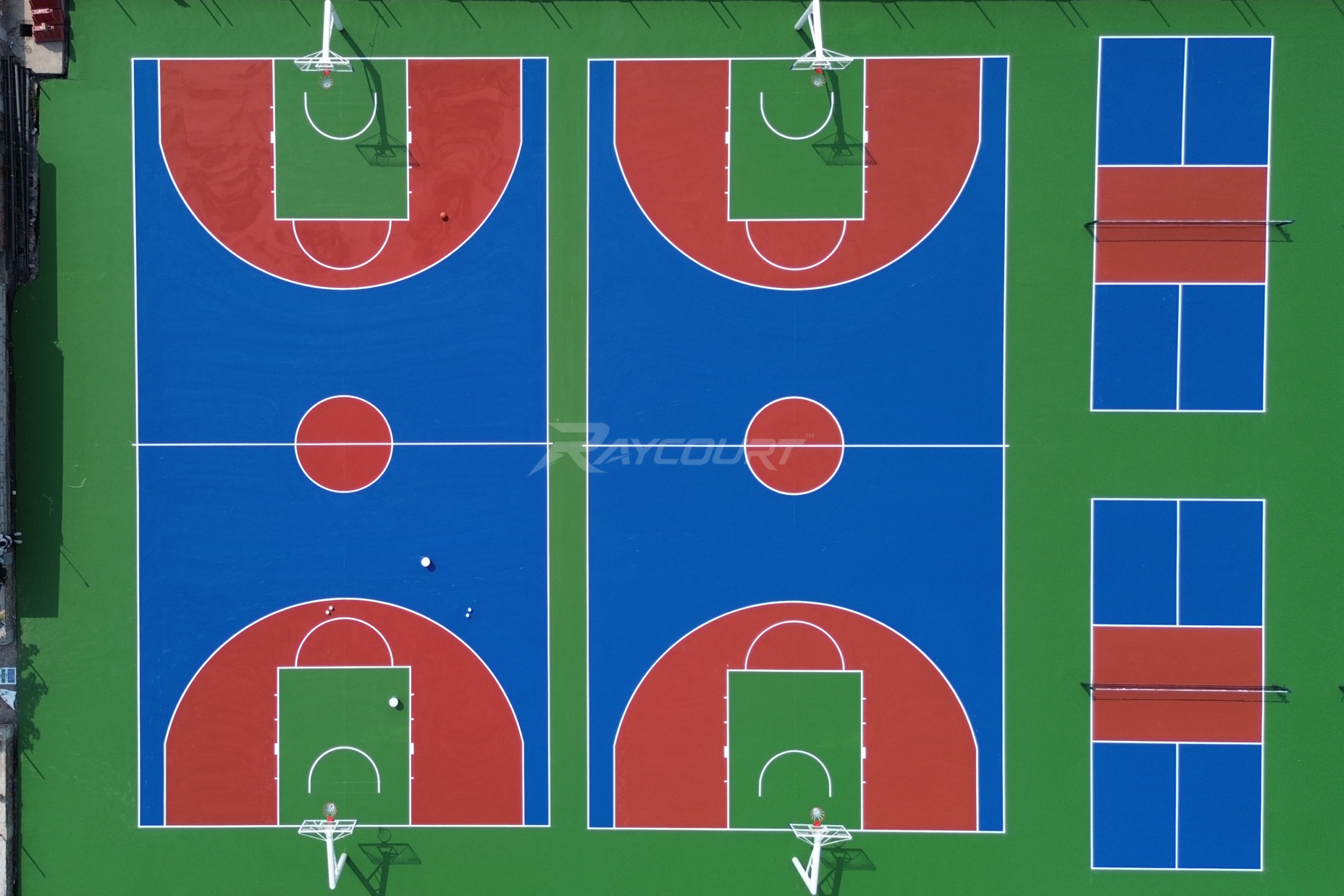
Run-Off Space and Total Area Requirements
The lines mark where the game happens, but players do not stop at the lines. They chase loose balls, land after lay-ups and slide across the sideline. For this reason, every court needs clear space around it.
How Much Run-Off Does a Court Need?
FIBA requires a clear boundary lane at least 2 m wide on all four sides. No seats, boards, posts or walls may sit within that zone. Accordingly, a full FIBA court needs a total floor of 32 m by 19 m. That equals 608 square metres of finished surface.
The same logic applies to smaller formats. If you add a 2 m margin to a half court, the floor grows to 18 m by 19 m. Recreational sites sometimes accept a narrower margin, yet safety should guide that decision. Above all, keep hard obstacles away from the area behind each basket.
Total Footprint Table
The table below shows the floor area each format needs with a 2 m margin on every side.
| Format | Playing court | Floor with 2 m margin | Total floor area |
|---|---|---|---|
| FIBA full court | 28 m × 15 m | 32 m × 19 m | 608 m² |
| FIBA half court | 14 m × 15 m | 18 m × 19 m | 342 m² |
| 3×3 court | 15 m × 11 m | 19 m × 15 m | 285 m² |
Planning Beyond the Margin
Your site plan should also allow for features outside the run-off. For example, outdoor courts often need fencing, floodlight poles and drainage channels. Spectator seating, team benches and a scorer’s table need room as well. Therefore, measure the whole plot before you fix the court position.
Expert tip: Extend the acrylic surface across the full run-off area, not just the playing court. A continuous surface gives players consistent grip when they cross the lines at speed.
Ready to build a court that performs for years to come?
Connect with Raycourt for sports flooring systems built for your project.
From Drawing to Surface: Applying Basketball Court Dimensions on Site
Numbers on a drawing mean little until they reach the ground accurately. This stage brings together the base, the surfacing system and the line marking. Raycourt manufactures the acrylic flooring material, while your chosen contractor handles the installation. Even so, our technical team sees how each stage affects the final dimensions.
Orientation and Site Layout
For outdoor courts, orientation comes first. Ideally, the long axis of the court should run north to south. That way, the low morning and evening sun stays out of the players’ eyes. If the plot prevents this, try to rotate the court as far as the boundaries allow.
Next, place the court within the plot. Leave the full run-off on every side before you add fences or seating. In addition, think about access for players, maintenance staff and spectators.
The Base and Its Slope
An acrylic sports surface needs a stable base of concrete or asphalt. The base must offer a smooth, even plane, because acrylic coats follow the surface beneath them. Any dip in the slab will hold water and distort the bounce.
Outdoor courts also need a gentle slope for drainage. Designers commonly specify a fall of about one per cent in a single plane. As a result, rainwater runs off the court instead of pooling on it. Indoor courts, by contrast, can stay level.
New concrete needs time before it accepts coatings. Contractors usually allow about four weeks of curing before they apply acrylic material. Rushing this step traps moisture, and trapped moisture can lift the surface later.
How the Acrylic System Relates to Court Dimensions
A synthetic acrylic system builds up in layers. Each layer covers the full floor area, so your dimensions drive every material quantity. A typical system includes the following layers:
- Primer: bonds the system to the concrete or asphalt base.
- Resurfacer: fills small voids and creates a uniform texture.
- Cushion coats: add optional shock absorption for player comfort.
- Colour coats: deliver the final colour, grip and UV resistance.
- Line-marking paint: defines every boundary, arc and key.
Because the layers cover the run-off too, calculate quantities from the total floor area. For a full FIBA court, that means 608 square metres rather than 420. Likewise, a two-colour design needs separate area figures for each colour.
Working Out Colour Zones
Many courts use one colour for the key and another for the main floor. Some designs add a third colour for the area inside the arc. Accurate basketball court dimensions make these calculations simple.
For example, each FIBA key covers 4.90 m by 5.80 m. That gives about 28.4 square metres per key, or roughly 57 for both. With these figures, your contractor can order the right quantity of each colour. Furthermore, strong contrast between zones helps players read the court at a glance.
A Practical Marking Sequence
Line marking rewards patience and a clear method. Most experienced marking teams follow a sequence similar to this one:
- Check for square. Measure both diagonals of the 28 m by 15 m rectangle. Each should read about 31.76 m.
- Set the boundary lines. Mark the inner edges of the endlines and sidelines first.
- Mark the centre. Add the centre line and then the 1.80 m centre circle.
- Locate each basket point. Measure 1.575 m in from the midpoint of each endline.
- Mark the arcs. From that point, set out the 6.75 m arc and the no-charge semi-circle.
- Mark the key. Add the 4.90 m by 5.80 m rectangle and the free-throw semi-circle.
- Mask and paint. Apply tape on both sides and paint each line 5 cm wide.
Finally, the team should re-measure the key distances before the paint dries. A quick check at this point prevents a time-consuming correction afterwards.
Colour, Contrast and Line Visibility
Lines must stand out in every light. White lines over blue, green or red acrylic give excellent contrast. Meanwhile, a matt, textured finish reduces glare under floodlights and strong sun. Good line-marking paint also resists scuffing, so the dimensions stay readable for years.
Expert tip: Share the final marking drawing with your material supplier before work begins. Raycourt’s technical team can then confirm quantities for each layer and each colour zone.
Common Mistakes With Basketball Court Dimensions
Even careful teams make errors when they transfer dimensions to the ground. Fortunately, most of these errors follow familiar patterns. If you know them in advance, you can avoid them with simple checks. Here are the mistakes our technical team hears about most often.
Measuring to the Wrong Edge of the Line
FIBA measures the court between the inner edges of the boundary lines. However, some marking teams measure to the centre or the outer edge instead. That habit shortens the court by up to 10 cm in each direction. The arc and the centre circle, on the other hand, use the outer edge. Therefore, your marking drawing should state the reference edge for every line.
Forgetting the Run-Off Space
Some projects fit the 28 m by 15 m court exactly and leave nothing around it. As a result, players run straight into fences, walls or kerbs. Always start your plan with the 32 m by 19 m floor. If the plot cannot hold it, shorten the court rather than the margin.
Setting the Ring Before the Surface
Installers sometimes fix the ring height against the bare slab. Later, the acrylic layers raise the floor, and the ring ends up too low. A cushion system makes the gap even larger. So, measure the 3.05 m from the finished surface every time.
Squeezing the Court Width
A narrow plot tempts designers to trim the width. Unfortunately, the FIBA arc already sits only 0.90 m from each sideline. If you cut the width, the corner three-point zone disappears. Instead, keep the 15 m width and reduce the length where necessary.
Overlooking Drainage Under the Lines
Water that pools on a court does more than interrupt play. Over time, standing water weakens coatings and stains the line paint. Consequently, check the slope and flood-test the base before any acrylic work begins. A sound base protects both the surface and the accuracy of your markings.
Expert tip: Ask for a signed dimension checklist before the first coat goes down. Corrections on bare concrete take minutes, whereas corrections on a finished surface take days.
Ready to build a court that performs for years to come?
Connect with Raycourt for sports flooring systems built for your project.
Quick Answers: Basketball Court Dimensions
The sections above explain the full picture. However, some readers arrive with one specific question. The short guides below answer the most frequent ones directly.
How Big Is a Basketball Court in Square Metres?
A FIBA court covers 420 square metres of playing area. Once you add the 2 m run-off, the floor reaches 608 square metres. An NBA court, meanwhile, covers about 437 square metres before its margins. Use the larger figure when you estimate surfacing material.
How Far Is the Three-Point Line From the Basket?
The answer depends on the rulebook. Under FIBA rules, the arc sits 6.75 m from the basket and 6.60 m in the corners. In the NBA, the arc sits at 7.24 m and the corners at 6.70 m. American high schools, by comparison, use a single arc at 6.02 m.
Can One Slab Host More Than One Sport?
Yes, and many schools choose this route. A full basketball floor of 32 m by 19 m offers generous space. For instance, a volleyball court of 18 m by 9 m fits comfortably inside it. Likewise, several badminton courts can sit across the width.
In a shared layout, give each sport its own line colour. Basketball usually keeps white, while secondary sports take yellow or another contrasting shade. That way, players can read their own court without confusion. An acrylic surface suits this approach, because it accepts multiple line colours cleanly.
Does the Flooring Material Change the Dimensions?
No, the surface does not change any official measurement. A FIBA court measures 28 m by 15 m on acrylic, wood or any other material. However, the surface does affect how those dimensions perform in practice. Grip, ball bounce and line clarity all depend on the quality of the material.
For outdoor courts in particular, synthetic acrylic offers clear advantages. It resists sun and rain, holds colour well and keeps its texture. Moreover, line-marking paint bonds strongly to acrylic colour coats. As a result, your carefully measured lines stay sharp through years of play.
Do Women’s Courts Use Different Dimensions?
No, every FIBA competition uses the same court. The court size, the ring height and the three-point distance all match. Only the ball differs, because women’s competitions use the smaller size 6 ball. Therefore, one correctly marked court serves every full-size competition.
Frequently Asked Questions
Under FIBA rules, the playing court measures 28 m long and 15 m wide. You take both measurements from the inner edges of the boundary lines. In addition, FIBA requires a clear margin of at least 2 m on every side. Consequently, the complete floor for official play measures 32 m by 19 m.
A FIBA court converts to roughly 91.9 ft by 49.2 ft. An NBA court, in comparison, measures exactly 94 ft by 50 ft. American high school courts run shorter at 84 ft by 50 ft. So, always check which standard your source uses before you compare numbers.
Plan for at least 32 m by 19 m, which equals 608 square metres. That figure covers the playing court and the 2 m run-off on all sides. However, fencing, lighting, seating and drainage need extra room beyond it. Therefore, survey the entire plot before you fix the final court position.
A FIBA half court measures 14 m long and 15 m wide. It includes one basket, the full key, the free-throw line and the complete three-point arc. If your site offers less depth, about 10 m still covers the top of the arc. Even then, keep the full 15 m width so the corners remain playable.
How Raycourt Supports Accurate Court Projects
Correct dimensions and quality material work together. A perfectly measured court still disappoints if the surface fades, cracks or loses grip. Equally, premium material cannot rescue a court with misplaced lines. For that reason, we encourage every client to treat both with equal care.
Raycourt focuses on the material side of that partnership. We manufacture complete acrylic systems, from primer and resurfacer to cushion coats, colour coats and line-marking paint. Each layer works with the next, so the finished surface performs as one system. In addition, our team helps contractors and project owners plan material for their exact court dimensions.
Because we manufacture rather than install, our advice stays focused on performance. We want your surface to deliver consistent bounce, reliable grip and lasting colour. Above all, we want your lines to stay sharp where the rulebook places them.
Final Thoughts on Basketball Court Dimensions
Basketball court dimensions look simple at first: 28 m by 15 m, with a ring at 3.05 m. Yet a great court depends on dozens of smaller measurements. The 6.75 m arc, the 4.90 m key and the 2 m run-off all shape the game.
So, begin with the right rulebook for your players. Then confirm your available space, including the margin around the court. After that, prepare a sound base and choose a surfacing system that protects your markings. Finally, check every measurement before the first line goes down.
With careful planning, your court will serve players well for many seasons. And when you reach the surfacing stage, Raycourt stands ready to help.
Ready to build a court that performs for years to come?
Connect with Raycourt for sports flooring systems built for your project.