
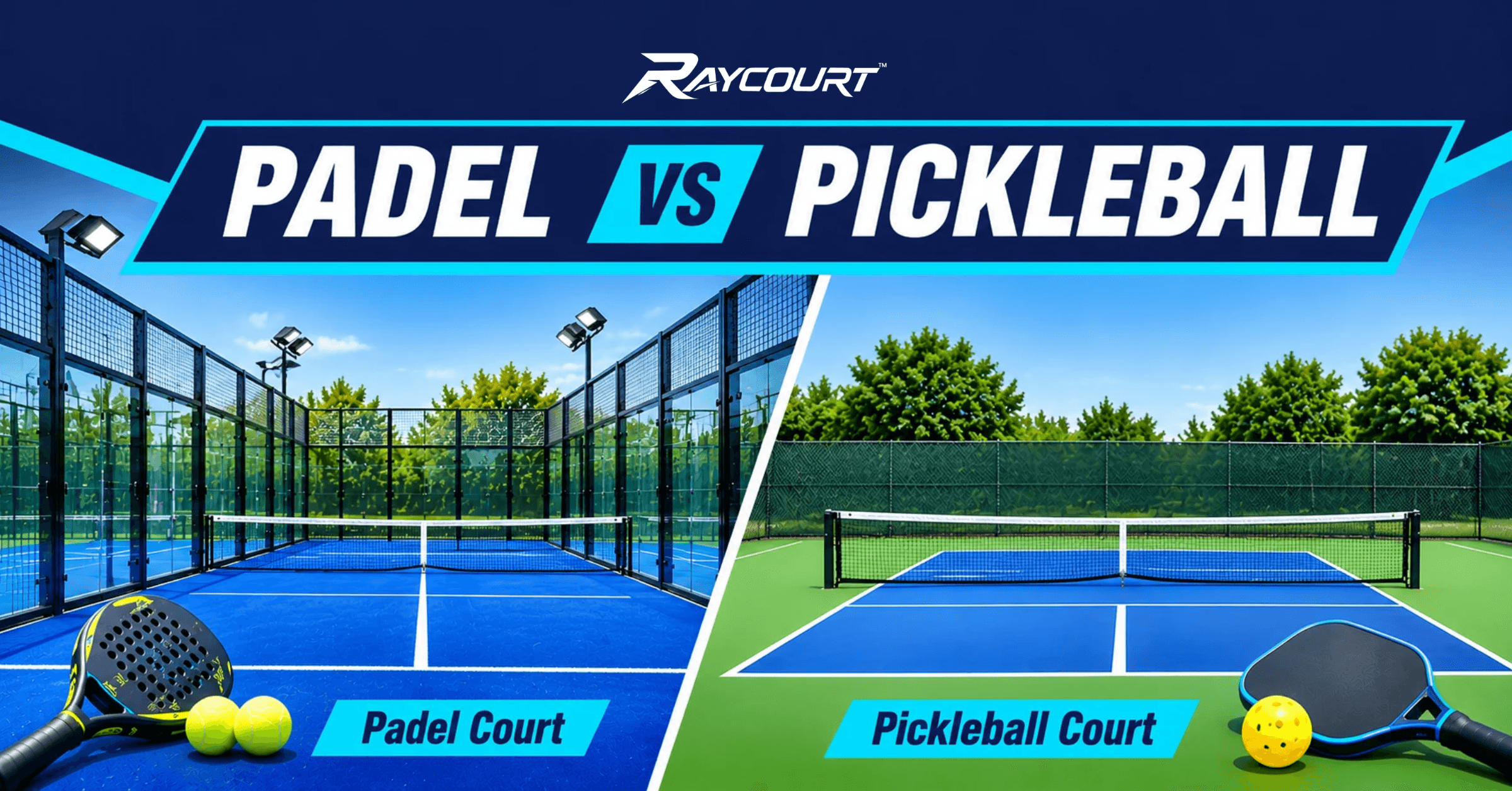
The padel vs pickleball question has a simple answer. Both are social, doubles-friendly racket sports, yet they differ in almost every technical detail. Padel uses a 20 m by 10 m court with glass walls and mesh around it. Players use those walls during rallies, much like squash. Pickleball, in contrast, uses a smaller open court of 13.41 m by 6.10 m. It has no walls, and it adds a non-volley zone near the net.
The equipment also differs. Padel players use solid, perforated rackets and a low-pressure ball similar to a tennis ball. Pickleball players, however, use flat paddles and a light, perforated plastic ball. Scoring follows tennis in padel, whereas pickleball games typically run to 11 points. Consequently, padel feels faster and more athletic, while pickleball feels easier to learn on day one.
The surface under the players matters just as much. Most padel courts use sand-dressed artificial turf, although the rules also permit other surface types. Pickleball, on the other hand, performs best on a synthetic acrylic hard court. Therefore, your choice of sport shapes your choice of flooring material, base and layout.
What This Guide Covers
In the sections below, we compare padel vs pickleball in depth. First, we look at origins and growth. Next, we compare courts, enclosures, equipment and rules. After that, we explain surfaces, acrylic systems and facility planning. Finally, we answer the questions that owners and players ask most often.
You do not need a technical background to follow along. We explain every term in plain language. Moreover, we point out where each detail affects real decisions on a real site.
Expert Tip: Decide the sport before you decide the surface. Each sport demands a different bounce, grip and footwork response from the floor.
Padel vs Pickleball at a Glance
Before we go deeper, here is a quick side-by-side view of padel vs pickleball. Use it as a reference while you read the detailed sections.
| Feature | Padel | Pickleball |
|---|---|---|
| Court size | 20 m × 10 m | 13.41 m × 6.10 m (44 ft × 20 ft) |
| Enclosure | Glass or solid walls plus metal mesh | Open court with optional perimeter fencing |
| Bat | Solid, perforated, stringless racket | Solid, flat paddle |
| Ball | Pressurised rubber ball with felt cover | Perforated plastic ball |
| Serve | Underarm after a bounce, two attempts | Underarm, one attempt |
| Scoring | Tennis scoring: 15, 30, 40, game | Games usually to 11, win by two |
| Walls in play | Yes, after the ball bounces | No |
| Special zone | None | Non-volley zone near the net |
| Common format | Doubles | Doubles and singles |
| Typical surface | Sand-dressed artificial turf | Synthetic acrylic over asphalt or concrete |
This table gives the quick view. However, each row hides details that affect players and court owners alike. So, let us start with where both sports came from.
Origins and Growth of Both Sports
History explains a great deal in the padel vs pickleball comparison. Each sport began as a family pastime. Even so, each one grew along a very different path.
How Padel Began
Padel started in Acapulco, Mexico, in 1969. Enrique Corcuera adapted a small court at his home and added walls around it. The walls kept the ball in play, and a new sport took shape. Soon after, the game travelled to Spain and then to Argentina. Both countries embraced it quickly. Today, Spain remains the heartland of padel. In addition, clubs now operate across Europe, the Middle East and Asia. The International Padel Federation (FIP) governs the sport and publishes its official rules. As a result, court builders everywhere work to one shared standard.
How Pickleball Began
Pickleball is slightly older. Three friends created it on Bainbridge Island, Washington, in 1965. Joel Pritchard, Bill Bell and Barney McCallum wanted a game for their families. They used a badminton court, lowered the net and picked up simple paddles. They also chose a perforated plastic ball. As a result, the sport stayed simple from the very first day. USA Pickleball later published the first official rulebook in 1984. Since then, pickleball has spread from North America to India, Australia and beyond.
Why Both Sports Keep Growing
Both sports grow for similar reasons. First, beginners enjoy real rallies within their first session. Second, doubles play makes every match social. Third, both courts need far less land than a tennis court. Therefore, clubs, schools, hotels and housing societies can add courts on modest plots.
Moreover, both sports suit mixed ages and mixed abilities. Yet the two sports attract slightly different crowds. Padel often appeals to fitness-minded players who enjoy fast, tactical rallies. Pickleball, meanwhile, welcomes families, older adults and first-time racket players with open arms.
In short, the padel vs pickleball debate rarely has a loser. Many facilities now offer both sports and let members choose. Because of this trend, owners increasingly ask about the right court and surface for each game.
Padel vs Pickleball: Court Dimensions and Layout
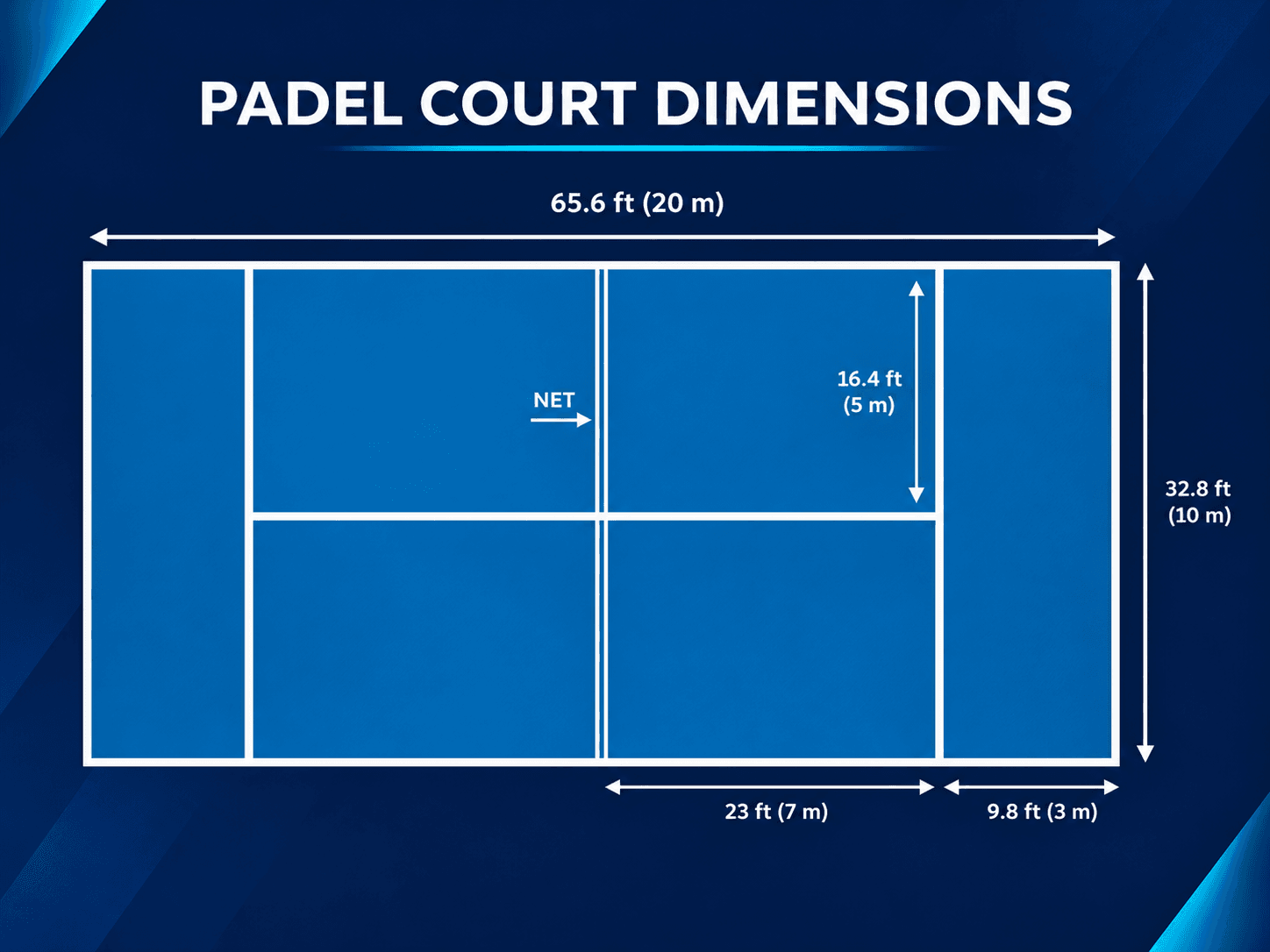
Court size creates the first big difference in padel vs pickleball. A padel court covers 200 square metres inside its walls. A pickleball court, in comparison, covers roughly 82 square metres within its lines. Let us look at each layout in turn.
Padel Court Dimensions
A padel court forms a rectangle of 20 m by 10 m, measured from inside the walls. The rules allow a tolerance of only 0.5 per cent. A net divides the court into two equal halves. Each half has a service line 6.95 m from the net. In addition, a central line splits each service area into two equal boxes. All lines measure 5 cm wide.
The net stands 0.88 m high at the centre and 0.92 m at the ends. Furthermore, the court needs a clear height of at least 6 m with no obstructions. The current FIP rules suggest 8 m for new facilities. Because walls surround the court, the playing area and the built footprint almost match. Still, you should allow extra room for access, seating and circulation.
Pickleball Court Dimensions
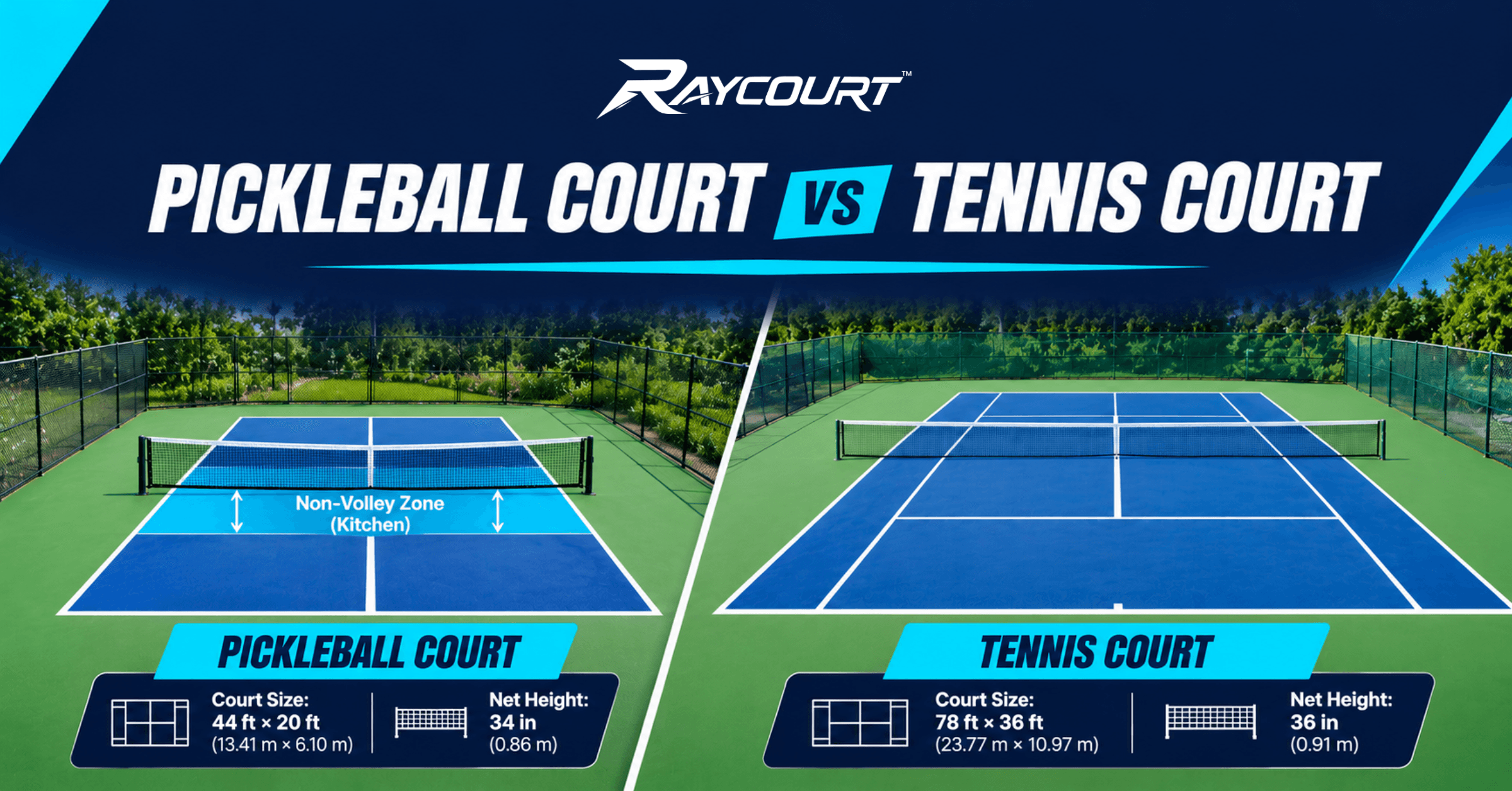
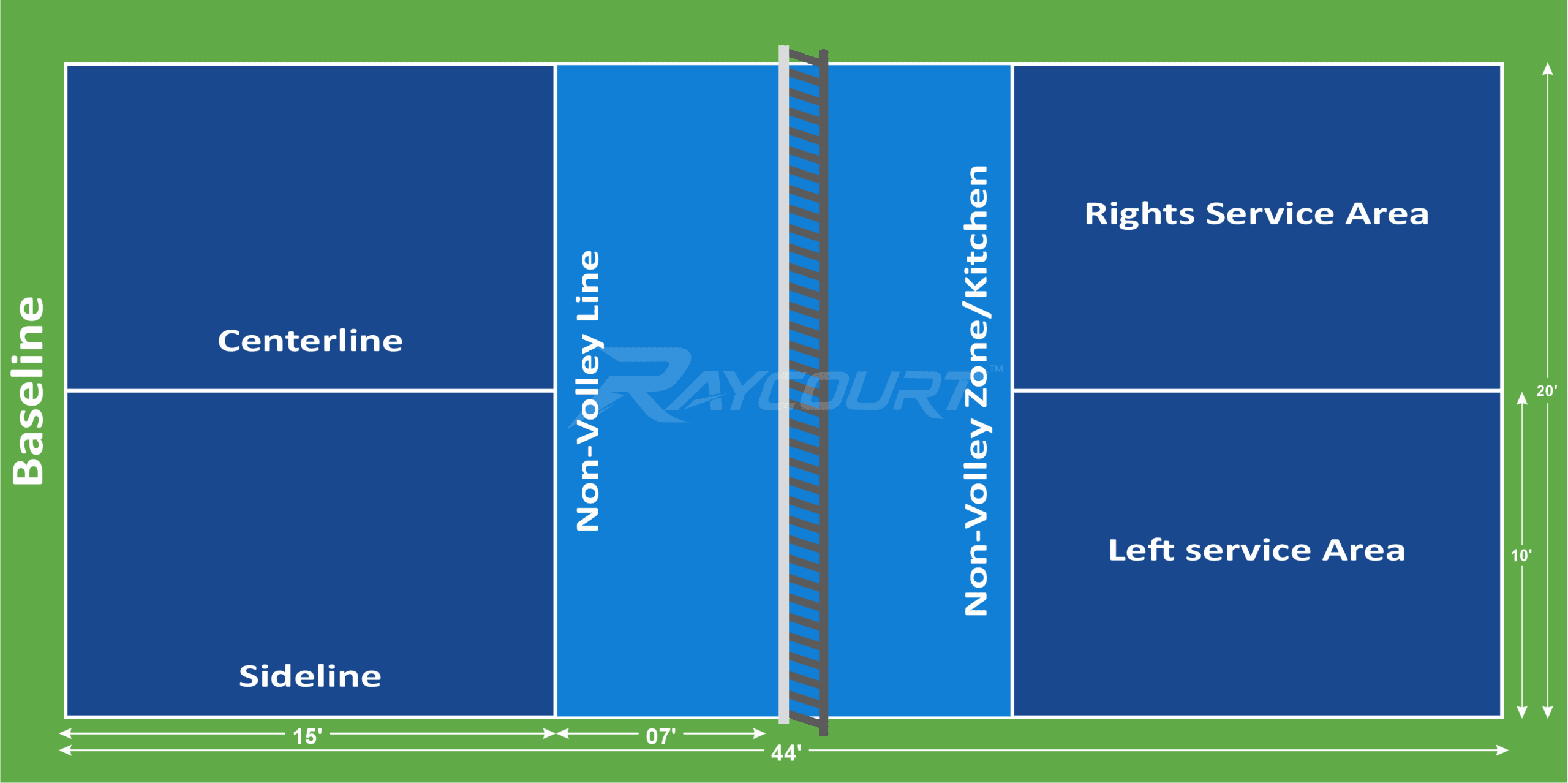
A pickleball court measures 44 ft by 20 ft, which equals 13.41 m by 6.10 m. The same court serves both singles and doubles. The net stands 36 inches high at the sidelines and 34 inches at the centre. On each side, a non-volley zone extends 7 ft from the net. Players call this zone the kitchen. Behind it, a centre line creates two service courts, each 10 ft wide and 15 ft deep. All lines measure 2 inches wide.
However, the lines tell only part of the story. Players also need run-off space around the court. USA Pickleball guidance recommends a total playing area of at least 30 ft by 60 ft. A larger area of 34 ft by 64 ft suits new construction better. Therefore, always plan for the full playing area and not just the lines.
Dimension Comparison Table
The table below places the key measurements side by side.
| Measurement | Padel | Pickleball |
|---|---|---|
| Length | 20 m | 13.41 m |
| Width | 10 m | 6.10 m |
| Playing area | 200 m² | About 82 m² |
| Net height at centre | 0.88 m | 0.864 m |
| Net height at ends | 0.92 m | 0.914 m |
| Line width | 5 cm | 5.08 cm |
| First line from the net | Service line at 6.95 m | Kitchen line at 2.13 m |
| Space beyond the lines | Walls sit on the boundary | Run-off space on all sides |
What the Numbers Mean for Your Site
These numbers have practical consequences. A pickleball court needs less than half the playing area of a padel court. Consequently, a site that holds one padel court can often hold two pickleball courts. For example, a standard tennis court pad can typically take up to four pickleball courts. The same pad usually takes two padel courts, depending on access space.
However, area alone does not decide the matter. Padel needs height for lobs, plus a structural frame for glass and mesh. Pickleball, in contrast, needs generous run-off space behind each baseline. Players move backwards quickly, so a tight boundary creates risk. Therefore, measure your plot carefully before you commit to a layout.
Expert Tip: Mark the full recommended playing area on site, not just the court lines. This simple step reveals clearance problems early.
Enclosures: Walls vs Open Courts
The enclosure marks the most visible difference in padel vs pickleball. One sport treats walls as part of the game. The other treats every boundary line as final.
The Padel Enclosure
Walls define padel. Each end of the court has an enclosure that reaches 4 m in total height. Typically, glass or a solid material forms the lower 3 m. Metal mesh then completes the top metre. The sides combine walls and mesh in a similar way, and they stand 3 m to 4 m high.
Glass panels give spectators a clear view of every rally. Moreover, they return the ball with a predictable rebound. That rebound matters because players rely on it for every defensive shot. In addition, the frame must resist wind loads and repeated ball impacts. Hence, a padel project is partly a structural project. The floor, the frame and the glass must work together as one system.
The Open Pickleball Court
Pickleball needs no walls at all. When the ball lands outside the lines, the rally ends. Perimeter fencing simply keeps stray balls nearby and separates adjacent courts. As a result, the court itself stays simple.
This simplicity brings real flexibility. For instance, owners can mark pickleball lines on an existing tennis or basketball court. Portable nets then turn that space into a playable court within minutes. Because no structure hides the floor, the surface carries the whole playing experience. Flatness, texture and colour therefore deserve close attention.
How Enclosures Change the Game
Walls change tactics completely. In padel, a deep lob does not end the point. Instead, the ball rebounds off the back glass, and the defender plays it again. Consequently, rallies last longer, and patience wins matches. Players learn to turn, read the rebound and counter-attack.
In pickleball, however, precision replaces rebounds. Players aim soft shots, known as dinks, just over the net. They wait for a high ball and then attack. So, the padel vs pickleball contrast comes down to space. Padel players use three dimensions, while pickleball players master a compact, flat chessboard.
Padel vs Pickleball: Equipment Compared
Equipment shapes how each sport feels in the hand. Although both bats look similar from a distance, they differ in build and behaviour. The balls differ even more.
Rackets and Paddles
A padel racket has a solid face with a pattern of holes. It has no strings. The FIP rules limit its total length to 45.5 cm. The head may measure up to 26 cm wide and 38 mm thick. In addition, every player must wear a wrist cord for safety. Most rackets combine a foam core with carbon or fibreglass faces. Therefore, they feel thick, powerful and slightly cushioned.
A pickleball paddle, in contrast, has a flat, solid face without holes. The rulebook limits its length to 17 inches. Moreover, the combined length and width cannot exceed 24 inches. Most paddles use a polymer honeycomb core with a composite or carbon face. As a result, they feel thin, light and quick in fast exchanges.
Balls
A padel ball looks like a tennis ball. However, it carries slightly lower pressure, so it bounces a little lower. It still rebounds strongly off glass and turf. Consequently, padel rallies stay lively and quick.
A pickleball ball is completely different. It is a hollow plastic sphere with 26 to 40 round holes. Outdoor balls usually have more, smaller holes and a harder shell. Indoor balls, meanwhile, have fewer, larger holes. Because of the holes, the ball slows down in the air and bounces low. Therefore, it needs a hard, uniform surface to bounce predictably. A soft or uneven floor quickly kills the rally.
Footwear and Accessories
Shoes follow the surface. Padel players choose herringbone or omni soles that grip sandy turf yet allow a controlled slide. Pickleball players, on the other hand, choose non-marking court shoes with firm lateral support. These soles grip textured acrylic without sticking. In addition, both sports reward light, breathable clothing and protective eyewear for close-range play.
Equipment Comparison Table
| Item | Padel | Pickleball |
|---|---|---|
| Bat length | Up to 45.5 cm | Up to 17 in (43.18 cm) |
| Bat face | Perforated and stringless | Solid with no holes |
| Ball material | Rubber with felt cover | Moulded plastic with holes |
| Ball bounce | Lively | Low |
| Shoe sole | Herringbone or omni | Non-marking court sole |
Ready to build a court that performs for years to come?
Connect with Raycourt for sports flooring systems built for your project.
Padel vs Pickleball: Rules, Serving and Scoring
Rules give each sport its rhythm. Here, padel vs pickleball diverge sharply, even though both begin with an underarm serve. The FIP Rules of Padel and the USA Pickleball rulebook set out the full details.
Serving Rules
In padel, the server stands behind the service line. The server first bounces the ball and then strikes it at or below waist height. The serve travels diagonally and must land in the opposite service box. Each server gets two attempts, just as in tennis. After the bounce, the ball may touch the glass. However, a serve that hits the metal fence before its second bounce counts as a fault.
In pickleball, the serve is also underarm and diagonal. The server strikes the ball below the waist or uses a drop serve. The ball must clear the non-volley zone and land in the opposite service court. Importantly, each server gets only one attempt. Therefore, consistency matters more than power.
The Two-Bounce Rule and the Kitchen
Pickleball adds two rules that shape every rally. First, the receiving side must let the serve bounce. Then, the serving side must let the return bounce as well. Only after these two bounces may players volley. This rule removes the serve-and-volley advantage and keeps rallies fair.
Second, the non-volley zone restricts play near the net. Players cannot volley while they stand in this zone, which everyone calls the kitchen. They may step in only to play a ball that has bounced. As a result, players cannot simply smash from the net. Padel has no such zone. Indeed, padel players rush the net and volley freely once the serve return passes.
Scoring Systems
Padel borrows tennis scoring. Points run 15, 30, 40 and game. Six games win a set, with a tie-break at six games all. Matches usually run to the best of three sets. In addition, some competitions use a single deciding point at deuce.
Pickleball scoring works differently. In the traditional format, only the serving side scores points. Games usually run to 11, and a side must win by two. Tournament games may also run to 15 or 21. Furthermore, doubles players announce three numbers: both scores and the server number. Newcomers find this odd at first, but it soon becomes natural.
Using the Walls
Wall play belongs to padel alone. The ball must first bounce on the opponent’s floor. After that, it may strike any wall, and the rally continues. Players may even hit the ball against their own glass to send it back. Similarly, some professional venues allow players to chase balls outside the court.
Pickleball has none of this. Every ball that lands beyond the lines ends the rally. So, in the padel vs pickleball comparison, padel rewards anticipation, whereas pickleball rewards placement.
Gameplay Style and Physical Demands
Numbers and rules only tell half the story. To understand padel vs pickleball fully, you must also consider how each game feels. Pace, movement and learning curve all differ.
How Padel Feels
Padel feels like a blend of tennis and squash. Rallies move quickly, and the ball arrives from unexpected angles. Players sprint forward, retreat for lobs and turn to read the glass. Consequently, padel demands agility, coordination and good stamina.
Overhead shots play a major role as well. For example, the bandeja and the smash help a team hold the net. Because teams defend with the walls, points rarely end in two or three shots. Instead, pairs build pressure patiently and wait for a short ball. This tactical depth keeps experienced players hooked for years.
How Pickleball Feels
Pickleball feels calmer at first, yet it hides real intensity. The small court keeps all four players close together. Therefore, hand speed and touch matter more than raw power. Much of the action happens at the kitchen line. There, players trade soft dinks and wait for a mistake. Then a sudden volley exchange breaks out, and reflexes decide the point.
Movement stays short and sharp. Players shuffle sideways, lunge forward and recover quickly. As a result, the game suits a wide range of fitness levels. Still, competitive pickleball rewards strong legs and quick reactions.
Learning Curve
Both sports welcome beginners, but pickleball has the gentler start. The underarm serve, slow ball and small court help new players rally within minutes. Moreover, the rules fit on a single page once someone explains the kitchen.
Padel takes a little longer. New players must learn to trust the glass and let the ball pass them. That instinct feels strange at first. However, a few sessions usually solve the problem. After that, improvement comes quickly, and the tactical side opens up.
Who Each Sport Suits
The following points summarise who usually enjoys each sport.
- Padel suits former tennis and squash players who enjoy speed and angles.
- Padel also suits clubs that want a premium, spectator-friendly attraction.
- Pickleball suits families, schools and older adults who want quick, easy fun.
- Pickleball also suits venues with limited space or existing hard courts.
- Both sports suit communities that value social, doubles-based play.
Expert Tip: Ask your future players what they want before you choose. A short survey prevents a mismatch between court and community.
Padel vs Pickleball: Playing Surfaces
The surface is where padel vs pickleball matters most to court owners. Each ball, shoe and movement pattern asks something different of the floor. As a flooring material manufacturer, we study these demands closely.
What a Good Surface Must Deliver
Every racket-sport surface must meet a few core demands.
- Consistent bounce: The ball must respond the same way across the whole court.
- Reliable grip: Players need traction for quick stops and safe turns.
- Comfort: The floor should soften repeated impact on legs and joints.
- Drainage: Outdoor courts must shed rainwater quickly.
- Visibility: Colours must contrast clearly with the ball and the lines.
- Durability: The surface must resist sun, rain and heavy foot traffic.
However, each sport ranks these demands differently. Therefore, the ideal surface for padel differs from the ideal surface for pickleball.
Padel Surfaces
The FIP rules permit three surface types for padel. These are cement, synthetic material and artificial grass. In every case, the surface must give a regular bounce. The rules also limit floor colours to green, blue or terracotta tones.
In practice, most padel courts use sand-dressed artificial turf. The sand supports the fibres and lets players slide slightly into shots. This controlled slide suits the twisting footwork of padel. On the other hand, turf needs regular brushing and occasional sand top-ups.
Some training venues and multi-sport facilities choose a hard synthetic surface instead. An acrylic-coated court offers a true bounce and simple upkeep. However, it gives firmer footing and less slide than turf. So, always confirm competition requirements with your federation before you select a padel surface.
Pickleball Surfaces
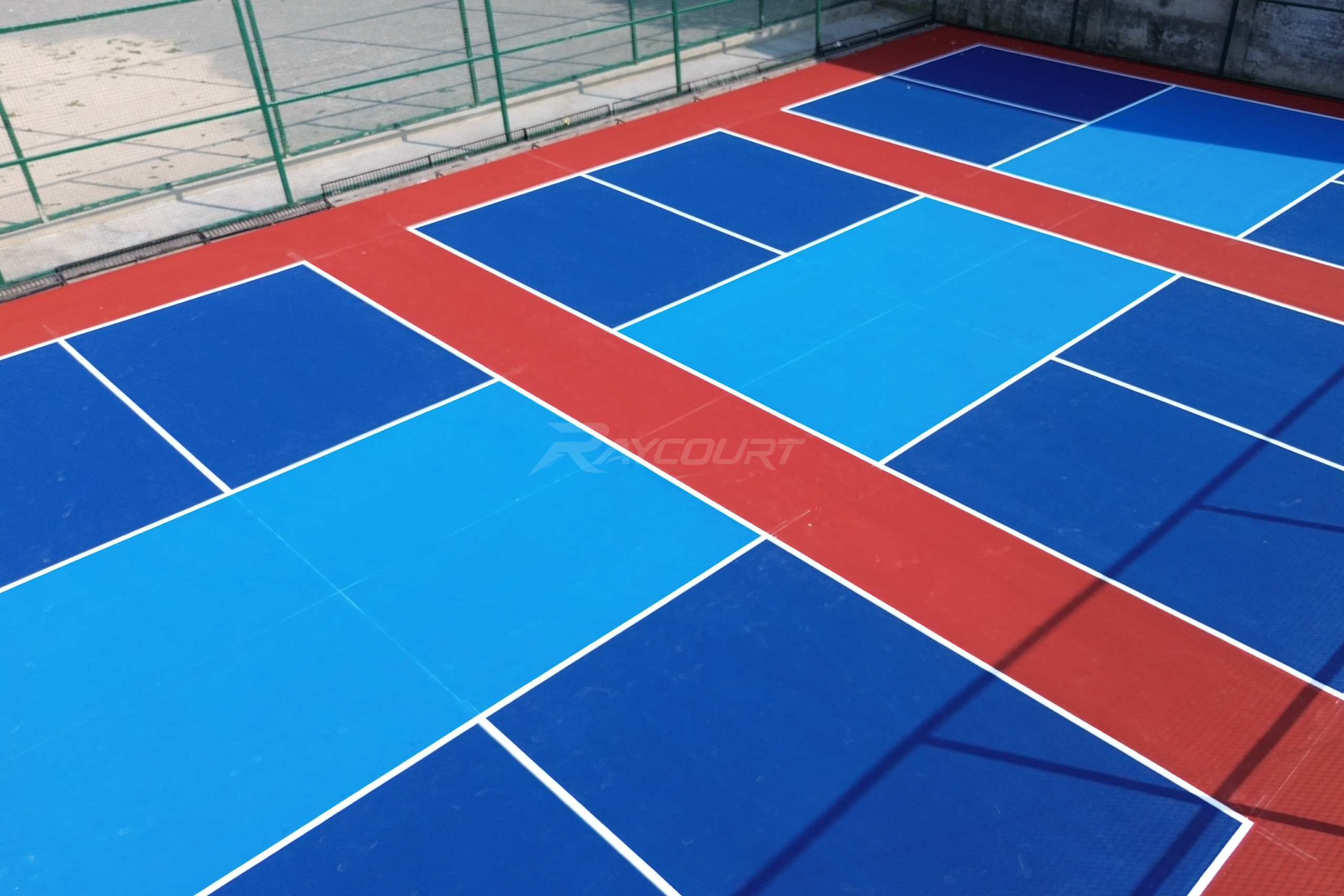
Pickleball has a clear favourite. Most dedicated courts use a synthetic acrylic system over asphalt or concrete. The reason is simple. A light plastic ball needs a hard, even floor to bounce properly. Acrylic coatings deliver exactly that.
In addition, manufacturers blend fine silica sand into the coatings. This texture gives shoes a secure grip and controls ball speed. Furthermore, optional cushion layers add comfort under the feet. Because acrylic bonds firmly to the base, it creates a seamless, uniform playing field. Lines stay crisp, and colours stay vivid for years with proper care.
Why Acrylic Suits Pickleball So Well
Several features make acrylic the natural partner for pickleball. First, the bounce stays uniform from baseline to kitchen. Second, the textured finish supports quick lateral steps. Third, the coating resists ultraviolet light and seasonal weather. Fourth, owners can choose from a wide palette of colours.
Moreover, an acrylic court adapts easily to multi-sport use. For instance, one court can carry tennis, basketball and pickleball lines together. Maintenance also stays simple, since the surface needs only cleaning. Consequently, schools and housing societies often prefer acrylic for shared spaces. It gives them a professional finish without complex upkeep.
Surface Comparison Table
| Factor | Sand-dressed turf | Synthetic acrylic |
|---|---|---|
| Main use | Padel | Pickleball and multi-sport courts |
| Ball bounce | Medium and slightly lower | True and uniform |
| Footing | Controlled slide | Firm grip |
| Routine care | Brushing and sand top-ups | Sweeping and washing |
| Colour choice | Limited set | Wide range |
| Multi-sport use | Limited | High |
Inside a Synthetic Acrylic Flooring System
An acrylic court is not a single coat of paint. Instead, it is a layered system, and each layer has a job. Understanding these layers helps you brief your contractor with confidence.
Layer by Layer
A typical system builds up in the following order.
- Base: A sound asphalt or concrete slab provides strength and the correct slope.
- Primer: This coat helps the system bond firmly to the base, especially on concrete.
- Resurfacer: An acrylic and sand mix fills small voids and creates an even texture.
- Cushion coats: Optional rubber-filled layers add shock absorption and comfort.
- Colour coats: Pigmented, textured acrylic layers set the grip, pace and appearance.
- Line paint: A dedicated acrylic line paint marks crisp, durable boundaries.
Each layer must cure before the next one goes down. Therefore, weather and patience both affect the final quality.
Cushioned vs Standard Systems
A standard system places colour coats directly over the resurfacer. It gives a firm, fast and durable court. Many clubs and schools choose it for everyday play.
A cushioned system, in contrast, adds several rubber-filled layers beneath the colour. These layers absorb part of each footfall. As a result, players often feel fresher after long sessions. This benefit matters for pickleball, because many players enjoy several games in a row. Likewise, academies with heavy daily use value the added comfort. Both systems deliver the same reliable bounce when the base is sound.
Texture, Pace and Grip
Texture controls how a court plays. Fine sand in the colour coats creates tiny peaks on the surface. These peaks grip the ball briefly and slow it slightly. They also give shoes dependable traction. Consequently, the amount and size of sand shape the pace of the court.
A smoother finish plays faster, whereas a rougher finish plays slower. For pickleball, a medium texture usually works best. It keeps the plastic ball under control and protects players from slipping. Meanwhile, consistent texture across the whole court prevents surprise bounces.
Colour and Line Choices
Colour is not only about looks. Good contrast helps players track the ball and judge the lines. For this reason, many pickleball courts use two tones. One colour marks the playing area, while another marks the kitchen or surround.
In addition, UV-stable pigments keep colours strong under harsh sunlight. Lighter shades can also feel cooler underfoot in hot climates. Finally, clear white lines complete the court and support fair calls.
Expert Tip: Let new concrete cure fully before any coating work starts. Then follow the manufacturer’s technical data sheet for every layer.
Planning a Facility: Padel, Pickleball or Both?
Now we can turn the padel vs pickleball comparison into a plan. A clear process saves time and avoids rework. The steps below apply to clubs, schools, hotels and residential projects alike.
Start With Your Users
Begin with people, not products. Who will play, and how often? A school needs durable courts for large groups. A premium club, however, may want a showpiece padel court with seating. Likewise, a housing society may prefer pickleball for all age groups. Therefore, list your user groups and their expectations first. This list will guide every later decision, from court count to surface type.
Check Your Space and Orientation
Next, study the site itself. Measure the usable area, including run-off zones and walkways. Then check the height if you plan an indoor venue. Outdoor courts work best with a north–south orientation. This direction keeps the low sun out of players’ eyes.
In addition, hard courts need a gentle, uniform slope for drainage. Standing water damages any surface over time. So, discuss levels and drainage with your engineer at the design stage.
Base Quality Comes First
No coating can hide a poor base. Cracks, dips and weak concrete will eventually show through the surface. Therefore, give the slab your full attention before you think about colour. The base should be flat, stable and fully cured. It should also include a suitable moisture barrier where conditions demand one. Once the base is right, the acrylic system can perform as its designers intended.
Combining Both Sports in One Venue
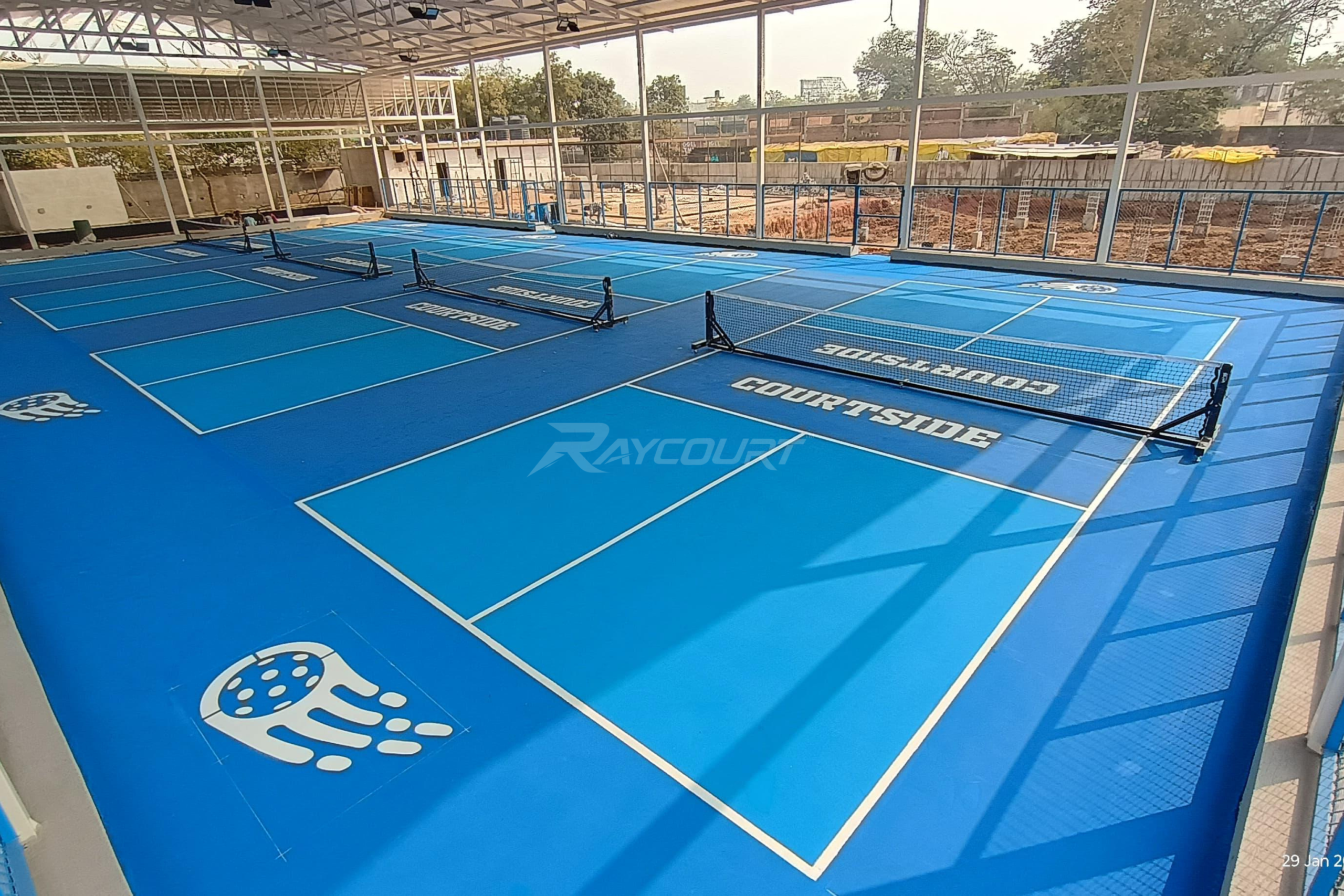
Many owners no longer choose between the two sports. Instead, they offer both. This approach widens the audience and fills more hours of the day. For example, a venue might pair one or two padel courts with several pickleball courts. The sports then share parking, lighting, changing rooms and a café.
However, each sport still needs its own dedicated court. The dimensions, walls and surfaces differ too much for a true shared court.
A Simple Planning Checklist
Use this checklist to organise your project.
- Define your user groups and playing hours.
- Measure the site and confirm the clear height.
- Choose the sport or the mix of sports.
- Select the surface type for each court.
- Appoint a qualified contractor for the base and coating work.
- Source materials from a trusted manufacturer.
- Plan lighting, fencing and seating around the courts.
- Set a routine maintenance schedule from day one.
Maintenance and Longevity
Good maintenance protects performance and appearance. Fortunately, both court types respond well to simple routines. The details, however, differ between acrylic and turf.
Caring for Acrylic Courts
Acrylic courts need little effort. Still, regular attention extends their life considerably.
- Sweep or blow away leaves, dust and grit every week.
- Wash the court with clean water and a soft brush when needed.
- Remove standing water after rain with a rubber squeegee.
- Treat stains, moss or mildew early with a mild cleaner.
- Allow only non-marking court shoes on the surface.
- Keep heavy or sharp objects off the court.
- Inspect for cracks each season and arrange timely repairs.
Over the years, play gradually wears the texture. At that point, a fresh set of colour coats restores grip and appearance.
Caring for Padel Turf and Structures
Padel courts need a different routine. First, brush the turf regularly to lift the fibres and spread the sand evenly. Next, top up the sand whenever levels drop. Uneven sand creates slippery patches and irregular bounces.
In addition, clean the glass panels so that players and spectators see clearly. Check the mesh, bolts and frame for corrosion or loose fittings as well. Finally, keep drainage points clear, because trapped water shortens the life of the turf.
Quick Answers: Padel vs Pickleball
This section answers common padel vs pickleball questions in a short format. Each mini-guide gives you a clear answer first and a brief explanation after.
Which Sport Is Easier for Beginners?
Pickleball is easier on the first day. The court is small, the ball moves slowly, and the serve is simple. Consequently, most newcomers rally within minutes. Padel takes slightly longer because players must learn the walls. However, most beginners feel comfortable after a few sessions.
Which Sport Needs Less Space?
Pickleball needs less space. Its court covers less than half the playing area of a padel court. Moreover, it needs no walls or tall structure. Padel, on the other hand, needs a fixed 20 m by 10 m enclosure and generous height.
Can One Court Host Both Sports?
No, not properly. The two courts differ in size, and padel depends on its walls. However, a multi-sport acrylic court can host pickleball alongside tennis or basketball. So, pickleball shares space far more easily than padel does.
Is Padel Just Tennis With Walls?
Not quite. Padel shares tennis scoring, but almost everything else differs. The court is smaller, the racket has no strings, and the serve is underarm. Above all, the walls create rallies that tennis cannot offer.
Does Surface Colour Really Matter?
Yes, it does. Strong contrast helps players see the ball and the lines. In addition, quality pigments resist fading under sunlight. Therefore, colour affects both playability and long-term appearance.
Ready to build a court that performs for years to come?
Connect with Raycourt for sports flooring systems built for your project.
Common Mistakes to Avoid
Even well-planned projects stumble on avoidable errors. Therefore, keep the following points in mind.
- Choosing the surface before the sport: Each game needs its own floor response.
- Ignoring run-off space: Tight boundaries make play uncomfortable and unsafe.
- Rushing the base: Coating over uncured or cracked concrete invites early failure.
- Skipping drainage design: Standing water harms every type of surface.
- Mixing unverified products: Layers from different sources may not bond well together.
- Forgetting maintenance: Even the best court needs a simple, regular routine.
In short, careful planning beats quick fixes every time.
How Raycourt Supports Your Court Project
Raycourt manufactures synthetic acrylic sports court flooring materials. We do not install courts ourselves. Instead, we supply complete material systems and technical guidance to the professionals who build them.
Materials Built for Performance
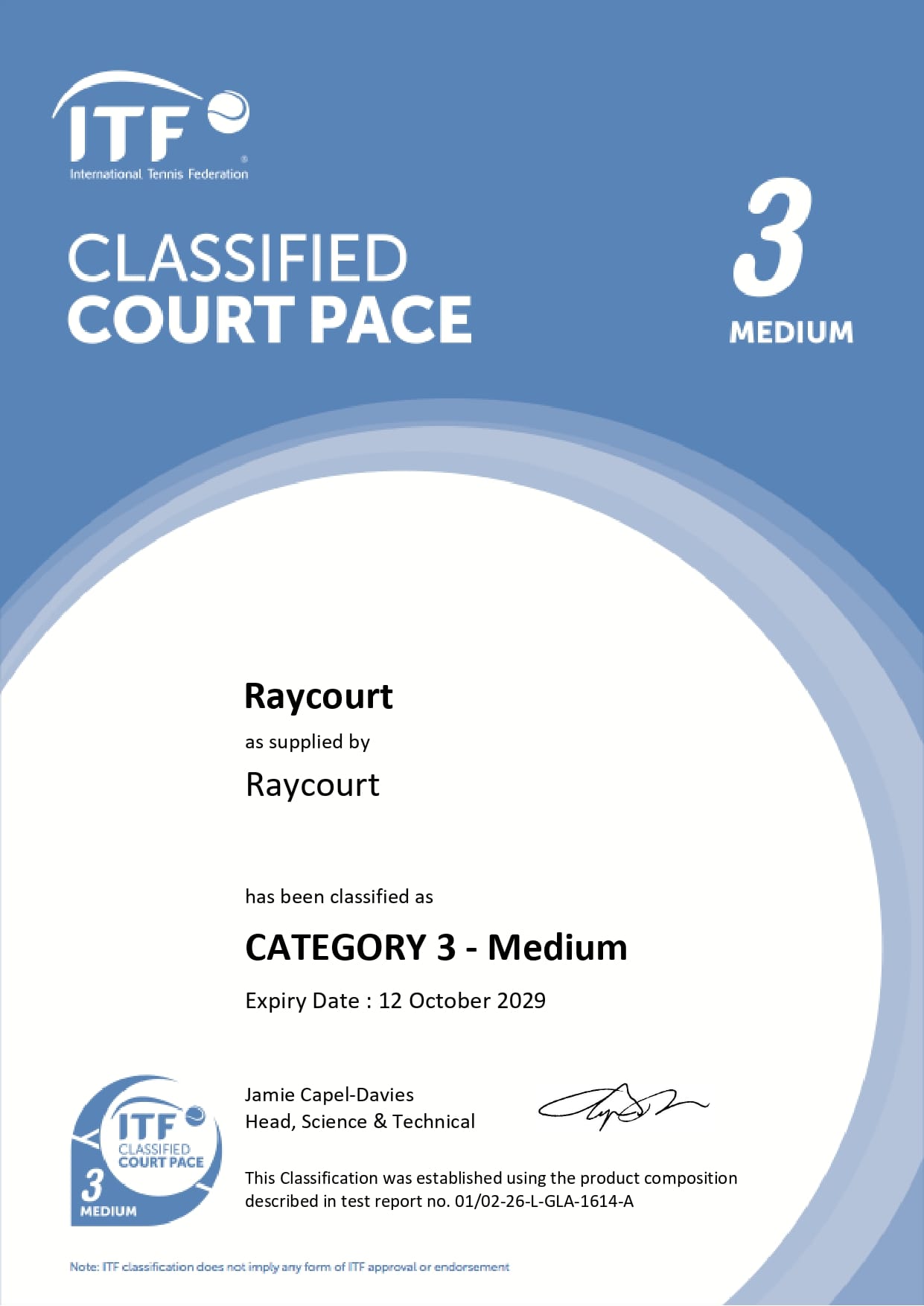
Our range covers every layer of an acrylic court. It includes primers, resurfacers, cushion coats, colour coats and line paints. We formulate each product to work with the others as one system. As a result, contractors achieve consistent texture, bounce and colour across the whole court. Furthermore, our ITF classification reflects our commitment to recognised performance standards. Our materials serve pickleball, tennis, basketball and other multi-sport courts.
Guidance for Your Contractor
Good materials need correct application. Therefore, we support your chosen contractor with clear technical data and application guidance. We explain coverage, mixing, curing times and weather limits for each layer. In addition, we help project teams select the right system for their sport and climate. Because we focus on manufacturing, we know our materials in depth. Your contractor then handles the base preparation and coating work on site.
Dependable Supply
Projects run on schedules, so supply matters. Our warehouse in Vadodara keeps materials ready for prompt dispatch. Consequently, contractors can plan coating work with confidence. We also maintain consistent batch quality, so colours match across project phases. Above all, we stay available to answer technical questions throughout your project.
Frequently Asked Questions
The main difference lies in the court. Padel uses a larger court with glass walls and mesh, and the walls stay in play. Pickleball uses a smaller open court with a non-volley zone near the net. In addition, the bats, balls and scoring systems all differ.
Popularity depends on the region. Padel leads in Spain, Latin America and much of Europe. Pickleball, meanwhile, leads in North America and grows quickly across India and Asia. Both sports continue to add players and courts every year.
You can rally casually, but it will not be a proper game. The padel court is larger, and its lines sit in different places. Moreover, sand-dressed turf dulls the bounce of a plastic pickleball. A hard acrylic court suits pickleball far better.
Service life depends on the base, climate, usage and maintenance. With a sound base and regular cleaning, an acrylic surface performs well for many years. After that, fresh colour coats renew the texture and appearance.
Padel vs Pickleball: The Final Word
The padel vs pickleball choice comes down to space, players and purpose. Padel offers fast, tactical rallies inside a glass enclosure. Pickleball, in contrast, offers easy, social play on a compact open court. Both sports reward good planning, and both depend on the surface beneath the players.
For pickleball and multi-sport projects, a quality acrylic system delivers the bounce, grip and durability that players expect. Therefore, choose your sport first, prepare a sound base and select proven materials. With those three steps, your court will serve its community well.
Ready to build a court that performs for years to come?
Connect with Raycourt for sports flooring systems built for your project.