
Introduction: What Does Pickleball Court Flooring Cost in India?
Pickleball court flooring cost in India typically ranges from ₹55 to ₹70 per square foot (+ gst), depending on court size and specification. This range reflects the general market rate for material and installation combined, and it excludes base construction. A single 1,800 sqft court usually falls between ₹65 and ₹70 per sqft (+ gst), while multi-court projects with three or four courts often bring the rate down to ₹55-₹60 per sqft (+ gst) for premium flooring systems.
These figures answer the core question upfront, but they only tell part of the story. Raycourt manufactures the acrylic flooring material itself and does not handle on-site installation. Contractors and court builders typically install the material, so the total market cost includes their labor, tools, and application process on top of the material price. Understanding this split matters, because it directly shapes how you budget for your project.
This article breaks down every factor that drives pickleball court flooring cost in India. It also explains how base conditions, raw material pricing, and regional variation affect your final number. By the end, you will understand exactly what goes into your quote and how to plan your budget with confidence.
What Determines Pickleball Court Flooring Cost in India?
Several variables shape the final price you pay for your pickleball court. No two projects look identical, so understanding these drivers helps you set realistic expectations before you request a quote. Let’s walk through each one.
Court Size and Number of Courts
The size of your project plays a major role in your per-square-foot rate. A standard pickleball court requires a minimum playing surface of 1,800 sqft, based on the 30-foot by 60-foot dimension recommended by USA Pickleball, the sport’s governing body. This is why the industry commonly references 1,800 sqft as the baseline unit for single-court pricing.
When you build just one court, your rate sits at the higher end of the range. However, larger projects benefit from economies of scale. Suppliers and applicators spread fixed costs, like mobilization, equipment setup, and logistics, across a bigger surface area. As a result, three or four courts built together typically cost less per square foot than a single standalone court.
Base Construction Condition
Your existing base heavily influences your total project cost, even though the ₹55-₹70 per sqft (+ gst) range excludes base construction itself. A smooth, well-cured concrete or asphalt surface requires minimal preparation before flooring application begins. In contrast, an uneven, cracked, or poorly graded base demands surface correction first.
This preparation work sits outside the flooring material cost, but it still affects your overall budget significantly. Always inspect your base condition early, since this step often determines whether your project stays on schedule and within scope.
Raw Material Pricing Trends
Acrylic sports flooring relies on raw materials like acrylic resins, silica sand, and specialty additives. Global commodity prices fluctuate throughout the year, and these shifts directly influence manufacturing costs. When raw material prices rise, flooring rates tend to follow.
Raycourt monitors these trends closely to maintain consistent quality without unpredictable price swings for our clients. Still, buyers should expect some natural variation in quotes depending on when they purchase materials.
Geographic Location and State-to-State Variation
Pickleball court flooring cost in India also varies from state to state. Transportation distances, local labor rates, and regional demand all contribute to this variation. A project in a metro city may carry different logistics costs than one in a smaller town.
Consequently, the ₹55-₹70 per sqft (+ gst) figure serves as a general reference point rather than a fixed nationwide rate. Always request a location-specific quote to get an accurate number for your exact project.
Expert Tip: Before finalizing your budget, ask your supplier whether their quote reflects material-only pricing or a combined material-plus-installation rate. This single question prevents most budgeting surprises later in the project.
Pickleball Court Flooring Cost Breakdown (Without Base Construction)
Now let’s look closely at the actual numbers. These figures represent general market pricing for material and installation combined, and they exclude base construction entirely.
- Single court (1,800 sqft): ₹65-₹70 per sqft (+ gst)
- Multiple courts (3-4 courts, premium flooring): ₹55-₹60 per sqft (+ gst)
Several conditions apply to both figures. First, these numbers assume the base is already prepared and ready for flooring application. Second, actual costs shift based on your base condition, since additional surface correction adds expense outside this range. Third, raw material pricing fluctuates over time, and this naturally affects final quotes.
Fourth, and importantly, costs vary by state due to transportation, labor, and regional market factors. Treat the ₹55-₹70 per sqft (+ gst) range as a starting reference for planning purposes rather than a guaranteed final quote.
Raycourt’s role within this pricing structure centers specifically on the flooring material itself. We manufacture the acrylic coating systems that installers apply to your prepared base. Installation labor, application expertise, and on-site execution come from independent contractors and court builders, not from Raycourt directly. This distinction matters because it clarifies exactly what you’re paying for when you compare quotes from different sources.
Ready to build a court that performs for years to come?
Connect with Raycourt for sports flooring systems built for your project.
Understanding Material Cost vs Installation Cost
Many first-time buyers assume a single quoted rate covers everything equally, but material and installation actually represent two distinct cost components. Separating them helps you evaluate quotes more accurately and negotiate with greater confidence.
What the Material Cost Covers
The material cost includes the acrylic flooring compound itself, along with any primers, color coats, and line-marking paints required for the system. Raycourt supplies these components as a manufacturer, formulating each layer for durability, traction, and ball response. This portion of your budget reflects product quality, formulation complexity, and the number of coating layers your system requires.
What the Installation Cost Covers
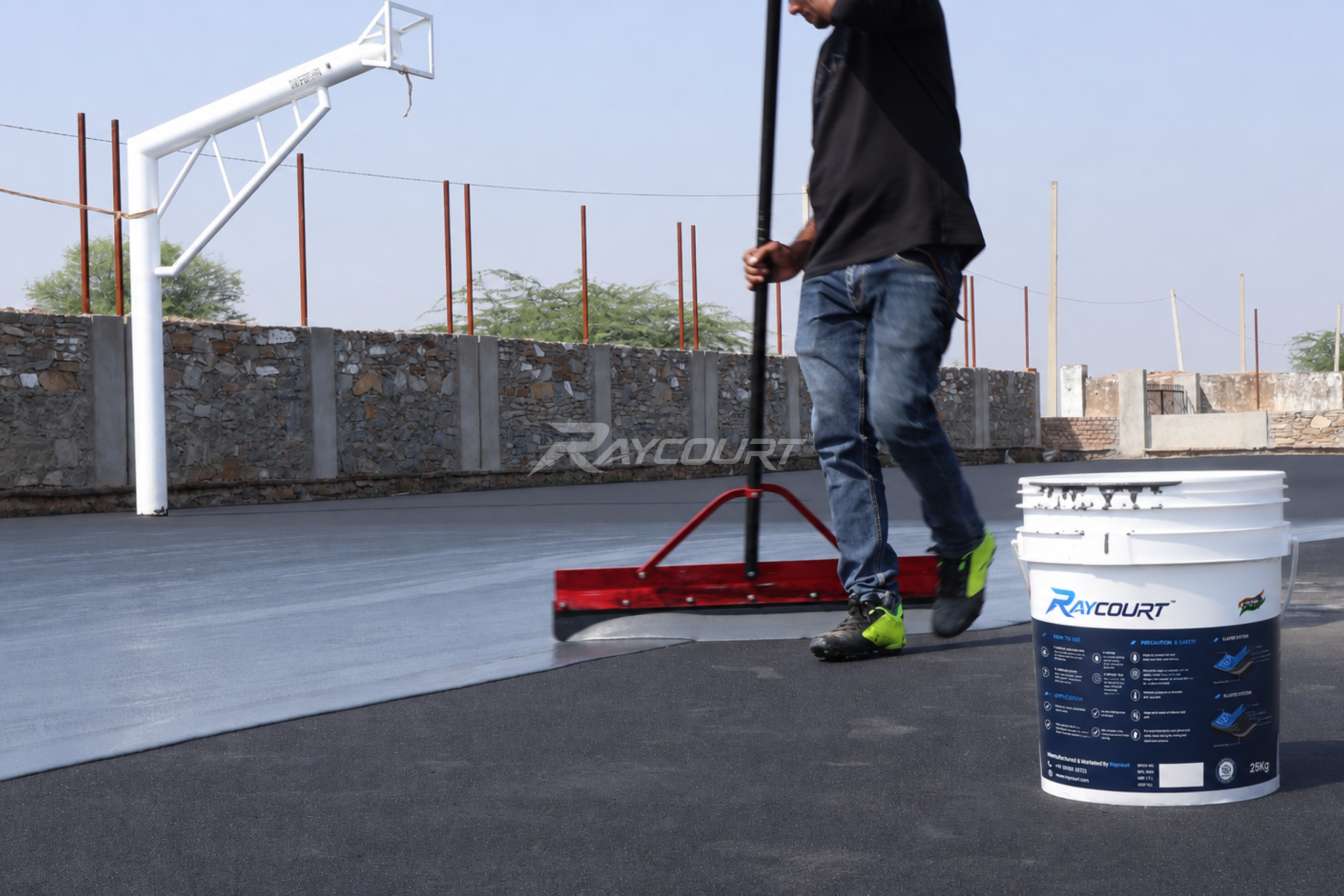
Installation cost covers the labor and expertise needed to apply the material correctly. Installers prepare the surface, mix and apply each coating layer, allow proper curing time between coats, and paint the court lines with precision. This process demands skill, since improper application can shorten a court’s lifespan considerably.
Because Raycourt focuses exclusively on manufacturing, we recommend working with experienced, reputable installers who understand acrylic sports flooring application. A quality material performs best when a skilled team installs it correctly.
Why This Distinction Matters for Your Budget
When you request quotes, ask suppliers to break down material and installation costs separately. This transparency helps you compare apples to apples, especially when different vendors bundle these costs differently. It also helps you identify where you can control spending, since material specifications offer more flexibility than labor rates in most regions.
Why Court Size Changes Your Price Per Square Foot
Pickleball court flooring cost in India follows a straightforward economic principle: larger projects generally cost less per unit. This happens for a few clear reasons, and understanding them helps explain the gap between single-court and multi-court pricing.
First, mobilization costs stay relatively fixed regardless of project size. Whether you’re flooring one court or four, the supplier still needs to transport materials and coordinate logistics once. Spreading this fixed cost across a larger surface area naturally lowers the per-square-foot rate.
Second, bulk material orders often qualify for better manufacturing efficiency. Producing larger batches of coating material reduces per-unit production overhead, and this savings can pass through to the final price.
Third, installers working across multiple adjacent courts complete their process more efficiently than they would on isolated single-court projects. Continuous work reduces downtime between setup and execution phases.
This is exactly why the market rate for 3-4 court projects with premium flooring specifications drops to ₹55-₹60 per sqft (+ gst), compared to ₹65-₹70 per sqft (+ gst) for a single court. If you’re planning a facility with multiple courts, whether for a club, academy, or residential complex, this scaling effect represents meaningful savings.
The Role of Base Construction in Total Project Cost
The ₹55-₹70 per sqft (+ gst) range covers flooring material and installation only. It does not include base construction, and this distinction deserves careful attention during your planning phase.
Base construction refers to the foundational surface beneath your acrylic flooring system. This typically means a concrete slab or a properly graded and compacted asphalt layer. The base must meet specific flatness, drainage, and curing standards before any acrylic coating application begins.
Why Base Quality Affects Flooring Performance
A poor-quality base compromises flooring performance regardless of the flooring material’s quality. Cracks in the base eventually telegraph through acrylic coatings, and improper drainage leads to water pooling, which accelerates wear. This is why sports flooring manufacturers consistently emphasize base preparation as a non-negotiable project step.
Budgeting for Base Construction Separately
Since base construction costs vary enormously based on location, soil conditions, and existing infrastructure, most flooring suppliers quote it separately from material and installation. Some project sites already have a usable base, such as a converted tennis court or existing concrete pad, which significantly reduces this line item. Other sites require ground-up construction, which adds substantial cost.
Always request a separate assessment for base construction before finalizing your overall budget. This approach gives you a clearer, more realistic total project cost from the start.
Expert Tip: Schedule a site inspection before requesting flooring quotes. A clear understanding of your base condition helps suppliers give you accurate, actionable pricing instead of broad estimates.
Why Pickleball Court Flooring Cost Varies Across Indian States
India’s diverse geography and market conditions create natural pricing variation from region to region. Several factors drive this difference, and recognizing them helps you interpret quotes more accurately.
Transportation distance plays a significant role, since raw materials and finished products travel from manufacturing hubs to project sites. Projects located farther from major logistics centers often carry higher freight costs, and this expense factors into final pricing.
Labor rates also differ by state and even by city. Metro areas with higher costs of living typically see higher installation labor charges compared to smaller towns. Meanwhile, local demand and market competition influence pricing too, since regions with more active sports infrastructure development sometimes see more competitive rates due to supplier density.
Climate conditions matter as well, though indirectly. States with extreme heat, heavy monsoon exposure, or coastal humidity may require specific material formulations suited to those conditions. This specification difference can influence material selection and, consequently, cost.
Given all these variables, treat any general pricing reference, including the ₹55-₹70 per sqft (+ gst) range discussed here, as a starting point for your research. Always request a location-specific quote for accurate budgeting.
Types of Acrylic Court Flooring Systems
Not all acrylic flooring systems perform identically, and understanding your options helps you choose the right specification for your project. Raycourt manufactures multiple system types, each suited to different performance needs and budget considerations.
Cushioned Acrylic Systems
Cushioned acrylic flooring incorporates a rubber or foam-based cushion layer beneath the acrylic coating. This layer absorbs impact and reduces stress on players’ joints during extended play sessions. Cushioned systems suit competitive facilities, academies, and any venue prioritizing player comfort and injury prevention.
Non-Cushioned Hard Court Systems
Non-cushioned systems apply acrylic coating directly onto the prepared base without an additional cushion layer. These systems offer excellent durability and faster ball response, making them popular for high-traffic recreational courts. They also typically involve fewer material layers, which can simplify the installation process.
Textured Coating Systems
Textured acrylic coatings incorporate fine sand or silica particles into the top layer. This texture improves traction and slip resistance, which matters significantly for a fast-paced sport like pickleball. Most quality court systems in India, including Raycourt’s formulations, use textured top coats as standard practice.
The table below compares these system types across key technical factors, without referencing pricing.
| System Type | Layer Composition | Ideal Application | Key Advantage |
|---|---|---|---|
| Cushioned Acrylic | Base coat + cushion layer + textured top coats | Academies, competitive facilities | Reduces joint impact, improves comfort |
| Non-Cushioned Hard Court | Base coat + textured top coats | High-traffic recreational courts | Faster ball response, simpler build |
| Multi-Layer Premium System | Multiple textured and color coats with UV protection | Outdoor courts in varied climates | Enhanced durability and weather resistance |
Choosing between these systems depends on your facility’s purpose, expected usage volume, and player demographic. A club catering to competitive players may prioritize cushioning, while a community recreational court might favor the simplicity and durability of a hard court system.
How Pickleball Court Flooring Cost Gets Calculated: A Step-by-Step Look
Understanding the calculation process helps demystify your final quote. Here’s how suppliers and installers typically approach pricing for a pickleball court project.
- Site assessment. The team evaluates your existing base condition, drainage, and overall site accessibility.
- System selection. You choose between cushioned, non-cushioned, or premium multi-layer specifications based on your needs.
- Area calculation. The team measures your total court area, whether it’s a single 1,800 sqft court or a multi-court facility.
- Material quantity estimation. Suppliers calculate the exact volume of coating material required for your chosen system and area.
- Base construction scope. If your base needs preparation or rebuilding, this gets quoted as a separate line item.
- Installation planning. Installers estimate labor requirements based on area, system complexity, and site conditions.
- Final quote compilation. All elements combine into a comprehensive project estimate, ideally broken down by category.
Following this structured approach helps you understand exactly what drives your total number, rather than receiving a single opaque figure. Always ask your supplier to walk you through each step during the quoting process.
Choosing the Right Flooring Specification for Your Project
Selecting the right specification requires balancing performance needs against practical constraints like usage volume and climate exposure. Let’s explore how to approach this decision systematically.
For Single-Court Residential or Small Club Projects
Smaller projects often benefit from straightforward, durable systems that deliver reliable performance without excessive complexity. A quality non-cushioned or lightly cushioned system typically satisfies these needs well, especially for recreational play.
For Multi-Court Academies and Competitive Facilities
Facilities hosting frequent, high-intensity play should prioritize premium flooring specifications with enhanced cushioning and UV-stable top coats. These systems withstand heavier usage patterns and provide better long-term value despite higher upfront material investment.
For Outdoor Courts in Extreme Climates
Courts exposed to intense sun, heavy rainfall, or significant temperature swings need weather-resistant formulations. Raycourt engineers specific coating systems to handle these conditions, incorporating UV inhibitors and moisture-resistant additives into the acrylic compound.
Expert Tip: Match your flooring specification to your actual usage pattern, not just your budget. Under-specifying a heavily used court often costs more in the long run through premature wear and earlier resurfacing needs.
Why Raycourt for Pickleball Court Flooring Material
Raycourt stands as a trusted name in synthetic acrylic sports court flooring across India. Our manufacturing process focuses on consistent quality, rigorous testing, and formulations designed specifically for demanding sports applications like pickleball.
Manufacturing Expertise You Can Trust
Years of manufacturing experience inform every batch of material we produce. Our formulations undergo careful quality checks before reaching your project site, ensuring consistency across every square foot of coverage.
Material Built for Indian Climate Conditions
India’s climate varies dramatically from region to region, and Raycourt formulates its acrylic systems to handle this diversity. Our coatings resist UV degradation, monsoon moisture, and temperature fluctuations across different geographic zones.
Supporting Your Project as a Manufacturing Partner
While Raycourt does not provide installation services, we work closely with distributors and installation partners to ensure our material performs as intended once applied. This manufacturing-focused approach lets us concentrate entirely on product quality, rather than spreading resources across installation logistics.
Consistent Supply for Projects of Any Scale
Whether you’re building one court or a multi-court facility, Raycourt supplies material at scale without compromising formulation consistency. This reliability matters significantly for large projects, where inconsistent material batches could create visible performance variation across courts.
Ready to build a court that performs for years to come?
Connect with Raycourt for sports flooring systems built for your project.
Maintenance and Long-Term Value Considerations
Your initial flooring investment represents only part of your court’s total lifecycle cost. Proper maintenance significantly extends your flooring’s lifespan and protects your investment over time.
Regular cleaning removes debris, dust, and organic buildup that can degrade coating surfaces gradually. Routine inspection helps you catch small issues, like minor cracking or surface wear, before they develop into larger, costlier problems. Prompt attention to drainage issues also prevents water damage, which remains one of the leading causes of premature flooring deterioration.
The table below outlines a general maintenance approach for acrylic sports court flooring.
| Maintenance Task | Recommended Frequency | Purpose |
|---|---|---|
| Surface sweeping/cleaning | Weekly | Removes debris and prevents surface buildup |
| Drainage inspection | Monthly | Identifies pooling risks before they cause damage |
| Crack and wear inspection | Quarterly | Catches minor damage before it spreads |
| Professional resurfacing assessment | Annually | Evaluates whether a recoat is needed |
Following a consistent maintenance routine helps your court deliver reliable performance for years. It also protects the substantial investment you’ve made in quality flooring material and professional installation.
Frequently Asked Questions
Pickleball court flooring cost in India ranges from ₹55 to ₹70 per square foot (+ gst). This covers material and installation combined, excluding base construction. A single 1,800 sqft court typically costs ₹65-₹70 per sqft (+ gst).
No, base construction is a separate cost. It covers the concrete or asphalt foundation beneath the flooring. Costs vary based on site condition, so always request a separate quote for this step.
Multi-court projects spread fixed costs like logistics across a larger area. Bulk material orders also improve manufacturing efficiency. This typically brings pricing down to ₹55-₹60 per sqft (+ gst) for 3-4 courts.
With proper installation and regular maintenance, acrylic flooring performs well for several years. Actual lifespan depends on usage intensity, climate exposure, and maintenance consistency. Heavily used outdoor courts may need earlier resurfacing.
Acrylic flooring relies on resins, additives, and silica sand, all tied to global commodity markets. When raw material costs rise, manufacturing costs typically follow. Requesting a quote close to your project timeline gives you the most accurate pricing.
Final Thoughts on Budgeting for Your Pickleball Court
Pickleball court flooring cost in India depends on multiple interconnected factors, from court size and base condition to raw material pricing and regional location. The general market range of ₹55-₹70 per sqft (+ gst) offers a useful starting point, but your actual project cost will reflect your specific circumstances.
Understanding the distinction between material and installation costs helps you evaluate quotes more intelligently. Raycourt supplies the acrylic flooring material within this pricing structure, manufacturing formulations built for durability, performance, and India’s varied climate conditions. Installation remains the domain of skilled contractors who bring your court to life on-site.
As you move forward with your project, request detailed, itemized quotes that separate material, installation, and base construction costs. This transparency helps you budget accurately and avoid surprises later in the process. With the right planning and the right material partner, your pickleball court investment delivers lasting value for years of play.
Ready to build a court that performs for years to come?
Connect with Raycourt for sports flooring systems built for your project.