
The basketball court flooring cost in India typically ranges from ₹55 to ₹60 per sq ft (plus GST) for a single court. That rate covers both material and installation, but it excludes base construction. If you build three or four courts in one project, the rate for premium flooring drops to ₹50 to ₹55 per sq ft (plus GST).
A standard single court covers 6,523.34 sq ft. Therefore, most buyers land between roughly ₹3.59 lakh and ₹3.91 lakh before GST and base work. Multi-court projects bring the per-court figure down to roughly ₹3.26 lakh to ₹3.59 lakh before GST.
These numbers give you a reliable starting point. However, the final basketball court flooring cost depends on your base condition, raw material pricing, and your state. This guide explains each factor in plain language. It also shows you how to plan your budget, compare surface options, and avoid expensive mistakes.
Raycourt manufactures the synthetic acrylic material that goes on top of your base. We do not install courts ourselves. Instead, your flooring contractor or a trusted installation partner handles the application. Throughout this article, the cost ranges reflect the typical all-in market rate for material plus installation.
Understanding the Basketball Court Flooring Cost in India
Many buyers ask one simple question: “How much will my court cost?” The honest answer starts with a rate per square foot. Then it adapts to your site. This section walks you through the pricing logic step by step.
The Rate for a Single Basketball Court
For one court, the basketball court flooring cost runs from ₹55 to ₹60 per sq ft (plus GST). This rate applies to a court of 6,523.34 sq ft. That area usually covers the playing court and the surrounding run-off zone.
Multiply the rate by the area, and you get a clear budget range. At ₹55 per sq ft, a single court comes to about ₹3.59 lakh. At ₹60 per sq ft, it comes to about ₹3.91 lakh. GST comes on top of both figures.
Why does the rate move within that range? Several factors push it up or down. For example, a smooth, well-cured base lets installers work faster. In contrast, a rough or uneven base needs extra surface preparation.
The Rate for Multiple Courts
If you build more than one court, you get better value. Projects with three to four courts fall in the ₹50 to ₹55 per sq ft (plus GST) range. This rate applies to premium flooring.
Why does the rate drop? Contractors save time and effort when they work on several courts in one visit. They mobilize their crew once, they ship equipment once, and they apply material in a continuous workflow. As a result, those savings reach you.
At ₹50 per sq ft, one court in a multi-court project comes to about ₹3.26 lakh. At ₹55 per sq ft, it comes to about ₹3.59 lakh. Notice that the top of the multi-court range matches the bottom of the single-court range.
What the Rate Includes and Excludes
Buyers often misread quotes, so clarity matters here. The rates in this article cover both material and installation. They do not cover base construction.
Think of the quote as a layer cake. The base sits at the bottom. The acrylic flooring system sits on top. The rate covers only the top layer. Consequently, you need a separate budget for the concrete or asphalt base.
💡 Expert Tip from Raycourt: Always ask your contractor to separate the base work from the surface work in writing. A split quote shows you exactly where your money goes. It also makes comparing bids much easier.
The Four Caveats Every Buyer Should Know
Every reliable price guide includes caveats. Here are the four that matter most for your basketball court flooring cost:
- The rate excludes base construction. You pay for the base separately.
- Base conditions change the cost. A damaged or uneven base needs repair before flooring starts.
- Raw material pricing changes the cost. Acrylic, pigments, and fillers respond to market shifts.
- State-wise variation applies. The ranges here serve as general reference, and local rates differ.
Keep these four points in mind as you read further. They explain nearly every difference you will see between two quotes.
Does the Basketball Court Flooring Cost Include Base Construction?
No, it does not. The ₹55 to ₹60 per sq ft range for a single court excludes base construction. The ₹50 to ₹55 range for multiple courts also excludes it.
The base is the concrete or asphalt slab under your flooring. It carries the load, and it controls drainage and surface flatness. Because it differs from site to site, contractors quote it separately.
If your site already has a sound slab, you may only need minor repairs. If you start from bare soil, you need full base construction. In that case, add a separate line item to your budget.
What You Actually Pay For: Material, Installation, and Base
To understand the basketball court flooring cost, you need to see how the project divides. Three parts make up every court. Each part has its own role, and each affects the final budget.
Part-1: The Flooring Material
Raycourt manufactures synthetic acrylic sports court flooring material. This material forms the playing surface. It includes resurfacer coats, cushion layers, color coats, and line-marking paint, depending on the system you choose.
The material determines how the court feels and plays. It controls ball bounce, grip, glare, and shock absorption. It also determines how long the court lasts under sun, rain, and heavy foot traffic.
Raw material pricing influences this part of the cost. When acrylic polymers or pigments rise in price, material rates follow. Therefore, quotes can shift between months.
Part-2: Installation
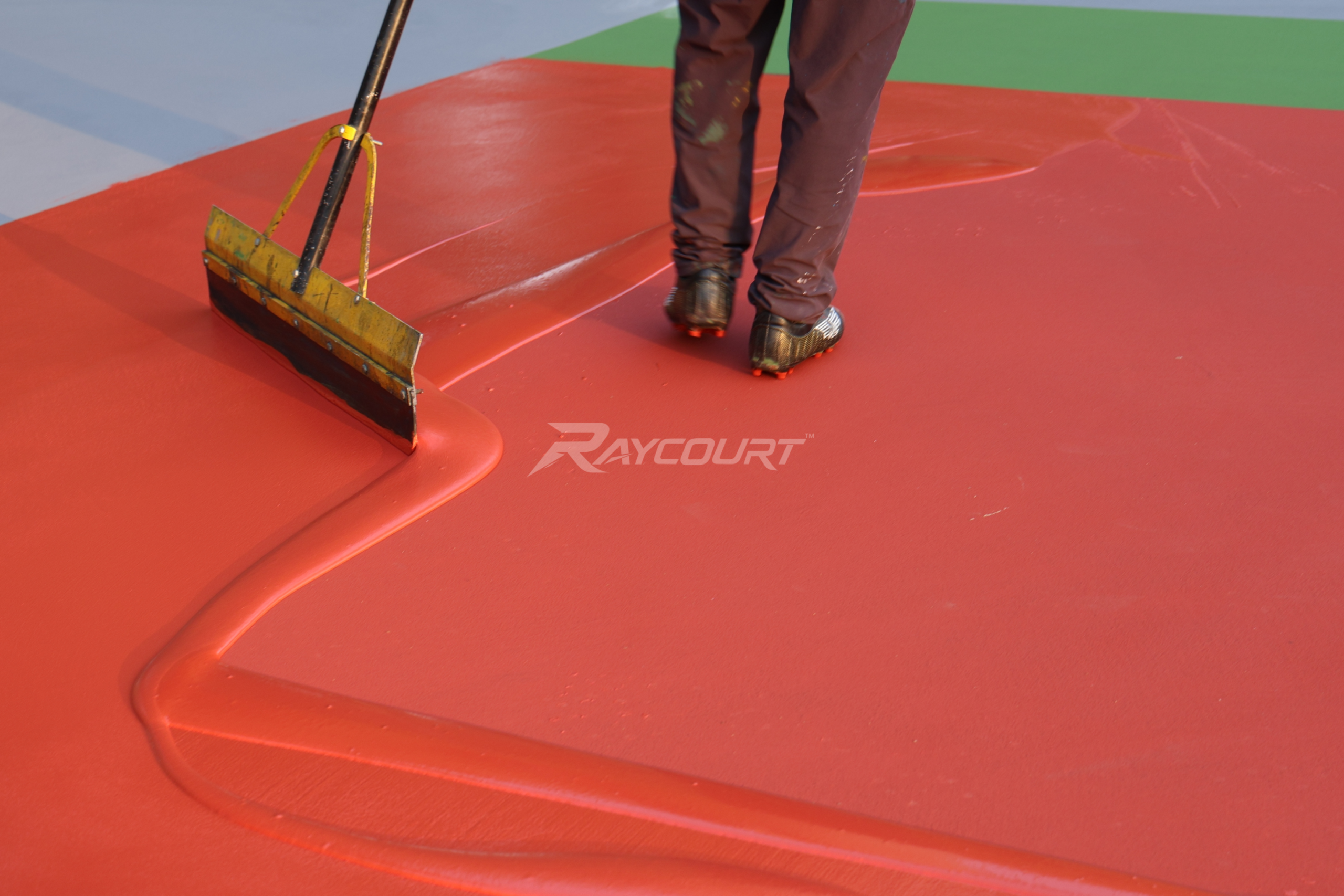
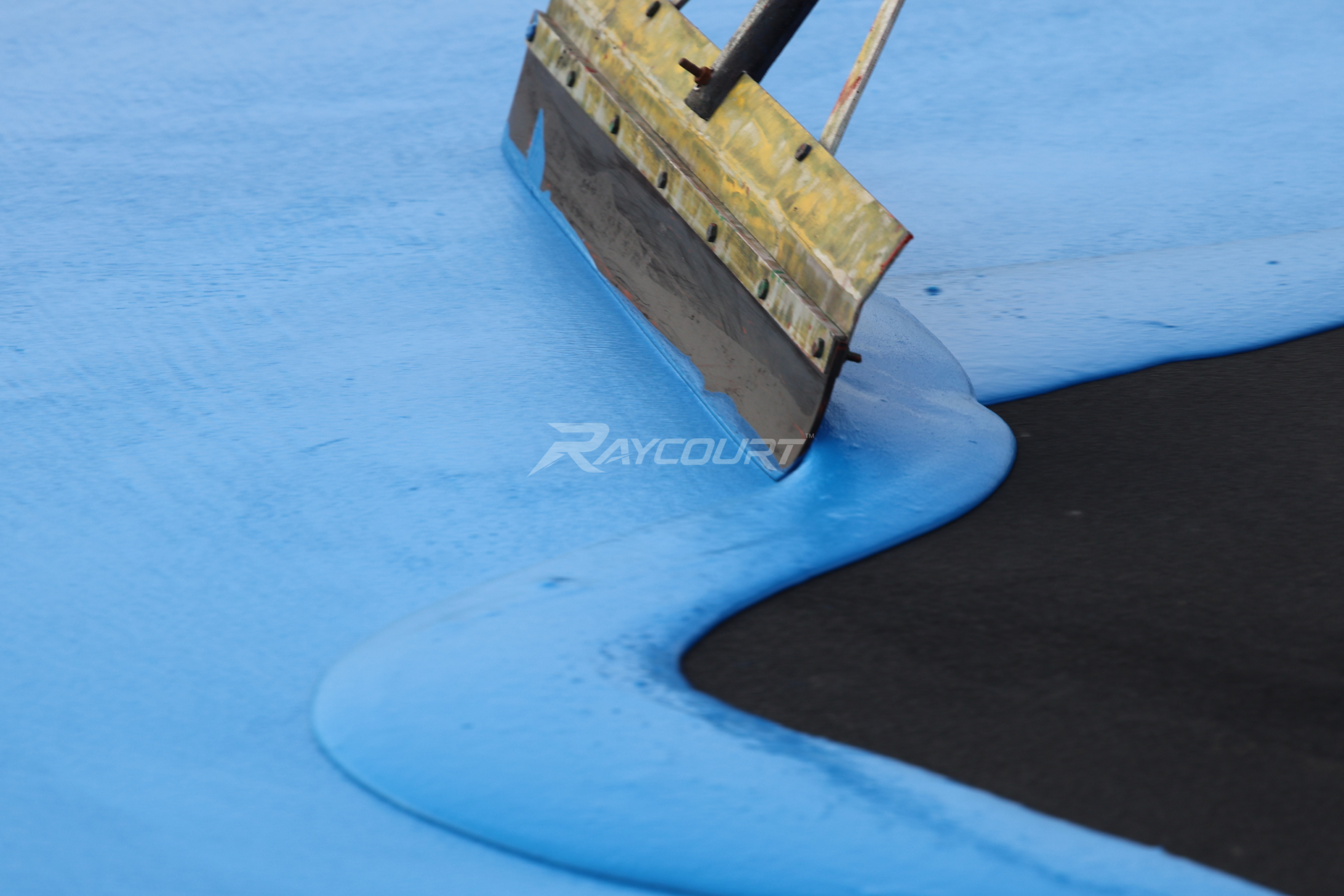
Installation turns raw material into a finished court. A skilled crew prepares the surface, mixes the coats, applies each layer, and paints the lines. This work needs experience, proper tools, and suitable weather.
Raycourt does not install courts. Instead, your flooring contractor or a trusted installation partner handles this stage. The all-in rates in this guide include that labor, so you can compare them fairly with contractor quotes.
Good installation matters as much as good material. A premium product can still fail if the crew rushes the curing time. For that reason, choose your installer carefully and ask for references.
Part-3: The Base
The base supports everything above it. A strong base keeps the court flat, drains water, and prevents cracks. Because the base sits outside the quoted flooring rate, you plan for it separately.
Most outdoor courts use a reinforced concrete slab or a well-compacted asphalt surface. Indoor courts usually use a level concrete slab. Either way, the base needs to cure fully before anyone applies acrylic coats.
How Synthetic Acrylic Flooring Works
Before we explore the factors behind the basketball court flooring cost, let us look at the product itself. Understanding the system helps you judge quotes and ask better questions.
What Is Synthetic Acrylic Court Flooring?
Synthetic acrylic flooring is a multi-layer coating system. Installers apply it over a concrete or asphalt base. The layers bond together and create a durable, slightly cushioned playing surface.
Players love this surface because it offers consistent ball bounce. It also gives good traction without grabbing the shoe too hard. In addition, the color options let you brand the court for your school, club, or academy.
Acrylic systems work especially well in India’s climate. They resist UV rays, heat, and monsoon moisture when installers apply them correctly. Moreover, owners can recoat them when the surface wears down, which extends the court’s life.
The Typical Layers in an Acrylic System
A complete system usually follows a layered structure. The table below shows the common layers and their jobs.
| Layer | Primary Purpose |
|---|---|
| Prepared base | Provides a flat, stable, well-drained foundation |
| Primer or binder coat | Bonds the system firmly to the base |
| Resurfacer or filler coats | Smooth minor imperfections and build texture |
| Cushion coats (optional) | Add shock absorption and comfort |
| Color coats | Deliver UV resistance, color, and grip |
| Line-marking paint | Define the court boundaries clearly |
Each layer adds to the finished court’s performance. Skipping a layer might look like a shortcut. However, it often shortens the court’s life and raises long-term costs.
Why Premium Flooring Matters
The multi-court rate applies to premium flooring. Premium systems use higher-grade acrylic, better pigments, and tighter quality control. They hold color longer, resist cracking, and keep their texture under heavy play.
Cheap systems might look similar on day one. But after a few monsoon seasons, differences show up. Colors fade, lines peel, and the surface loses grip. Consequently, a lower upfront price can cost more over time.
What Size Is a Standard Basketball Court?
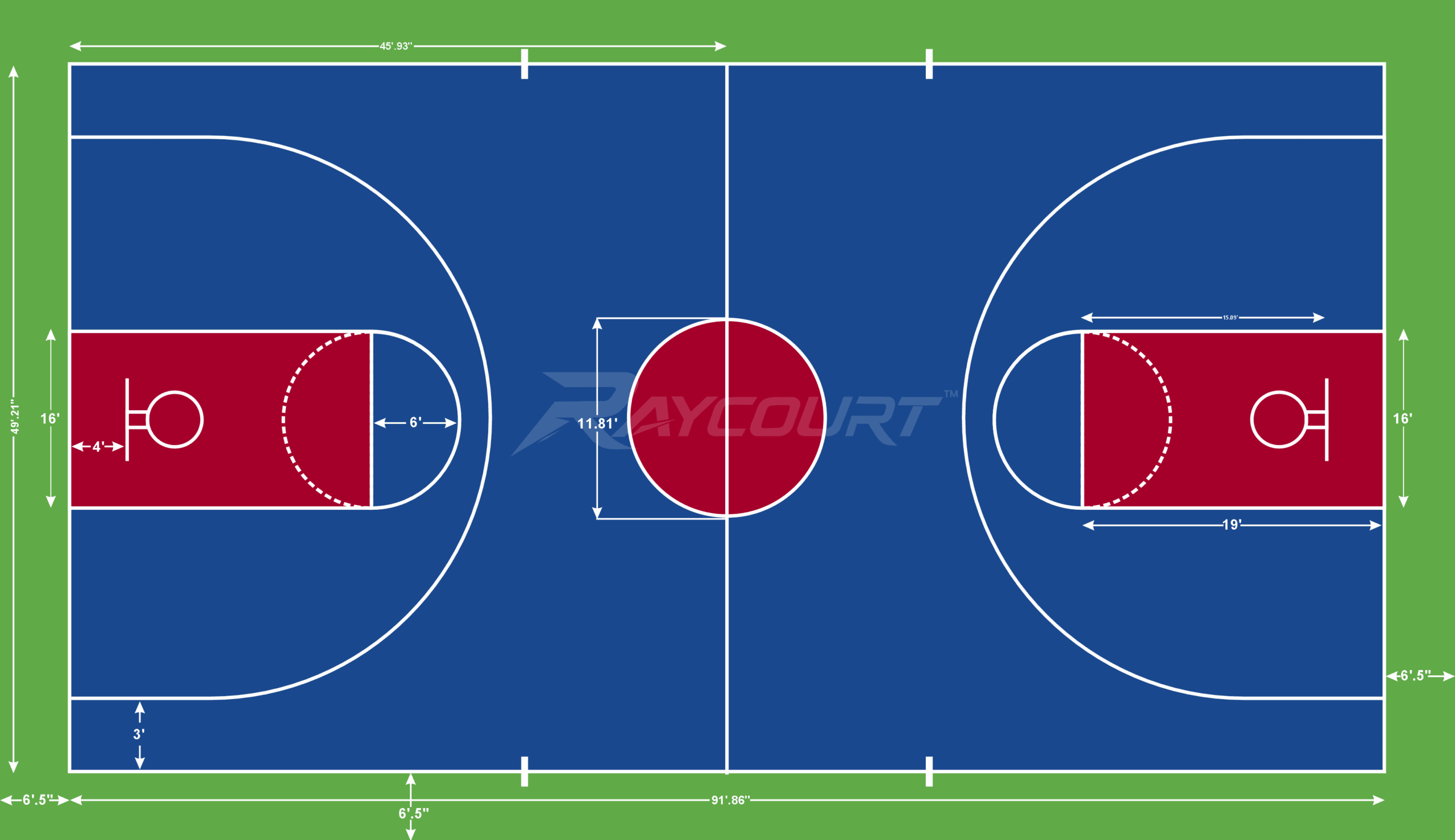
A FIBA-standard basketball court measures 28 meters by 15 meters. An NBA court measures 94 feet by 50 feet. Both sizes cover only the playing area.
Real projects need extra space around the court. Players need run-off zones, and spectators or benches need room. That is why the reference area in this guide reaches 6,523.34 sq ft for one court.
| Standard | Playing Area Dimensions |
|---|---|
| FIBA | 28 m × 15 m |
| NBA | 94 ft × 50 ft |
| School or recreational | Often smaller, based on available space |
The official FIBA rules offer detailed guidance on court markings and dimensions. You can review them on the FIBA official website.
Key Factors That Shape the Basketball Court Flooring Cost
Now we reach the heart of the topic. The base rate gives you a starting point. However, six or seven factors decide where your final number lands. Let us explore each one.
Factor-1: Base Condition
The base condition ranks as the biggest swing factor in your basketball court flooring cost. A flat, fully cured, crack-free slab needs little preparation. In contrast, a damaged slab needs grinding, patching, and sometimes full replacement.
Contractors inspect the base before they quote. They look for cracks, low spots, moisture, and oil stains. They also check whether water drains away from the court.
If the inspection reveals problems, the contractor adds repair work to the scope. This work raises the total budget. Therefore, always request a site visit before you accept any quote.
💡 Expert Tip from Raycourt: Pour water on your slab and watch where it flows. If puddles form, the base needs correction. Acrylic coatings cannot fix standing water.
Factor-2: Raw Material Pricing
Acrylic polymers, pigments, fillers, and additives make up the raw materials. Their prices move with petrochemical markets and supply chains. When those inputs get more expensive, material rates rise.
This factor explains why two quotes from different months can differ slightly. It also explains why suppliers give price validity periods. If you plan a project, lock in your quote early and confirm how long it stays valid.
Raycourt works to keep material quality steady even when markets move. Our manufacturing process emphasizes consistency, so every batch performs the same way on your court.
Factor-3: State and Location
The state-wise variation affects the basketball court flooring cost. Labor rates, transport distances, and local taxes all differ across India. A project in a metro city may cost differently than one in a smaller town.
Transport matters more than many buyers expect. Material has to travel from the manufacturer to your site. Longer distances raise freight charges. Remote sites also add logistics challenges for crews.
The ranges in this guide serve as general reference. For an accurate figure, ask for a quote based on your exact location.
Factor-4: Number of Courts
As we saw earlier, building more than one court lowers the per-square-foot rate. The multi-court range of ₹50 to ₹55 per sq ft (plus GST) applies to projects with three to four courts.
Several things drive this saving. First, the crew mobilizes once. Second, material ships in bulk. Third, the contractor schedules work efficiently across courts. Together, these advantages reduce overhead per court.
If you plan to build a sports complex, think ahead. Grouping your courts into one phase often beats building them one by one.
Factor-5: Court Size and Layout
Bigger courts need more material and more labor. Smaller practice courts need less. The 6,523.34 sq ft reference area gives you a benchmark, but your site may differ.
Layout also matters. A simple rectangle goes down faster than a court with curves, shared lines, or multi-sport markings. For example, a court that doubles as a volleyball or badminton space needs extra line work.
Plan your layout early. A clear design prevents mid-project changes, which often waste material and time.
Factor-6: System Specification
The type of acrylic system you choose affects the price. A basic system uses fewer layers. A premium system adds cushion coats, higher-grade pigments, and extra durability features.
Premium systems cost more upfront. However, they last longer, need fewer recoats, and give players a better experience. In many cases, the long-term value outweighs the extra initial spend.
Ask your supplier to explain each layer in the specification. Then you can judge what each upgrade adds.
Factor-7: Site Access and Weather
Easy site access speeds up work. Narrow gates, long carry distances, and crowded locations slow crews down. Similarly, rain delays can stretch a project’s schedule.
Acrylic coatings need dry weather to cure properly. Contractors often avoid applying them during heavy monsoon. Consequently, project timing can influence both schedule and cost.
Plan your project for the dry season when possible. This choice often saves time and reduces the risk of rework.
Base Construction: The Foundation of Every Court
Because the quoted rates exclude base construction, this topic deserves its own section. A weak base ruins even the best flooring. Therefore, treat the base as a serious part of your basketball court flooring cost planning.
Concrete vs. Asphalt Bases
Most Indian courts use concrete bases. Concrete offers long life, strong load capacity, and a smooth finish. It also suits both indoor and outdoor courts.
Asphalt bases work well for some outdoor courts. They tolerate small movements better than rigid concrete. However, they need proper compaction and edge support.
Both options accept acrylic flooring. The right choice depends on your site, soil, budget, and local contractor expertise. Ask a civil engineer to advise you.
What a Good Base Looks Like
A good base meets several requirements. First, it stays flat within tight tolerances. Next, it slopes gently to drain water. Additionally, it cures fully before anyone applies coatings. Finally, it stays free of cracks, dust, and oil.
Here are the main qualities to look for:
- Flatness: Minimal surface variation across the court
- Slope: A gentle gradient that sheds water without affecting play
- Curing: Full strength and moisture stability before coating
- Cleanliness: No dust, grease, or loose particles
- Strength: Enough thickness and reinforcement for long-term use
Each point protects your flooring investment. If the base fails, the acrylic layers crack, bubble, or peel.
Why Slope Matters
Outdoor courts need a slight slope for drainage. Without it, water pools on the surface. Pooled water damages coatings, grows algae, and creates slipping hazards.
Engineers usually design a gentle slope across the length or width of the court. Players barely notice it, but water flows away smoothly. Check this detail with your civil contractor before pouring the slab.
Why Curing Time Matters
Fresh concrete holds moisture. If installers coat it too early, trapped moisture pushes upward and lifts the acrylic layers. Blisters and delamination follow.
Contractors usually let concrete cure for a set period before surface work begins. Never rush this stage to save time. A short delay costs far less than a repair.
When an Existing Base Works
Sometimes you already own a usable slab. Perhaps you plan to resurface an old court or convert a multipurpose pad. In that case, the base work may stay minimal.
A contractor will still inspect it carefully. They will check for cracks, hollow spots, and moisture. If the slab passes, you can save significantly on the overall project budget.
💡 Expert Tip from Raycourt: Do not assume an old slab works. A quick inspection by your flooring contractor can reveal hidden problems before they become expensive surprises.
Can I Install Acrylic Flooring Over an Existing Court?
Yes, often you can. If the existing surface is sound, contractors can apply acrylic systems over it. They clean the surface, repair cracks, and prime it before coating.
However, the old surface must bond well and drain properly. Loose coatings, deep cracks, or severe unevenness need correction first. In those cases, base repair raises the project scope.
Ask your installer for a base assessment. Then you will know whether resurfacing or full reconstruction suits your court.
Indoor vs. Outdoor Basketball Courts
Your court’s location influences the choice of system and, in turn, the basketball court flooring cost. Indoor and outdoor courts face very different conditions.
Outdoor Court Considerations
Outdoor courts face sun, rain, dust, and temperature swings. Flooring for these courts needs excellent UV resistance and strong adhesion. It also needs surface texture that grips well when wet.
India’s heat can soften or fade weak coatings. Therefore, outdoor courts benefit from premium color coats with quality pigments. Good drainage also protects the surface from monsoon damage.
Outdoor courts need regular cleaning and occasional recoating. With good care, though, acrylic surfaces serve for many seasons.
Indoor Court Considerations
Indoor courts avoid weather, but they bring other needs. Players expect consistent grip, comfortable cushioning, and low glare. Lighting in halls can reflect off glossy surfaces, so matte or low-sheen finishes help.
Indoor floors also need a perfectly flat base. Even small bumps affect ball bounce and player movement. Moreover, humidity control matters in some regions, because trapped moisture can harm coatings.
Indoor courts last longer between recoats because sunlight does not age them. That advantage can improve long-term value.
Which Option Fits You?
Choose based on your use case. Schools and community clubs often prefer outdoor courts for space and access. Academies and training centers often prefer indoor courts for year-round play.
Whichever you choose, share the details with your supplier early. They can recommend a system that fits your climate and play style.
Comparing Basketball Court Surface Options
Acrylic is not your only choice. Understanding the alternatives helps you see why many Indian buyers choose acrylic for performance and value. The table below compares the main surface types on performance, not price.
| Surface Type | Durability | Shock Absorption | Maintenance | Best For |
|---|---|---|---|---|
| Synthetic acrylic | High | Moderate to good (with cushion layers) | Low to moderate | Schools, clubs, academies, outdoor and indoor courts |
| Bare concrete | High | Poor | Low | Casual play only |
| Wooden (parquet) | High with care | Excellent | High | Professional indoor arenas |
| PU or rubber | Moderate to high | Good | Moderate | Indoor multipurpose halls |
| Modular PP tiles | Moderate | Moderate | Low | Quick, temporary, or recreational setups |
Why Many Buyers Choose Acrylic
Acrylic strikes a strong balance. Players get dependable bounce and grip from this surface. Weather resistance adds to its appeal. Furthermore, acrylic allows custom colors and easy recoating.
Wood offers superb feel, but it needs climate control and constant care. Bare concrete costs little to finish, but it punishes joints and wears shoes fast. Modular tiles install quickly, yet they can shift or wear faster under heavy play.
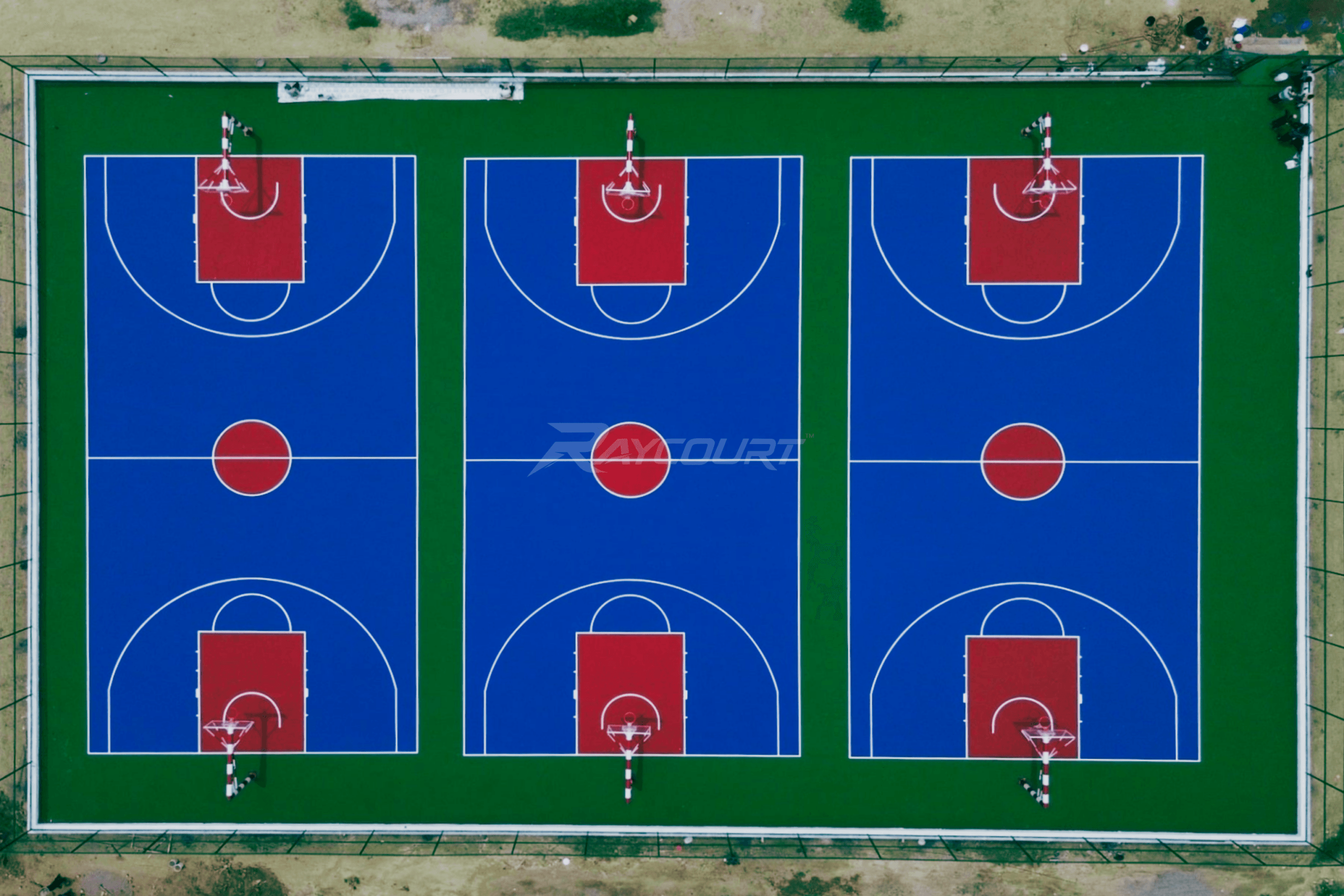
For most Indian schools, clubs, and sports complexes, synthetic acrylic offers the best mix of performance and practicality.
How Does Raw Material Pricing Affect My Court?
It affects the material portion of your quote. Acrylic polymers, pigments, and fillers depend on global markets. When their prices rise, manufacturers adjust rates.
You cannot control these shifts. However, you can manage their impact. First, request a quote with a clear validity date. Second, place your order promptly after you approve it. Third, avoid last-minute scope changes that force a requote.
Raycourt keeps its pricing transparent and its quality consistent. That approach helps buyers plan without surprises.
How to Plan Your Basketball Court Budget Step by Step
A clear process protects you from overspending. Follow these steps when you plan your basketball court flooring cost.
- Define your purpose. Decide whether the court serves a school, academy, club, or residential community.
- Choose indoor or outdoor. This choice shapes your system and your timeline.
- Measure your site. Confirm the total area, including run-off zones.
- Inspect the base. Ask a contractor to check for cracks, slope, and moisture.
- Decide on base work. Budget separately for repairs or new construction.
- Select the flooring system. Compare basic and premium options with your supplier.
- Request detailed quotes. Ask for material, installation, and base work in separate lines.
- Add GST and contingency. Include taxes and a small buffer for surprises.
- Confirm the schedule. Plan around weather and curing times.
- Review warranty and maintenance terms. Understand what coverage you receive and what upkeep you owe.
Each step reduces risk. Together, they turn a vague idea into a solid plan.
Ready to build a court that performs for years to come?
Connect with Raycourt for sports flooring systems built for your project.
A Worked Example with the Reference Court
Let us walk through a simple example. Suppose you build one court of 6,523.34 sq ft. The rate falls between ₹55 and ₹60 per sq ft (plus GST).
At the lower rate, your flooring comes to about ₹3.59 lakh. At the higher rate, it comes to about ₹3.91 lakh. You then add GST and the separate base budget.
Now suppose you build three courts together. The rate drops to between ₹50 and ₹55 per sq ft (plus GST). Each court then costs about ₹3.26 lakh to ₹3.59 lakh before GST. Across three courts, the savings add up noticeably.
This example shows why grouping courts into one project makes financial sense.
Why Multi-Court Projects Deliver Better Value
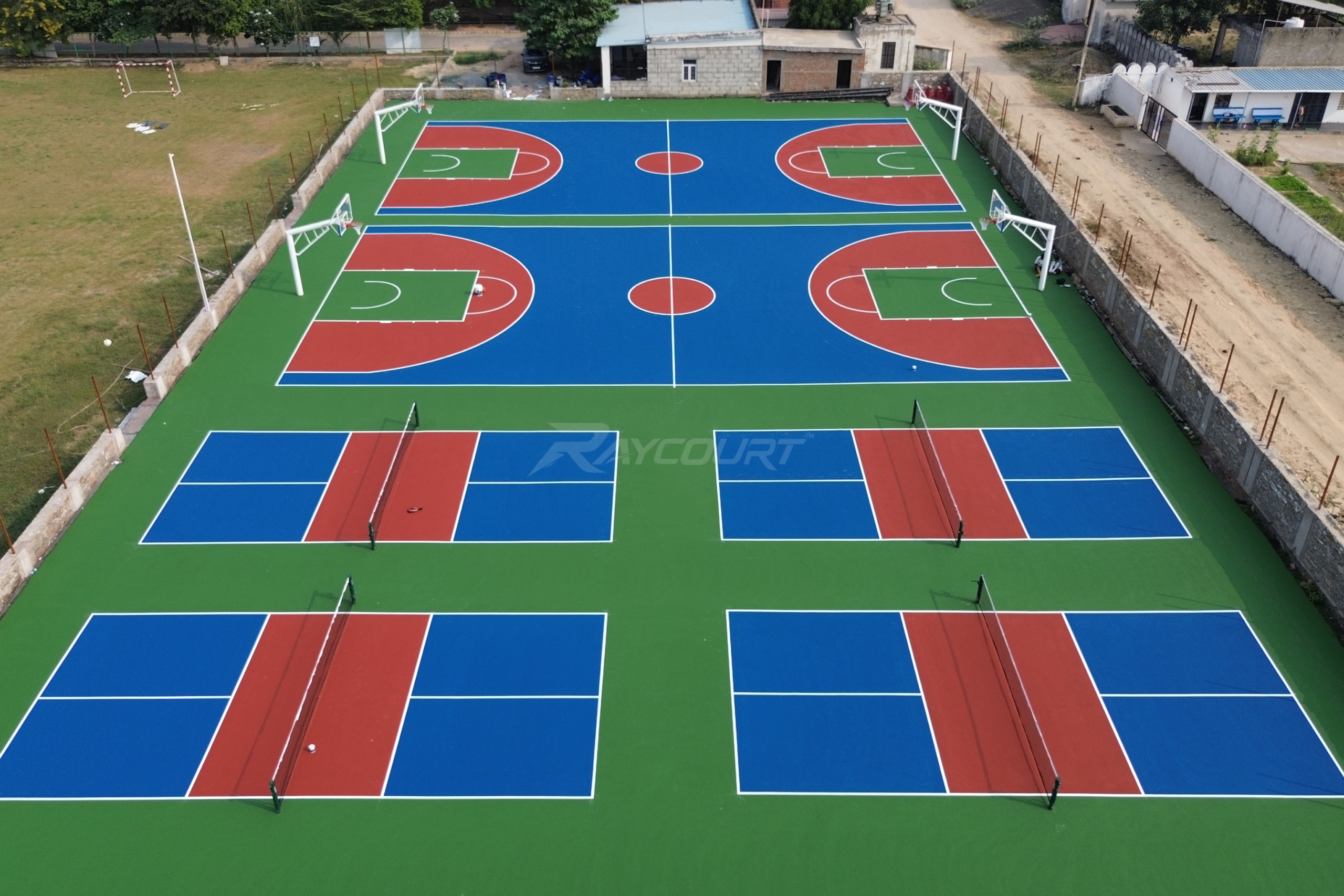
Many institutions plan more than one court. They might build several basketball courts, or they might mix basketball with tennis, badminton, or volleyball. The multi-court rate rewards this approach.
Efficiency Gains for Installers
When contractors work on several courts at once, they lose less time. Crews set up equipment once. They mix larger batches of material. They also keep a steady rhythm, which improves finish quality.
These efficiencies reduce their cost per square foot. As a result, they pass part of the savings to you.
Consistent Quality Across Courts
Building all courts together also ensures a uniform look. The same material batch, the same crew, and the same weather conditions produce matching surfaces. Players enjoy consistent performance on every court.
Building in phases, however, can create small color or texture differences. Different batches and different seasons may change the final look slightly.
Planning for Future Expansion
If you cannot build all courts now, plan the layout for future growth. Leave space, set drainage correctly, and keep your supplier informed. This foresight lets you add courts later without redoing existing work.
Is Cheaper Flooring Always a Bad Idea?
Not always, but low price often signals trade-offs. A very low quote may use thinner coats, lower-grade pigments, or fewer layers. These shortcuts reduce lifespan.
Sometimes a lower price reflects an efficient contractor or a simple site. In those cases, you get real value. However, always compare specifications, not just prices.
Ask each bidder the same questions. What layers do you apply? Which material brand do you use? How long do you let each coat cure? Honest answers reveal the true difference between quotes.
Maintenance and Long-Term Value
The upfront basketball court flooring cost is only part of the story. Maintenance and lifespan decide the real return on your investment. A well-cared court gives you many years of play.
Routine Care Tips
Regular maintenance keeps your court safe and attractive. Simple habits make a big difference.
- Sweep regularly to remove dust, sand, and leaves.
- Wash the surface with mild cleaner and water when it gets dirty.
- Clear standing water after rain to protect coatings.
- Inspect for cracks every few months and repair them early.
- Avoid sharp objects and heavy equipment that can gouge the surface.
These tasks take little time. Yet they prevent small problems from becoming big repairs.
When to Recoat
Acrylic courts age gradually. Over time, color fades, and the surface texture wears down. When you notice these signs, plan a recoat.
Recoating refreshes the color and restores grip. It costs far less than rebuilding the court. Many owners recoat every few seasons, depending on traffic and climate.
Your supplier can recommend a recoating schedule for your court. Raycourt provides technical guidance to help owners maintain their surfaces properly.
Protecting Your Investment
Treat your court as an asset. Set clear rules for footwear, events, and equipment. Ban skateboards, bikes, and metal-cleated shoes. Moreover, train staff to recognize early damage.
A disciplined routine extends your court’s life and protects your original investment.
💡 Expert Tip from Raycourt: Schedule a yearly inspection with your flooring contractor. Early repairs cost far less than late ones, and they keep your court safe for players.
How to Choose the Right Material Supplier and Installer
Quality results need quality partners. Because Raycourt manufactures material but does not install, you work with two parties. One supplies the material, and the other applies it. Choose both carefully.
What to Look for in a Material Manufacturer
A reliable manufacturer shows consistency, transparency, and technical support. Look for these qualities:
- Proven experience with sports court systems
- Consistent product quality across batches
- Technical data sheets that explain each product clearly
- Support for installers with guidance and training
- A track record with schools, clubs, and sports complexes
Raycourt checks each of these boxes. Our team has supplied material for courts across India, and we support contractors with practical technical advice.
What to Look for in an Installer
A strong installer follows proper procedures. They inspect the base, explain the process, and respect curing times. They also show you completed projects and give references.
Ask installers about their crew experience. Next, find out how they handle weather delays. You should also check how they test surface flatness. Their answers show how seriously they take quality.
Questions to Ask Before You Sign
Use this checklist when you speak with bidders:
- Which material system do you plan to use, and why?
- How many coats do you apply, and what is the curing time between coats?
- How do you test the base before you start?
- What warranty do you offer on workmanship?
- Can you share recent court projects I can visit?
Clear, confident answers signal a trustworthy partner. Vague answers should make you cautious.
Ready to build a court that performs for years to come?
Connect with Raycourt for sports flooring systems built for your project.
Common Mistakes That Inflate Your Basketball Court Flooring Cost
Smart planning saves money. Careless planning wastes it. Here are the mistakes we see most often, along with ways to avoid them.
Mistake-1: Ignoring the Base
Many buyers focus only on the flooring rate. Then they discover base repairs that double their budget. Always inspect the base first. Plan for base work from day one.
Mistake-2: Choosing on Price Alone
The lowest quote rarely gives the best value. Cheap systems often skip layers or use weak pigments. Over time, you pay more in recoats and repairs. Compare specifications, not just numbers.
Mistake-3: Rushing the Schedule
Pressure to finish quickly leads to shortcuts. Installers might coat uncured concrete or apply layers too fast. These shortcuts cause bubbles, peeling, and cracks. Give the project the time it needs.
Mistake-4: Skipping Drainage Planning
Water ruins courts. Poor drainage leads to puddles, algae, and surface damage. Plan slope and drainage during base construction, not after.
Mistake-5: Forgetting Maintenance
Even the best court needs care. Owners who ignore cleaning and inspections shorten their court’s life. Build a simple maintenance plan from the start.
Mistake-6: Overlooking GST and Contingency
Quotes in this guide come plus GST. Many buyers forget this detail and face surprise additions later. Also set aside a small contingency for unexpected site issues.
Real-World Scenarios: How the Basketball Court Flooring Cost Plays Out
Examples help you picture your own project. The scenarios below show how different buyers approach the basketball court flooring cost.
Scenario-1: A School Building a Single Court
A school in a mid-sized town wants one outdoor court. The campus already has a level concrete slab in good condition. The team inspects it and finds only minor cracks.
Because the base needs little work, the school focuses its budget on the flooring system. The single-court rate of ₹55 to ₹60 per sq ft (plus GST) applies. The school chooses a premium system for durability under daily student use.
The result: a bright, long-lasting court that serves students for many seasons. Careful base inspection saved the school from major surprises.
Scenario-2: An Academy Building Four Courts
A sports academy plans four courts in one complex. The land is bare, so the team builds a new concrete base first. They budget the base separately from the flooring.
Because they build four courts together, they qualify for the multi-court rate of ₹50 to ₹55 per sq ft (plus GST). The crew works continuously, and all courts match in color and texture.
The academy gains a consistent look, a faster timeline, and a stronger value per square foot.
Scenario-3: A Residential Community Resurfacing an Old Court
A housing society owns an aging court with faded paint and small cracks. Residents want a refresh without a full rebuild. The contractor inspects the surface and finds the base still solid.
The team repairs the cracks, cleans the surface, and applies a new acrylic system. Because the base stays, the society avoids major construction costs. Residents enjoy a renewed court in a short time.
Each scenario shows the same lesson. The base condition and the number of courts shape the final number more than anything else.
How Long Does Acrylic Court Flooring Last?
Lifespan depends on use, climate, and maintenance. A well-built, well-maintained acrylic court can serve for many years before it needs a major overhaul. Light recoats extend that life further.
Heavy traffic, harsh sun, and poor drainage shorten it. Premium systems also last longer than basic ones. Therefore, the quality of your material and your installer matters as much as your upkeep.
Plan on periodic recoating, and treat it as a normal part of ownership. That habit keeps your court performing at its best.
Performance Features That Add Value to Your Court
Price tells only part of the story. Performance tells the rest. When you compare options, look at how the surface plays and how safe it feels.
Ball Bounce and Consistency
Basketball demands predictable bounce. A good acrylic surface returns the ball evenly across the court. Players trust the floor, so they focus on their game.
Uneven bases or poorly applied coats disrupt this consistency. Therefore, flatness and layer quality matter greatly.
Traction and Grip
Players need to cut, pivot, and sprint without slipping. The textured finish of acrylic coatings provides reliable grip. Too little texture leads to slipping. Too much texture wears down shoes and skin.
Quality systems strike the right balance. They give controlled traction in both dry and slightly damp conditions.
Shock Absorption
Hard surfaces strain joints. Cushion layers in premium systems soften impact and reduce fatigue. This feature matters for young athletes and for players who train for long hours.
If your court serves an academy or school, consider a system with added cushioning. Player comfort and injury prevention deserve attention.
UV Resistance and Color Retention
Sunlight fades weak coatings quickly. Premium acrylic systems use UV-stable pigments that hold color for longer. A vibrant court also looks professional and inviting.
For outdoor courts in India, UV resistance stands out as one of the most important performance features.
Customization Options
Acrylic systems offer many color choices. You can paint the court area, the run-off zone, and the key in different shades. You can also add school logos or club branding.
Customization makes your court distinctive. It also boosts team pride and community identity.
Why Raycourt Is a Trusted Name in Court Flooring Material
Raycourt has built its reputation as a leading manufacturer of synthetic acrylic sports court flooring material. We focus on what we do best: producing high-quality, consistent material that performs under real conditions.
Our Manufacturing Approach
We control quality from raw material selection to final packaging. Our team tests each batch for consistency, color accuracy, and performance. This discipline helps installers deliver reliable results every time.
Because we manufacture in-house, we also understand how our products behave in different climates. That knowledge helps us guide buyers across India’s varied regions.
Our Role in Your Project
Raycourt supplies material. We do not install courts. Instead, we work alongside your flooring contractor or installation partner. We share technical data, answer questions, and help your team choose the right system.
This approach keeps our expertise focused on product excellence. It also lets you pick an installer who suits your site and schedule.
Our Commitment to Reliability
We have supplied material to schools, academies, clubs, and sports complexes. These customers trust us because our products deliver consistent quality. Moreover, our team responds quickly to technical questions.
When you choose Raycourt material, you choose a partner who cares about your court’s long-term performance.
Frequently Asked Questions
A single court costs ₹55 to ₹60 per sq ft (plus GST). That rate covers material and installation, but it excludes base construction. A standard 6,523.34 sq ft court therefore costs roughly ₹3.59 lakh to ₹3.91 lakh before GST. Projects with three or four courts drop to ₹50 to ₹55 per sq ft (plus GST) for premium flooring.
No, it does not. The rates cover only flooring material and installation. Budget separately for base construction or repair. Ask your contractor for a split quote, so you can compare bids clearly.
Labor rates, transport distances, and local conditions differ across India. Remote sites add freight charges, while metro areas may carry higher labor costs. Treat the ranges in this guide as general reference, and request a location-specific quote.
Contractors work more efficiently when they build several courts together. They mobilize crews once, ship material in bulk, and keep a continuous workflow. These savings lower the cost per square foot. Building in one phase also gives all courts a consistent color and texture.
No. Raycourt manufactures synthetic acrylic sports court flooring material, but we do not install courts. Your flooring contractor or a trusted installation partner handles the application. We still support your project with technical data, system recommendations, and guidance for your installer.
Final Thoughts on Basketball Court Flooring Cost in India
The basketball court flooring cost in India starts with a clear rate: ₹55 to ₹60 per sq ft (plus GST) for a single court, and ₹50 to ₹55 per sq ft (plus GST) for three or four courts. These rates cover material and installation. They exclude base construction.
Beyond the headline numbers, remember the key drivers. Base condition, raw material pricing, and state-wise variation shape your final budget. Court count, system specification, and site access also play important roles.
Smart buyers plan carefully. First, they inspect the base early. Next, they compare specifications, not just prices. Likewise, they choose reliable material suppliers and experienced installers. Moreover, they commit to simple maintenance that protects their investment.
Raycourt stands ready to support your project. As a manufacturer of synthetic acrylic sports court flooring material, we deliver consistent quality that your installer can trust. Our team shares technical guidance, helps you choose the right system, and answers your questions along the way.
Ready to build a court that performs for years to come?
Connect with Raycourt for sports flooring systems built for your project.