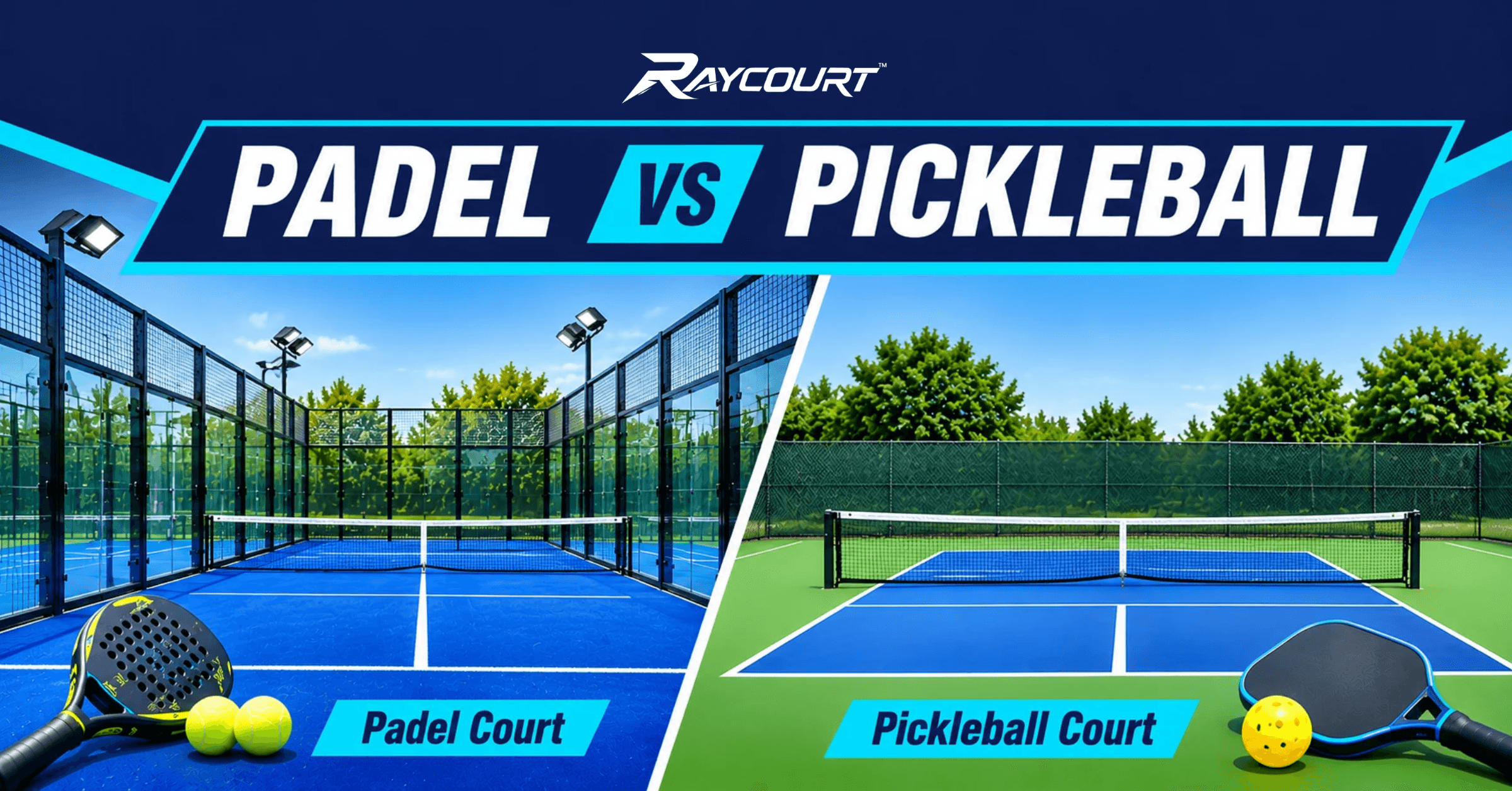

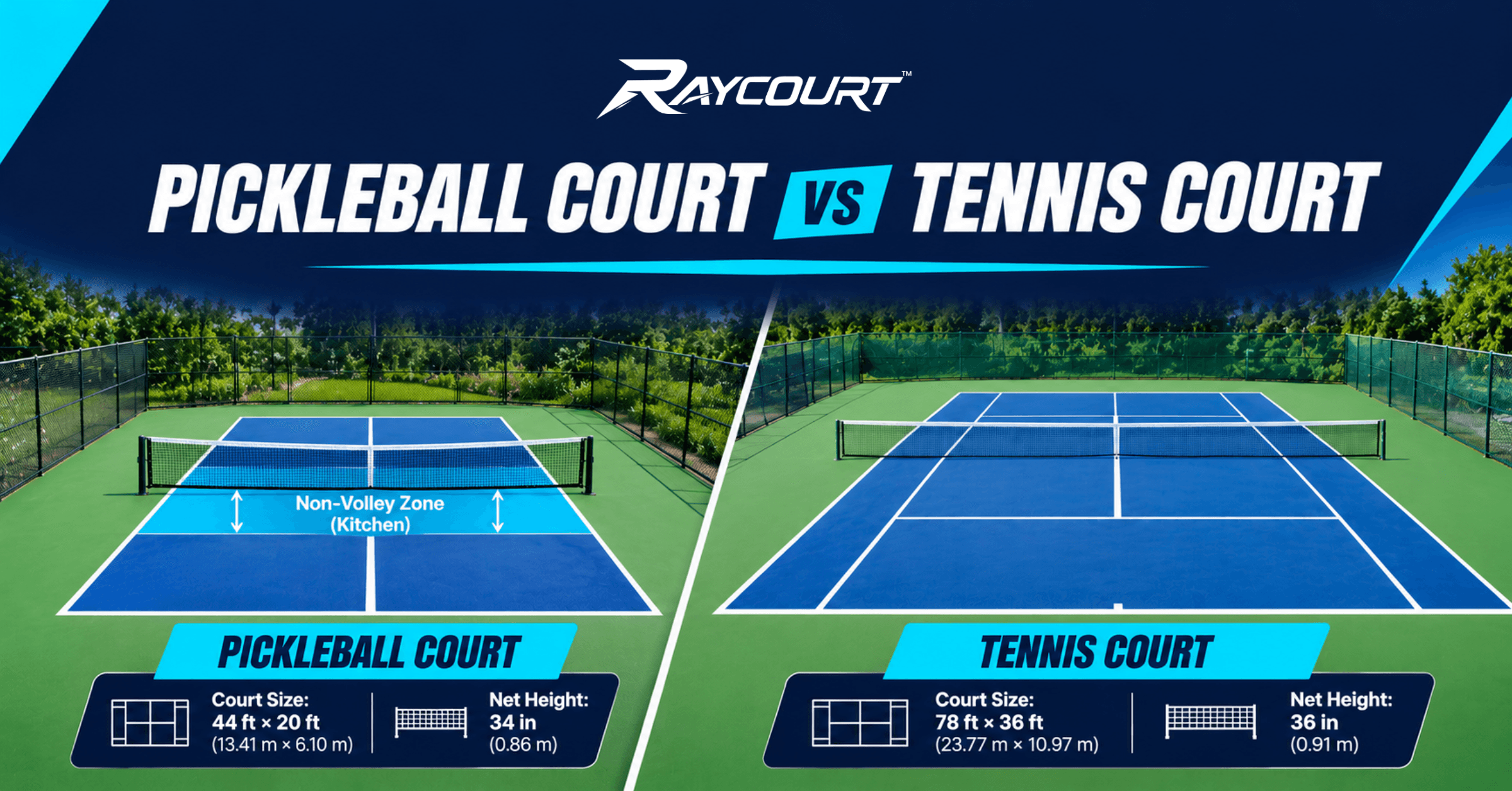
The Pickleball Court vs Tennis Court question has a clear answer. A pickleball court is much smaller, carries a lower net and rewards control near the net. A tennis court is far larger, carries a higher net and rewards power, spin and reach.
In numbers, a pickleball court measures 20 feet by 44 feet. A tennis court measures 78 feet long and 36 feet wide for doubles play. Therefore, one tennis court covers roughly three times the playing area of a pickleball court.
However, the two courts share one important feature. Both perform best on a synthetic acrylic surface over a sound asphalt or concrete base. As a result, the same family of flooring materials can serve either sport.
So, which court should you build? The answer depends on your space, your players and your long-term plans. For example, a compact community plot often suits pickleball. In contrast, a sports academy with serious tennis coaching needs full-size tennis courts.
This guide walks through every major difference in the Pickleball Court vs Tennis Court comparison. First, we explain the dimensions, nets and line markings. Next, we look at how each sport treats the surface. Finally, we cover planning, shared courts, colour choices and upkeep.
Expert tip: Decide who will play before you decide what to build. Player age, skill level and group size shape every later choice.
Why This Comparison Matters Today
Pickleball has grown quickly in India and around the world. Consequently, many clubs, schools and societies now weigh pickleball against tennis for the same piece of land. Some owners want a new court. Others want to add pickleball lines to an existing tennis court.
Each route demands a clear grasp of both courts. Moreover, a wrong assumption about size or surface can waste space and reduce playing quality. This guide therefore gives you the facts in plain language. It also shares practical advice from a manufacturer’s point of view.
Understanding the Two Courts
Before we compare details, it helps to see each court on its own terms. Both sports use a rectangular court with a net across the middle. However, each game grew from different roots and makes different demands.
What Defines a Pickleball Court?
A pickleball court is a compact rectangle with one layout for singles and doubles. Players use solid paddles and a light, perforated plastic ball. The ball travels slower than a tennis ball and bounces lower.
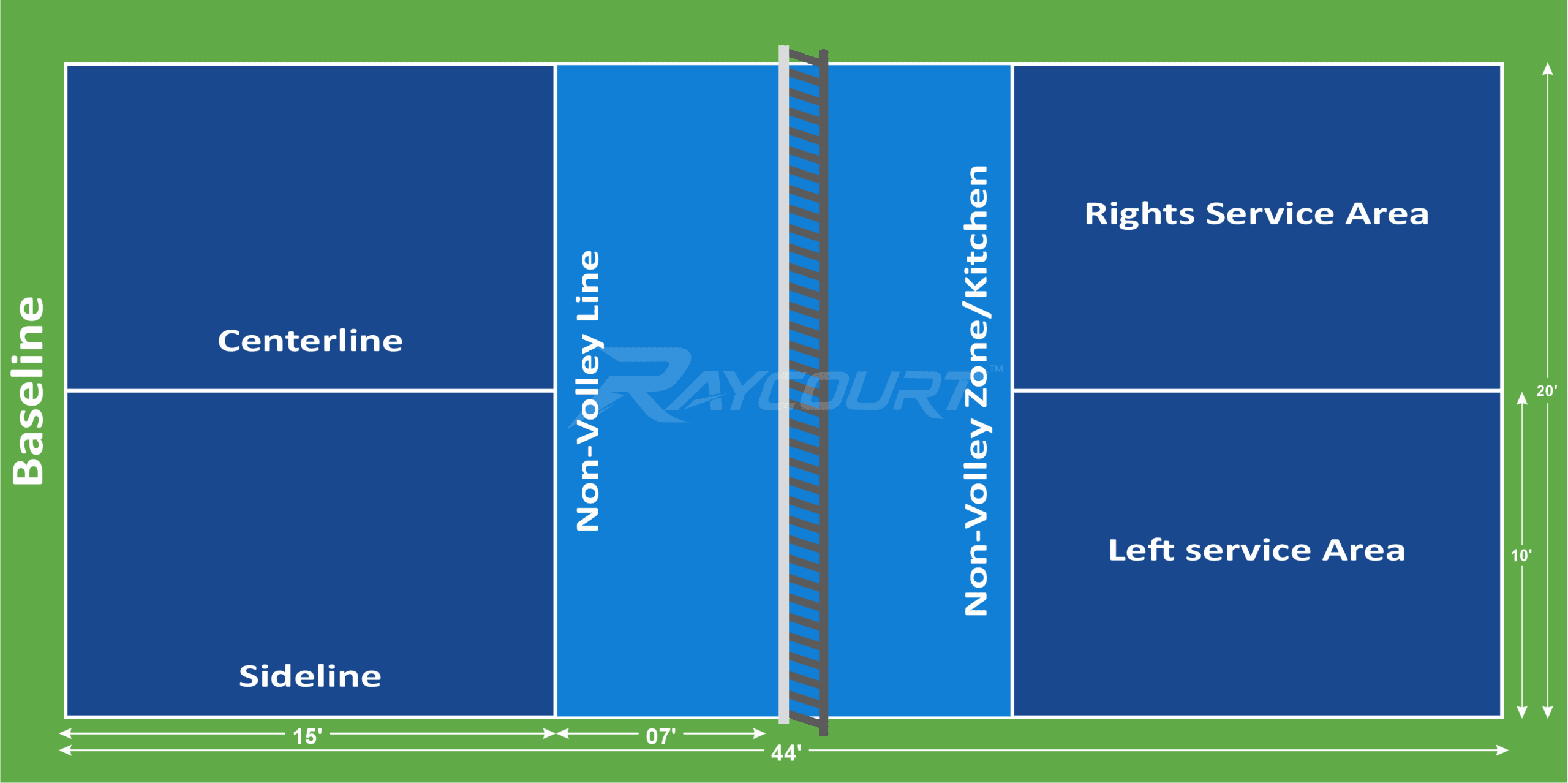
The court’s most distinctive feature is the non-volley zone, which players call the kitchen. This zone extends seven feet from the net on each side. Players cannot volley the ball while standing inside it. Consequently, rallies often turn into soft, precise exchanges close to the net.
Because the court is small, players stand close together. As a result, the game feels social and easy to learn. Beginners can enjoy a rally within minutes. Moreover, doubles play dominates the sport, so four players share a small space comfortably.
What Defines a Tennis Court?
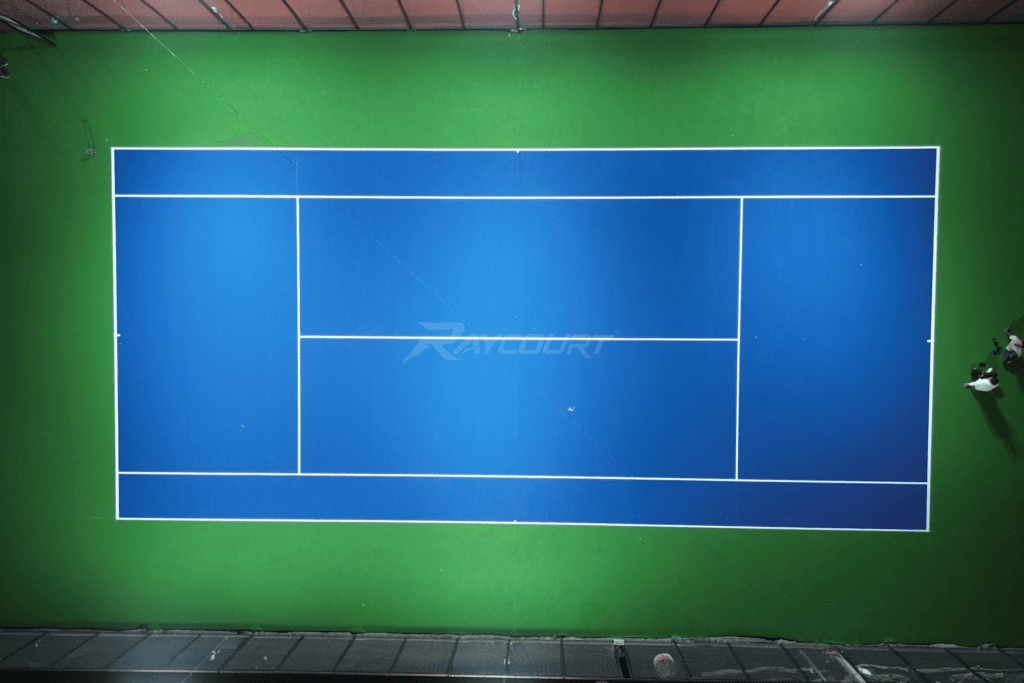
A tennis court is a long rectangle with separate sidelines for singles and doubles. Players use strung rackets and a pressurised rubber ball with a felt cover. The ball travels fast, bounces high and responds strongly to spin.
Tennis has no non-volley zone. Instead, service boxes and baselines shape the play. Players cover long distances behind the baseline and sprint forward to the net. Therefore, the court needs generous run-off space beyond the lines.
Tennis also has a long competitive tradition. World Tennis, formerly the International Tennis Federation (ITF), publishes the rules for court dimensions and equipment. Clubs and academies follow those rules closely.
How a Rally Unfolds in Each Sport
In pickleball, the serve travels underhand and diagonally across the court. The receiving side lets the ball bounce, and so does the serving side on the return. After those two bounces, players may volley outside the kitchen. Consequently, points build gradually through placement and patience.
In tennis, the serve travels overhead and often at great speed. The receiver must react quickly, and the point can end within a few shots. Alternatively, long baseline rallies test stamina and consistency. Therefore, tennis rewards both explosive power and endurance.
These patterns explain why the courts differ so much. A game of soft touch needs little room. A game of pace and spin, however, needs length, width and generous space behind the baseline.
The Shared DNA of Both Courts
Despite the differences, the two courts have much in common. Both need a flat, stable base with a consistent slope for drainage. Both need clear, accurate line markings. In addition, both reward a surface that offers reliable grip and true ball bounce.
This shared foundation explains why acrylic systems work so well for each sport. It also explains why many facilities now host both games side by side.
Pickleball Court vs Tennis Court Dimensions
Size is the first and most visible difference in the Pickleball Court vs Tennis Court comparison. The table below sets out the key measurements side by side.
| Feature | Pickleball court | Tennis court |
|---|---|---|
| Court length | 44 feet (13.41 m) | 78 feet (23.77 m) |
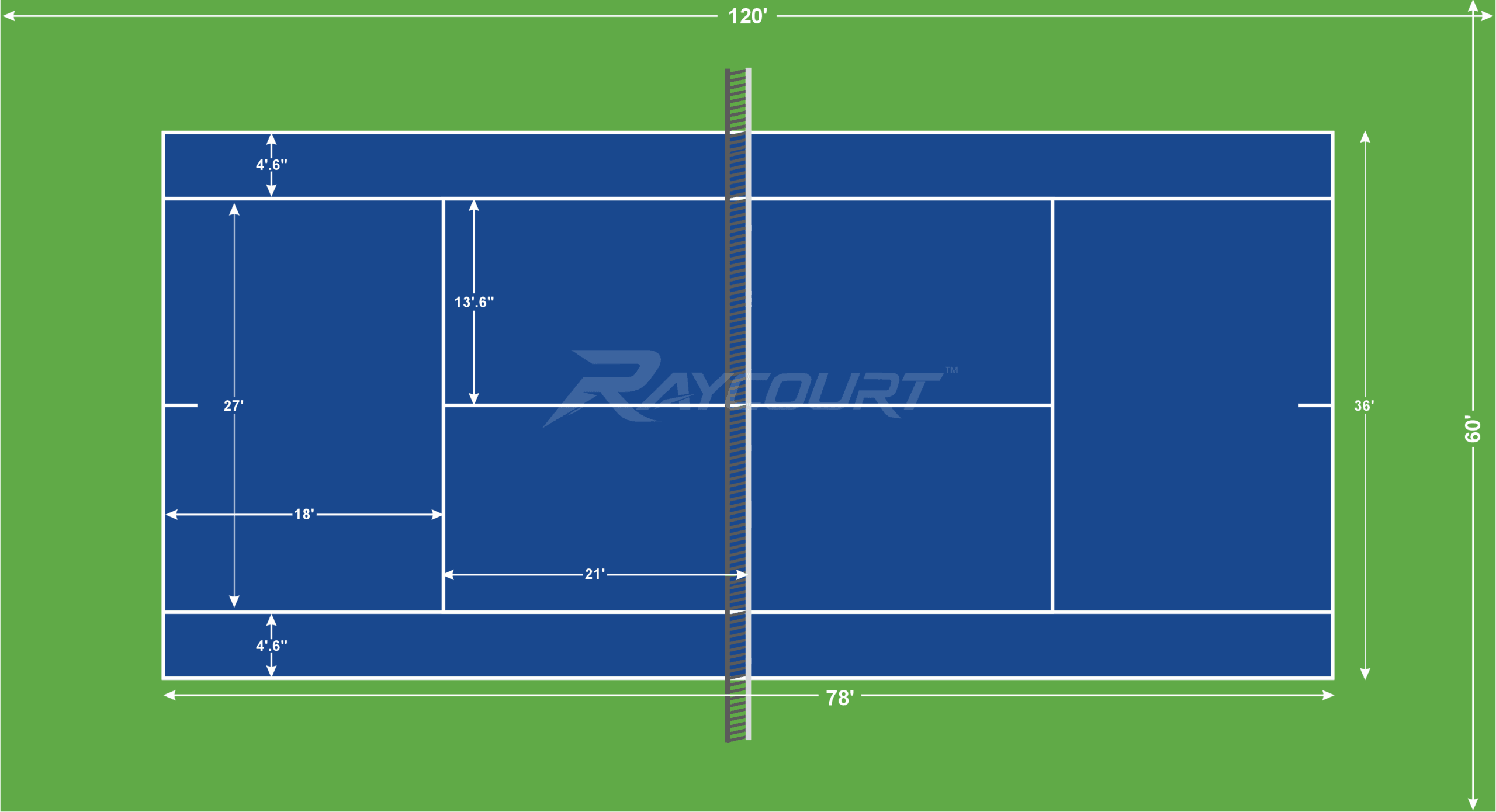
| Court width | 20 feet (6.10 m) for singles and doubles | 27 feet (8.23 m) singles; 36 feet (10.97 m) doubles |
| Playing area | 880 square feet (about 82 sq m) | 2,808 square feet (about 261 sq m) for doubles |
| Net height at centre | 34 inches (86.4 cm) | 36 inches (91.4 cm) |
| Net height at posts | 36 inches (91.4 cm) | 42 inches (1.07 m) |
| Special zone | Non-volley zone, 7 feet (2.13 m) from the net | Service line, 21 feet (6.40 m) from the net |
| Typical total footprint | 30 feet by 60 feet minimum; 34 feet by 64 feet recommended | About 60 feet by 120 feet |
These figures follow the published rules of USA Pickleball and World Tennis. Always confirm current requirements with the relevant federation before you finalise drawings.
Playing Area Compared
A pickleball court covers 880 square feet inside its lines. A doubles tennis court covers 2,808 square feet. Therefore, the tennis playing area is a little more than three times larger.
That gap changes everything about how the two games feel. For instance, a tennis player may run several metres to reach a wide ball. A pickleball player usually needs only two or three quick steps. As a result, pickleball suits a wider range of ages and fitness levels.
Total Footprint and Run-Off Space
The lines only tell part of the story. Every court also needs clear space beyond the lines for safe movement. Designers call this the run-off or the total playing surface.
For pickleball, USA Pickleball sets a minimum playing surface of 30 feet by 60 feet. It recommends 34 feet by 64 feet for new construction and tournament play. Meanwhile, planners commonly allow about 60 feet by 120 feet for a single tennis court.
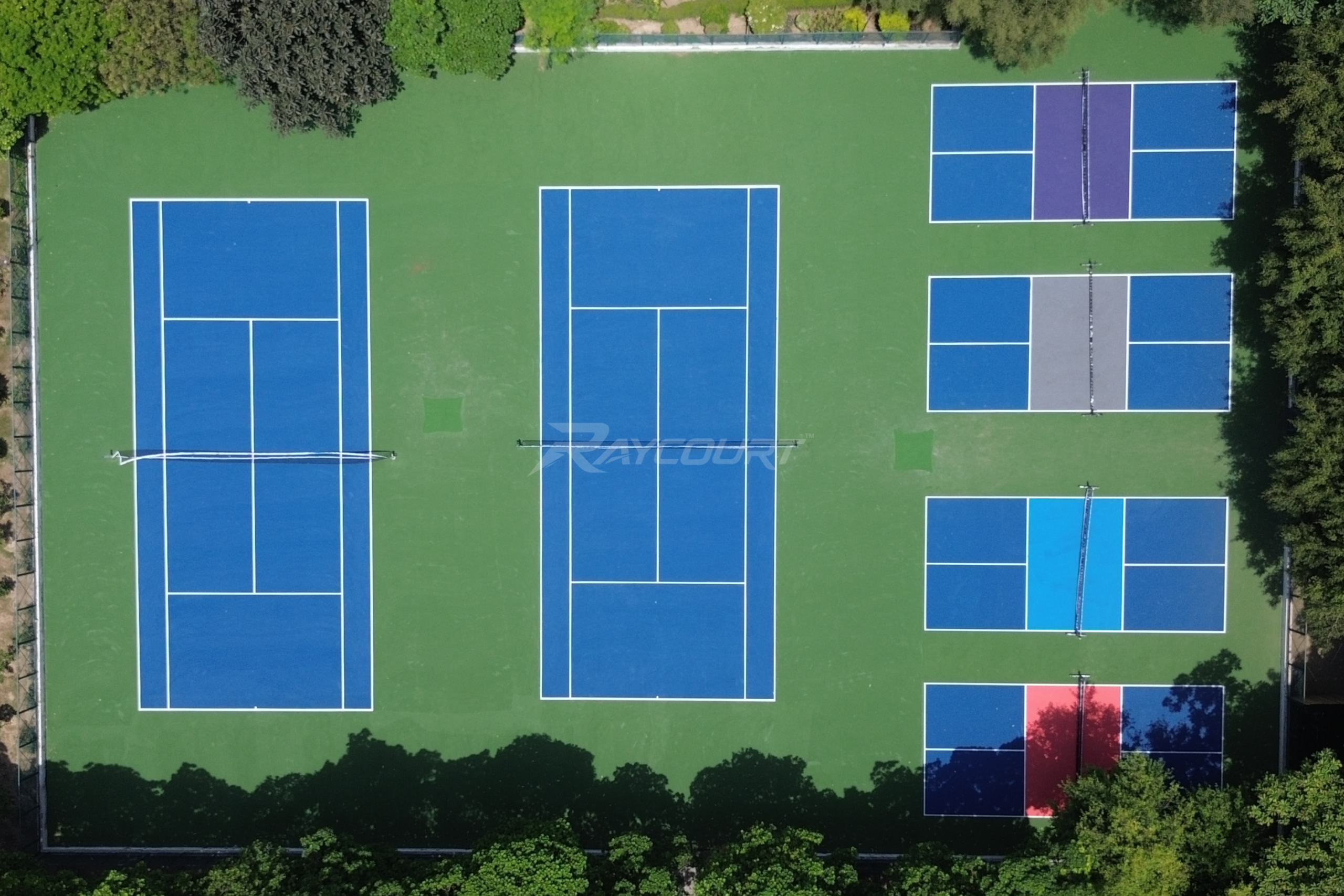
Notice the neat relationship between those numbers. Four pickleball pads of 30 feet by 60 feet equal one tennis pad of 60 feet by 120 feet. Consequently, a single tennis footprint can hold up to four pickleball courts.
Expert tip: Measure your site for the total footprint, not the lined court. Tight run-off space spoils play and raises injury risk.
One Layout Versus Two
Pickleball uses the same court for singles and doubles. Tennis, however, uses a narrower court for singles and adds side alleys for doubles. Most tennis courts carry both sets of sidelines.
For that reason, tennis line marking involves more lines and more measuring. Pickleball marking is simpler, although it still demands accuracy.
Nets, Lines and Zones Compared
Dimensions set the stage, but nets and lines direct the play. Small differences here create very different games.
Net Height and Structure
A pickleball net stands 36 inches high at the posts and 34 inches at the centre. A tennis net stands 42 inches at the posts and 36 inches at the centre. Therefore, the pickleball net sits two inches lower in the middle and six inches lower at the posts.
Those inches matter more than they seem. A lower net invites flatter shots and gentle drops. A higher net, in contrast, forces players to lift the ball with topspin.
The nets also differ in width. Pickleball posts stand 22 feet apart. Tennis posts for doubles stand 42 feet apart. Consequently, a tennis net cannot simply replace a pickleball net without adjustment.
Line Markings and Their Roles
Pickleball lines are two inches wide and share one colour. The court has baselines, sidelines, non-volley lines and centrelines. Together, these lines create two service courts on each side, each 10 feet by 15 feet.
Tennis lines have their own widths under the rules. Most lines measure between one and two inches wide. The baseline, however, may measure up to four inches. The court includes baselines, singles sidelines, doubles sidelines, service lines and a centre service line.
In both sports, the lines count as part of the court. Therefore, crisp edges and true measurements matter in every match. Quality acrylic line paint helps installers achieve sharp, durable lines on either court.
The Kitchen Versus the Service Box
The non-volley zone gives pickleball its character. It stops players from smashing volleys right at the net. As a result, the game rewards patience, placement and soft hands.
Tennis has no such restriction. Instead, the service boxes control where a serve must land. After the serve, players may strike the ball anywhere on their side. Hence, tennis opens the door to aggressive net play and powerful overheads.
These zones also influence surface wear. In pickleball, feet shuffle constantly along the kitchen line. In tennis, wear concentrates along the baseline and around the service line. We return to this point in the maintenance section.
How Each Sport Uses the Surface
A court surface does far more than look good. It controls how the ball bounces and how players move. Therefore, understanding each sport’s demands helps you choose the right system.
Ball Behaviour on Court
A tennis ball has a pressurised rubber core and a felt cover. It compresses on impact and springs up with energy. Moreover, the felt grips the surface texture, so spin changes the bounce sharply.
A pickleball is a hard, hollow plastic ball with 26 to 40 holes. It weighs far less than a tennis ball and compresses very little. Consequently, it bounces lower and loses speed quickly through the air.
Because of this, the two balls read the surface differently. A tennis ball reacts strongly to surface texture and pace. A pickleball, on the other hand, needs a smooth, even plane above all. Any dip, ridge or rough patch can send it off line.
Player Movement and Footwork
Tennis players sprint, slide into position and change direction at speed. They cover long distances along the baseline. Therefore, the surface must provide firm grip without locking the foot.
Pickleball players move in shorter bursts. They step forward to the kitchen line, shuffle sideways and reset. Movement is frequent, but each step covers less ground. As a result, players value sure footing during quick lateral moves.
Both patterns load the knees, ankles and hips. In addition, many pickleball players are older adults who appreciate a gentler surface. A cushioned acrylic system can reduce impact forces for players in either sport.
Surface Texture and Grip
Acrylic colour coats contain fine silica sand. The sand creates a controlled texture across the court. This texture provides slip resistance in dry conditions and helps footing after light moisture.
For tennis, texture also sets the pace of the court. A coarser texture slows the ball after the bounce. A finer texture lets the ball skid through faster. Installers can therefore tune the texture to match the players’ needs.
For pickleball, a uniform medium texture works well. It gives dependable grip without wearing the plastic ball too quickly. Furthermore, an even texture keeps the low bounce consistent across the whole court.
Expert tip: Ask your installer to keep the sand blend and application rate consistent across the court. Uneven texture produces uneven play.
Sound, Glare and Comfort
Pickleball produces a sharp popping sound when the paddle meets the ball. The surface itself has little effect on that sound. However, court placement and fencing choices can reduce disturbance to neighbours.
Glare affects both sports. A matte acrylic finish limits reflection under sunlight and floodlights. Consequently, players track the ball more easily throughout the day.
Heat also deserves attention in the Indian climate. Lighter colours stay cooler under strong sun. Meanwhile, quality acrylic coatings resist fading through long summers. We discuss colour selection in more detail later.
Ready to build a court that performs for years to come?
Connect with Raycourt for sports flooring systems built for your project.
Surface Systems for Pickleball and Tennis Courts
Now we reach the heart of the Pickleball Court vs Tennis Court discussion. Which surface suits each court? In most cases, the answer is a synthetic acrylic system.
Why Acrylic Surfaces Lead Both Sports
Acrylic hard courts dominate modern tennis and pickleball facilities for several reasons. First, they deliver a consistent, predictable bounce. Second, they withstand sun, rain and heavy foot traffic. Third, they need little routine care compared with clay or natural grass.
Moreover, acrylic systems offer a wide choice of colours. They also let installers adjust pace and cushioning during application. As a result, one technology adapts to beginners, club players and professionals alike.
World Tennis lists acrylic as a recognised surface type in its classification scheme. Pickleball likewise favours hard, smooth, non-slip surfaces. Therefore, an acrylic system aligns with the expectations of both sports.
The Layers of an Acrylic System
An acrylic court surface is a system of layers, not a single coat. Each layer has a specific job. The usual sequence runs as follows:
- Primer: This coat bonds the system to concrete or other suitable bases.
- Resurfacer: An acrylic and sand blend fills small voids and creates an even plane.
- Cushion layers (optional): Acrylic coats with rubber granules add comfort and absorb impact.
- Colour coats: Pigmented acrylic coats with fine sand provide colour, grip and pace.
- Line paint: A dense acrylic paint creates crisp, lasting markings.
Each layer supports the next. Consequently, skipping a step or thinning a coat weakens the whole system. Raycourt supplies every material in this sequence along with clear application guidance.
Standard Versus Cushioned Systems
A standard acrylic system places colour coats directly over the resurfacer. It gives a firm, fast-draining and durable court. Many schools, societies and public facilities choose this option.
A cushioned system adds several rubber-rich layers beneath the colour coats. These layers soften each step and reduce fatigue over long sessions. Hence, academies and clubs with daily play often prefer cushioning.
Both systems suit tennis and pickleball. However, your player profile should guide the choice. For example, a senior-friendly pickleball club gains real value from extra cushioning. Similarly, a tennis academy with intensive training benefits from reduced joint stress.
| Factor | Standard acrylic system | Cushioned acrylic system |
|---|---|---|
| Feel underfoot | Firm | Softer and more forgiving |
| Typical users | Schools, societies, public courts | Academies, clubs, frequent players |
| Ball bounce | Consistent and lively | Consistent with added comfort |
| Layer count | Fewer layers | Additional rubber-rich layers |
| Suits tennis | Yes | Yes |
| Suits pickleball | Yes | Yes |
Court Pace and Classification
Tennis treats court speed as a measurable property. World Tennis runs a court pace classification programme for surface products. It sorts surfaces into five categories, from slow to fast.
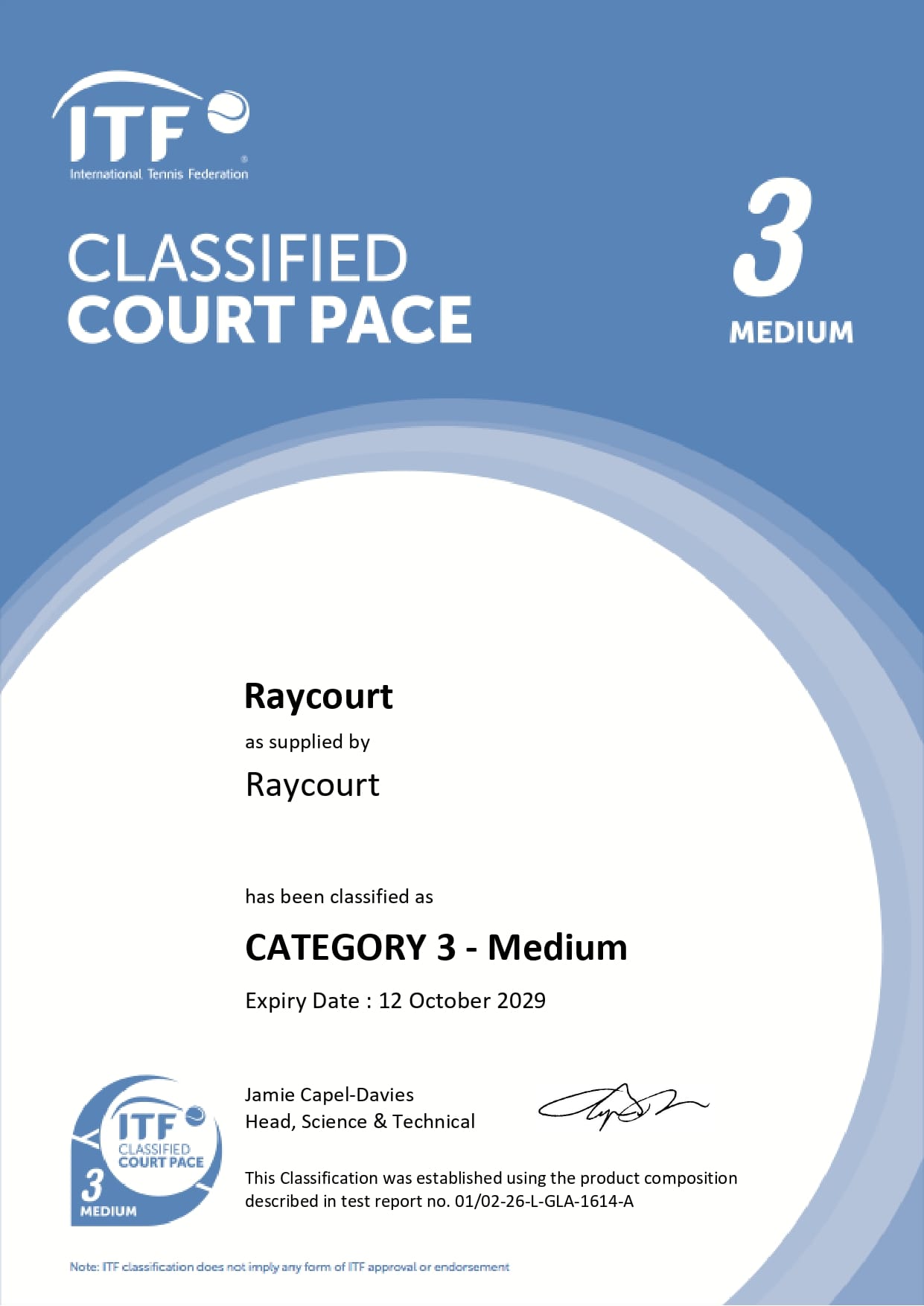
This classification helps buyers compare products with confidence. A classified product has passed laboratory testing for pace. Raycourt holds ITF classification for its acrylic surface system. Consequently, facility owners can specify our materials with a clear performance reference.
Pickleball has no identical pace scheme. Nevertheless, the same qualities matter: even texture, true bounce and lasting grip. A system that proves itself under tennis testing therefore gives pickleball owners added reassurance.
Expert tip: Ask your supplier for classification documents and technical data sheets. Reliable manufacturers share them readily.
Questions to Ask Before You Finalise the Surface
A few direct questions help you compare surface options quickly.
- Does one manufacturer supply every layer? A complete system ensures compatibility between coats.
- Does the product carry independent classification? Classification confirms that a laboratory has tested the pace.
- Which texture suits my players? Your installer can adjust sand content for the pace you want.
- How many cushion layers do I need? More layers add comfort, so match the count to your players.
- What care does the surface need? A clear routine protects your court from the first day.
Planning Space, Base and Orientation
A great surface needs a great foundation. Planning decisions at this stage affect the court for its whole life. Therefore, give them careful attention before any material arrives on site.
Choosing the Right Base
Acrylic systems need a rigid, stable base. Asphalt and concrete are the two common choices. Each has strengths, and your engineer can advise on local soil and climate.
Concrete offers strength and a long service life. However, it needs proper curing, a suitable surface finish and a compatible primer. Installers typically allow new concrete to cure for about four weeks before coating.
Asphalt gives a slightly more flexible base. It also needs time to cure before any coating work begins. In both cases, the base must be clean, dry and free from loose material.
Importantly, the base requirements do not change with the sport. A base that suits tennis also suits pickleball. As a result, future conversions between the two become much easier.
Slope and Drainage
Outdoor courts must shed water quickly. Standing water damages coatings and delays play after rain. Hence, designers build a gentle, uniform slope into the base.
Many court-building guidelines recommend a slope of about one per cent in a single plane. The slope can run side to side, end to end or corner to corner. It should never rise to a crown under the net, because that alters net height.
Pickleball is especially sensitive to flatness. Its light ball exaggerates every dip and bump. Therefore, ask your contractor to check the base for low spots before coating. A flood test with water quickly reveals hollows that need levelling.
Court Orientation
Sun position affects every outdoor match. Designers generally align the long axis of the court north to south. This layout keeps the low morning and evening sun out of players’ eyes.
The same principle applies to both courts. Nevertheless, local conditions sometimes call for a small adjustment. For instance, nearby buildings, prevailing winds and plot shape may influence the final angle.
Fencing, Lighting and Surroundings
Tennis courts usually need taller perimeter fencing because balls fly high and fast. Pickleball courts can use lower fencing, since the ball travels shorter distances. Additionally, low divider fences between adjacent pickleball courts keep stray balls from interrupting play.
Lighting requirements also differ in scale. A tennis court needs light across a much larger area. A pickleball court needs fewer fixtures, although uniform coverage still matters. In both cases, a matte acrylic finish helps by limiting glare.
Expert tip: Plan fencing, lighting and net post foundations before base construction. Adding sleeves and footings later disturbs the finished surface.
Indoor, Outdoor and Inclusive Design
Location shapes the brief as much as the sport does. The points below apply to both sides of the Pickleball Court vs Tennis Court comparison.
Outdoor Courts in the Indian Climate
Most courts in India sit outdoors. They face intense sun, heavy monsoon rain and wide temperature swings. Therefore, the surface system must resist UV light, shed water and stay stable through each season.
Acrylic coatings handle these conditions well when installers apply them correctly. Water-based acrylic coatings also let moisture vapour escape from the base. However, application timing matters. Installers should avoid coating during rain, high humidity or extreme midday heat.
Coastal and high-rainfall regions need extra attention to drainage. Similarly, dusty regions need more frequent cleaning to protect texture. In each case, a quality system and a sensible care routine deliver long service.
Indoor Courts
Indoor courts remove weather from the equation. They still need a stable, level base and a non-glare finish. Moreover, ceiling height becomes a design factor. Tennis needs much greater clear height because lobs travel high. Pickleball manages with a lower ceiling, which suits many existing halls.
Ventilation also matters indoors. Good airflow helps acrylic coats dry during application and keeps players comfortable afterwards. As a result, indoor acrylic courts can offer year-round play with very little weather wear.
Accessibility and Inclusive Play
Both sports welcome wheelchair players. For wheelchair pickleball, USA Pickleball recommends a larger playing surface of 44 feet by 74 feet. Wheelchair tennis uses the standard court, although extra surrounding space helps movement.
In addition, think about access routes, gate widths and seating areas. A smooth, firm acrylic surface suits wheels as well as feet. Therefore, inclusive design fits naturally with either court type.
Ready to build a court that performs for years to come?
Connect with Raycourt for sports flooring systems built for your project.
Shared and Converted Courts
Many owners do not face a strict either-or choice. Instead, they want both sports from the same space. Fortunately, the Pickleball Court vs Tennis Court relationship makes this practical.
Adding Pickleball Lines to a Tennis Court
The simplest route adds pickleball lines to an existing tennis court. Installers paint the pickleball lines in a contrasting colour. Players then use a portable pickleball net or adjust the tennis net.
This approach keeps the tennis court fully playable. It also introduces pickleball with very little disruption. However, shared lines can distract some tennis players. Therefore, choose a line colour that is visible yet calm against the court colour.
One layout places a single pickleball court across the centre, using the tennis net. In that case, a centre strap adjustment lowers the net to 34 inches. Another layout places two pickleball courts, one on each half, with portable nets.
Converting a Tennis Court Fully
Some facilities convert a tennis court entirely to pickleball. A standard tennis pad of 60 feet by 120 feet can hold up to four pickleball courts. Each court then receives its own net posts and lines.
Before conversion, inspect the existing surface carefully. Cracks, low spots and worn coatings need repair first. After that, installers apply resurfacer and fresh colour coats across the pad. Finally, they mark the new pickleball courts.
A full conversion multiplies playing capacity. Up to sixteen players can enjoy doubles where four once played tennis. Consequently, busy clubs often see conversion as an efficient use of land.
Building Dedicated Courts Side by Side
Where space allows, dedicated courts give the best experience for each sport. Tennis players keep clean lines and a full-height net. Pickleball players get permanent nets and purpose-built spacing.
Using the same acrylic system across both zones brings practical benefits. The facility gains a consistent look and consistent maintenance routines. Moreover, the owner works with one material specification for future recoating.
| Approach | Best for | Key consideration |
|---|---|---|
| Shared lines on a tennis court | Clubs testing pickleball demand | Line colour contrast and portable nets |
| Full conversion to pickleball | Quiet tennis courts with high pickleball demand | Surface repair and new post foundations |
| Dedicated courts for each sport | New facilities with adequate land | Layout, fencing and matching surface systems |
Which Route Should You Take?
Start with demand. If pickleball interest is new, shared lines offer a low-commitment trial. If demand is already strong, conversion or dedicated courts make more sense.
Next, consider your tennis community. Regular tennis players deserve a court that still feels right. Therefore, consult them before you add lines or change nets.
Colour, Lines and Visual Design
Colour does more than decorate a court. It affects ball visibility, surface temperature and the identity of your facility. Hence, it deserves a thoughtful decision.
Choosing Court Colours
Both sports benefit from strong contrast between ball and surface. Tennis balls are optic yellow. Pickleballs come in several bright colours, including yellow, orange and green. Therefore, blues and greens remain popular court colours for both games.
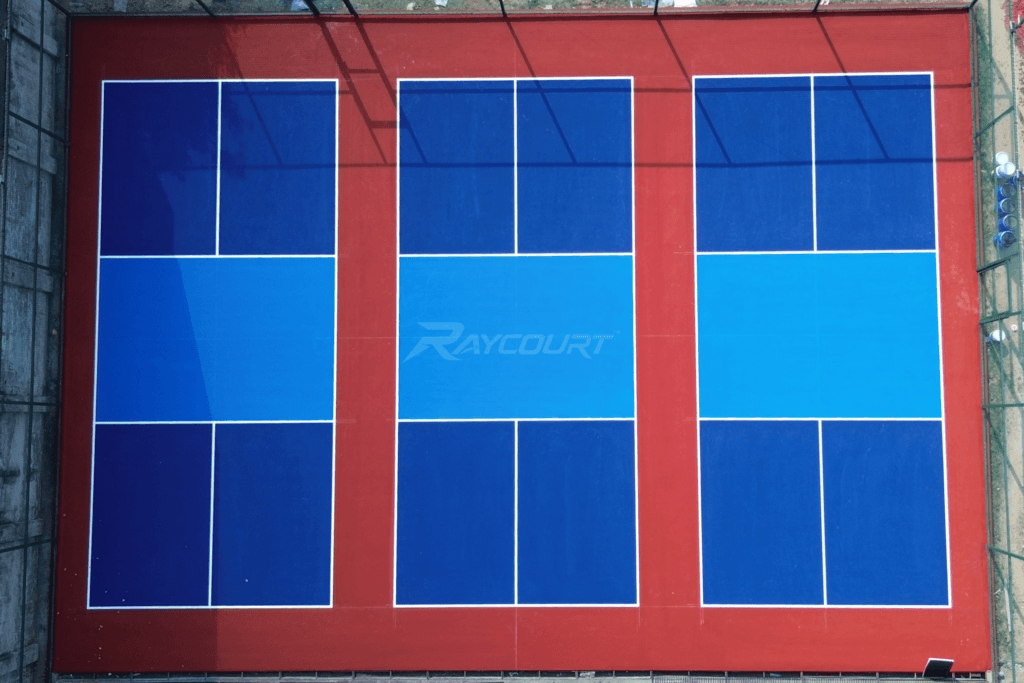
Many facilities use a two-tone scheme. One colour fills the playing area and another fills the surround. This contrast helps players judge the lines at a glance. In pickleball, some owners also give the non-volley zone its own colour.
Lighter shades absorb less heat under direct sun. Consequently, they can keep the surface more comfortable during hot afternoons. Darker shades, meanwhile, often hide dust and marks more effectively.
Line Colours on Shared Courts
On a dedicated court, white lines offer the clearest contrast. On a shared court, tennis lines usually stay white. Pickleball lines then take a different colour, such as yellow, blue or orange.
The goal is easy recognition without clutter. In addition, installers often stop pickleball lines just short of tennis lines. This small gap keeps the primary lines clean for tennis.
UV Stability and Colour Retention
Indian sunlight tests every outdoor coating. Poor pigments fade and chalk within a few seasons. In contrast, quality acrylic coatings use UV-stable pigments that hold their colour far longer.
Raycourt formulates its colour coats for strong outdoor performance. As a result, courts keep a fresh, professional appearance through years of sun and monsoon.
Maintenance and Durability
Every court needs care, yet acrylic courts ask for relatively little. Still, the two sports wear a surface in different ways. Understanding those patterns helps you plan upkeep.
How Wear Patterns Differ
Tennis concentrates wear along the baselines and near the service line. Players push off hard and drag their feet in those zones. Therefore, baseline areas usually show the first signs of texture loss.
Pickleball concentrates wear along the non-volley line. Players plant, pivot and shuffle there throughout every rally. Furthermore, a four-court conversion places many more feet on the same pad. Total traffic can rise sharply as a result.
Because of this, busy pickleball courts may need recoating sooner than quiet tennis courts. Regular inspection lets you act before wear reaches the layers below.
Routine Care for Both Courts
A simple routine protects any acrylic court. The following steps apply equally to tennis and pickleball:
- Sweep or blow debris regularly. Leaves, sand and grit act like sandpaper underfoot.
- Rinse the court periodically. Clean water removes dust and prevents staining.
- Treat mould and algae early. Shaded, damp corners need prompt attention with a mild cleaner.
- Clear standing water after rain. Soft rollers or squeegees work without harming the coating.
- Insist on proper footwear. Non-marking court shoes protect both players and surface.
- Keep sharp or heavy objects off the court. Furniture legs and equipment can dent or scratch coatings.
In addition, inspect the surface at the start of each season. Look for cracks, blisters, faded areas and worn lines. Early repairs stay small and simple.
When to Recoat
Over time, play smooths the surface texture. Grip falls and ball behaviour changes. At that stage, fresh colour coats restore performance and appearance.
The right interval depends on usage, climate and maintenance quality. A quiet private court lasts longer between recoats than a busy club court. Therefore, judge by condition, not by the calendar alone.
Expert tip: Photograph high-wear zones every few months. Comparing images over time shows wear trends before players notice them.
Choosing Between a Pickleball Court and a Tennis Court
With the technical ground covered, we can return to the main decision. The Pickleball Court vs Tennis Court choice rests on four practical factors.
Available Space
Space often decides the matter immediately. A site that cannot fit 60 feet by 120 feet cannot comfortably host full-size tennis. That same site may easily hold one or two pickleball courts.
Conversely, a large site opens more options. You might build one tennis court and two pickleball courts. Alternatively, you might design a tennis pad that also carries pickleball lines.
Player Profile
Think carefully about who will use the court. Housing societies often serve mixed ages and casual players. Pickleball fits that profile well because newcomers learn it quickly.
Schools and academies, in contrast, may run structured tennis programmes. Those programmes need full-size courts and proper run-off. Meanwhile, many clubs now serve both groups and plan for both sports.
Usage Intensity
Consider how many people will play each hour. A tennis court hosts two to four players at once. After conversion to pickleball, the same footprint hosts up to sixteen.
Therefore, pickleball delivers more play per square metre. However, heavier use also means faster wear. Factor that into your surface choice and your maintenance plan.
Future Flexibility
Finally, think ahead. Sports preferences shift over time. A sound base and a quality acrylic system keep your options open. For instance, a tennis court can gain pickleball lines later. Likewise, a pickleball block on a tennis-sized pad can return to tennis.
| Your situation | Likely best fit |
|---|---|
| Limited plot in a housing society | One or two pickleball courts |
| Academy with competitive tennis coaching | Dedicated tennis courts |
| Club with a quiet tennis court | Shared lines or full conversion |
| New multi-sport facility with ample land | Dedicated courts for both sports |
| School serving many students per session | Pickleball courts or a shared layout |
A Step-by-Step Planning Sequence
Good projects follow a clear order. The sequence below works for either court.
- Define your players. List the age groups, skill levels and group sizes you expect.
- Measure the site. Record the usable length and width, plus any slopes or obstructions.
- Choose the court mix. Decide between tennis, pickleball, shared lines or a combination.
- Confirm dimensions. Check current federation rules for court size and recommended run-off.
- Design the base. Work with an engineer on base type, slope and drainage.
- Select the surface system. Choose standard or cushioned acrylic to match your players.
- Pick colours and lines. Balance ball visibility, heat and the look of your facility.
- Appoint an experienced installer. Share the manufacturer’s data sheets and application guidance.
- Plan maintenance. Set a cleaning routine and an inspection schedule from day one.
Following this order prevents rework and delays. Moreover, it keeps every specialist working from the same plan.
Ready to build a court that performs for years to come?
Connect with Raycourt for sports flooring systems built for your project.
Common Mistakes to Avoid
Even carefully planned projects stumble on avoidable errors. Here are the mistakes our technical team sees most often.
Underestimating Run-Off Space
Some owners squeeze a court into a space that only fits the lines. Players then collide with fences or stop short on wide balls. Always design for the full recommended footprint.
Coating a Poor Base
No coating can rescue a weak or uneven base. Cracks reflect through and low spots hold water. Therefore, invest effort in base preparation before any acrylic work.
Ignoring Cure Times
New concrete and asphalt need time before coating. Rushing this step traps moisture and causes blisters or peeling. Likewise, each acrylic layer must dry fully before the next coat.
Mixing Incompatible Products
An acrylic system works because its layers bond chemically and mechanically. Mixing products from different sources risks poor adhesion. Hence, use a complete system from one manufacturer and follow its data sheets.
Treating Pickleball as an Afterthought
Some facilities add pickleball lines without checking net height, spacing or flatness. Players quickly notice the shortcuts. Instead, give pickleball the same planning discipline you give tennis.
How Raycourt Supports Your Court Project
Raycourt is a manufacturer of synthetic acrylic sports court flooring materials. We do not install courts. Instead, we focus on producing dependable materials and supporting the professionals who apply them.
A Complete Acrylic System
Our range covers every layer of the surface system. It includes primers, resurfacers, cushion coats, colour coats and line paints. Because one team formulates all these products, they work together reliably.
This matters for both sports. A tennis court and a pickleball court can share the same specification. Consequently, multi-sport facilities enjoy consistent colour, texture and performance across every court.
Tested Performance
Raycourt holds ITF classification for court pace. This recognition reflects independent laboratory testing of our surface. It also gives architects and owners a reliable benchmark when they write specifications.
Beyond classification, we maintain strict quality control in manufacturing. Each batch follows clear standards for consistency. As a result, installers get predictable handling and coverage on site.
Technical Guidance for Installers and Owners
Good materials need correct application. Therefore, we provide technical data sheets, mixing guidance and application sequences. Our team also answers questions about base conditions, weather windows and system selection.
Owners benefit from this support as well. We help you understand which system suits your players and your site. You can then brief your installer with confidence.
Reliable Supply
Projects run on schedules, and material delays hurt everyone. Raycourt maintains stock and an efficient supply network across key Indian regions. Hence, contractors can plan application work without long waits for material.
Frequently Asked Questions
The main difference is size. A pickleball court measures 20 feet by 44 feet. A tennis court measures 78 feet by 36 feet for doubles. In addition, pickleball uses a lower net and a non-volley zone near the net. Tennis uses service boxes and needs far more run-off space.
Yes, you can. Many facilities add pickleball lines to a tennis court in a contrasting colour. Players then use portable nets or lower the tennis net to 34 inches at the centre. However, dedicated pickleball courts give a better experience for regular play.
A standard tennis pad of 60 feet by 120 feet can hold up to four pickleball courts. Each court then has a playing surface of 30 feet by 60 feet. That figure matches the minimum that USA Pickleball sets. Two courts fit more comfortably if you want extra space around each one.
In most cases, yes. Both sports perform very well on synthetic acrylic systems over asphalt or concrete. The same primers, resurfacers, cushion layers and colour coats suit either court. Only the line layout and net arrangement change.
Cushioned systems reduce impact on joints and lower fatigue. Therefore, they suit facilities with frequent play, older players or intensive coaching. Standard systems remain an excellent choice for general recreational use. Your player profile should guide the decision.
Conclusion: Pickleball Court vs Tennis Court
The Pickleball Court vs Tennis Court comparison comes down to scale and style. Pickleball needs less land, welcomes more players and rewards touch. Tennis needs more room, offers a classic athletic challenge and rewards power.
Nevertheless, the two courts stand on common ground. Both demand a sound base, accurate lines and a consistent playing surface. Moreover, both perform superbly on a carefully chosen synthetic acrylic system.
So, start with your space and your players. Then choose the layout that serves them best, whether dedicated, shared or converted. Finally, specify proven materials and insist on correct application.
Raycourt brings years of manufacturing experience to both sports. Our ITF-classified acrylic systems give tennis and pickleball courts lasting colour, grip and true bounce.
Ready to build a court that performs for years to come?
Connect with Raycourt for sports flooring systems built for your project.