

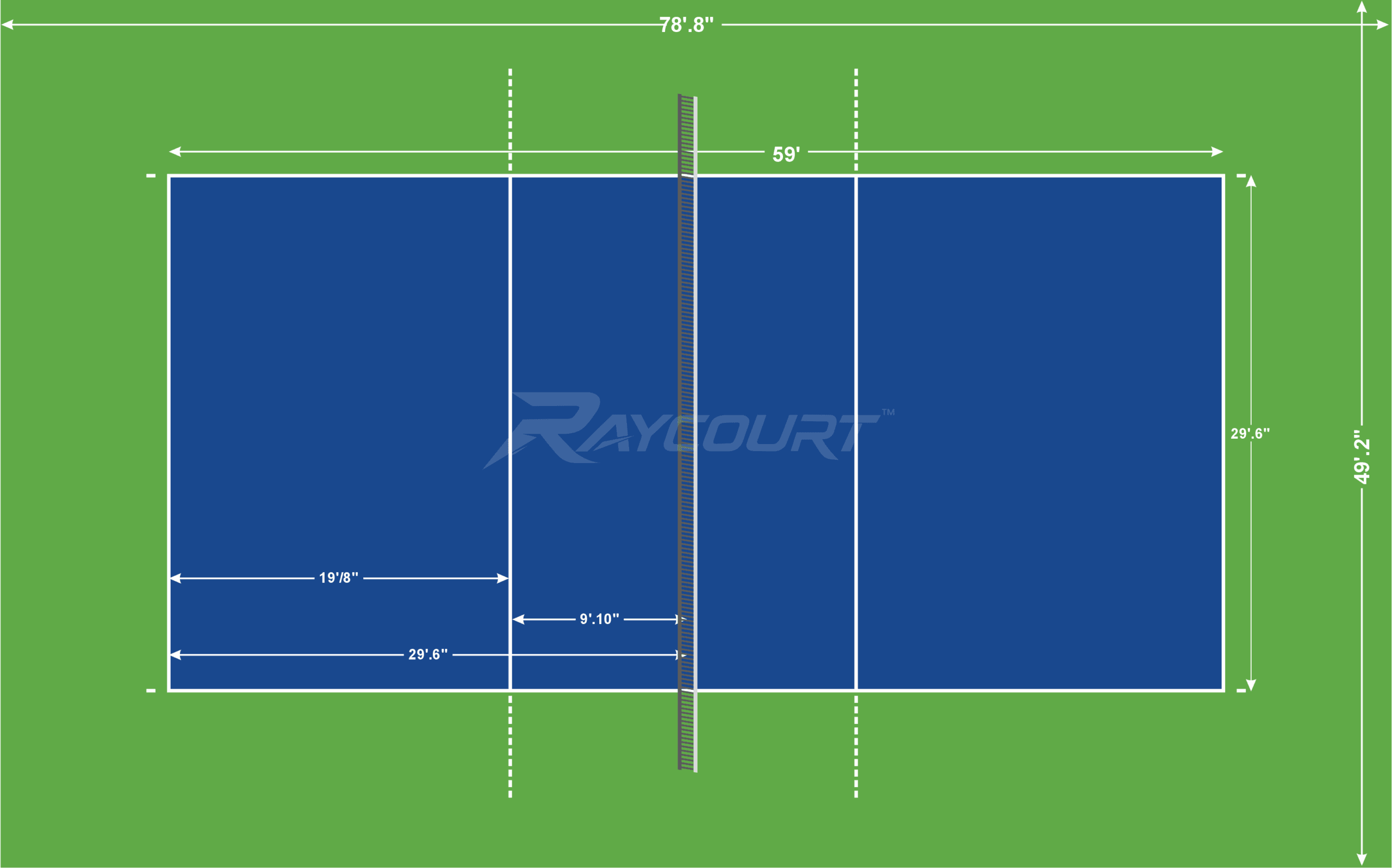
A volleyball ground combines an 18 m × 9 m playing court with a surrounding free zone. That free zone measures at least 3 m on every side. In practice, you need a flat, level area of at least 24 m × 15 m. For FIVB, World and Official competitions, the free zone grows to 5 m beyond the sidelines. It also extends to 6.5 m beyond the end lines.
However, size only solves half the problem. The surface decides how the ground plays, how safe it feels and how long it lasts. For outdoor play, a synthetic acrylic surface over a sound concrete or asphalt base offers the best balance. It delivers consistent grip, joint-friendly comfort, weather resistance and low maintenance.
In this guide, we cover everything you need to plan a volleyball ground with confidence. First, we explain the official dimensions and markings. Next, we compare the main surface types. After that, we look closely at acrylic flooring systems, base preparation, colours, safety and maintenance. Finally, we answer the questions facility owners ask us most often.
One point deserves clarity from the start. Raycourt manufactures sports court flooring materials. We do not carry out installation. Instead, we supply high-performance acrylic systems to the contractors and facility teams who build your court.
Understanding the Volleyball Ground
Volleyball looks simple on television. Two teams, one net and a ball that must not touch the floor. Yet the ground beneath the players shapes almost every rally.
Think about what happens during a single point. A server sprints and leaps behind the end line. Receivers drop low and shuffle sideways. A setter pivots sharply under the ball. Then an attacker launches upward and lands on one foot. Meanwhile, blockers jump repeatedly at the net.
Each of these movements loads the surface in a different way. Jumping and landing send impact forces through the ankles, knees and lower back. Lateral shuffles demand reliable traction without excessive grip. Sudden stops need a surface that responds the same way everywhere on the court.
That is why a good volleyball ground goes far beyond a marked rectangle. It brings together four elements:
- Correct dimensions, so play follows official rules and players have safe run-off space.
- A stable base, so the surface stays flat and drains well for years.
- A performance surface, so players enjoy grip, comfort and true ball bounce.
- Clear markings and colours, so players, referees and spectators read the court instantly.
In India, the term “volleyball ground” often describes an outdoor court at a school, college, village or police campus. Many of these grounds still use compacted mud or bare concrete. Consequently, players face uneven bounce, dust, puddles and painful falls. A properly engineered surface changes that experience completely.
Ready to build a court that performs for years to come?
Connect with Raycourt for sports flooring systems built for your project.
Volleyball Ground Dimensions and Layout
The Fédération Internationale de Volleyball (FIVB) sets the global standard for court size and layout. You can read the full specification in the FIVB Official Volleyball Rules 2025–2028. Below, we break down the key measurements in plain language.
The Playing Court
The playing court forms a rectangle measuring 18 m long and 9 m wide. A centre line divides it into two equal halves of 9 m × 9 m. Each team defends one square.
Every line measures 5 cm wide. Moreover, the boundary lines sit inside the court dimensions. So, a ball touching any part of a line counts as “in”. This rule makes accurate line marking essential for fair play.
The Free Zone
The free zone surrounds the playing court on all four sides. Players use it to chase balls, recover after digs and serve. Under standard rules, the free zone measures at least 3 m wide on every side.
For FIVB, World and Official competitions, the requirement increases. The free zone must reach 5 m from the sidelines and 6.5 m from the end lines. Therefore, a competition-grade volleyball ground needs a total area of roughly 31 m × 19 m.
The Free Playing Space
Indoor grounds also need vertical clearance. The free playing space above the playing area must stay clear up to at least 7 m. FIVB competitions raise this to 12.5 m. Outdoor grounds rarely face this issue, but overhanging trees and cables still deserve a check.
Lines and Zones on the Court
Several lines and zones organise play on a volleyball ground:
- End lines and sidelines mark the outer boundary of the playing court.
- The centre line runs directly beneath the net and splits the court in half.
- The attack line sits 3 m from the centre line on each side. It separates the front zone from the back zone.
- The front zone lies between the centre line and the attack line.
- The service zone runs 9 m wide behind each end line and extends to the end of the free zone.
- The substitution zone sits beside the scorer’s table, between the extended attack lines.
Quick Reference: Volleyball Ground Measurements
| Element | Standard Requirement | FIVB / World / Official Competitions |
|---|---|---|
| Playing court | 18 m × 9 m | 18 m × 9 m |
| Free zone (sidelines) | Minimum 3 m | 5 m |
| Free zone (end lines) | Minimum 3 m | 6.5 m |
| Minimum total area | 24 m × 15 m | Approx. 31 m × 19 m |
| Free playing space (height) | Minimum 7 m | Minimum 12.5 m |
| Line width | 5 cm | 5 cm |
| Attack line distance | 3 m from centre line | 3 m from centre line |
Expert Tip: Always plan around the full playing area, not just the 18 m × 9 m court. Fences, benches, poles and drains belong outside the free zone. Otherwise, players risk collisions during fast recoveries.
Net and Post Requirements
The net sits at the heart of every volleyball ground. Its height changes with the category of play. For men, the top of the net stands at 2.43 m. For women, it stands at 2.24 m. Youth and age-group competitions often use lower heights, so check your local federation rules.
The posts that hold the net also matter for safety. FIVB rules place the posts 0.50 m to 1.00 m outside the sidelines. They should stand rounded and smooth, without guy wires. Most outdoor grounds use sleeve sockets set into the base. As a result, teams can remove the posts for multi-sport use.
| Component | Key Requirement |
|---|---|
| Net height (men) | 2.43 m |
| Net height (women) | 2.24 m |
| Net width | 1 m |
| Net length | 9.50 m to 10 m |
| Post position | 0.50 m to 1.00 m outside the sidelines |
| Post finish | Rounded, smooth, no guy wires |
Before the surface goes down, your contractor should fix the post sockets in the correct positions. Cutting into a finished acrylic court later creates weak points. Planning the sockets early protects the surface and keeps the net perfectly aligned.
Types of Volleyball Ground Surfaces
Not every volleyball ground uses the same surface. Each option suits a different setting, level of play and climate. Let us look at the most common choices.
Mud and Clay Grounds
Compacted mud remains the traditional volleyball ground surface across rural India. It feels soft underfoot when maintained well. However, it turns dusty in summer and slippery during the monsoon. Moreover, the surface develops ruts and puddles quickly. Lines fade after a few matches, so teams must remark them constantly.
Grass Grounds
Natural grass offers a soft landing and a pleasant playing feel. On the other hand, grass wears out fast in high-traffic areas. The zones near the net and the service area turn into bare patches. Grass also needs regular watering, mowing and rolling to stay playable.
Sand Grounds
Sand belongs to beach volleyball, a separate discipline with its own court size of 16 m × 8 m. FIVB requires sand at least 40 cm deep for competition. Sand provides excellent cushioning, yet it changes the game entirely. It suits dedicated beach volleyball venues rather than standard indoor-style play.
Plain Concrete and Bitumen
Many schools simply pour concrete and paint lines on top. Concrete lasts a long time and drains well with the right slope. Unfortunately, bare concrete feels extremely hard. It offers little shock absorption, so players hesitate to dive or land aggressively. Painted concrete also turns slippery when wet.
Synthetic Acrylic Surfaces
Acrylic systems apply multiple layers of specially formulated coatings over a concrete or asphalt base. The finish delivers controlled texture, UV-stable colour and optional cushioning. Acrylic suits outdoor volleyball grounds exceptionally well. It also works for indoor multi-sport halls.
Polyurethane (PU) Surfaces
PU systems create a seamless, elastic floor. They often appear in indoor sports halls and multi-purpose arenas. PU offers good comfort and a uniform feel. Nonetheless, it generally suits covered spaces better than fully exposed outdoor sites.
Wooden Floors
Sprung hardwood floors dominate top-level indoor volleyball. They provide excellent shock absorption and a classic ball response. However, wood cannot survive outdoor exposure. It also demands strict humidity control and careful upkeep.
PVC and Modular Tiles
Interlocking polypropylene tiles and vinyl sheet floors offer quick, flexible options. Tiles drain well outdoors, while vinyl suits indoor halls. Yet some players find tiles noisy, and the joints can feel uneven under sliding contact.
Volleyball Ground Surface Comparison
| Surface | Best Setting | Shock Absorption | Weather Resistance | Maintenance Demand | Line Durability |
|---|---|---|---|---|---|
| Mud / Clay | Rural, informal play | Moderate | Poor | Very high | Poor |
| Natural Grass | Parks, casual play | Good | Moderate | High | Poor |
| Sand | Beach volleyball | Excellent | Good | Moderate | Uses tapes |
| Plain Concrete | Basic school courts | Very low | Good | Low | Moderate |
| Synthetic Acrylic | Outdoor and indoor courts | Low to high (system-dependent) | Excellent | Low | Excellent |
| Polyurethane | Indoor halls | Good | Limited outdoors | Low | Excellent |
| Sprung Wood | Elite indoor arenas | Excellent | None outdoors | High | Excellent |
| Modular Tiles | Temporary or multi-use | Moderate | Good | Low | Good |
Why Synthetic Acrylic Suits an Outdoor Volleyball Ground
For most outdoor projects in India, synthetic acrylic stands out as the smartest choice. It handles intense sun, heavy rain and constant use without losing its character. Let us examine why.
Consistent Grip and Traction
Volleyball players change direction constantly. They need a surface that grips enough to prevent slips. At the same time, the surface must allow controlled sliding during digs. Acrylic colour coats contain graded silica sand, which creates a fine, uniform texture. The texture stays consistent across the whole volleyball ground. So, players trust their footing in every zone.
Comfort and Joint Protection
Jumping athletes land hundreds of times in a single training session. A hard surface sends that shock straight into their joints. Cushioned acrylic systems add rubber-granule cushion layers beneath the colour coats. These layers absorb part of the impact energy. Consequently, players feel less fatigue and recover faster between sessions.
Weather and UV Resistance
India’s climate tests every outdoor surface. Summer heat, intense UV and monsoon downpours break down weaker materials quickly. Quality acrylic coatings use UV-stable pigments and weather-resistant binders. They resist fading, chalking and softening. In addition, the textured finish sheds water quickly once rain stops.
Low Maintenance Demands
Unlike mud or grass, an acrylic volleyball ground needs no rolling, watering or mowing. Regular sweeping and occasional washing keep it in top condition. The lines stay crisp because they bond chemically to the surface. As a result, facility teams spend more time on play and less time on upkeep.
True Ball Bounce and Visibility
Volleyball rarely involves the ball bouncing on court. However, the surface still affects play through visibility and player confidence. Acrylic delivers bold, contrasting colours that help players judge lines and spacing. Referees also make clearer calls when the boundary lines stand out sharply.
Multi-Sport Flexibility
Many schools and clubs want one ground for several sports. An acrylic surface can carry volleyball, basketball, badminton and even tennis markings. Different line colours keep each sport easy to read. Removable volleyball posts complete the multi-sport set-up.
Expert Tip: For a volleyball ground that hosts frequent jumping drills, choose a cushioned acrylic system. The extra layers make a noticeable difference to player comfort during long training blocks.
Ready to build a court that performs for years to come?
Connect with Raycourt for sports flooring systems built for your project.
Inside an Acrylic Volleyball Ground System
An acrylic volleyball ground works as a system, not a single coat of paint. Each layer performs a specific job. Together, they create a surface that plays well and lasts.
The Layer-by-Layer Build-Up
A typical acrylic system follows this sequence over a prepared base:
- Primer: Bonds the coating system firmly to the concrete or asphalt base.
- Acrylic resurfacer: Fills minor pores and surface irregularities to create a smooth, even canvas.
- Cushion layers (optional): Add rubber granules in an acrylic binder for shock absorption.
- Colour coats: Deliver the final colour, texture and UV protection.
- Line paint: Marks the court boundaries, attack lines and centre line in crisp, durable colour.
Each layer must cure fully before the next one goes down. Weather conditions, especially temperature and humidity, influence curing times. Skilled applicators watch these conditions closely.
Hard Court Versus Cushioned Systems
Facility owners usually choose between two broad options.
A hard acrylic system applies resurfacer and colour coats directly over the base. It offers a firm, fast feel and suits recreational grounds with moderate use. It also requires fewer layers.
A cushioned acrylic system adds several cushion layers between the resurfacer and the colour coats. It provides noticeably better shock absorption. Therefore, it suits academies, competitive teams and schools with heavy daily use.
| Feature | Hard Acrylic System | Cushioned Acrylic System |
|---|---|---|
| Underfoot feel | Firm and fast | Softer and more forgiving |
| Shock absorption | Basic | Enhanced |
| Ideal users | Recreational and school play | Academies, clubs, competitive teams |
| Joint comfort over long sessions | Moderate | High |
| Number of layers | Fewer | More |
Why Material Quality Matters
The best application technique cannot rescue poor materials. Low-grade coatings fade, peel and wear unevenly. They may also lose texture within a short time, which affects grip. High-quality acrylic materials, by contrast, keep their colour, bond and texture through years of play.
At Raycourt, we manufacture every component with consistent formulation and batch quality. That consistency gives your contractor a dependable system to work with from primer to line paint.
Planning Your Volleyball Ground: Site, Orientation and Base
Great surfaces start with great planning. Before anyone opens a drum of coating, the site and base must meet a few key requirements.
Choosing the Right Site
Look for a site with good natural drainage and firm subgrade soil. Avoid low-lying areas that collect rainwater. Also, keep the ground away from large trees. Falling leaves stain surfaces, and roots can crack the base over time.
Next, measure the full playing area, including the free zone. Then add space for fencing, benches, a scorer’s table and spectator movement. A generous footprint makes the volleyball ground safer and more comfortable for everyone.
Getting the Orientation Right
Outdoor volleyball players look upward constantly. They track high sets, serves and blocks. A low sun directly in their eyes makes this difficult and even dangerous.
For this reason, orient an outdoor volleyball ground with its long axis running north to south. This alignment keeps the morning and evening sun to the sides of the court. Players at both ends then compete on more equal terms.
Slope and Drainage
Standing water ruins play and damages surfaces. An outdoor volleyball ground therefore needs a gentle slope. FIVB rules allow a slope of up to 5 mm per metre on outdoor courts for drainage.
Ideally, the slope runs in a single plane from one side to the other. Avoid a ridge down the centre, because it changes how the court feels. Perimeter drains then collect the runoff and carry it away.
Base Preparation
The base carries the entire volleyball ground. It must stay flat, stable and free from cracks. Most acrylic courts use either reinforced concrete or hot-mix asphalt as the base.
For a concrete base, your contractor should follow these essentials:
- Compact the subgrade thoroughly before laying the sub-base.
- Use a well-graded aggregate sub-base for strength and drainage.
- Lay a vapour barrier where moisture rises from the ground.
- Pour concrete with the planned slope built in.
- Provide a lightly textured finish, such as a broom finish, to help coatings bond.
- Allow the concrete to cure for at least 28 days before coating.
For an asphalt base, the contractor should let the asphalt cure properly and check it for flatness. A flood test helps here. Water the surface and look for puddles deeper than a coin’s thickness. Then fix those low spots before coating.
Expert Tip: Never rush base curing to meet a launch date. Coatings applied over damp or uncured concrete can blister and delaminate. A few extra days of patience protect the volleyball ground for years.
Who Does What?
Clear roles keep projects on track. Typically, a civil contractor builds the base. A specialist sports surface applicator then applies the acrylic system. Raycourt supplies the flooring materials and shares technical product guidance with these teams. This approach ensures every party focuses on what it does best.
Choosing Colours for Your Volleyball Ground
Colour does more than make a volleyball ground look attractive. It affects visibility, heat absorption and the overall atmosphere of the venue.
FIVB rules require light colours for indoor playing surfaces. For FIVB, World and Official competitions, the lines must appear white. Additionally, the playing court and the free zone must use different colours from each other. This contrast helps players sense the boundary even without looking down.
Outdoor grounds follow similar logic. A clear contrast between court, free zone and lines improves readability for players and officials alike. Lighter tones also absorb less heat, which matters greatly under Indian summer sun.
Popular Colour Combinations
| Playing Court | Free Zone | Lines | Character |
|---|---|---|---|
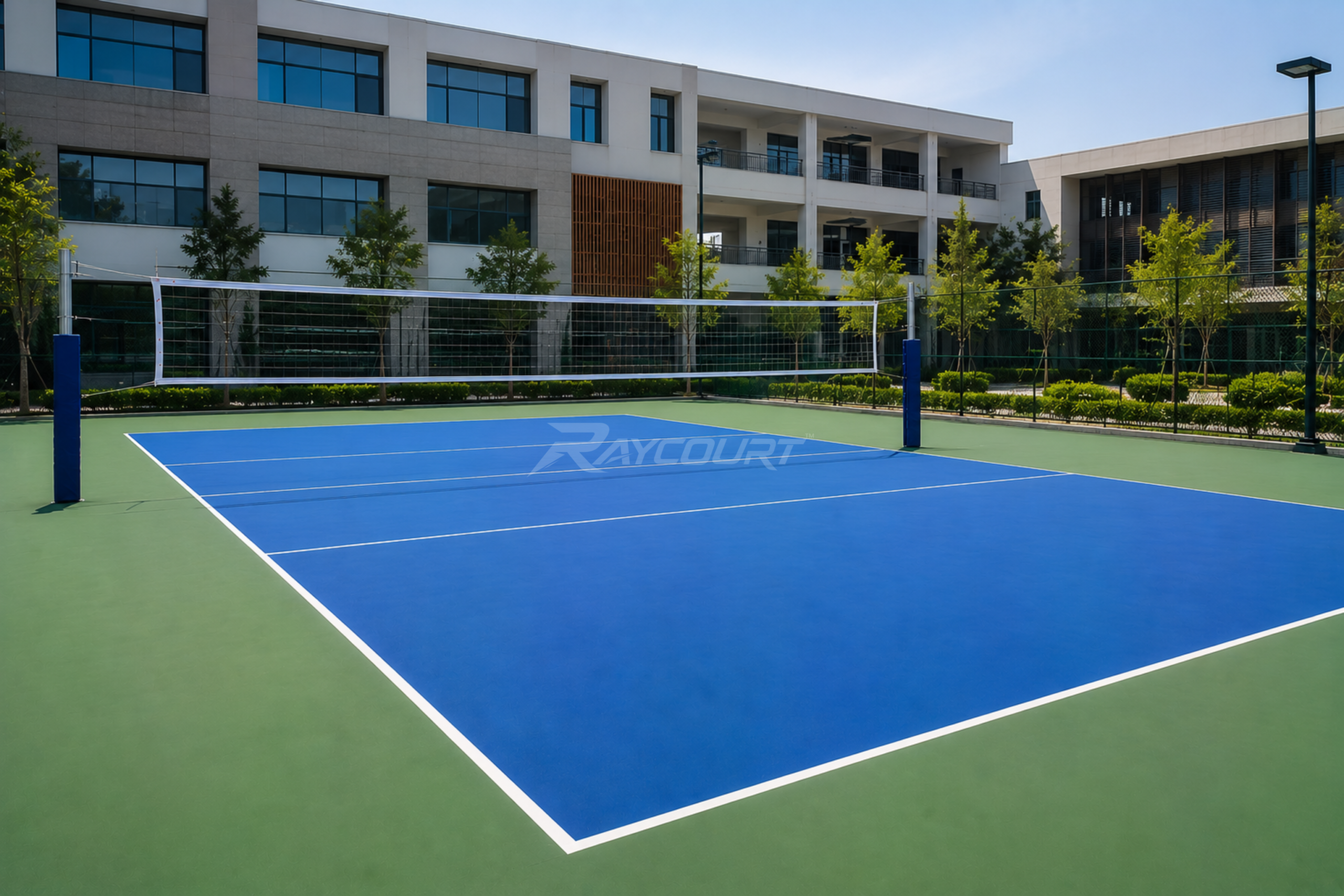
| Blue | Green | White | Classic, calm and high contrast |
| Orange | Blue | White | Energetic, arena-style look |
| Light Blue | Dark Blue | White | Modern and professional |
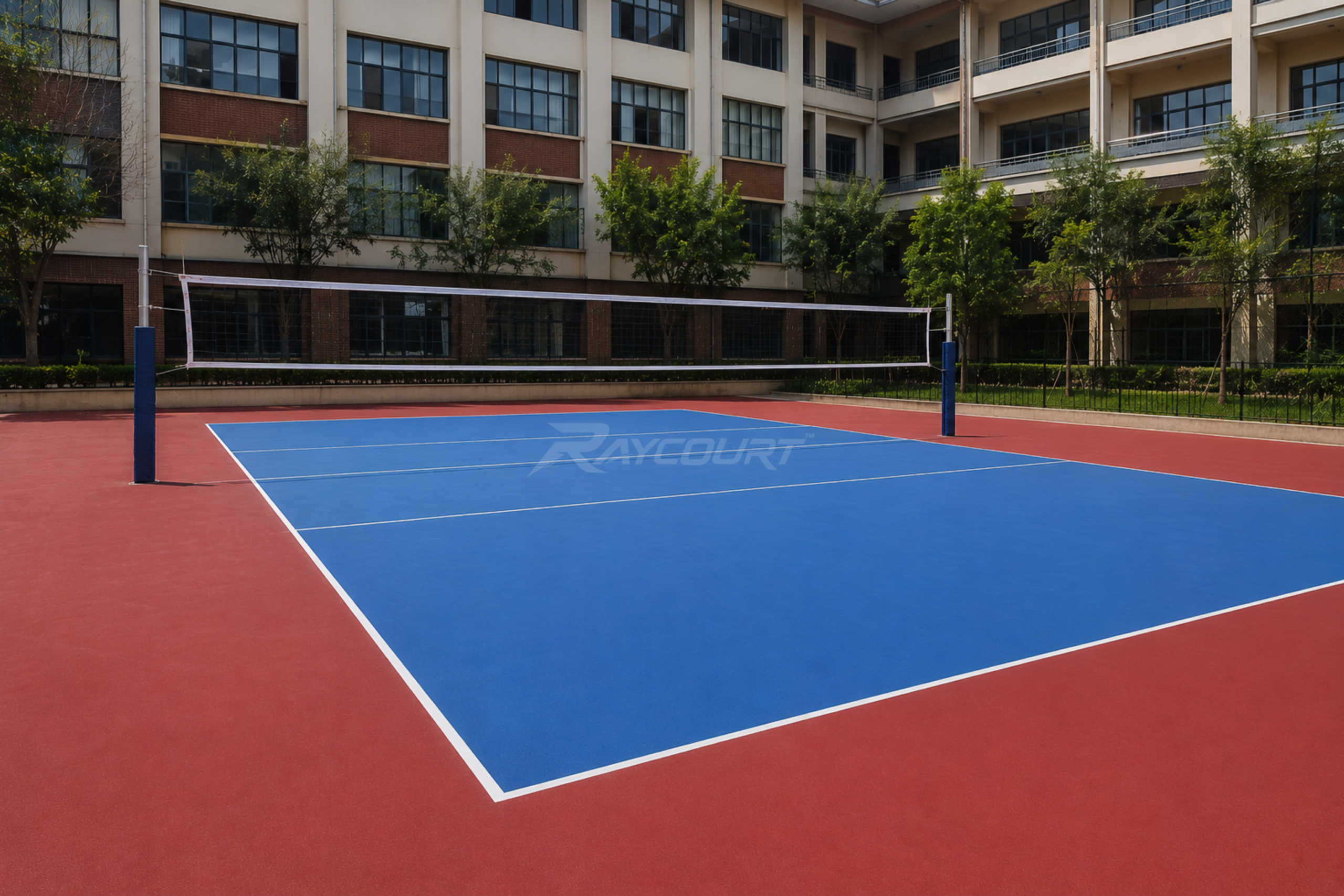
| Green | Red | White | Traditional multi-sport feel |
| Sky Blue | Grey | White | Cool tones that reduce glare |
When choosing colours, think about the surroundings too. A ground next to green lawns may benefit from a blue court for stronger contrast. Similarly, a court that hosts several sports may need distinct line colours for each sport.
Expert Tip: Ask for colour samples and view them outdoors at different times of day. Colours look very different under midday sun compared with evening floodlights.
What Makes a Volleyball Ground Competition-Ready?
Many clubs start with a recreational court and later aim to host tournaments. So, it helps to understand what separates a training ground from a competition venue.
First, competition grounds need the larger free zone that FIVB sets for official events. That extra space gives players room for full-speed recoveries. It also leaves space for officials, line judges and team benches.
Second, the surface must stay perfectly uniform. Referees and players expect identical grip and feel in every corner. A professionally applied acrylic system delivers that consistency far better than patched concrete or worn clay.
Third, markings must meet exact standards. Every line should measure 5 cm wide and stand out clearly against the court colour. The court and free zone should also contrast with each other.
Beyond these essentials, competition venues usually add a few extras:
- A scorer’s table and team benches positioned outside the free zone.
- Warm-up areas away from the main playing area.
- Spectator seating set back behind safe barriers.
- Even floodlighting for evening fixtures and live broadcasts.
- Clear signage and access routes for players and officials.
Above all, a competition-ready volleyball ground reflects careful planning from the very first site survey. When you design with tournaments in mind, you avoid major rebuilds later.
Indoor Versus Outdoor Volleyball Ground
Indoor and outdoor volleyball grounds share the same court dimensions. Still, the environment changes almost every other decision. Here is how they compare.
| Factor | Indoor Volleyball Ground | Outdoor Volleyball Ground |
|---|---|---|
| Typical surfaces | Wood, PU, vinyl, acrylic | Acrylic, concrete, clay, grass |
| Weather exposure | None | Sun, rain, dust, heat |
| UV resistance needed | Low | High |
| Drainage slope | Not needed | Up to 5 mm per metre |
| Vertical clearance | Minimum 7 m | Usually unlimited |
| Lighting | Artificial lighting | Daylight plus floodlights |
| Recommended orientation | Flexible | North to south |
Synthetic acrylic offers a real advantage here. It works both indoors and outdoors. So, an organisation can use one surface family across multiple venues. That approach simplifies maintenance training and keeps the playing feel consistent for teams.
Ready to build a court that performs for years to come?
Connect with Raycourt for sports flooring systems built for your project.
Player Safety on a Volleyball Ground
Safety must guide every decision when you plan a volleyball ground. Players dive, jump and collide at speed. The surface and surroundings either protect them or put them at risk.
Surface-Related Safety
The surface influences injury risk in several ways. Excessive grip can twist knees and ankles during sudden turns. Too little grip causes slips and falls. Hard surfaces increase stress on joints during repeated landings.
A well-built acrylic system addresses all three issues. Its controlled texture balances grip and slide. Meanwhile, cushioned layers reduce landing stress. The surface also stays uniform, so players never meet a surprise patch of different grip.
Surroundings and Equipment
Beyond the surface, check these safety points carefully:
- Keep the free zone clear of benches, bags, bottles and equipment.
- Pad the net posts and referee stand where players might run into them.
- Avoid guy wires on posts, as FIVB rules require.
- Fix drain covers flush with the surface around the perimeter.
- Fit fencing at a safe distance beyond the free zone.
- Light the ground evenly for evening play, without glare in players’ eyes.
Heat Management on Outdoor Grounds
Indian summers bring intense heat. Dark surfaces can grow uncomfortably hot by midday. Lighter colours reduce this heat build-up noticeably. Additionally, scheduling training in the morning and evening protects players from heat stress.
Expert Tip: Encourage players to wear proper indoor-court or multi-court shoes on acrylic surfaces. Running shoes with deep treads offer less lateral support and can wear the surface unevenly.
Maintaining Your Volleyball Ground
A synthetic acrylic volleyball ground needs far less care than mud or grass. Still, simple routines extend its life and keep it playing at its best.
Daily and Weekly Care
Dust, leaves and grit act like sandpaper underfoot. They also reduce grip and make the surface feel slippery. So, sweep the volleyball ground regularly with a soft broom or leaf blower. Remove standing water with a squeegee after rain.
Periodic Cleaning
Every few weeks, wash the surface with clean water and a soft brush. For stubborn marks, use a mild detergent recommended for acrylic courts. Avoid harsh chemicals and pressure washers set too high. These can strip texture from the colour coats.
What to Avoid
Certain activities damage acrylic surfaces quickly. Protect your court by preventing these habits:
- Dragging heavy equipment or furniture across the court.
- Allowing bicycles, motorbikes or vehicles onto the surface.
- Using sharp objects or metal-spiked footwear.
- Leaving chewing gum, oil or food spills untreated.
- Placing hot items such as cookers or generators directly on the court.
Maintenance Schedule at a Glance
| Task | Suggested Frequency |
|---|---|
| Sweep or blow off debris | Daily or before each session |
| Squeegee standing water | After rain |
| Inspect net, posts and fittings | Weekly |
| Wash surface with water | Monthly |
| Check for cracks and drainage issues | Every season |
| Refresh line markings | As needed |
| Apply new colour coats | Every few years, depending on use |
Resurfacing When the Time Comes
Over time, heavy use and UV exposure wear down the top colour coats. When the colour dulls or the texture smooths out, a resurfacing project restores the volleyball ground. The applicator cleans the court, repairs any cracks and applies fresh colour coats. The result looks and plays like a new surface.
Lighting a Volleyball Ground for Evening Play
Many players can only train after school, college or work. Consequently, good lighting turns a daytime facility into an all-day asset. Yet volleyball places unusual demands on floodlights.
Players spend much of each rally looking upward. Poorly placed lights shine straight into their eyes during serves, sets and blocks. Therefore, lighting designers usually mount floodlights along the sidelines rather than behind the end lines. They also angle the fittings to keep glare away from the main sightlines.
Even coverage matters just as much. Dark patches near the corners or the free zone make digs and recoveries risky. Uniform light also helps the court colours and white lines stay readable at night.
Keep these points in mind when you plan lighting:
- Position poles outside the free zone so players never run into them.
- Aim for uniform light levels across the court and the free zone.
- Avoid fittings directly above the net, where players look most often.
- Choose energy-efficient LED floodlights for bright, steady light.
- Plan cable routes early so trenches do not cut through a finished surface.
Expert Tip: Install lighting poles and underground cables before the acrylic system goes down. Trenching through a finished volleyball ground damages the surface and leaves visible repair marks.
Ready to build a court that performs for years to come?
Connect with Raycourt for sports flooring systems built for your project.
Common Mistakes to Avoid When Building a Volleyball Ground
Even well-funded projects stumble over avoidable errors. Fortunately, a little foresight prevents most of them. Here are the mistakes we see most often.
Ignoring the Free Zone
Some projects squeeze an 18 m × 9 m court into a tight plot. As a result, walls and fences sit right beside the lines. Players then hold back on digs or, worse, crash into obstacles. Always secure the full playing area before construction begins.
Skipping Drainage Design
A perfectly flat outdoor ground looks neat on paper. In reality, it holds water after every shower. Puddles stain the surface and delay play for hours. A planned slope with perimeter drains solves this problem from day one.
Rushing the Base
Contractors sometimes face pressure to finish quickly. However, coating fresh concrete traps moisture beneath the surface. Bubbles and peeling often follow within months. Patience at the base stage protects everything above it.
Choosing the Wrong System for the Users
A hard acrylic system suits light recreational use well. Yet academies with daily jumping drills need more cushioning. Match the system to your players, not just to the drawings.
Fixing Posts After Surfacing
Drilling post sockets into a finished court creates cracks and weak edges. Instead, set the sockets during base construction. Then the surface flows neatly around them.
Volleyball Ground Questions Facility Owners Ask Most
Over years of supplying acrylic flooring materials, we hear certain questions again and again. Here are quick answers to the most common ones.
How Much Land Do You Need for a Volleyball Ground?
You need at least 24 m × 15 m for a standard volleyball ground. This space covers the 18 m × 9 m court and a 3 m free zone. For competition use, plan for roughly 31 m × 19 m. Then add extra space for fencing, benches and spectators.
Can You Convert an Old Concrete Ground into an Acrylic Volleyball Ground?
Yes, in many cases. A contractor first checks the existing concrete for cracks, flatness and drainage. Next, they repair damage and clean the surface thoroughly. Once the base passes inspection, they can apply a full acrylic system. This upgrade transforms a hard, slippery slab into a proper sports surface.
Is Acrylic Flooring Suitable for School Volleyball Grounds?
Absolutely. Schools need surfaces that handle heavy daily use with minimal upkeep. Acrylic offers exactly that. Cushioned systems also protect growing students from excessive impact stress. Furthermore, schools can add markings for other sports on the same surface.
Can One Ground Host Volleyball and Basketball Together?
Yes. Many multi-sport grounds combine volleyball and basketball markings. The volleyball court fits comfortably within a standard basketball court footprint. Use different line colours for each sport to avoid confusion. Removable volleyball posts then free the space for basketball whenever needed.
Does an Acrylic Volleyball Ground Get Slippery in Rain?
Any surface loses some grip when wet. However, acrylic colour coats include silica sand for texture, which helps. The slope also clears water quickly. Simply squeegee the surface after rain, and play can resume once it dries.
Why Choose Raycourt Materials for Your Volleyball Ground
Selecting the right flooring material shapes the entire life of your volleyball ground. At Raycourt, we focus on one thing: manufacturing high-performance synthetic acrylic sports court flooring.
Our team brings years of experience in formulating coatings for Indian conditions. We understand how heat, UV, monsoon rain and heavy use affect outdoor courts. That knowledge flows directly into our products.
Here is what sets Raycourt materials apart:
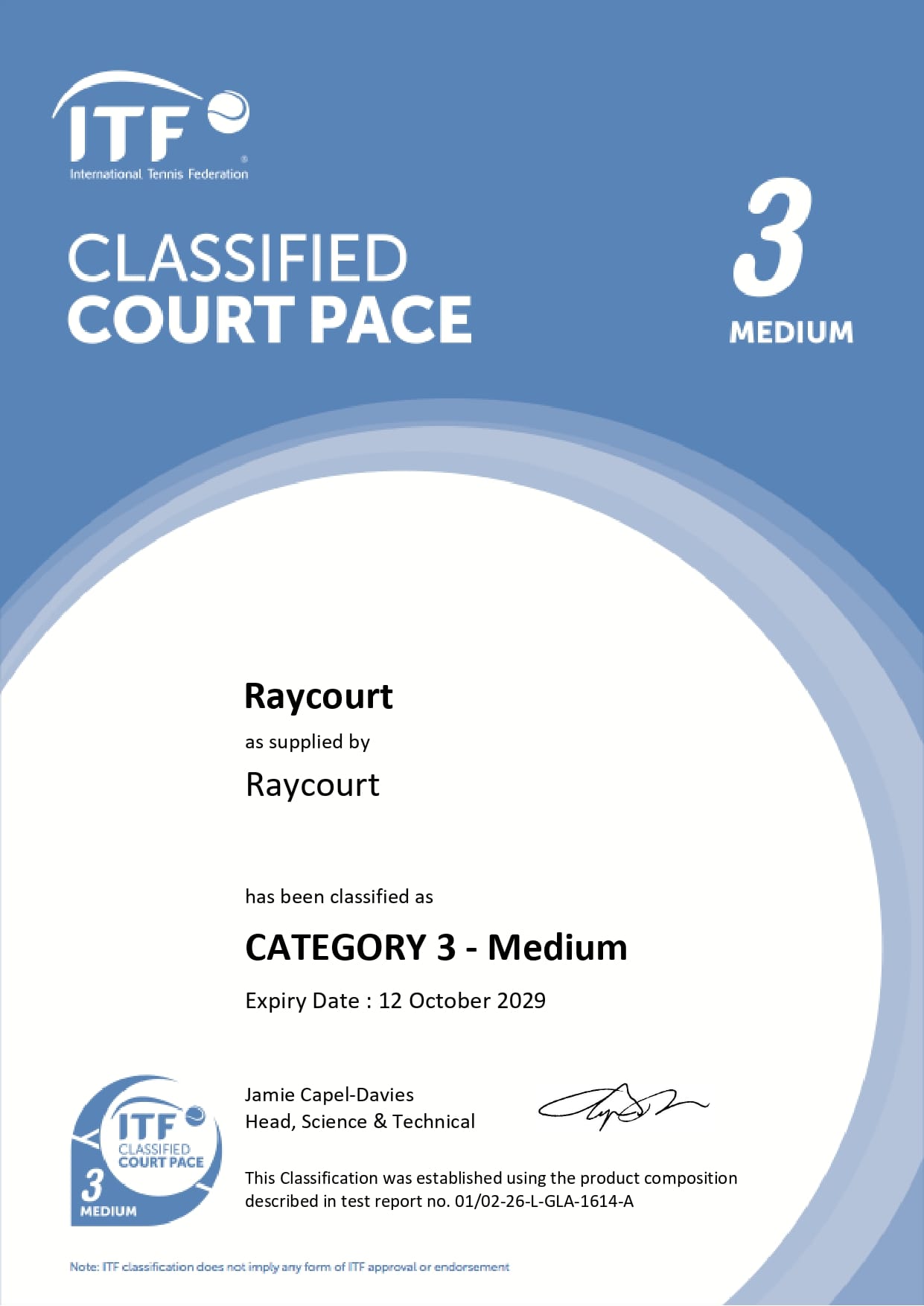
- ITF-classified acrylic systems that reflect tested, consistent performance.
- UV-stable pigments that resist fading under strong sunlight.
- Graded texture for balanced grip and controlled sliding.
- Cushioned and hard court options to match every level of play.
- A full system from primer and resurfacer to colour coats and line paint.
- Technical product guidance for contractors and facility teams.
We also make supply simple. Our Vadodara warehouse offers same-day delivery to Ahmedabad and Vadodara. We deliver within a day to Surat, Rajkot and Indore. Mumbai, Pune, Nagpur, Nashik and Udaipur receive deliveries within two to three days.
Remember, Raycourt supplies the flooring materials only. Your chosen contractor or applicator handles the installation. This clear division lets each specialist deliver their best work for your volleyball ground.
Ready to build a court that performs for years to come?
Connect with Raycourt for sports flooring systems built for your project.
Frequently Asked Questions About Volleyball Grounds
The playing court measures 18 m long and 9 m wide. A free zone of at least 3 m surrounds it on all sides. Therefore, the minimum total area comes to 24 m × 15 m. FIVB, World and Official competitions require 5 m beyond the sidelines and 6.5 m beyond the end lines.
Synthetic acrylic over a concrete or asphalt base works best for most outdoor grounds. It resists UV, heat and rain far better than mud or grass. It also offers controlled grip and optional cushioning. Moreover, it needs very little routine maintenance.
A new concrete base should cure for at least 28 days before coating. This period lets moisture escape and the concrete gain strength. Coating too early can trap moisture underneath. That moisture may later cause blistering or peeling.
The net stands at 2.43 m for men and 2.24 m for women. Youth and age-group categories usually use lower heights. Always confirm the exact height with your local federation rules. Then measure from the centre of the court for accuracy.
Build a Volleyball Ground That Performs for Years
A great volleyball ground brings together correct dimensions, a solid base and a high-performance surface. Get these three right, and players enjoy safer, faster and more confident volleyball. Get them wrong, and problems appear within a single season.
To recap, start with the full playing area, including the free zone. Then orient the ground north to south and build in a gentle drainage slope. Next, prepare a stable concrete or asphalt base and let it cure properly. Finally, choose a quality synthetic acrylic system with the right level of cushioning for your players.
Raycourt stands ready to supply the flooring materials that make this possible. Our acrylic systems give contractors a dependable foundation for courts that look sharp and play true.
Ready to build a court that performs for years to come?
Connect with Raycourt for sports flooring systems built for your project.