
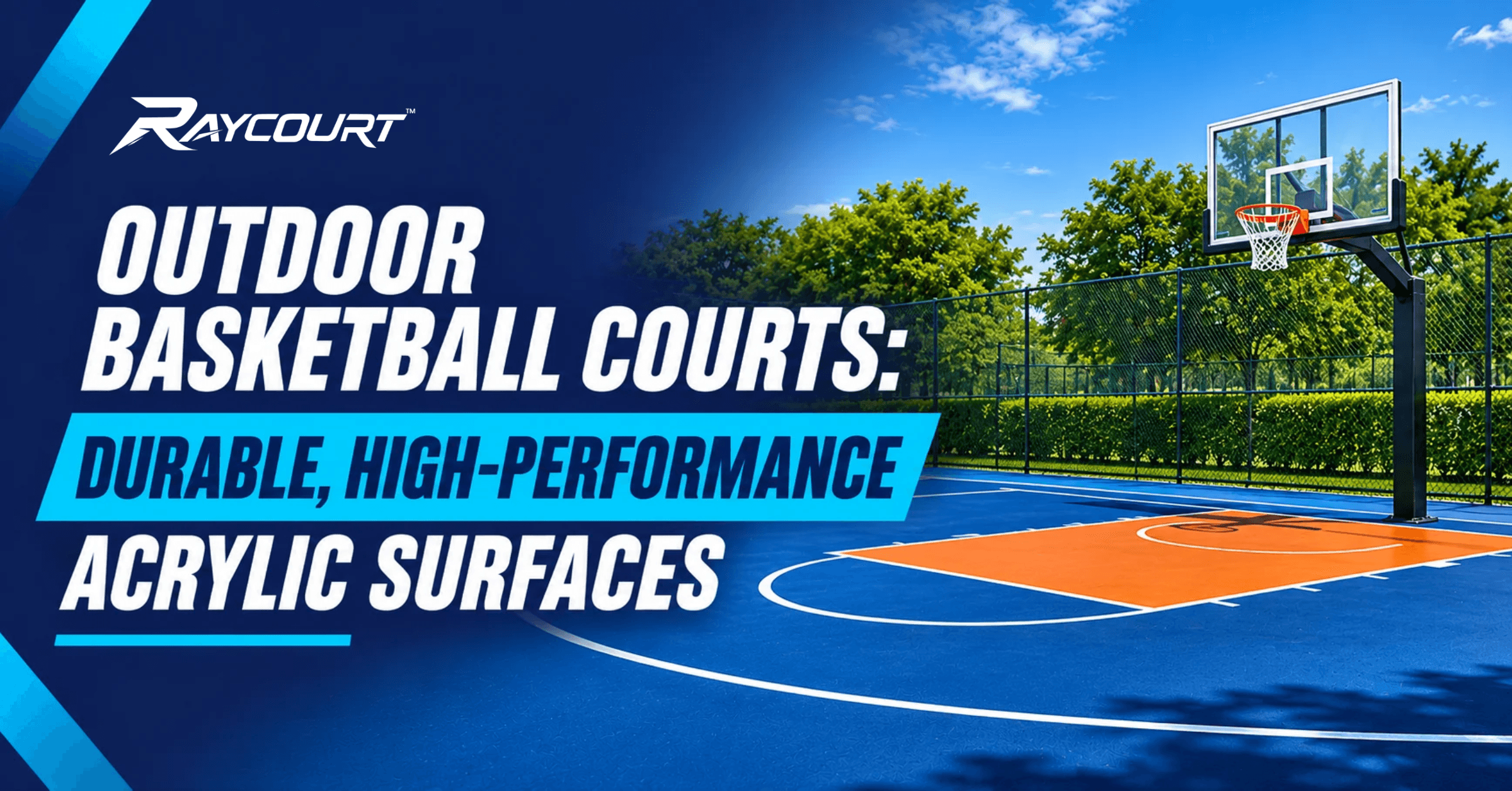
Outdoor basketball courts need a surface that handles sun, rain, heat and heavy footfall without losing grip or bounce. Synthetic acrylic court systems meet that need better than bare concrete, asphalt or painted floors. They bond to a stable base, resist UV fading and deliver consistent ball rebound in every season.
So, if you plan to build or resurface an outdoor court, start with three decisions. First, choose a sound base. Next, select the right acrylic system, either hard or cushioned. Finally, plan drainage, colours and markings before work begins.
This guide walks you through each of those decisions in detail. Moreover, it explains how every layer works and how Indian weather affects performance. It also shows you how to protect the finished surface. Along the way, you will find expert tips, comparison tables and answers to common questions.
Throughout the guide, remember one point about Raycourt. We manufacture sports court flooring materials. We do not install courts. Instead, we supply contractors and facility owners with tested acrylic systems and technical guidance.
What Makes Outdoor Basketball Courts Different From Indoor Courts?
At first glance, an outdoor court and an indoor court look similar. Both use the same dimensions, the same lines and the same hoop height. However, the conditions around them differ sharply, and those conditions shape every material choice.
Constant Exposure to the Elements
Indoor courts sit inside a controlled environment. Temperature stays steady, and rain never touches the floor. Outdoor basketball courts, by contrast, face the full force of nature every single day.
Strong sunlight carries ultraviolet (UV) radiation that breaks down weak coatings. Heavy monsoon rain tests drainage and adhesion. Meanwhile, daily temperature swings make the base expand and contract. Dust, leaves and bird droppings also settle on the surface.
As a result, an outdoor surface must do far more than look good on opening day. It must hold its colour, grip and bond for years. That requirement explains why the coating system matters so much.
Different Usage Patterns
Outdoor courts also attract a wider mix of players. A school court may host physical education classes in the morning. Then, local teams may use it for evening practice. On weekends, families and casual players often take over.
Consequently, the surface faces varied footwear, varied skill levels and constant traffic. Some players wear proper basketball shoes. Others wear running shoes or even street footwear. A good outdoor system tolerates all of these without rapid wear.
Higher Maintenance Demands
Because nature keeps acting on the surface, outdoor courts need a clear care routine. Regular sweeping, prompt crack repair and periodic recoating keep the court safe. Fortunately, a well-chosen acrylic system makes this routine simple and predictable.
Ready to build a court that performs for years to come?
Connect with Raycourt for sports flooring systems built for your project.
Why Synthetic Acrylic Surfaces Lead the Way for Outdoor Basketball Courts
Facility owners can choose from several outdoor surface options. These include bare concrete, plain asphalt, modular tiles, rubber flooring and acrylic coatings. Among them, synthetic acrylic systems offer the best balance of performance, durability and appearance.
Acrylic coatings use water-based acrylic resins combined with fine silica sand and pigments. Once they cure, they form a tough, textured and flexible layer. That layer bonds tightly to concrete or asphalt and moves slightly with the base.
The Core Benefits of Acrylic Surfaces
Here is what makes acrylic the preferred choice for outdoor basketball courts:
- UV resistance: Quality pigments and resins hold their colour under intense sunlight.
- Weather durability: The cured film resists rain, heat and humidity without peeling.
- Consistent ball bounce: A uniform surface delivers a predictable, true rebound.
- Controlled traction: Silica texture gives players reliable grip for cuts and stops.
- Seamless finish: Unlike tiles, acrylic forms one continuous surface with no joints.
- Easy maintenance: Simple cleaning and periodic recoating restore the court.
- Design flexibility: Owners can pick from a wide palette of court colours.
- Water-based chemistry: Low-odour products make application safer for crews.
How Acrylic Compares With Bare Concrete
Many older outdoor courts use plain concrete with painted lines. At first, this option seems simple. However, bare concrete punishes the body and wears shoes quickly. It also stains easily, cracks without warning and offers uneven traction when wet or dusty.
An acrylic system turns that same concrete slab into a true sports surface. It seals the pores, smooths small irregularities and adds engineered texture. Therefore, players enjoy better grip, and the slab gains protection against water and wear.
Expert Tip: Never treat an acrylic coating as simple paint. A true sports system includes several engineered layers. Each layer performs a specific job, and skipping one weakens the entire court.
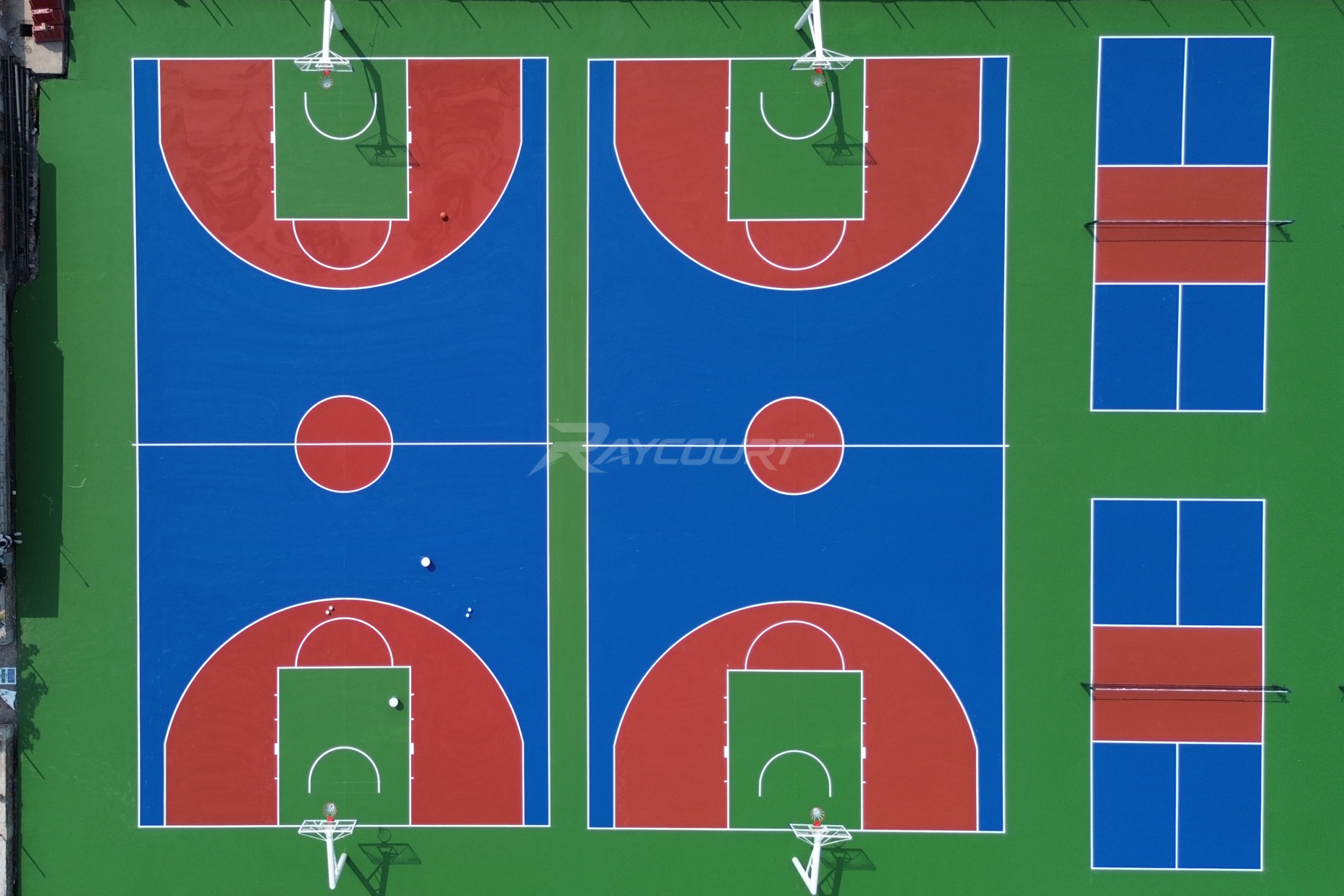
Understanding the Layers of an Acrylic Outdoor Basketball Court System
A high-performance outdoor court works like a well-built sandwich. Each layer supports the next, and together they create the final playing experience. Let us walk through the layers from the bottom up.
The Base: Foundation of Every Outdoor Court
Everything starts with the base. Most outdoor basketball courts use either reinforced concrete or hot-mix asphalt. The base must stay level, stable and free from major cracks.
Moreover, the base must include the correct slope for drainage. Contractors also need to let it cure fully before coating begins. A rushed or weak base causes most court failures, regardless of coating quality.
The Primer or Sealer Coat
Next, the applicator applies a primer or sealer. This coat penetrates the base and improves adhesion. It also seals fine pores so later layers do not soak in unevenly.
On concrete, a dedicated primer helps the acrylic layers grip the dense, smooth surface. On asphalt, a sealer evens out absorption and locks down loose fines. In both cases, this thin layer quietly protects the entire system.
The Resurfacer or Filler Coat
After priming, the applicator spreads one or more resurfacer coats. These coats contain acrylic resin and coarser sand. They fill small voids, smooth minor surface defects and build film thickness.
In addition, the resurfacer creates an even, uniform texture across the court. That uniformity matters because the colour coats will follow every bump beneath them. A good resurfacer stage sets up a truly consistent finish.
Cushion Layers (Optional)
Some outdoor basketball courts include cushion layers. These layers use acrylic binders mixed with rubber granules. Applicators build them up in several passes to create a softer, more forgiving surface.
Cushioning reduces impact on joints and improves comfort during long sessions. Consequently, many schools and academies choose cushioned systems for younger or high-volume players.
The Colour Coats
Then come the colour coats, usually two of them. These coats carry pigment, acrylic resin and fine silica sand. They give the court its final look, its texture and much of its traction.
Quality colour coats resist UV fading and chalking. They also set the pace of the court. More texture slows the ball and adds grip. Less texture creates a faster, smoother surface.
Line Paint
Finally, the applicator marks the game lines with dedicated line paint. Good line paint stays crisp, bonds well with the colour coats and resists early wear. Sharp, clean lines also help players and referees read the court quickly.
Layer Summary Table
| Layer | Main Function | Typical Material |
|---|---|---|
| Base | Provides stable, level, sloped foundation | Reinforced concrete or asphalt |
| Primer / Sealer | Improves adhesion and seals pores | Acrylic primer or sealer |
| Resurfacer | Fills voids and smooths the surface | Acrylic resin with coarse sand |
| Cushion (optional) | Adds shock absorption and comfort | Acrylic binder with rubber granules |
| Colour Coats | Delivers colour, texture and traction | Pigmented acrylic with fine silica |
| Line Paint | Marks game lines clearly | Dedicated acrylic line paint |
Hard Court vs Cushioned Court Systems for Outdoor Basketball
Once you understand the layers, you face a key decision. Should your outdoor basketball court use a hard system or a cushioned system? Both work well outdoors, yet each suits different users.
The Case for Hard Acrylic Systems
A hard acrylic system skips the rubber cushion layers. It applies primer, resurfacer and colour coats straight onto the base. This approach creates a firm, fast and highly durable surface.
Hard systems suit busy public courts, multi-use school grounds and recreational spaces. They handle heavy traffic well and need fewer layers. Furthermore, they offer a crisp, lively ball bounce that many players enjoy.
The Case for Cushioned Acrylic Systems
A cushioned system adds several rubber-filled acrylic layers beneath the colour coats. These layers absorb part of the impact from jumping and running. As a result, players feel less strain on their knees, ankles and backs.
Cushioned systems suit academies, training centres and courts with long daily sessions. They also suit facilities that serve children and older recreational players. However, they need more layers and careful application.
Side-by-Side Comparison
| Factor | Hard Acrylic System | Cushioned Acrylic System |
|---|---|---|
| Comfort | Firm feel underfoot | Softer, more forgiving feel |
| Joint impact | Higher impact on joints | Reduced impact on joints |
| Ball bounce | Lively and fast | Slightly softer yet consistent |
| Ideal users | Public, school and multi-use courts | Academies and training facilities |
| Number of layers | Fewer layers | More layers |
| Traffic tolerance | Excellent for heavy use | Very good with proper care |
Expert Tip: Match the system to the player, not the trend. A community court with heavy casual use often benefits from a hard system. An academy with daily drills often benefits from cushioning.
Choosing the Right Base for Outdoor Basketball Courts
The base determines how long your court surface lasts. Even the finest acrylic coating cannot fix a weak foundation. So, give the base the same attention you give the surface.
Concrete Bases
Concrete offers excellent strength and stability. It resists deformation under heavy loads and suits most climates in India. For outdoor basketball courts, contractors usually prefer post-tensioned or well-reinforced concrete slabs.
However, concrete needs proper curing before coating. Most acrylic system guidelines call for a curing period of around 28 days. During this time, moisture leaves the slab, and its surface strength develops. Coating too early traps moisture and causes blistering or peeling.
Surface preparation also matters. Contractors should give the slab a light broom finish rather than a steel-trowel shine. Afterwards, they should remove curing compounds, laitance and dust before priming.
Asphalt Bases
Asphalt offers a slightly flexible base that installs quickly. It also handles minor ground movement well. Many recreational outdoor basketball courts use asphalt for these reasons.
Nevertheless, asphalt needs its own curing time so oils can evaporate from the surface. It also softens in extreme heat and may show cracks over time. Therefore, contractors must build it on a well-compacted sub-base with good drainage.
Base Comparison Table
| Feature | Concrete Base | Asphalt Base |
|---|---|---|
| Strength | Very high | Moderate to high |
| Flexibility | Rigid | Slightly flexible |
| Heat behaviour | Stable in high heat | May soften in extreme heat |
| Crack tendency | Low with proper joints and reinforcement | Moderate over time |
| Curing need | Around 28 days before coating | Curing time for oils to leave surface |
| Best fit | Long-term, high-use outdoor courts | Recreational and quick-build courts |
Expert Tip: Ask your contractor to flood-test the base before coating. Water standing in shallow pools reveals low spots. Fixing them early saves the surface from future damage.
Official Dimensions and Markings for Outdoor Basketball Courts
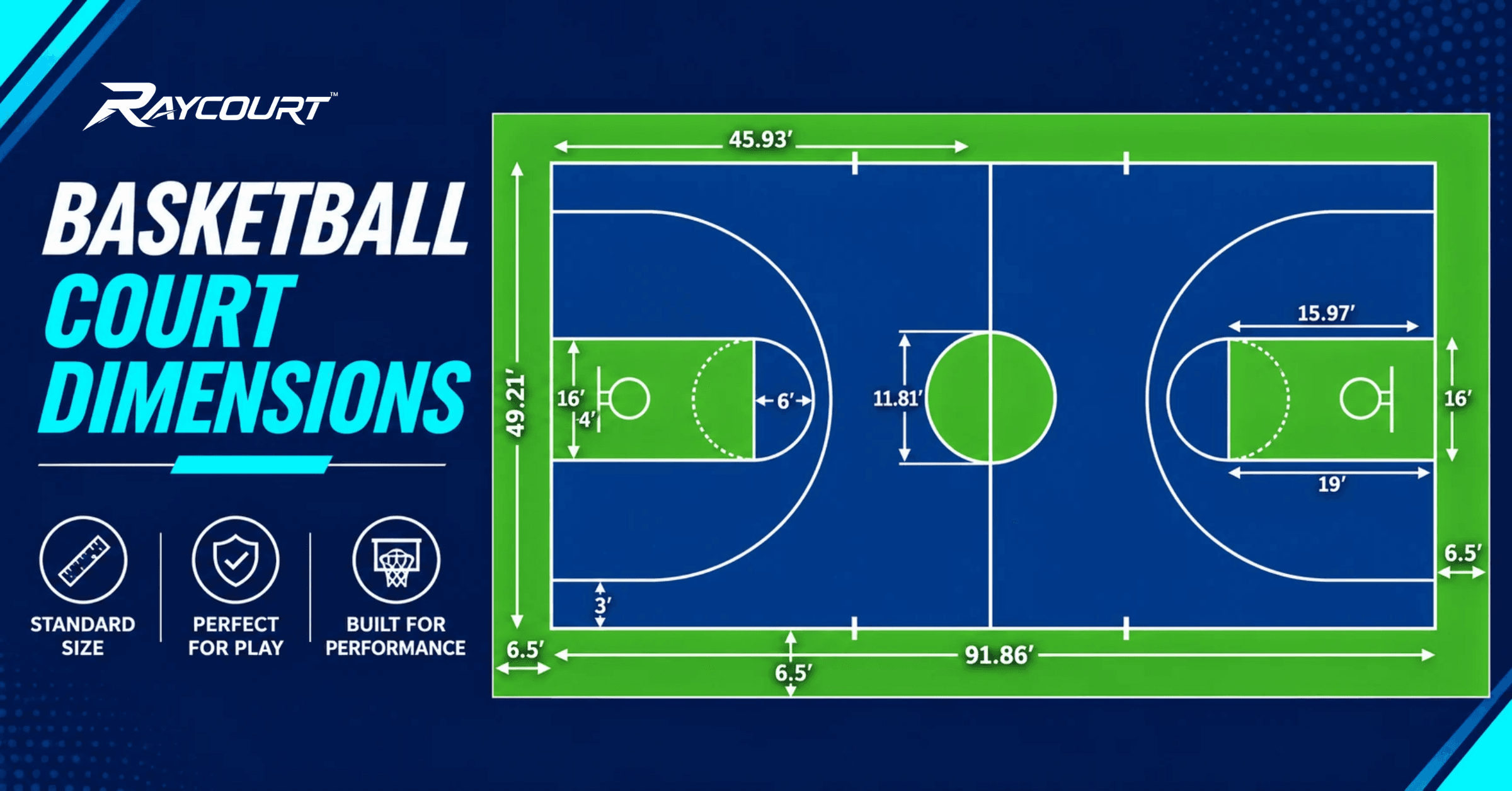
Outdoor basketball courts follow the same playing dimensions as indoor courts. If you plan competitive use, follow international standards from the start. That way, players train on the exact layout they meet in tournaments.
Key FIBA Dimensions
The FIBA Official Basketball Rules 2026 set the standard for international play. Here are the essential measurements every planner should know:
| Element | FIBA Specification |
|---|---|
| Court length | 28 m |
| Court width | 15 m |
| Basket (ring) height | 3.05 m above the floor |
| Three-point line distance | 6.75 m from the centre of the basket |
| Line width | 5 cm |
| Centre circle radius | 1.80 m (to outer edge) |
| No-charge semi-circle radius | 1.25 m |
Run-Off Space Around the Court
Beyond the playing area, every outdoor court needs safe run-off space. Players often run past the boundary line while chasing loose balls. Clear space prevents collisions with fences, posts and walls.
Most planners allow at least 2 m of clear space on all sides. Where space permits, a wider margin improves safety further. Additionally, many facilities coat this run-off area in a contrasting colour for visual definition.
Half Courts and Compact Layouts
Not every site can fit a full-size court. Fortunately, half courts work well for schools, residential societies and backyard spaces. A half court covers one end of the full court up to the centre line.
Even on compact layouts, keep the key markings accurate. Correct free-throw and three-point distances help players build sound shooting habits. Later, those habits transfer smoothly to full-size courts.
Ready to build a court that performs for years to come?
Connect with Raycourt for sports flooring systems built for your project.
Drainage, Slope and Site Planning for Outdoor Courts
Water causes more damage to outdoor basketball courts than almost anything else. Standing water softens bonds, encourages algae and creates slippery patches. Therefore, smart drainage planning protects both players and the surface.
Getting the Slope Right
An outdoor court needs a gentle slope so rain runs off quickly. Most court guidelines recommend a slope of roughly 0.8 to 1 percent. This gradient moves water away without affecting play.
Ideally, the slope runs in one direction, from side to side or end to end. A single plane is easier to build accurately than a crowned or multi-directional surface. It also keeps ball roll and bounce consistent across the court.
Perimeter Drainage
Next, plan where the water goes once it leaves the court. Perimeter drains, channels or gravel trenches carry runoff away safely. Without them, water may pool at the edges and creep back under the slab.
During monsoon months, this step matters even more. Heavy downpours in many Indian cities can flood poorly planned sites within minutes. Good perimeter drainage keeps the court playable soon after rain stops.
Orientation and Surroundings
Court orientation also affects player comfort. Many designers align the long axis roughly north to south. This layout reduces the low morning and evening sun shining straight into players’ eyes.
Furthermore, consider the trees and structures around the court. Overhanging trees drop leaves, sap and seeds that stain the surface and block drainage. Similarly, nearby construction can blow dust across fresh coatings. So, plan landscaping with the court’s long-term care in mind.
Expert Tip: Plan lighting conduits during base construction. Adding trenches for floodlight cables later can damage the finished slab and its coating.
Choosing Colours for Outdoor Basketball Courts
Colour does more than make a court attractive. It affects visibility, heat absorption and how players read the game. As a result, colour selection deserves careful thought.
Visibility and Contrast
Players track a fast-moving orange ball against the court surface. A strong contrast between the ball and the court helps them react faster. Likewise, contrast between the playing area and the key helps players judge position.
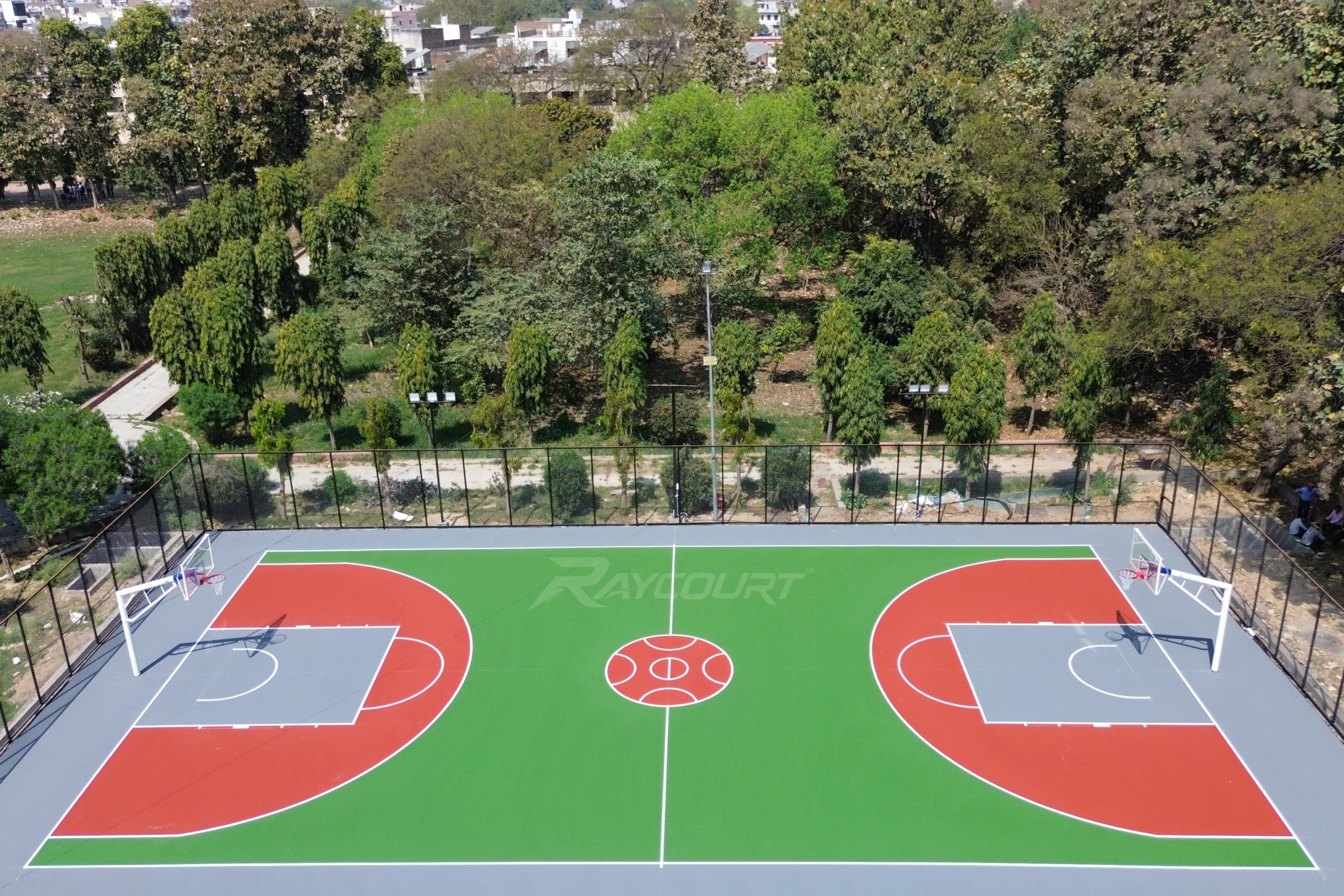
Popular combinations include blue courts with green surrounds, or green courts with red surrounds. Many facilities also paint the key in a third colour for clear definition. Meanwhile, white line paint stands out well against most court colours.
Heat and Climate Considerations
In hot climates, colour also influences surface temperature. Darker shades absorb more heat, while lighter shades stay slightly cooler. In much of India, summer afternoons get intensely hot. So, mid-tone colours often strike a sensible balance between appearance and comfort.
Branding and Identity
Schools, clubs and townships often want their courts to reflect their identity. Acrylic systems make this easy because pigments come in a wide range of shades. Facilities can match school colours, club colours or architectural themes.
Additionally, a distinctive colour scheme makes a court instantly recognisable. It turns a functional space into a proud landmark for the community. Raycourt offers a broad palette so specifiers can match almost any design vision.
Popular Colour Combinations
- Blue court with green surround: Classic, cool-toned and highly visible.
- Green court with red surround: Traditional look with strong boundary definition.
- Blue court with grey surround: Modern and understated appearance.
- Red court with green surround: Warm, energetic look for school campuses.
- Custom key colours: Distinct paint zones that help players read positions.
Performance Factors That Define a Great Outdoor Basketball Court
Players judge a court within minutes of stepping onto it. They notice the bounce, the grip and the speed straight away. Fortunately, an acrylic system lets specifiers fine-tune each of these qualities.
Ball Rebound
Basketball depends on predictable ball rebound. Every dribble, bounce pass and loose-ball scramble relies on it. Uneven surfaces create dead spots where the ball loses energy. Those dead spots frustrate players and disrupt the flow of play.
A properly applied acrylic system eliminates dead spots. Its uniform film thickness and stable bond with the base deliver consistent rebound everywhere. Consequently, players can trust the ball wherever they dribble.
Traction and Grip
Traction controls how well players can start, stop and change direction. Too little grip leads to slips and falls. Too much grip, however, can stress knees and ankles during sharp turns.
Acrylic colour coats use graded silica sand to strike the right balance. The texture gives shoes enough bite for explosive moves. At the same time, it allows the controlled pivoting that basketball demands.
Surface Speed
Surface speed describes how quickly the ball travels after contact with the court. In basketball, speed mainly affects bounce passes and rolling balls. Texture level controls this property. Finer textures play faster, while coarser textures slow the ball slightly.
Shock Absorption
Shock absorption measures how much impact the surface returns to the body. Hard systems return more force, while cushioned systems absorb part of it. For long training sessions, extra absorption helps reduce fatigue and soreness.
How Indian Weather Shapes Outdoor Court Performance
India’s climate varies widely across regions. Yet most outdoor basketball courts face three common challenges. These include intense UV exposure, heavy monsoon rain and high summer heat.
Intense Sunlight and UV Exposure
Strong sunlight shines on outdoor courts for much of the year. Over time, UV radiation attacks weak resins and low-grade pigments. The result shows up as faded colour, chalky residue and brittle film.
Quality acrylic systems use UV-stable resins and lightfast pigments. These ingredients hold their colour and flexibility for far longer. Therefore, the court keeps both its appearance and its performance.
Monsoon Rain and Humidity
Monsoon seasons bring heavy, sustained rainfall to much of the country. Water tests every weak point in the court system. It seeps into cracks, lifts poorly bonded coatings and encourages algae growth.
A well-sloped base and a sealed acrylic system handle these conditions far better. The continuous film keeps water from soaking into the base. Meanwhile, good drainage clears the surface quickly after each shower.
Application timing matters too. Acrylic coatings need dry conditions and suitable temperatures to cure correctly. So, contractors usually schedule coating work outside the peak monsoon weeks.
High Summer Heat
Summer temperatures can climb very high in many regions. Heat makes the base expand during the day and contract at night. This repeated movement stresses rigid coatings.
Flexible acrylic films move with the base instead of cracking. Additionally, applicators often avoid coating during the hottest hours. They prefer early mornings or late afternoons, when coatings can level and cure evenly.
Expert Tip: Ask your applicator to check surface temperature, not just air temperature. A slab can run much hotter than the air around it at midday.
Quick Answers: Common Questions About Planning Outdoor Basketball Courts
Before you finalise plans, a few practical questions usually come up. The short sections below answer them directly.
How Long Does an Acrylic Outdoor Basketball Court Surface Last?
Lifespan depends on base quality, usage, climate and maintenance. With a sound base and regular care, an acrylic surface performs well for several years. Eventually, the colour coats wear down through normal use.
At that stage, owners do not need a full rebuild. Instead, a contractor cleans the court, repairs any cracks and applies fresh colour coats. This recoating process restores the surface and extends the court’s life considerably.
Can You Coat an Existing Outdoor Court?
Yes, in many cases you can. The existing concrete or asphalt base must remain structurally sound. Then, a contractor can prepare it and apply a new acrylic system.
First, the contractor inspects the base for cracks, low spots and loose material. Next, they repair defects and clean the surface thoroughly. Finally, they apply primer, resurfacer and colour coats. This approach transforms tired courts into modern playing surfaces.
Are Acrylic Outdoor Courts Suitable for Children?
Absolutely. Acrylic systems give children reliable grip and a consistent bounce. Water-based formulations also suit school environments well.
For younger players, many schools prefer a cushioned system. The added comfort reduces strain during running and jumping. Furthermore, bright colours make the court inviting and help children learn court zones quickly.
Can One Outdoor Court Support Multiple Sports?
Yes. Many facilities add extra line markings for sports like volleyball, pickleball or futsal training. Using different line colours helps players focus on their own game.
However, too many overlapping lines can confuse players. So, plan the layout carefully and keep the basketball lines most prominent if basketball remains the main sport.
Do Outdoor Courts Need Lighting?
Lighting extends playing hours well into the evening. In hot regions, evening play often suits players better than afternoon play. Plan lighting poles outside the run-off zone to keep players safe.
Ready to build a court that performs for years to come?
Connect with Raycourt for sports flooring systems built for your project.
Raycourt’s Role: A Materials Manufacturer, Not an Installer
Understanding who does what helps any outdoor court project run smoothly. Raycourt manufactures synthetic acrylic sports court flooring materials. We do not carry out installation work.
What Raycourt Provides
Raycourt focuses entirely on making high-quality court coating systems. Our role centres on materials, consistency and technical knowledge. Specifically, we provide:
- Complete acrylic court systems: Primers, resurfacers, cushion layers, colour coats and line paints.
- Consistent batch quality: Uniform materials that help applicators achieve even finishes.
- Technical product guidance: Clear application instructions and coverage recommendations.
- Colour options: A broad palette for courts, surrounds and key areas.
- Reliable supply: Dependable dispatch so projects stay on schedule.
Why Our ITF Classification Matters
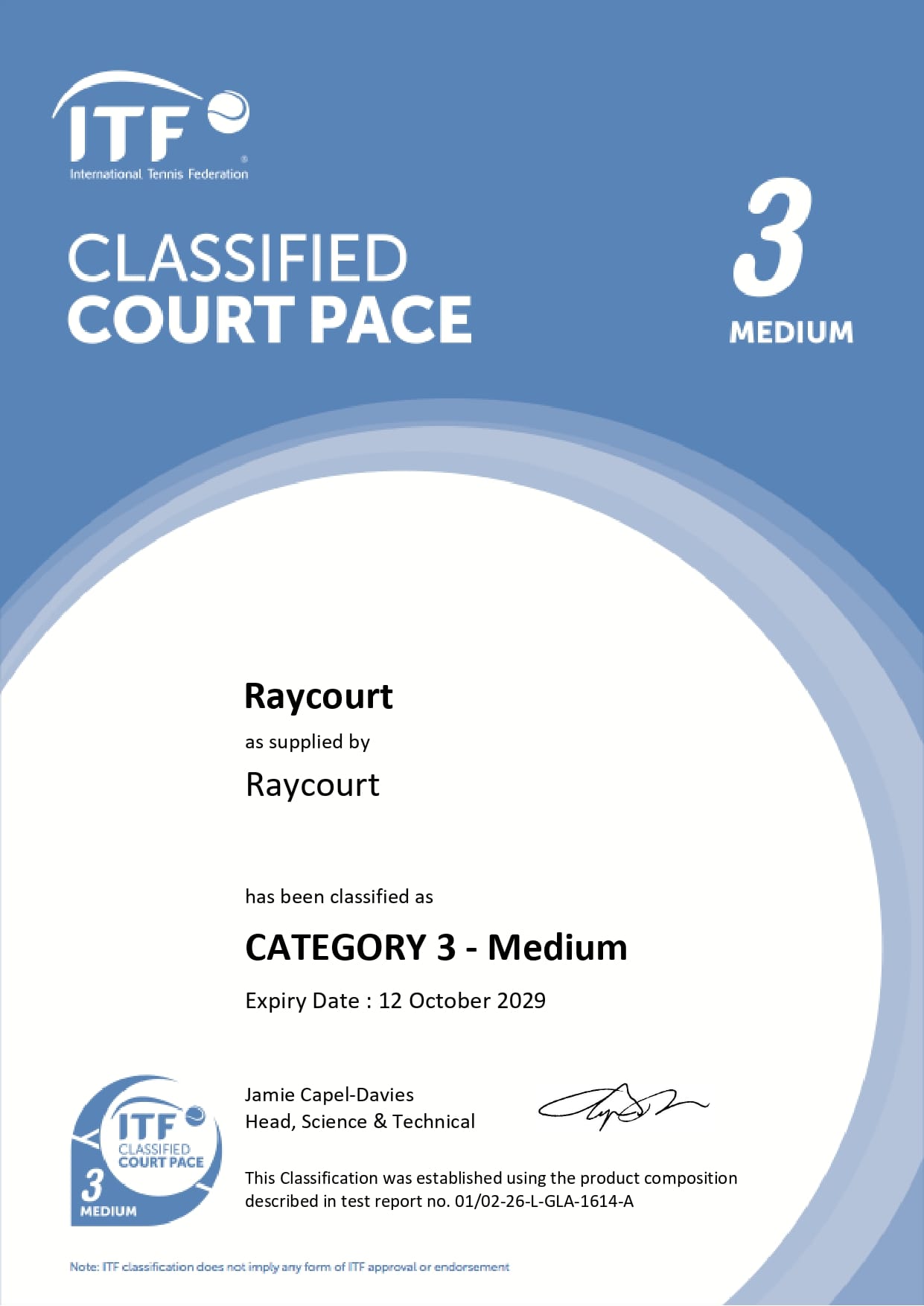
Raycourt holds ITF Classification for its court surfaces. The International Tennis Federation runs a demanding surface testing programme. That classification reflects independent testing of surface pace and performance.
Although the classification relates to tennis, it signals something important for basketball buyers. It shows that our materials meet recognised international benchmarks for consistency. Contractors can therefore specify Raycourt systems with confidence.
How Contractors and Owners Work With Us
Facility owners usually appoint a qualified court contractor to build and coat the court. That contractor then sources materials from Raycourt. In turn, our team supports the contractor with product information and system selection advice.
This arrangement gives owners the best of both worlds. They benefit from specialist application skills and from purpose-built, tested materials. Moreover, clear responsibilities make communication simpler throughout the project.
Fast Supply Across Western India
Raycourt operates a warehouse in Vadodara to support quick material dispatch. This location helps us serve projects across Gujarat and neighbouring states efficiently. Shorter delivery times help contractors keep their schedules on track.
A Practical Step-by-Step Overview of an Outdoor Court Project
Every project differs, yet most outdoor basketball courts follow a similar path. Knowing the sequence helps owners plan time and coordinate contractors effectively.
- Define the purpose. Decide who will use the court and how often.
- Survey the site. Check soil conditions, drainage paths and available space.
- Choose the layout. Select full court, half court or a multi-sport layout.
- Build the base. Construct concrete or asphalt with the correct slope.
- Allow curing. Give the base enough time to cure fully.
- Select the acrylic system. Choose hard or cushioned, plus colours and texture.
- Prepare the surface. Clean, repair and flood-test the base.
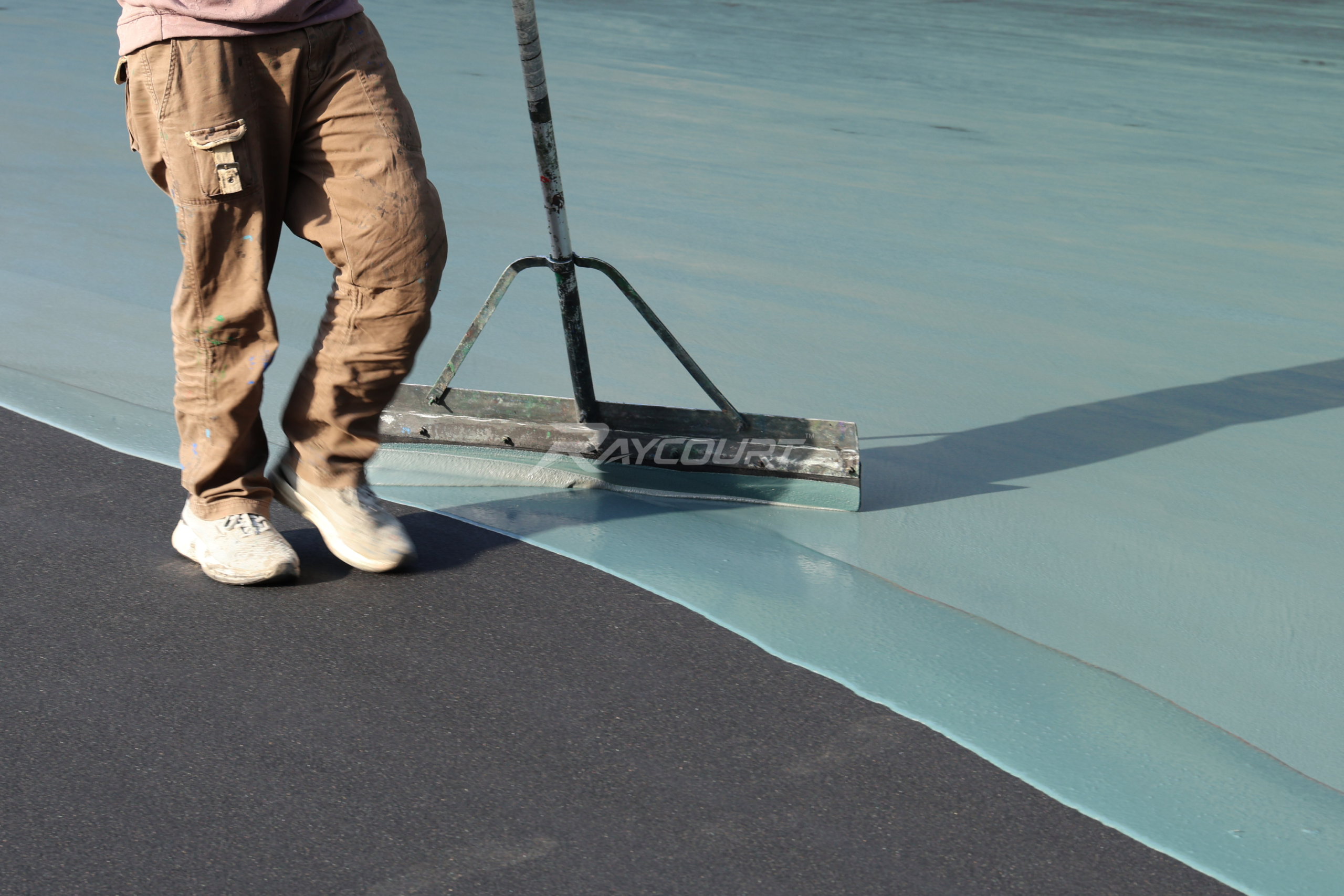
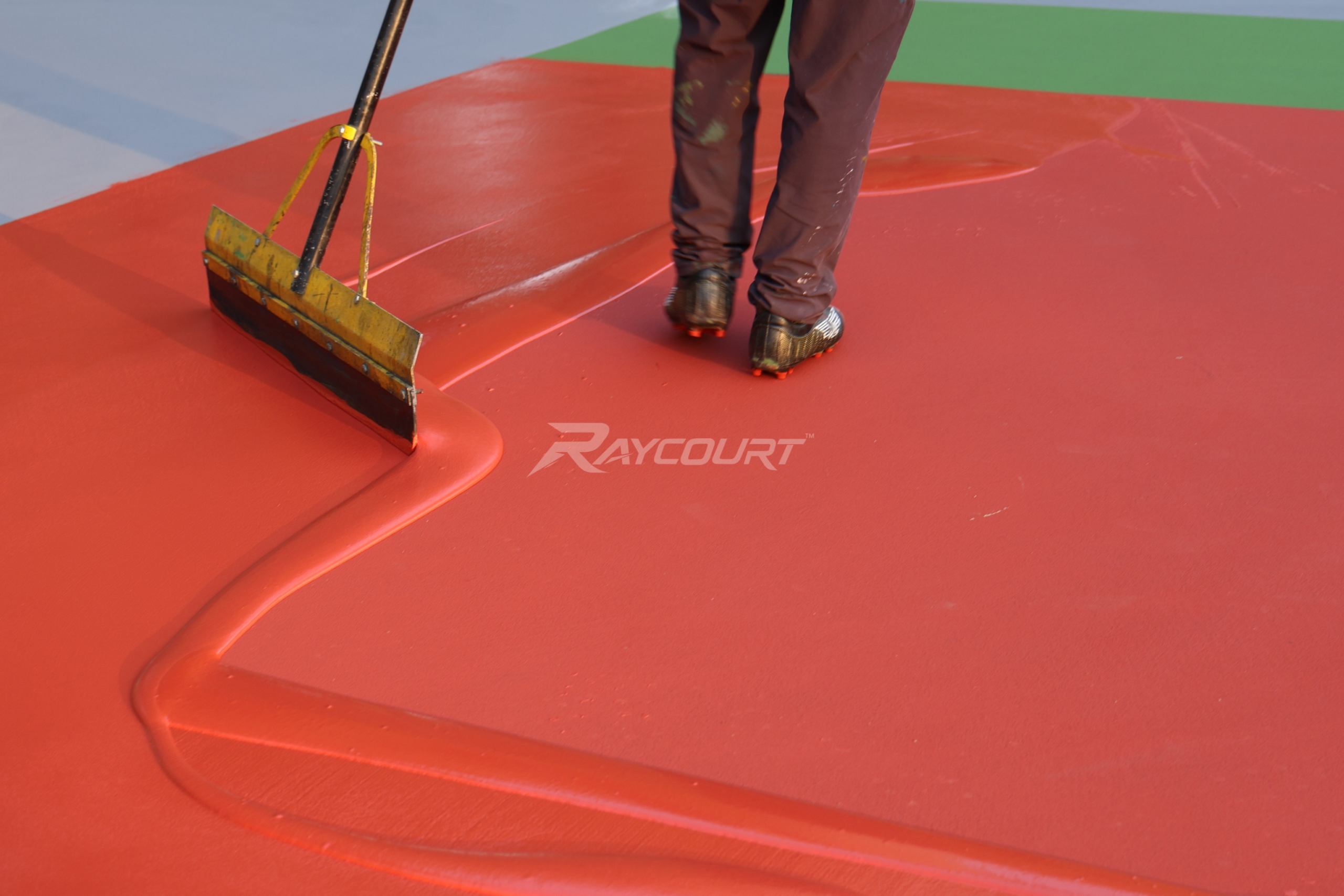
- Apply the coating layers. Prime, resurface, cushion if needed, then apply colour coats.
- Mark the lines. Paint accurate game lines with dedicated line paint.
- Install equipment. Fit hoops, backboards, fencing and lighting safely.
- Allow final curing. Keep players off until the coating cures completely.
- Start a maintenance routine. Begin regular cleaning and inspections from day one.
Expert Tip: Agree on the colour scheme and line layout before coating begins. Changing plans mid-project wastes material and delays completion.
Maintenance Guide for Outdoor Basketball Courts
A good maintenance routine protects your court and keeps it safe. Fortunately, acrylic surfaces need only simple, regular care. Consistency matters more than intensity.
Daily and Weekly Care
Start with the basics. Sweep or blow away leaves, dust and debris regularly. Debris traps moisture, stains the surface and wears the texture under players’ feet.
Additionally, remove standing water after rain using a soft squeegee. Check the court for spills, chewing gum or oil marks. Clean these promptly with mild soap and water.
Monthly Care
Once a month, give the court a deeper clean. Use a soft-bristle brush and low-pressure water to lift embedded dirt. Avoid harsh chemicals and high-pressure jets that can damage the coating.
Also inspect drains and perimeter channels. Clear any blockages so water can leave the court freely. Meanwhile, trim overhanging branches and keep nearby planting tidy.
Seasonal and Annual Care
Before and after the monsoon, carry out a thorough inspection. Look for cracks, lifted edges, faded areas and algae growth. Small problems grow quickly if you ignore them.
Ask a qualified contractor to repair cracks promptly with suitable crack-filling products. Over time, plan recoating when colour coats show visible wear. Timely recoating protects the underlying layers and keeps play consistent.
Maintenance Do’s and Don’ts
Do:
- Sweep the court regularly to remove debris.
- Insist that players wear non-marking sports shoes.
- Clean spills and stains promptly with mild soap.
- Keep drains and channels clear at all times.
- Schedule inspections before and after the monsoon.
Don’t:
- Drag heavy equipment or furniture across the surface.
- Allow bicycles, skateboards or vehicles on the court.
- Use harsh solvents, acids or bleach for cleaning.
- Let standing water sit for long periods.
- Ignore small cracks until they spread.
Expert Tip: Place mats or a clean entry zone at court gates. Players then carry far less grit and mud onto the playing surface.
Common Mistakes to Avoid When Planning Outdoor Basketball Courts
Even experienced teams sometimes make avoidable errors. Recognising these mistakes early helps you protect your court from the start.
Rushing the Base
Many failures begin with an uncured or poorly built base. Coating a damp slab traps moisture, which later causes blisters and peeling. Patience at this stage pays off for years.
Ignoring Drainage
Some planners treat drainage as an afterthought. Unfortunately, poor slope and blocked outlets create ponding, algae and early coating failure. Plan drainage first, not last.
Treating Paint as a Sports Surface
Ordinary floor paint lacks the texture, flexibility and UV resistance of a sports system. It wears quickly, turns slippery when wet and fades under sunlight. Always choose a purpose-built acrylic court system instead.
Skipping System Layers
To save time, some applicators skip primers or resurfacers. This shortcut weakens adhesion and leaves surface defects visible. Every layer in a system exists for a reason.
Coating in Poor Weather
Applying acrylic during rain, high humidity or extreme heat disrupts curing. The coating may not bond or level correctly. So, always follow the manufacturer’s application guidelines on temperature and weather.
Neglecting Maintenance
Finally, some owners assume an outdoor court needs no care. Yet debris, standing water and unrepaired cracks shorten surface life dramatically. A simple routine prevents most of these problems.
Ready to build a court that performs for years to come?
Connect with Raycourt for sports flooring systems built for your project.
Why Specifiers Choose Raycourt for Outdoor Basketball Courts
Selecting a materials partner shapes the success of every outdoor court. Raycourt combines years of experience with a firm focus on quality and support.
Purpose-Built for Outdoor Conditions
We formulate our acrylic systems for demanding outdoor environments. Our products target UV stability, weather durability and strong adhesion. Consequently, courts keep their colour, grip and bounce through changing seasons.
Complete Systems From One Source
Raycourt supplies every layer of the acrylic system, from primer to line paint. Using components designed to work together improves compatibility between layers. It also simplifies sourcing for contractors.
Technical Knowledge You Can Rely On
Our team understands court systems in depth. We guide contractors on system selection, coverage and application conditions. This support helps each project start on the right footing.
Recognised Quality
Our ITF Classification reflects independent testing of our court surfaces. That recognition gives architects, contractors and owners added confidence in every specification.
Dependable Supply
Projects depend on timely material delivery. Our Vadodara warehouse and dispatch network help keep site schedules moving. As a result, contractors avoid frustrating delays from material shortages.
Frequently Asked Questions
A synthetic acrylic court system offers the best overall performance for outdoor basketball courts. It resists UV, rain and heat while delivering consistent bounce and reliable grip. It also bonds seamlessly to concrete or asphalt, so no joints or loose edges develop.
Both work well when contractors build them correctly. Concrete offers greater rigidity and stability, especially for high-use courts in hot climates. Asphalt installs quickly and suits many recreational projects. Whichever you choose, ensure proper slope, compaction and full curing before coating.
A hard system applies colour coats directly over primer and resurfacer layers. It creates a firm, fast and durable surface. A cushioned system adds rubber-filled acrylic layers that absorb impact. Academies and schools often prefer cushioning for player comfort during long sessions.
Sweep the court regularly, clear standing water and clean stains with mild soap. Keep drains open and trim overhanging trees. Inspect the court before and after the monsoon, and repair cracks promptly. Finally, plan recoating when the colour coats show visible wear.
Yes, provided the existing base remains structurally sound. A contractor inspects the base, repairs cracks and cleans the surface. Then, they apply a full acrylic system. This process gives an older court a fresh, high-performance finish.
Build Outdoor Basketball Courts That Perform Season After Season
Outdoor basketball courts face tough conditions every day. Sun, rain, heat and heavy use all test the surface. Yet the right planning and the right materials turn those challenges into manageable tasks.
Start with a solid, well-drained base. Next, choose an acrylic system that suits your players, whether hard or cushioned. Then, select colours that balance visibility, comfort and identity. Finally, commit to a simple maintenance routine from the very first day.
When you follow these steps, your court rewards you with consistent bounce, dependable grip and lasting good looks. Players enjoy the game more, and owners enjoy fewer surprises.
Raycourt supports that journey with tested acrylic systems and dependable technical guidance. We supply the materials, and your chosen contractor brings them to life on site.
Ready to build a court that performs for years to come?
Connect with Raycourt for sports flooring systems built for your project.