
Introduction
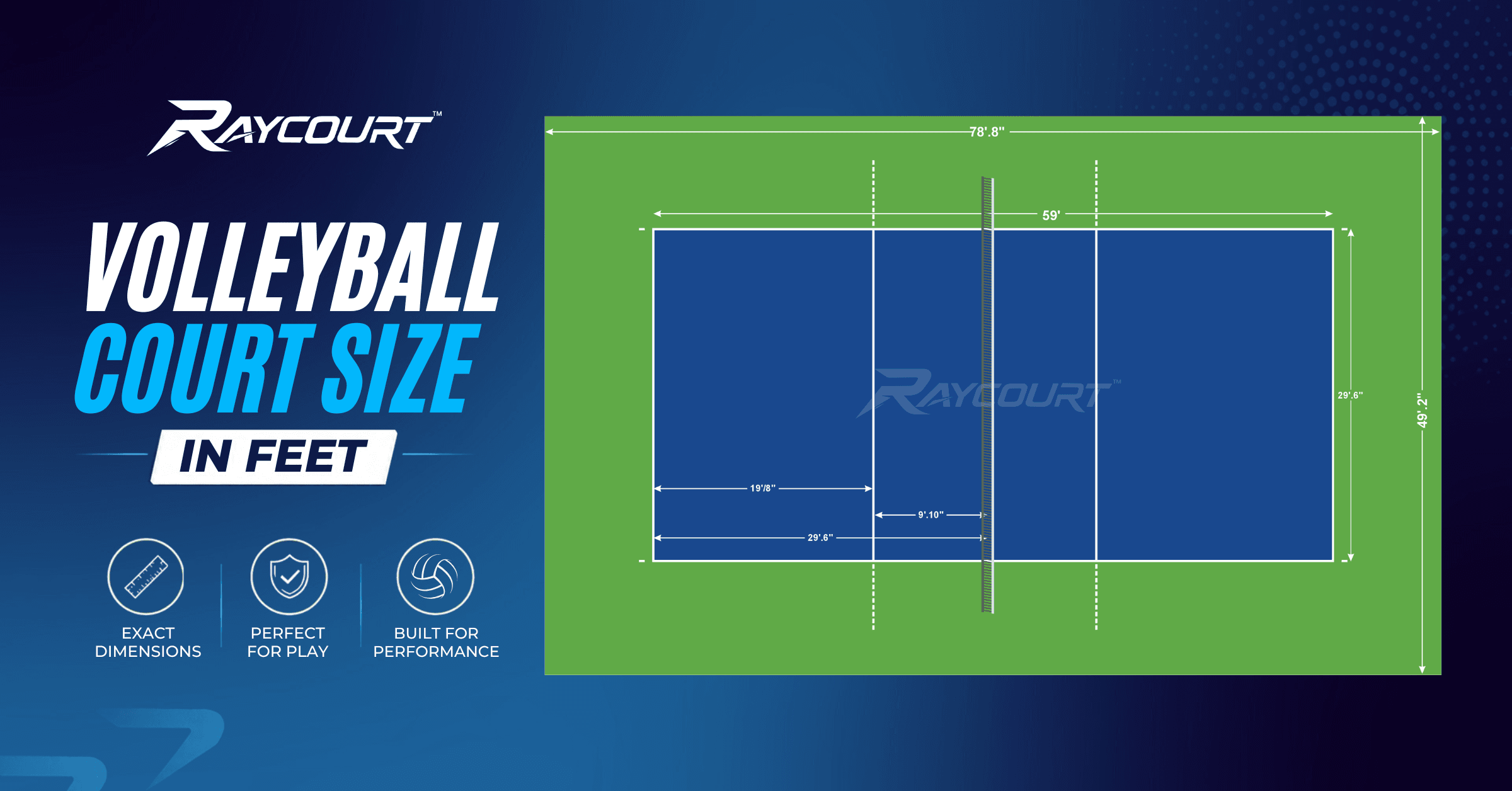
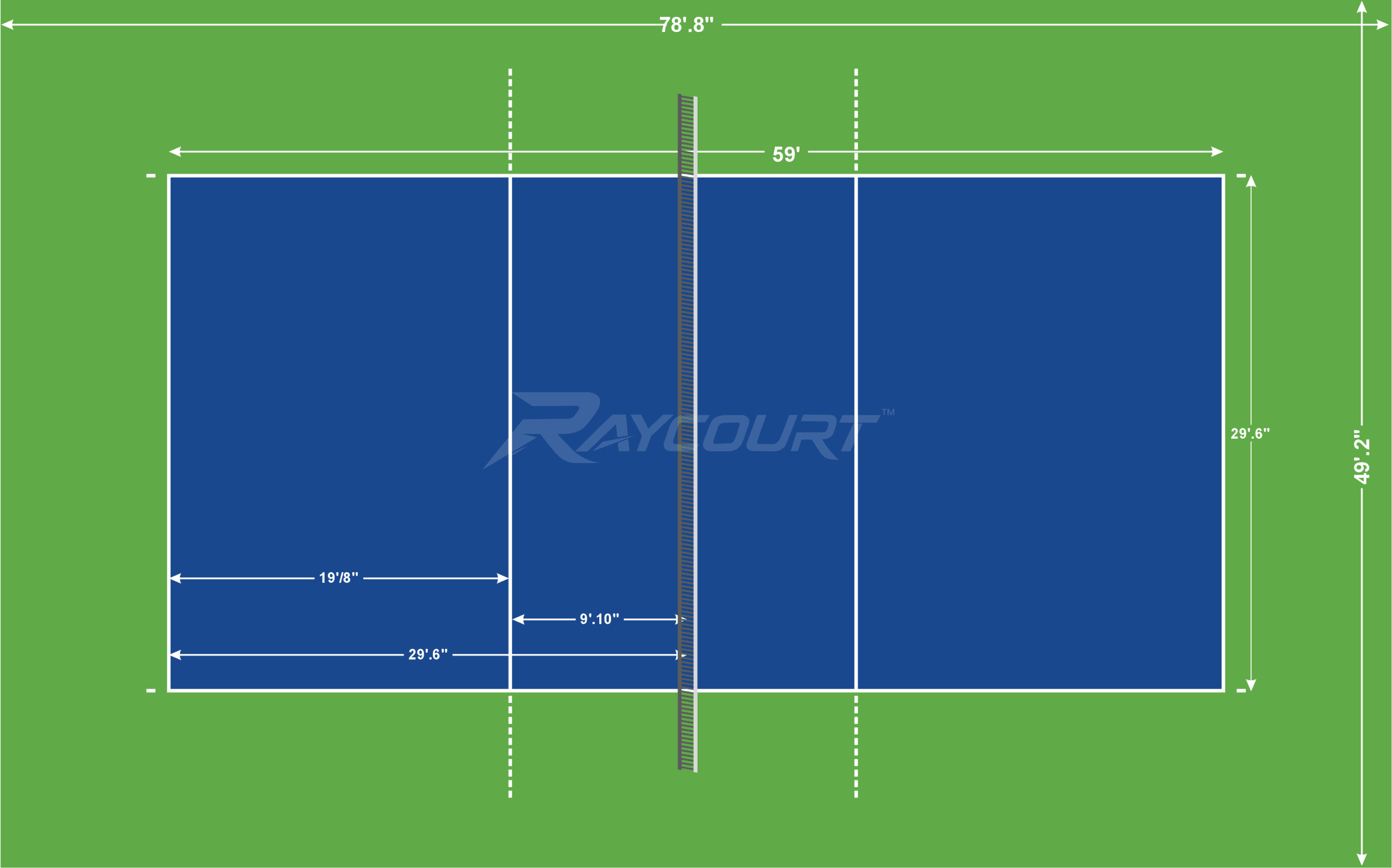
The official volleyball court size in feet is 59 feet long by 29.5 feet wide. This matches the international standard of 18 meters by 9 meters set by the FIVB. Every certified indoor court follows this same measurement, whether it hosts a school match or an Olympic final. A net divides the court into two equal halves of 29.5 feet by 29.5 feet each.
Coaches, architects, and flooring manufacturers rely on these numbers daily. Accurate dimensions keep gameplay fair and consistent across every level of competition. They also guide the layout of lines, zones, and surrounding space around the court.
This guide walks through every measurement you need in feet. You will find court length, width, net height, and line placement explained clearly. Along the way, Raycourt shares practical insight into how these dimensions shape flooring design and planning for volleyball facilities everywhere.
School administrators, gymnasium designers, and sports program directors all benefit from this same information. Whether you manage a single practice court or a full multi-court complex, correct dimensions form the foundation of every decision that follows. Read on for a complete, practical breakdown of volleyball court size in feet.
A Brief History of Volleyball Court Size
Volleyball began as a simple recreational game in the late 1800s. Early courts varied widely, since no official governing body existed yet. Players adjusted court size based on available space and local preference.
The sport grew quickly across schools, clubs, and community centers worldwide. As international competition expanded, the need for a single standard became clear. The Fédération Internationale de Volleyball eventually stepped in to unify court dimensions.
FIVB established the 18-by-9-meter court as the official international standard. This measurement translated directly to the 59-by-29.5-foot size used today. National federations across the globe adopted this same specification soon after.
FIVB formed in the mid-twentieth century to oversee international volleyball rules. The organization set clear standards for court size, net height, and equipment. National bodies like USA Volleyball, NCAA, and NFHS later aligned their own rules with these FIVB specifications.
This alignment created a seamless path for athletes moving between levels. A player training on a high school court practices on the exact same dimensions used in college and professional leagues. That continuity remains one of the sport’s most practical advantages today.
Modern volleyball still honors this same foundational measurement. Every certified court, from a small gymnasium to an Olympic arena, follows the same 59-by-29.5-foot layout. This consistency reflects decades of careful standardization work across the global volleyball community.
What Is the Official Volleyball Court Size in Feet?
A regulation volleyball court measures 59 feet in length and 29.5 feet in width. The Fédération Internationale de Volleyball, known as FIVB, sets this standard for every certified competition. National bodies like USA Volleyball, NCAA, and NFHS follow the exact same specification. This consistency lets players move between leagues without adjusting to a different court.
The rectangular shape stays constant across professional, collegiate, and recreational play. A center line splits the court into two symmetrical halves under the net. Each half measures 29.5 feet by 29.5 feet, creating a perfectly balanced playing surface.
Court Length and Width in Feet
The length of a standard volleyball court runs 59 feet from end line to end line. The width spans 29.5 feet from sideline to sideline. Together, these two measurements define the full playing area for every match.
Facility planners often round these figures for quick reference. Many use 60 feet by 30 feet as a working estimate during early design stages. However, the precise regulation size stays at 59 by 29.5 feet for official markings and certified competitions.
Total Playing Area and Two Court Halves
Multiply the length by the width, and you get the total playing area. A regulation court covers roughly 1,740.5 square feet of surface. The net splits this area into two equal zones of 870.25 square feet each.
Each team defends one half during play. Players rotate through six positions within their own zone. This layout keeps rotation, serving, and attacking consistent across every match, regardless of skill level.
Free Zone Dimensions Around the Court
The playing court never stands alone on a facility floor. A free zone surrounds it on all sides, giving players room to move safely. This buffer zone measures a minimum of 9.8 feet, or 3 meters, at the standard competitive level.
International and FIVB-sanctioned events require a wider buffer. Sidelines need at least 16.4 feet of clearance, while end lines need 26.2 feet. This extra space protects players during dives, blocks, and fast transitions near the boundary lines.
Volleyball Court Dimensions Table (Feet and Meters)
Numbers become easier to compare side by side. The table below breaks down every core measurement in both feet and meters, based on standards followed by FIVB, NCAA, NFHS, and USA Volleyball.
| Measurement | Feet | Meters | Governing Standard |
|---|---|---|---|
| Court Length | 59 ft | 18 m | FIVB, NCAA, NFHS |
| Court Width | 29.5 ft | 9 m | FIVB, NCAA, NFHS |
| Half-Court (each side) | 29.5 x 29.5 ft | 9 x 9 m | FIVB |
| Attack Line Distance | 9.8 ft | 3 m | FIVB |
| Minimum Free Zone | 9.8 ft | 3 m | FIVB, USA Volleyball |
| International Free Zone (Sidelines) | 16.4 ft | 5 m | FIVB World Competitions |
| International Free Zone (End Lines) | 26.2 ft | 8 m | FIVB World Competitions |
| Minimum Overhead Clearance | 23 ft | 7 m | FIVB, NFHS |
| International Overhead Clearance | 41 ft | 12.5 m | FIVB World Competitions |
| Net Height (Men) | 7 ft 11⅝ in | 2.43 m | FIVB, NCAA, NFHS |
| Net Height (Women) | 7 ft 4⅛ in | 2.24 m | FIVB, NCAA, NFHS |
This table gives you a fast reference point for design and verification. Keep it handy when you plan markings, net installation, or overall facility layout.
Converting Volleyball Court Dimensions: Feet, Inches, and Meters
Many facility owners work between metric and imperial measurements daily. International equipment often lists specifications in meters, while local contractors typically prefer feet. Understanding both systems prevents measurement errors during planning and line marking.
One meter equals approximately 3.28 feet. This simple conversion factor helps you translate any FIVB specification into feet quickly. Multiply the meter measurement by 3.28 to get an approximate feet equivalent.
For example, the 18-meter court length converts to roughly 59.04 feet, rounded to 59 feet. The 9-meter width converts to about 29.52 feet, rounded to 29.5 feet. These small rounding differences rarely affect real-world court marking accuracy.
Net height conversions require a bit more precision, since they involve inches as well as feet. The 2.43-meter men’s net height converts to 7 feet 11⅝ inches. The 2.24-meter women’s net height converts to 7 feet 4⅛ inches.
| To Convert | Multiply By | Example |
|---|---|---|
| Meters to Feet | 3.28 | 9 m × 3.28 = 29.52 ft |
| Feet to Meters | 0.3048 | 29.5 ft × 0.3048 = 8.99 m |
| Meters to Inches | 39.37 | 0.05 m × 39.37 = 1.97 in |
Keep a reliable conversion reference on hand during any court planning project. Small rounding errors can compound across multiple measurements. Double-checking your math helps you avoid mismatched lines and inaccurate free zone spacing.
Key Lines and Markings on a Volleyball Court (in Feet)
Every volleyball court needs specific lines to guide fair play. Each line serves a distinct purpose, from marking boundaries to controlling attack positioning. Understanding these markings in feet helps you plan accurate, regulation-ready courts.
Boundary Lines (Sidelines and End Lines)
Two sidelines run the full 59-foot length of the court. Two end lines close off each 29.5-foot width. Together, these four lines form the outer boundary of legal play.
Officials require boundary lines to measure exactly 2 inches wide. They must also use a color that contrasts clearly against the court surface. This visibility helps referees make fast, accurate calls during live rallies.
Center Line
The center line sits directly beneath the net. It stretches the full 29.5-foot width of the court from sideline to sideline. This line divides the court into two equal 29.5-by-29.5-foot halves.
Players may not fully cross this line during play, according to FIVB rules. Partial contact rules apply depending on foot or hand placement. Referees watch this boundary closely during blocking and net-adjacent plays.
Attack Line (3-Meter Line)
The attack line sits 9.8 feet, or 3 meters, back from the center line. This line marks the front zone on each half of the court. Back-row players must stay behind this line when attacking the ball above net height.
Coaches use this line to teach positioning and rotation strategy. It also separates front-row specialists from back-row defenders during transition plays.
Service Line and Service Zone
A service zone extends behind each end line for serving. This zone spans the full 29.5-foot width of the court. Servers must release the ball from within this designated area.
FIVB rules require the service zone to reach at least 6.6 feet, or 2 meters, deep. This depth gives servers enough room for a full approach and swing.
Substitution Zone
The substitution zone sits between the attack line and the team bench area. Coaches and players use this zone to request and complete substitutions during a match. This area does not carry a fixed dimension in feet, but it must remain clear and accessible throughout play.
Officials monitor this zone closely to keep substitutions organized and efficient. A cluttered or poorly defined substitution zone can slow down game flow unnecessarily. Clear court markings help everyone identify this space at a glance.
Teams also use this area during the libero replacement process. FIVB rules define specific procedures for libero substitutions near this zone. Facility layouts should keep this space free from obstructions like chairs, bags, or equipment carts.
Net Height Requirements in Feet and Inches
Net height plays just as important a role as court size. FIVB sets distinct net heights for men’s and women’s competition. These heights stay consistent across professional, collegiate, and most amateur leagues.
Men’s Net Height
The men’s net sits at 7 feet 11⅝ inches, or 2.43 meters. This height applies to professional, collegiate, and most high school men’s matches. Facility owners must measure this height at the exact center of the net.
Women’s Net Height
The women’s net stands at 7 feet 4⅛ inches, or 2.24 meters. This measurement applies across FIVB, NCAA, and most national federations. The height difference reflects average variations in reach and jump height between divisions.
Net Height for Junior and Mixed Competitions
Youth and junior leagues often lower net height to match player development. Many programs adjust height by age group, gradually raising it each season. Mixed and coed leagues sometimes use a middle-ground height between men’s and women’s standards.
Expert Tip: Always confirm net height requirements with your specific league or governing body before final installation. Small variations exist across school districts and regional associations.
Ready to build a court that performs for years to come?
Connect with Raycourt for sports flooring systems built for your project.
Free Zone and Overhead Clearance Explained
Space around and above the court matters just as much as the court itself. FIVB rules define both a minimum free zone and a minimum clearance height. These numbers protect players and support smooth, uninterrupted gameplay. For complete regulation details, review the official volleyball dimensions guide published by Western Australia’s Department of Local Government, Sport and Cultural Industries, which outlines FIVB standards in full.
Minimum Free Zone Width
Standard competitions require a free zone of at least 9.8 feet, or 3 meters, on every side. This buffer gives players room to dive, recover, and chase loose balls safely. Smaller facilities sometimes reduce this space, though FIVB discourages it for competitive play.
Free Zone for International Competitions
FIVB World and Official Competitions raise this requirement significantly. Sidelines need a minimum of 16.4 feet, or 5 meters, of clearance. End lines require even more space, reaching 26.2 feet, or 8 meters, at the highest competitive level.
Overhead Clearance Height
Overhead space prevents interference during spikes, blocks, and high serves. Standard courts need a minimum clearance of 23 feet. International competitions raise this figure to 41 feet above the playing surface.
Gymnasium designers must account for lighting fixtures, scoreboards, and support beams. Nothing should hang low enough to interfere with a full vertical jump.
Indoor vs Beach Volleyball Court Size in Feet
Indoor and beach volleyball share the same sport but differ in court size. Understanding both helps facility planners choose the right layout for their space.
Indoor Court Dimensions
Indoor courts follow the standard 59-by-29.5-foot measurement discussed throughout this guide. Synthetic and wooden surfaces both meet FIVB approval for indoor competition. Consistent, hard flooring supports fast footwork and precise line calls.
Beach Court Dimensions
Beach volleyball uses a smaller court than its indoor counterpart. The beach court measures 52.5 feet long by 26.2 feet wide, or 16 by 8 meters. This reduction accounts for the slower movement sand naturally creates underfoot.
Key Differences Between the Two
Court size represents just one difference between these formats. Indoor volleyball features six players per team, while beach volleyball uses two. Surface material, weather exposure, and boundary rules also vary significantly between the two disciplines.
Quick Questions: Indoor vs Beach Courts
Is a beach volleyball court smaller than an indoor court?
Yes, beach courts measure 52.5 by 26.2 feet, compared to 59 by 29.5 feet indoors.
Do beach and indoor courts use the same net height?
Yes, both formats use identical net heights for men’s and women’s competition.
Can indoor synthetic flooring work for beach-style training?
No, beach volleyball requires sand, but many facilities use indoor courts for cross-training drills.
Volleyball Court Size in Feet for Outdoor and Recreational Courts
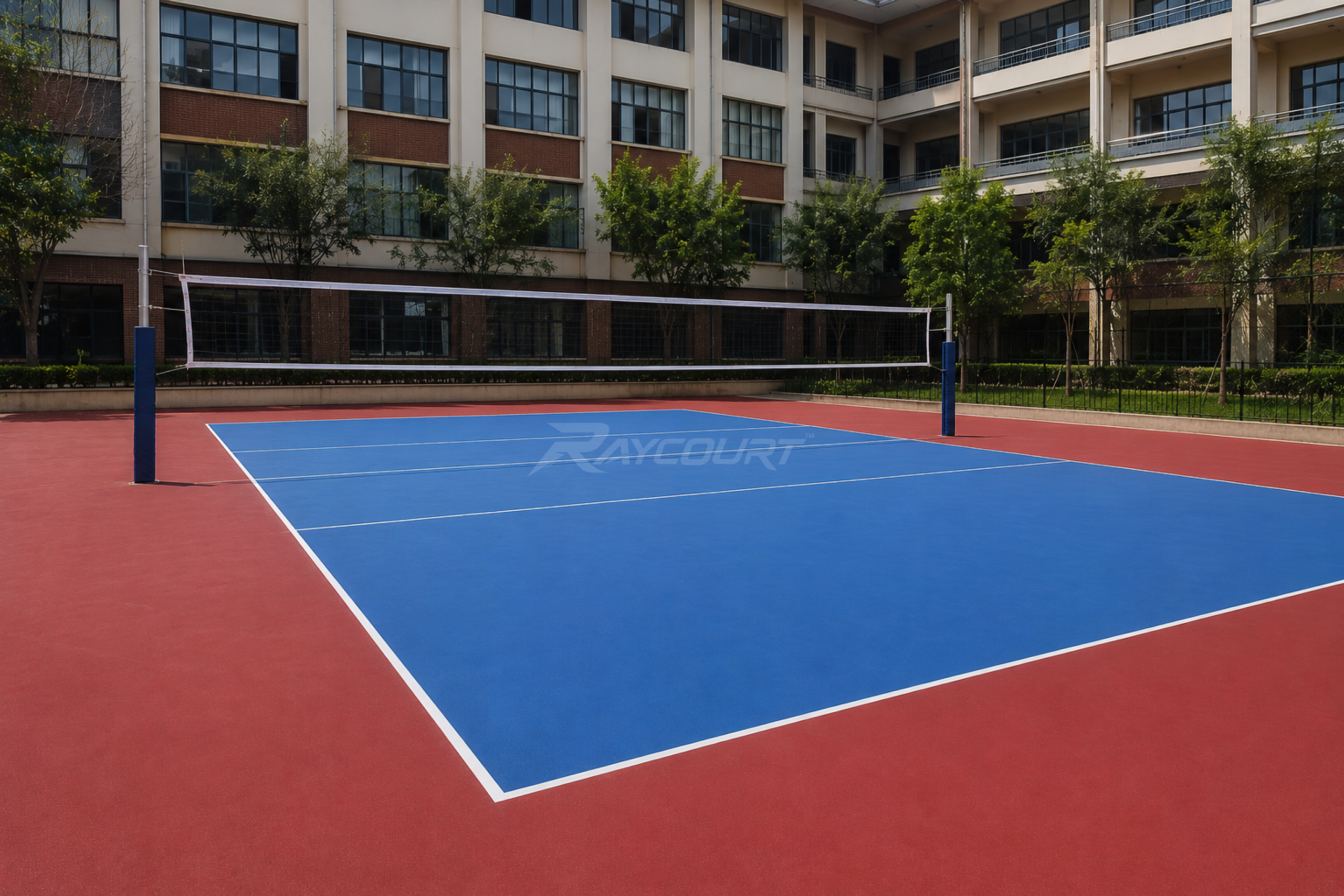
Not every volleyball court sits inside a gymnasium. Parks, schools, and recreation centers often build outdoor courts for casual and semi-competitive play. These courts typically follow the same 59-by-29.5-foot standard whenever space allows.
Outdoor recreational courts sometimes adjust slightly due to property limitations. A backyard or community court might shrink to fit available land. However, most organized outdoor leagues still aim for the full regulation size whenever possible.
Surface material becomes especially important for outdoor installations. Weather exposure, temperature swings, and UV rays all affect flooring performance over time. Weather-resistant synthetic acrylic surfaces hold their color and line accuracy far better than basic paint on asphalt.
Recreational facility owners benefit from planning with regulation dimensions from the start. A court built to the correct 59-by-29.5-foot standard supports both casual games and future competitive play. This flexibility gives community centers and schools far more long-term value from a single installation.
Multi-purpose outdoor courts often combine volleyball with other recreational activities. Some facilities paint pickleball or badminton lines within the same outdoor space. Careful color separation keeps each sport’s boundaries clear despite the shared surface.
Outdoor free zone requirements deserve extra attention as well. Fences, benches, or landscaping should never crowd the standard 9.8-foot buffer zone. Maintaining this space keeps outdoor play just as safe as any indoor gymnasium court.
Volleyball Court Size in Feet Compared to Other Indoor Sports Courts
Facility owners rarely build for volleyball alone. Many gymnasiums host basketball, badminton, and other indoor sports on the same flooring. Comparing court sizes helps planners design flexible, multi-purpose spaces.
Volleyball vs Basketball Court Size
A regulation volleyball court measures 59 by 29.5 feet. A standard NBA basketball court measures 94 by 50 feet, much larger overall. Many gymnasiums overlay a volleyball court within the boundaries of a full basketball court.
Volleyball vs Badminton Court Size
Badminton courts measure just 44 feet by 20 feet, considerably smaller than volleyball. Facilities often fit two or three badminton courts within the footprint of one volleyball court. This size difference makes badminton popular for smaller, space-limited facilities.
Volleyball vs Tennis Court Size
A tennis court measures 78 feet by 36 feet for doubles play, larger than a volleyball court. Indoor tennis facilities rarely double as volleyball venues due to this size gap. Ceiling height requirements also differ significantly between the two sports.
| Sport | Length | Width |
|---|---|---|
| Volleyball | 59 ft | 29.5 ft |
| Basketball (NBA) | 94 ft | 50 ft |
| Badminton | 44 ft | 20 ft |
| Tennis (Doubles) | 78 ft | 36 ft |
Raycourt manufactures synthetic acrylic flooring suited for all of these sports. Multi-purpose facilities benefit from a single, durable surface that supports overlapping line layouts. This flexibility helps gymnasiums maximize their space without sacrificing surface quality for any sport.
Ready to build a court that performs for years to come?
Connect with Raycourt for sports flooring systems built for your project.
Volleyball Court Size Variations by Level and Age Group
While the regulation court stays consistent at higher levels, younger age groups often use modified dimensions. These adjustments support skill development without overwhelming new players.
Professional and Collegiate Courts
Professional, Olympic, and collegiate matches always use the full 59-by-29.5-foot court. NCAA rules mirror FIVB standards almost exactly. Athletes at this level train and compete on identical dimensions worldwide.
High School Courts
High school volleyball generally follows the same 59-by-29.5-foot regulation size. NFHS guidelines align closely with FIVB and NCAA standards. Minor variations sometimes appear in free zone space, depending on gymnasium size.
Youth and Recreational Courts
Youth leagues frequently reduce court size for younger age divisions. Some programs use a shortened court around 40 to 45 feet long. Net height also drops for these divisions, helping young players develop proper technique early.
Recreational leagues sometimes adjust dimensions based on available gym space. These changes stay informal and vary widely between community programs and schools.
Coaches at this level often prioritize skill-building over strict regulation compliance. A smaller court lets young athletes cover the full playing area more easily. As players grow stronger and more experienced, programs typically transition them toward the full 59-by-29.5-foot regulation court.
Why Accurate Court Dimensions Matter for Facility Owners
Precise court dimensions affect far more than rule compliance. Accurate measurements protect player safety during fast, high-impact movements. They also determine how many courts fit within a given facility.
Player Safety and Injury Prevention
Tight or undersized free zones increase collision risk near the boundary lines. Players dive, lunge, and change direction constantly during competitive rallies. Adequate space gives athletes room to recover without hitting walls, bleachers, or other equipment.
Overhead clearance matters just as much as floor space. A low ceiling or hanging fixture can interfere with a player’s full vertical jump. Facility owners reduce injury risk significantly by respecting both horizontal and vertical clearance standards.
Certification and League Compliance
Miscalculated dimensions create real problems during certification and league approval. Some governing bodies reject courts that fall outside tolerance limits. Facility owners avoid rework and delays by confirming measurements before marking any lines.
Schools and clubs seeking official sanctioning face strict inspection standards. Inspectors typically check court length, width, net height, and free zone space. A single measurement error can delay certification and push back an entire competition schedule.
Consistent Athlete Performance Across Venues
Consistent sizing also supports athlete performance across different venues. Players build muscle memory around specific distances, like the 9.8-foot attack line. When every court matches this standard, athletes adapt quickly regardless of location.
This consistency matters most for traveling teams and multi-site tournaments. Athletes who train on regulation courts perform confidently no matter where they compete. Coaches also benefit, since practice drills translate directly to any certified venue.
Multi-Sport Facility Planning
Multi-sport facilities face additional challenges when combining volleyball with basketball or badminton. Overlapping lines require careful planning and clear color differentiation. Getting these details right from the start saves confusion during future events.
Facility managers often color-code each sport’s lines for quick visual identification. Volleyball lines might use one color, while basketball boundaries use another. This approach keeps courts flexible without sacrificing clarity for players, coaches, or officials.
How Volleyball Court Size Affects Flooring and Surface Design
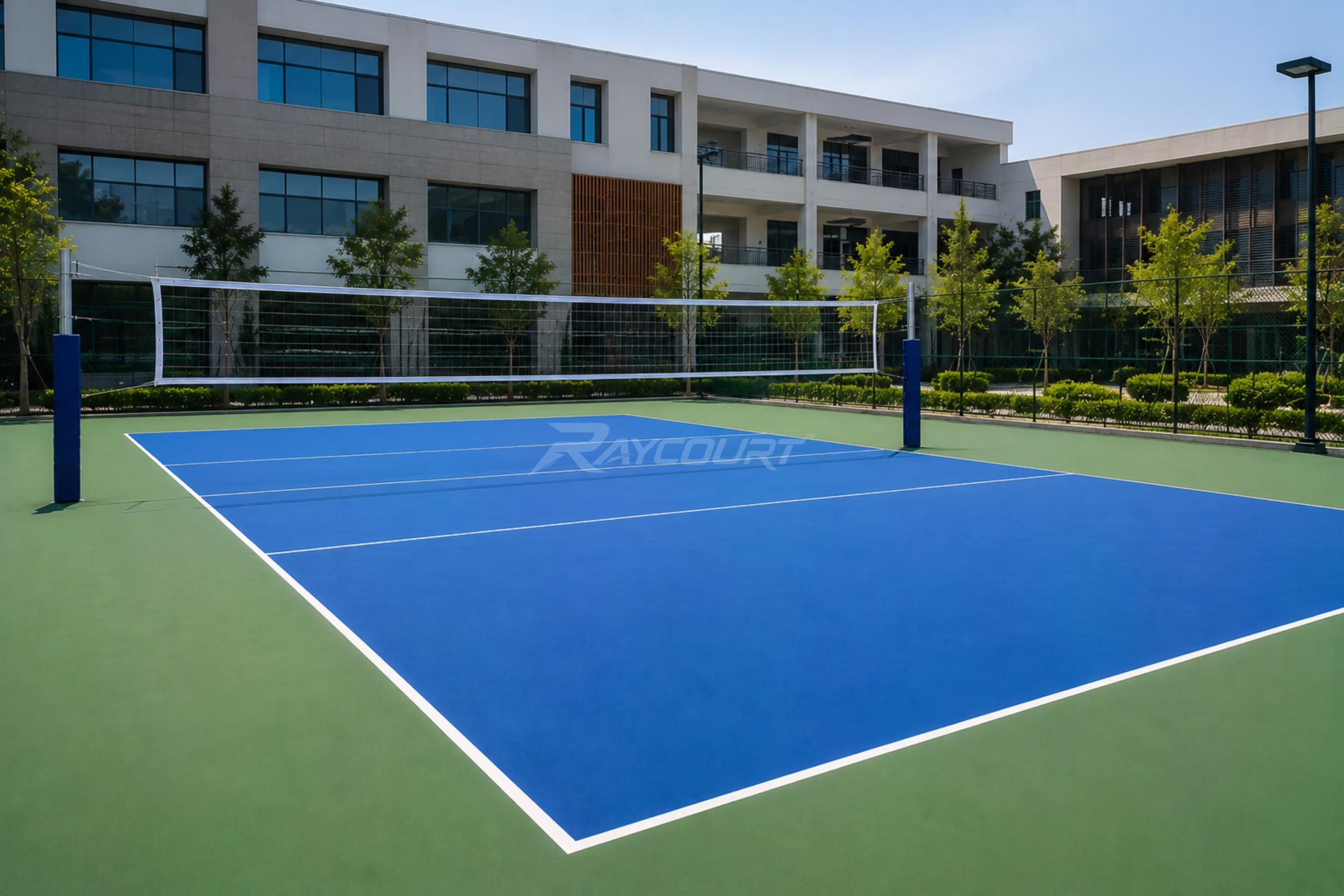
Court dimensions directly influence flooring design decisions. Raycourt’s synthetic acrylic surfaces support precise, long-lasting line markings across the full 59-by-29.5-foot area. Surface quality plays a major role in how well these dimensions hold up over time.
Marking Precision on Synthetic Acrylic Surfaces
Synthetic acrylic flooring provides a smooth, consistent base for accurate line application. This consistency matters most along high-traffic zones like the attack line and center line. A stable surface prevents lines from cracking, fading, or shifting out of tolerance.
Surface Consistency Across the Full Court Area
Uneven flooring creates real problems across a 1,740-square-foot playing surface. Players notice inconsistent bounce or footing almost immediately. Raycourt’s acrylic systems maintain uniform texture and traction across every inch of the regulation court.
Durability Considerations for High-Traffic Zones
Certain areas absorb far more impact than others during typical play. The attack line and service zone see constant foot traffic and quick directional changes. Durable, high-density acrylic coatings resist wear better in these demanding zones.
Choosing Surface Colors for Line Visibility
Color contrast plays a major role in line visibility during fast-paced play. Referees and players need to distinguish boundary lines instantly, even under bright gym lighting. High-contrast acrylic coatings make regulation lines easy to see from any angle on the court.
Facility owners often choose a neutral base color with bold, contrasting line colors. This combination keeps the full 59-by-29.5-foot court legible throughout an entire match. Consistent color choices also help players adjust quickly when switching between different venues.
Sub-Floor Preparation and Long-Term Line Accuracy
A well-prepared sub-floor supports accurate, long-lasting court markings. Uneven concrete or asphalt beneath the acrylic surface can cause lines to shift or crack over time. Proper leveling before installation protects the full regulation layout for years to come.
Temperature changes and moisture also affect surface stability in outdoor or semi-outdoor facilities. Raycourt’s acrylic systems resist these environmental factors better than many traditional coatings. This resilience helps facility owners maintain accurate court dimensions through repeated seasons of play.
Expert Tip: Choose flooring materials rated for high-impact, multi-directional movement, especially near the attack line and center court. This reduces surface degradation in the busiest parts of the court.
Step-by-Step: How to Measure and Mark a Volleyball Court in Feet
Marking a regulation court requires careful planning and the right tools. Follow these steps to achieve accurate, consistent lines across the full playing area.
Tools Needed for Accurate Marking
- Long-distance tape measure or laser measuring tool
- Chalk line or marking string
- Line marking paint or tape rated for the court surface
- Right-angle square for corner accuracy
- Stakes or anchor points for straight-line guidance
Marking the Boundary Lines
- Measure and mark the 59-foot length along one side first.
- Mark the 29.5-foot width at each end, forming a rectangle.
- Use a right-angle square to confirm true 90-degree corners.
- Snap chalk lines between each marked point for a clean guide.
- Apply paint or tape directly over the chalked guideline.
Marking the Center Line and Attack Line
- Find the exact midpoint along both 59-foot sidelines.
- Connect these midpoints to form the center line.
- Measure 9.8 feet back from the center line on each side.
- Mark this distance clearly to form both attack lines.
- Double-check symmetry by comparing both halves of the court.
Common Marking Mistakes to Avoid
- Skipping the right-angle check, which causes crooked boundary lines
- Measuring from the outer edge instead of the correct reference point
- Using low-quality tape that peels under heavy foot traffic
- Forgetting to verify free zone space before finalizing court placement
- Rushing the center line measurement, throwing off attack line accuracy
Standard Tolerances and Measurement Accuracy in Volleyball Court Construction
Perfect precision matters, but small tolerances exist within official guidelines. FIVB and national federations allow minor variance to account for real-world construction limitations. Understanding these tolerances helps facility owners avoid unnecessary rework.
Most governing bodies accept a tolerance of about half an inch across major boundary lines. This small margin accounts for natural variations in flooring installation and paint application. Exceeding this tolerance, however, can trigger certification issues during official inspections.
Professional surveying tools improve accuracy significantly compared to standard tape measures. Laser measuring devices reduce human error across long distances like the 59-foot court length. Many flooring contractors now use these tools as standard practice for regulation courts.
Consistency across every measurement matters more than any single number in isolation. A court can meet the 59-by-29.5-foot standard yet still fail certification due to uneven attack line placement. Double-checking every line against the center point helps prevent this kind of avoidable oversight.
Documentation also plays a role in long-term accuracy. Facility managers benefit from keeping detailed records of original court measurements. These records make future line touch-ups or resurfacing projects far more straightforward.
Ready to build a court that performs for years to come?
Connect with Raycourt for sports flooring systems built for your project.
Multi-Court Layouts and Space Planning in Feet
Many gymnasiums and sports complexes host multiple volleyball courts at once. Planning these layouts requires careful attention to spacing between each court. Adjacent courts need enough shared free zone space to prevent player collisions.
Facility designers often align courts end-to-end or side-by-side, depending on available square footage. Side-by-side layouts typically share sideline free zones between courts. End-to-end layouts require more generous spacing near the end lines instead.
A single 59-by-29.5-foot court with standard free zones needs roughly 79 feet by 49 feet total. This figure accounts for the full playing area plus buffer space on all sides. Multiplying this footprint helps facility owners calculate how many courts realistically fit within their space.
Consider a facility planning two side-by-side courts within one gymnasium. Sharing a single free zone between both courts often works well. This shared buffer typically needs at least 9.8 feet, matching the standard minimum free zone width.
| Layout Type | Courts | Approximate Total Width Needed |
|---|---|---|
| Single Court | 1 | 49 feet |
| Two Courts, Shared Sideline Buffer | 2 | 88.3 feet |
| Three Courts, Shared Sideline Buffers | 3 | 127.6 feet |
These figures assume a standard 9.8-foot free zone between adjacent courts. Facility owners should always confirm local gymnasium dimensions before finalizing a multi-court layout. Adjusting for support columns, doorways, or storage areas often changes the final plan.
Cross-court sightlines also matter for spectators and officials. Well-planned layouts keep scoreboards, benches, and walkways clear of active play zones. Thoughtful spacing improves both safety and the overall game-day experience for everyone involved.
Choosing a Flooring Manufacturer for Regulation-Ready Volleyball Courts
Court dimensions only matter as much as the surface beneath them. A regulation-ready volleyball court needs flooring that holds precise lines through years of active play. Choosing the right manufacturer makes a measurable difference in long-term court performance.
Raycourt specializes in synthetic acrylic surfaces engineered for accurate, durable line marking. Our material supports the full 59-by-29.5-foot layout without compromising surface consistency. Facility owners across many regions rely on Raycourt for dependable, regulation-compliant flooring material.
Look for a manufacturer that understands both sport-specific dimensions and material science. Surface texture, color stability, and line adhesion all affect how well a court performs over time. A knowledgeable manufacturer helps you avoid guesswork during the planning stage.
Raycourt works alongside architects, contractors, and facility planners to support accurate court layouts. While Raycourt manufactures the flooring material rather than handling installation, our technical guidance helps installation teams achieve precise, regulation-ready results. This collaborative approach keeps every volleyball court size in feet accurate from the very first line.
Quick Facts: Volleyball Court Size at a Glance
- Standard court size: 59 feet long by 29.5 feet wide
- Each half of the court: 29.5 by 29.5 feet
- Attack line distance: 9.8 feet from the center line
- Minimum free zone: 9.8 feet on all sides
- Net height (men): 7 feet 11⅝ inches
- Net height (women): 7 feet 4⅛ inches
- Minimum overhead clearance: 23 feet
- Beach court size: 52.5 feet long by 26.2 feet wide
FAQs
A standard volleyball court measures 59 feet long and 29.5 feet wide. This size applies to FIVB, NCAA, NFHS, and USA Volleyball competitions. A center line divides the court into two equal 29.5-by-29.5-foot halves, one for each team.
Each half measures 29.5 feet by 29.5 feet. The center line under the net divides the two halves evenly. This equal split keeps serving, blocking, and attacking fair for both teams.
The attack line sits 9.8 feet behind the center line. This distance stays consistent across professional and amateur levels. Back-row players must stay behind this line when attacking above net height.
Yes, beach courts measure 52.5 feet by 26.2 feet. Indoor courts remain larger at 59 by 29.5 feet. This reduction accounts for the slower movement sand naturally creates underfoot.
Standard play requires at least 9.8 feet of free zone on all sides. International competitions require significantly more space around every boundary line. This extra space protects players during dives, blocks, and fast transitions near the court edges.
Conclusion
Volleyball court size in feet stays remarkably consistent across most competitive levels. A regulation court measures 59 feet long and 29.5 feet wide, with clearly defined lines, zones, and net heights. These numbers guide everything from initial facility planning to final line marking.
Raycourt brings deep material expertise to every volleyball flooring project. Our synthetic acrylic surfaces support precise, durable markings across the full regulation court. Whether you’re planning a single court or a multi-court complex, accurate dimensions set the foundation for safe, professional-grade play.
From the initial 59-by-29.5-foot layout to the smallest attack line detail, every measurement plays a role in fair, safe competition. Facility owners who plan carefully avoid confusion during construction and certification. That careful planning pays off through years of consistent, dependable play.
Raycourt remains ready to support architects, contractors, and facility planners with dependable flooring material for every court type. Reach out to Raycourt to learn more about synthetic acrylic flooring solutions built for regulation volleyball courts and beyond.
Ready to build a court that performs for years to come?
Connect with Raycourt for sports flooring systems built for your project.