
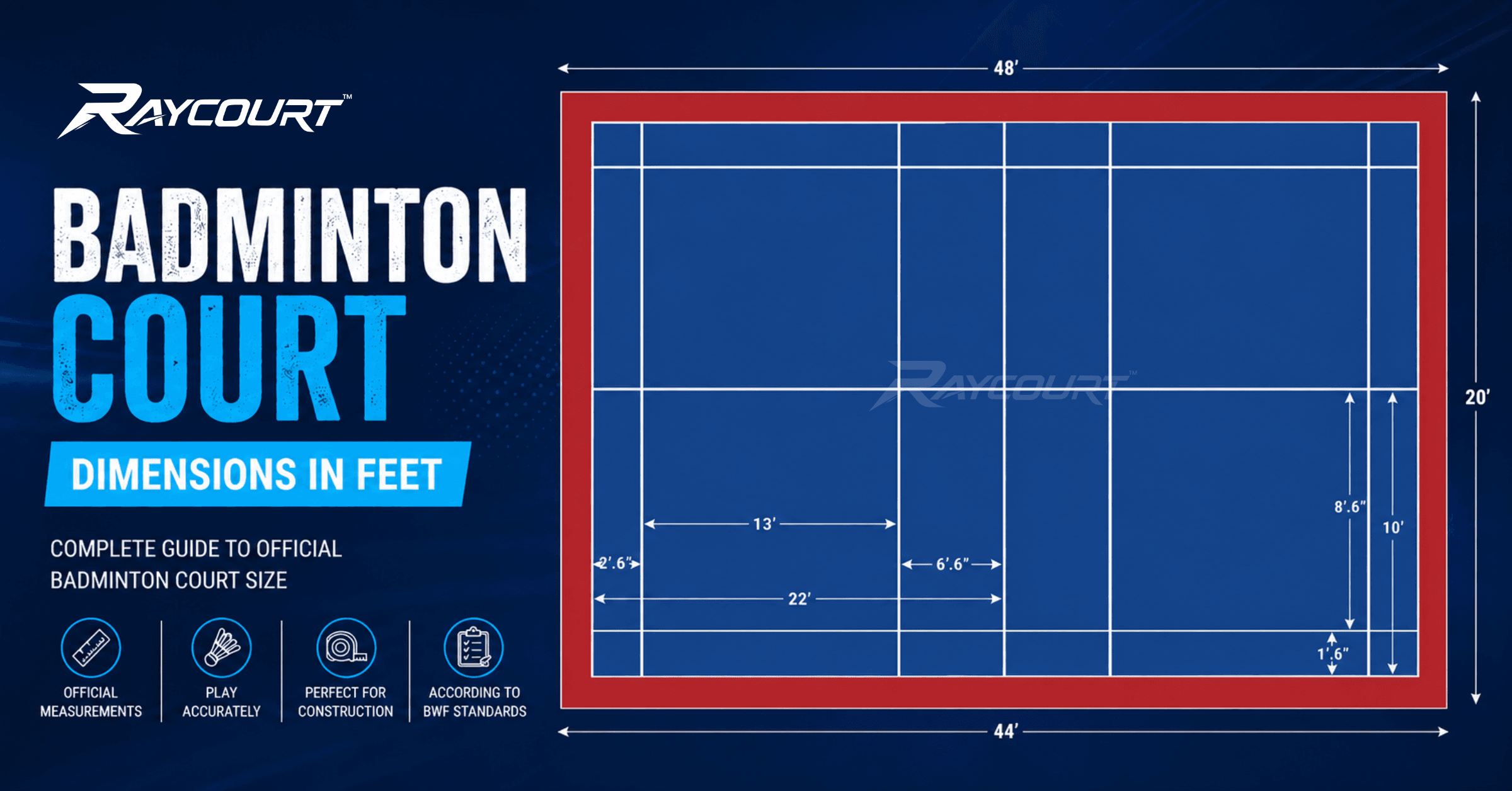
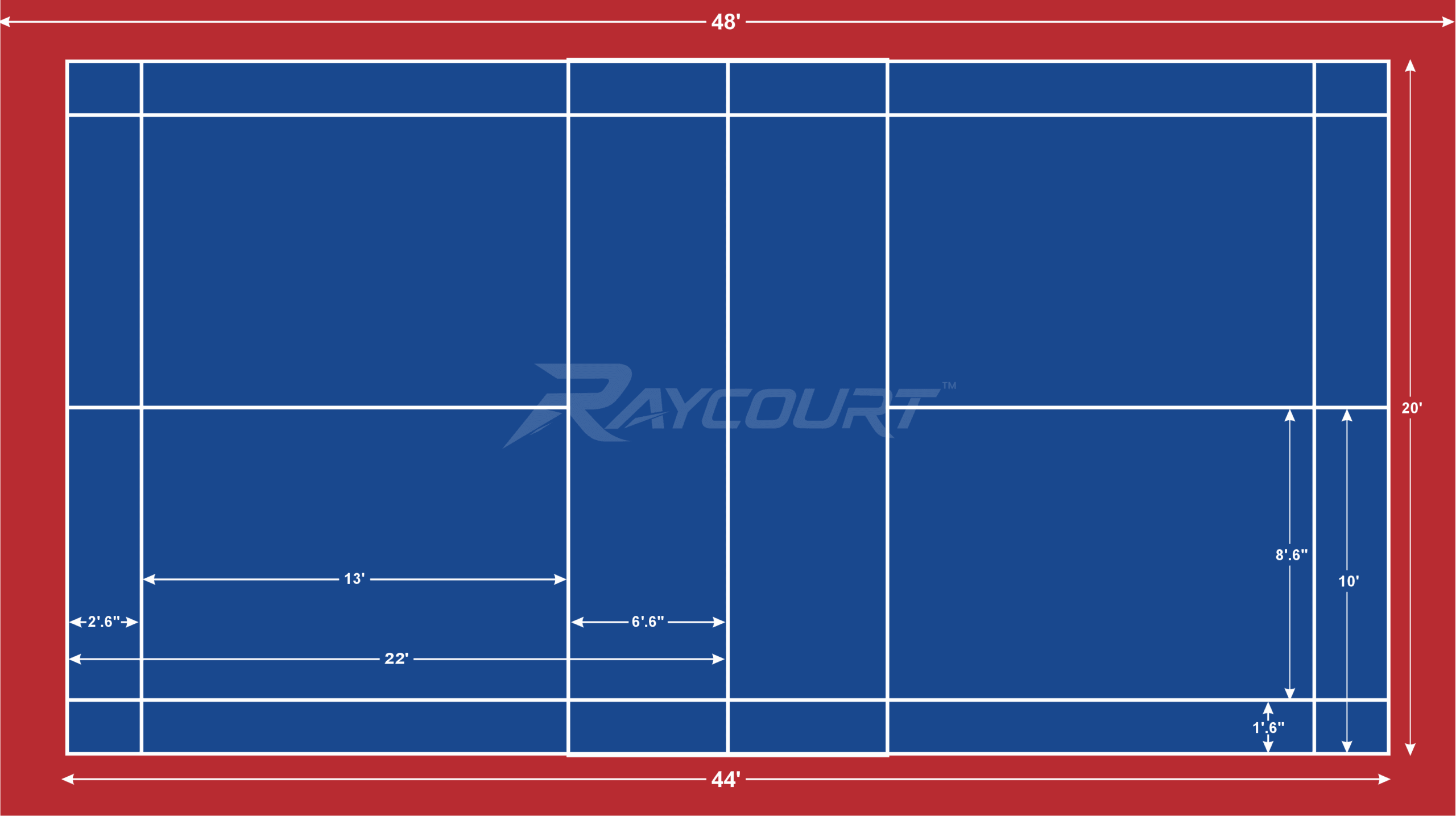
A standard badminton court measures 44 feet long. The width changes depending on the format. A doubles court spans 20 feet wide, while a singles court narrows to 17 feet wide. These figures come directly from the Badminton World Federation (BWF), the sport’s global governing body. Every certified badminton venue, from a school gymnasium to an Olympic arena, follows this exact layout. Understanding these numbers helps you plan a court correctly from day one.
This guide breaks down every measurement you need. You will learn the full court layout, net height, service line placement, and the clearance space required around the boundaries. You will also discover how flooring quality affects the accuracy of these dimensions over time. Whether you manage a school gymnasium, a community sports centre, or a home court project, this guide has you covered. These figures give you a reliable starting point. Each section below builds on the last. You can read straight through, or jump directly to the details you need most right now.
A Brief History of Standardized Badminton Court Dimensions
Badminton evolved from an informal lawn game into a codified sport during the late nineteenth century. Early matches often used inconsistent court sizes, which created confusion whenever players travelled to different clubs. The Badminton Association of England, formed in 1893, began the work of standardizing rules and boundaries. This effort eventually led to the internationally recognised dimensions players use today.
The Badminton World Federation later took over global governance of the sport. It refined and published the official Laws of Badminton, which fix the 44-foot length and format-specific widths still used worldwide. Standardization matters enormously here, because it lets players compete confidently at any certified venue. A player in Delhi trains on the exact same court geometry as a player in London or Jakarta. This consistency forms the backbone of fair international competition. It remains just as important for amateur clubs and school programmes today. Even recreational venues benefit from following these established standards, since players carry the same expectations wherever they play.
Standard Badminton Court Dimensions in Feet
Badminton uses one court for two formats: singles and doubles. Both formats share the same length, but the width differs based on which sidelines are active during play.
Doubles Court Size in Feet
A doubles badminton court measures 44 feet in length and 20 feet in width. Players use the outermost sidelines during doubles matches, which gives both teams more room to cover the court. This wider boundary supports the faster net exchanges and cross-court shots common in doubles play. The doubles format also uses a shorter service zone near the back boundary, which we cover later in this guide.
Singles Court Size in Feet
A singles badminton court keeps the same 44-foot length but narrows to 17 feet in width. Singles players use the inner sidelines instead of the outer ones. This narrower width reflects the fact that one player alone cannot cover as much horizontal ground as a doubles team. However, singles matches use a longer service zone that stretches deeper toward the back boundary.
Quick Reference Table: Court Width and Length by Format
| Court Element | Doubles | Singles |
|---|---|---|
| Court Length | 44 feet | 44 feet |
| Court Width | 20 feet | 17 feet |
| Sidelines Used | Outer sidelines | Inner sidelines |
| Service Line Depth | Shorter, closer to net | Longer, closer to back boundary |
| Total Playing Area | Approximately 880 sq ft | Approximately 748 sq ft |
Expert Tip: Always mark both sets of sidelines on a multi-purpose court. This lets a single surface serve singles and doubles players without repainting lines between matches.
Full Breakdown of Badminton Court Measurements
A badminton court involves more than just its outer boundary. Several internal lines and structural elements work together to define fair play. Contractors and facility owners need to understand each element before they mark a court. Missing even one internal measurement can throw off the entire layout. Every line ties back to the court’s overall geometry in some way.
Court Length and Width Explained
The 44-foot length stays fixed regardless of format, and this consistency matters for training purposes. Players who practice on a doubles court still cover the full 44-foot length during singles rallies. The court divides into two equal halves of 22 feet each, split by the net. This symmetry ensures neither side gains a positional advantage before the first serve.
Net Height and Post Placement
The net sits at the centre of the court and separates the two halves. Official rules set the net height at 5 feet at the centre and 5 feet 1 inch at the posts. This slight difference creates a gentle sag across the middle of the net. Posts always sit on the doubles sidelines, even during singles matches. This placement keeps the net taut and prevents shuttlecocks from slipping under loose netting near the edges.
Service Line Dimensions
Service lines determine where a legal serve must land, and they differ between singles and doubles. The short service line sits 6 feet 6 inches from the net on both sides of the court. Doubles matches use a long service line positioned 2 feet 6 inches from the back boundary. Singles matches skip this shorter zone entirely; the back boundary line itself serves as the long service line. These distinctions prevent confusion during fast-paced rallies and keep serves within a fair, consistent zone.
Centre Line and Side Alleys
A centre line splits each service box into two equal sections, directing serves toward the correct diagonal opponent. The side alleys, which run along the outer edges of the court, only come into play during doubles matches. Singles players treat these alleys as out-of-bounds. Accurate alley width matters here, since even a small marking error can turn a fair shot into a disputed call.
Para-Badminton Court Dimensions
Para-badminton uses the same overall court footprint as standard badminton, keeping the familiar 44-foot length. Wheelchair categories use a narrowed playing area, since athletes cannot cover the full width as quickly as standing players. Officials mark reduced service boxes for wheelchair events, while standing para-badminton categories generally follow standard singles or doubles boundaries. Facility owners planning inclusive programmes should mark both standard and para-specific lines clearly, using distinct colours wherever possible. A stable acrylic surface supports this layered marking approach without sacrificing clarity for any category of play.
Badminton Court Size in Feet vs Metres
International standards use metric measurements, but many facilities in the United States and other countries plan in feet. This table converts every major badminton court measurement between the two systems for quick reference.
| Measurement | Feet | Metres |
|---|---|---|
| Court Length | 44 ft | 13.4 m |
| Doubles Width | 20 ft | 6.1 m |
| Singles Width | 17 ft | 5.18 m |
| Net Height (Centre) | 5 ft | 1.524 m |
| Net Height (Posts) | 5 ft 1 in | 1.55 m |
| Short Service Line (from net) | 6.5 ft | 1.98 m |
| Long Service Line, Doubles (from back) | 2.5 ft | 0.76 m |
| Diagonal Court Length | 48.3 ft | 14.72 m |
Knowing both unit systems helps you communicate clearly with international suppliers, architects, and equipment vendors. It also helps you double-check contractor measurements against official BWF documentation, which typically lists dimensions in metres first. Raycourt works with clients across multiple regions, so our team stays fluent in both measurement systems throughout every project conversation. This flexibility removes a common source of confusion during international court planning and material ordering.
Why Accurate Court Dimensions Matter
Precise court dimensions protect players and preserve the integrity of the game. A court that runs even six inches short can change how a rally develops near the back boundary. Players who train on undersized courts often struggle to adjust when they compete on regulation surfaces. This mismatch can affect footwork, shot timing, and overall confidence during competitive play. Even experienced players notice the difference immediately when they step onto an incorrectly sized court.
Safety also depends heavily on correct sizing. Adequate court width gives players enough room to lunge, pivot, and recover without colliding with sidelines or nearby obstacles. A cramped layout increases the risk of ankle injuries and collisions between doubles partners. Beyond safety, dimensional accuracy supports fair competition. Umpires rely on precise lines to make quick, confident calls during fast exchanges. Blurred or misplaced lines slow down matches and create unnecessary disputes. Coaches also lose valuable training time correcting habits that formed on an inaccurate court.
Consistency across venues matters just as much. A player who trains at one facility and competes at another expects the same court experience in both locations. Standardized dimensions make this possible, and they let coaches design training drills that translate directly to competitive settings. For these reasons, precise measurement should never feel like an afterthought during court construction.
Certification bodies and school athletic programmes also depend on accurate dimensions. Many tournaments require venues to pass a formal inspection before hosting sanctioned matches. Facility owners who skip careful measurement often face costly corrections later, along with possible disqualification from hosting official events. Insurance providers sometimes reference safety clearance standards too, since undersized courts raise the likelihood of player collisions. Getting the dimensions right from the start protects players, satisfies governing bodies, and saves facility owners from expensive rework.
Badminton Court Size Compared to Other Racquet Sports
Facility planners often manage multiple court types within the same building. Comparing badminton dimensions against other racquet sports helps with overall space planning. Badminton actually occupies a smaller footprint than tennis but a larger one than pickleball. Squash, by contrast, uses an entirely enclosed court with walls instead of open sidelines. Reviewing these differences side by side makes it easier to allocate gymnasium space across several sports at once.
| Sport | Court Length (Feet) | Court Width (Feet) |
|---|---|---|
| Badminton (Doubles) | 44 ft | 20 ft |
| Badminton (Singles) | 44 ft | 17 ft |
| Pickleball | 44 ft | 20 ft |
| Tennis (Doubles) | 78 ft | 36 ft |
| Squash | 32 ft | 21 ft |
Interestingly, a badminton doubles court shares identical outer dimensions with a pickleball court. However, the two sports use completely different net heights and surface markings. This overlap sometimes lets facilities convert space between sports with careful re-marking, provided the flooring supports multiple line colours clearly. Tennis, meanwhile, requires nearly double the length and width of badminton. This difference explains why indoor tennis facilities need significantly larger buildings. Understanding these comparisons helps multi-sport facility owners plan gymnasium space more efficiently. This clarity matters most when budgeting limited indoor square footage across several activities at once.
Space Requirements Beyond the Playing Court
The 44-by-20-foot playing area only tells part of the story. Facility planners must also account for buffer zones, ceiling height, and total footprint before finalizing a badminton facility layout.
Clearance Space Around the Court
Players need room beyond the boundary lines to chase wide shots and recover safely. Most guidelines recommend a minimum clearance of 6.5 feet on every side of the court. Recreational facilities often extend this to 10 feet or more for added safety margin. This buffer prevents players from slamming into walls, poles, or spectator areas during aggressive rallies. Without this space, even a technically correct court becomes unsafe for competitive play.
Ceiling Height Requirements
Badminton produces some of the highest shuttlecock trajectories of any racquet sport, so ceiling height matters enormously. Facilities should aim for a minimum clearance of 20 feet, though competitive venues often exceed 30 feet. International tournament venues frequently reach ceiling heights above 39 feet to accommodate powerful clears and defensive lifts. A low ceiling forces players to alter their natural shot selection, which undermines proper training and fair competitive play.
Total Facility Footprint Planning
Combining the playing court, side clearance, and back clearance quickly increases total footprint needs. A single badminton court typically requires roughly 60 feet by 34 feet of total space. This figure assumes every buffer zone factors into the final layout. Multi-court facilities need proportionally larger spaces, along with walkways between adjacent courts. Planners should also factor in space for seating, equipment storage, and circulation paths. Skipping this step often forces expensive layout changes later in a project, well after construction has already begun.
Multi-Court Badminton Facility Layout in Feet
Many gymnasiums and sports centres install several badminton courts side by side. This approach maximizes participation but demands careful spatial planning. Each court still needs its own 44-by-20-foot doubles boundary, along with adequate clearance on every side. Adjacent courts typically share a common buffer zone rather than doubling clearance space unnecessarily.
Most facility designers position courts with roughly 3 to 4 feet of shared walkway between neighboring boundaries. This sits in addition to standard side clearance on each court. This spacing lets players and officials move safely between matches without interrupting nearby games. A gymnasium hosting four badminton courts, arranged in a two-by-two grid, needs significant floor space overall. Once clearance and walkways factor in, the total area often exceeds 120 by 68 feet.
Line colour also becomes important in multi-court layouts. Facilities sometimes host badminton alongside basketball, volleyball, or pickleball on the same floor. Using distinct line colours for each sport prevents confusion during fast-paced play. Raycourt’s acrylic coating systems support multiple colour layers. This helps facilities keep every sport’s boundaries crisp and easy to distinguish, even on a shared multi-purpose floor.
Expert Tip: When designing a multi-court gymnasium, choose badminton line colours that contrast sharply against other sports already marked on the floor. This small choice prevents players from misreading boundaries during quick transitions between games.
The Role of Flooring in Badminton Court Accuracy and Performance
Court dimensions only matter if the flooring beneath them holds those measurements accurately over time. This is where surface material becomes just as important as the layout itself. Raycourt focuses exclusively on manufacturing high-performance acrylic flooring systems, engineered to support precise, long-lasting court markings.
Shock Absorption and Player Safety
Badminton involves rapid lunges, quick direction changes, and repeated jumping. A quality acrylic surface absorbs impact and reduces stress on players’ joints during these movements. Raycourt’s cushioned acrylic systems distribute force evenly across the surface, which helps lower the risk of repetitive strain injuries. Firm yet responsive flooring also supports faster footwork, since players trust the surface to respond predictably under pressure. Over a long season of training, this predictability adds up to noticeably fewer overuse injuries among regular players.
Line Marking Precision on Acrylic Surfaces
An acrylic surface holds paint and markings far better than many alternative materials. This matters because badminton courts rely on multiple overlapping lines, including sidelines, service lines, and centre lines. A stable, textured acrylic base prevents lines from bleeding, fading, or shifting under UV exposure and heavy foot traffic. Raycourt formulates its acrylic coatings to bond tightly with court markings, which keeps every measurement crisp and legible for years.
Durability and Weather Resistance for Outdoor Courts
Outdoor badminton courts face constant exposure to sun, rain, and temperature swings. These conditions can warp inferior surfaces and distort critical measurements over time. Raycourt’s acrylic systems resist UV degradation and moisture penetration, which helps outdoor courts maintain their original dimensions season after season. This durability protects the investment facility owners make in professional-grade court construction. A surface that resists these environmental stresses also reduces how often facilities need to schedule downtime for repairs or re-marking.
Ready to build a court that performs for years to come?
Connect with Raycourt for sports flooring systems built for your project.
Indoor vs Outdoor Badminton Courts: Size and Surface Considerations
Indoor and outdoor badminton courts share identical official dimensions, but their surrounding conditions differ significantly. Indoor venues offer controlled airflow, which matters because wind easily disrupts a shuttlecock’s flight path. Outdoor courts, by contrast, expose players to wind, glare, and changing weather. Even so, the court measurements themselves stay the same across both settings. Facility owners should still plan carefully for these environmental differences when choosing materials and orientation.
Does court size change for outdoor badminton?
No. The official 44-by-20-foot doubles layout and 44-by-17-foot singles layout apply to both indoor and outdoor settings. Only the surrounding environment changes, not the core dimensions.
Why do outdoor courts need tougher flooring?
Outdoor surfaces face rain, heat, and UV exposure daily. A weather-resistant acrylic coating prevents cracking, fading, and dimensional drift, which keeps lines accurate despite constant environmental stress.
Can casual outdoor badminton use smaller dimensions?
Recreational, non-competitive play sometimes uses relaxed dimensions for convenience. However, any facility hosting organised matches or training sessions should always follow official BWF measurements.
How to Measure a Badminton Court Accurately in Feet
Marking a badminton court correctly starts with the right tools and a careful process. Contractors typically begin with a long tape measure or a laser measuring device. Accuracy over a full 44-foot span matters enormously here. A chalk line or string line helps establish straight boundaries before any paint touches the surface.
The process usually starts at one corner of the court. From there, the crew measures the full 44-foot length along one sideline and marks the opposite corner. Next, they measure the correct width, either 20 feet for doubles or 17 feet for singles. They then mark the remaining two corners. Once all four corners sit in place, the crew checks both diagonal measurements. Equal diagonals confirm a true rectangle, while unequal diagonals signal a skewed layout that needs correction before painting begins.
After confirming the outer boundary, the crew marks internal lines, including the centre line, service lines, and side alleys. Each of these lines follows a precise distance from the net or back boundary, as outlined earlier in this guide. Working on a stable acrylic surface makes this entire process far more reliable. The base layer will not shift once markings go down.
Expert Tip: Recheck all four corner angles with a carpenter’s square before painting any lines. Small angle errors compound quickly across a 44-foot court, distorting the final layout.
Common Mistakes When Marking Badminton Court Dimensions
Even experienced contractors sometimes make measurement errors during court layout. These mistakes can compromise safety, fairness, and long-term usability. Watch for the following common issues:
- Mixing up singles and doubles sidelines. This error leads to incorrect width markings and confuses players about legal boundaries.
- Measuring diagonals inconsistently. Skipping this check lets the court form a skewed parallelogram instead of a true rectangle.
- Ignoring clearance space. This mistake places walls or obstacles too close to the boundary lines, raising injury risk.
- Using inconsistent line widths. Uneven lines create confusion during fast, close calls near the boundary.
- Skipping surface leveling. An unlevel base allows the flooring to shift and distort markings over time.
- Overlooking net post placement. Contractors sometimes position posts inside the sidelines instead of directly on them.
Avoiding these mistakes early saves significant time and effort down the line. A well-planned court, built on a stable acrylic surface, rarely needs re-marking or structural correction.
How Facility Owners and Contractors Verify Court Accuracy
Confirming correct court dimensions takes more than a single tape measurement. Facility owners can follow this structured verification process before finalizing any badminton court layout.
- Measure the outer boundary first. Confirm the 44-foot length and correct width for either singles or doubles use, checking each sideline individually.
- Check both diagonals. Equal diagonal measurements confirm the court forms a true rectangle rather than a distorted shape.
- Verify net height at three points. Check the centre and both posts to confirm the required 5-foot and 5-foot-1-inch heights.
- Confirm service line distances. Measure 6 feet 6 inches from the net and 2 feet 6 inches from the back boundary for doubles play.
- Inspect clearance zones. Ensure at least 6.5 feet of open space surrounds every boundary line on all four sides.
- Review the flooring surface. Look for cracking, bubbling, or uneven sections that could distort future measurements.
- Document every measurement. Keep a written record for future maintenance checks and facility inspections.
This process helps facility owners catch problems before they affect competitive play. Regular re-verification also protects long-term investment in professional court construction. Many facilities schedule a full dimensional check once or twice each year, especially before hosting organised tournaments. This simple habit costs little time but prevents far larger headaches down the road.
Ready to build a court that performs for years to come?
Connect with Raycourt for sports flooring systems built for your project.
Badminton Court Size in Feet for Different Settings
Court dimensions stay consistent across most contexts, but planning needs shift depending on where you build the court. This section answers common questions about badminton court size across different environments.
What is the badminton court size in feet for home installations?
Homeowners often lack space for a full 44-by-20-foot doubles court plus clearance zones. Many opt for a singles-only layout at 44 by 17 feet, paired with smaller clearance margins where possible. Backyard courts sometimes trim clearance space further, though this trade-off can limit safe recovery room during fast rallies. A homeowner planning a permanent installation should still aim for official dimensions wherever the available space allows it.
Do schools use the same court dimensions as professional venues?
Yes, most school gymnasiums follow standard 44-by-20-foot doubles dimensions. Schools benefit from consistency, since students who compete outside school will already know the layout well. Physical education programmes also rely on this consistency to teach proper positioning and movement patterns early. Building young players’ habits around correct dimensions pays off later, once they compete in club or tournament settings.
Are community centre courts smaller than professional courts?
Community centres typically follow official dimensions too, though ceiling height and clearance space sometimes fall short of tournament-grade standards. Facility managers should still aim for at least 20 feet of ceiling clearance where feasible.
Does professional-level play require anything beyond standard dimensions?
Professional and tournament venues add stricter requirements around lighting, ceiling height, and flooring certification. The core court dimensions, however, remain identical to recreational courts.
Expert Tip: When space runs short, prioritize accurate singles dimensions over an undersized doubles layout. A correctly sized singles court trains better habits than a doubles court that falls short of regulation width.
Choosing the Right Acrylic Surface for Standard-Sized Courts
Selecting the right flooring material directly affects how well a court maintains its dimensions over time. Raycourt manufactures multi-layer acrylic systems specifically engineered for sports courts, including badminton. These systems combine a stable base layer with a textured, colour-coated top layer designed for line marking accuracy. Facility owners who invest in quality flooring upfront typically avoid the recurring re-marking costs that plague lower-grade surfaces.
A well-engineered acrylic surface resists expansion and contraction caused by temperature changes. This stability matters because even minor surface movement can shift painted lines out of regulation position. Raycourt’s manufacturing process focuses on consistent thickness and adhesion across the entire court area, which supports long-term dimensional accuracy.
Facility owners should also consider surface texture when selecting acrylic flooring. A properly textured surface improves traction, which helps players execute quick lateral movements safely. Raycourt formulates its coatings to balance grip and glide, supporting the explosive footwork badminton demands. Raycourt manufactures flooring materials rather than performing installation. We recommend working with a qualified court contractor who can apply our acrylic systems according to official BWF layout specifications. This partnership between manufacturer and contractor ensures the finished court meets both material and dimensional standards from day one.
Understanding the Acrylic Layer System
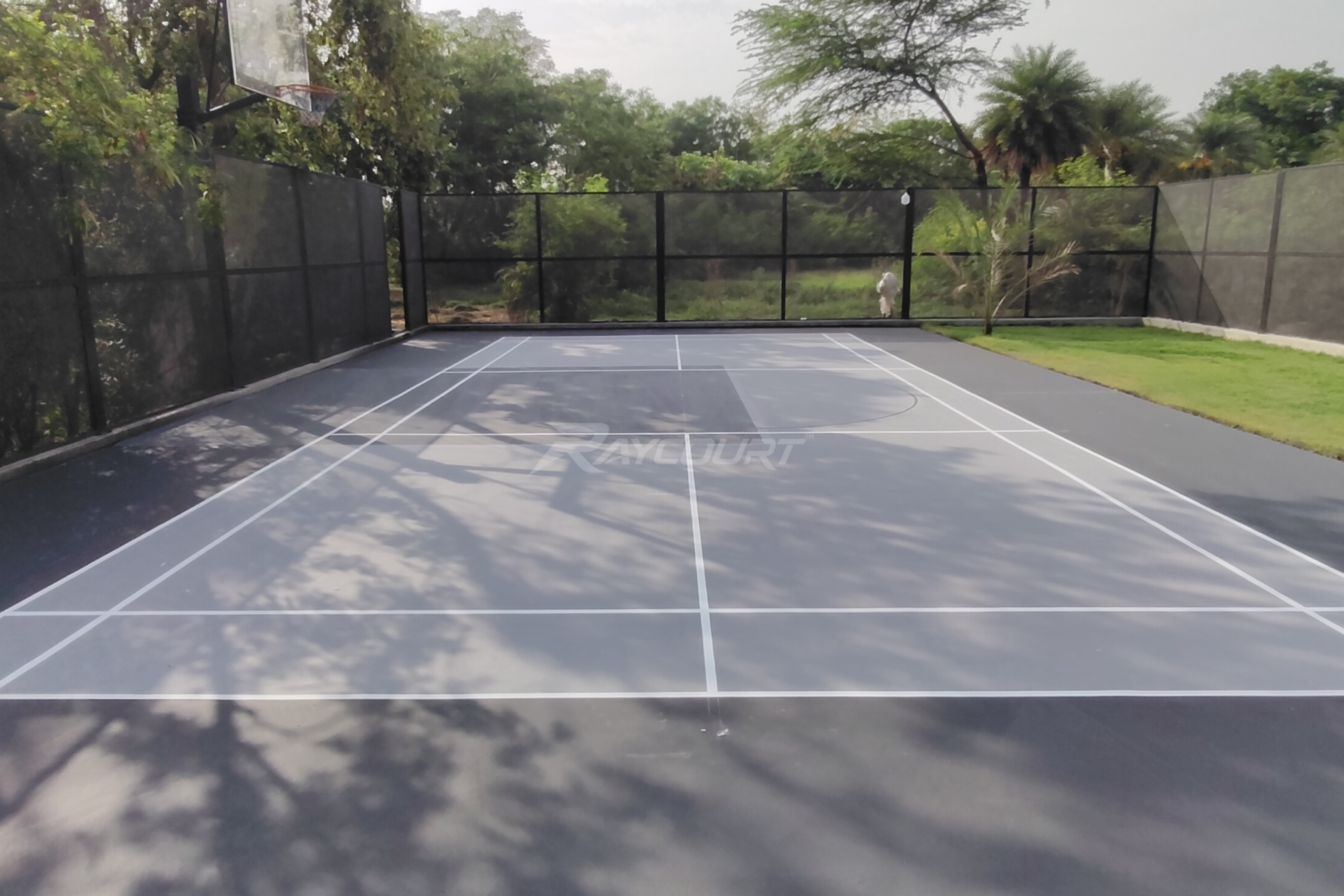
A typical Raycourt acrylic system builds up in multiple distinct layers, and each layer serves a specific purpose. The base layer levels minor surface imperfections and creates a uniform foundation across the entire court. A cushioning layer sits above this base, absorbing shock during jumps and quick directional changes. A textured colour coat finishes the system, providing both grip and the vivid contrast needed for clear line marking.
This layered approach matters directly for dimensional accuracy. Because each layer bonds tightly to the one beneath it, the finished surface resists shifting, cracking, or peeling over time. Painted lines applied to this stable base stay locked in their official positions, rather than drifting as the surface ages. Facility owners benefit from fewer re-marking sessions and a longer usable lifespan for the entire court.
Maintenance and Long-Term Dimensional Stability
Routine maintenance also protects official court dimensions over time. Regular cleaning prevents dirt and grit from wearing down painted lines prematurely. Facility staff should inspect boundary lines periodically, checking for fading, chipping, or surface bubbling. Acrylic surfaces generally require far less intervention than alternative materials, since the coating resists moisture absorption and temperature-driven expansion.
Raycourt designs its acrylic systems specifically to minimize this kind of long-term maintenance burden. A well-maintained acrylic court can preserve accurate, regulation-compliant dimensions for many years of consistent play. This reliability gives facility owners confidence that their investment will continue performing well into the future.
Colour Systems and Court Branding
Many facilities also want their badminton courts to reflect a specific colour scheme or brand identity. Acrylic coatings accommodate this easily, since manufacturers can formulate custom colour combinations for the playing surface and surrounding apron. Raycourt offers a range of colour options that still meet the contrast requirements needed for clear, legible line marking. This flexibility lets schools, clubs, and commercial venues personalize their courts without compromising official measurement accuracy.
Lighting and Additional Facility Considerations
Court dimensions and flooring quality form the foundation of a strong badminton facility, but lighting deserves attention too. Poor lighting makes it difficult for players to track a fast-moving shuttlecock, especially during high, looping clears. Competitive venues generally aim for bright, even illumination across the entire 44-by-20-foot playing surface. This lighting should avoid harsh shadows near the net or back boundary, since shadowed zones slow player reaction time.
Ventilation also plays a role in indoor badminton venues. Shuttlecocks react strongly to airflow, so indoor courts need stable climate control rather than open windows or strong fans. Facility owners planning a new badminton space should coordinate lighting, ventilation, and flooring decisions together. Each element affects overall playing conditions in a meaningful way. A well-planned facility supports fair play just as much as accurate boundary measurements do. Together, these factors create an environment where players can focus entirely on the game itself.
Frequently Asked Questions
A doubles badminton court measures 44 feet long and 20 feet wide. This layout uses the outer sidelines and a shorter service zone near the back boundary. These dimensions apply to every certified badminton venue worldwide, from local clubs to international tournaments.
A singles badminton court keeps the same 44-foot length but narrows to 17 feet wide. Singles players use the inner sidelines instead of the outer boundary. The service zone also extends further back compared to the doubles format.
Court width depends on which format players use, singles or doubles. A doubles court measures 20 feet wide, while a singles court measures 17 feet wide. Both formats share the same 44-foot length, regardless of width.
The net stands 5 feet tall at the centre of the court. It rises slightly to 5 feet 1 inch at each post. This slight height difference creates a natural sag across the middle of the net. Official BWF regulations require this exact sag for fair, consistent play.
No, both indoor and outdoor courts follow the same official 44-by-20-foot doubles and 44-by-17-foot singles measurements. Only the surrounding conditions differ, since outdoor courts face wind, sun, and weather exposure that indoor venues avoid.
Building a Court That Lasts
Accurate badminton court dimensions form the foundation of fair, safe, and enjoyable play. From the 44-foot length to the precise net height and service line placement, every measurement serves a specific purpose. Facility owners who understand these numbers can plan smarter layouts and avoid common marking mistakes. This knowledge also supports better training outcomes for their players over the long term.
Flooring quality plays an equally important role in preserving these dimensions long after installation. Raycourt engineers acrylic sports flooring systems designed to hold precise line markings and resist weather damage. These systems support safe, responsive play across singles and doubles courts alike, season after season.
Whether you are planning a single home court or an entire multi-court facility, getting the numbers right matters. Accuracy from the start pays off for years of reliable play. Pair that accuracy with a flooring system built to hold its shape, and your court will stay competition-ready far longer.