
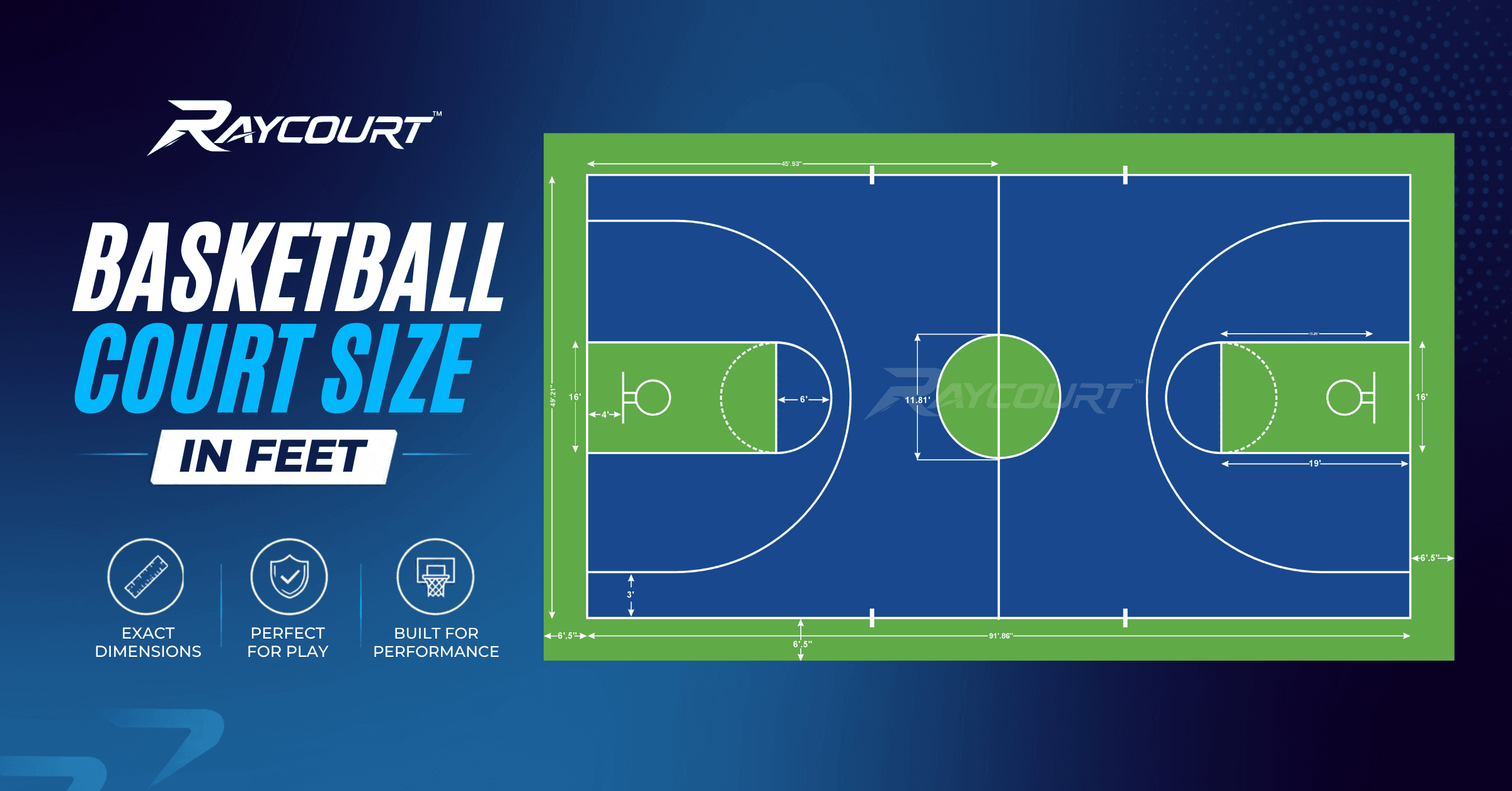
A standard basketball court size in feet depends on which league or governing body sets the rules. The NBA and NCAA use a court of 94 feet long by 50 feet wide. FIBA, the international governing body, sets its official court at 91.9 feet long by 49.2 feet wide. High school courts typically measure 84 feet long by 50 feet wide. Junior courts shrink even further to suit younger players.
These differences might look small on paper. Yet they change gameplay, training routines, and flooring specifications in real ways. A three-point shooter trains differently on an NBA court than on a FIBA court. A facility planner also orders different flooring quantities depending on the chosen layout. Even a half-court practice space follows specific proportions rather than random guesswork.
This guide walks through every major basketball court size in feet. It covers NBA and FIBA dimensions in dedicated sections below. It also explains NCAA, high school, and practice-court sizing. Along the way, you will find the key markings inside each court. You will also see how court size in feet connects to flooring material choices. Raycourt built this resource for anyone who wants clear, dependable numbers before starting a court project.
Why Basketball Court Size in Feet Matters
Basketball court size in feet is not an arbitrary number. Every inch of a regulation court supports player safety, competitive fairness, and long-term facility performance. Understanding these dimensions helps coaches plan drills. It also helps architects design gyms and helps flooring buyers order the correct materials.
Player Safety and Freedom of Movement
A regulation-size court gives players enough room to sprint, cut, and jump. This space prevents collisions with walls or benches during fast play. Tight or undersized courts increase collision risk during fast breaks. They also raise risk during quick defensive rotations near the sideline. Proper spacing protects players during dives for loose balls too. Sports federations calculate these dimensions with player safety as a core priority.
Consistency Across Competitive Levels
Standardized court sizes let teams and players compete fairly. This fairness holds true regardless of the host venue. A player training on a 94-foot NBA court knows what to expect elsewhere. That player can walk into any NBA arena and feel instantly familiar with the layout. This consistency extends training value across cities, states, and even countries. Without agreed dimensions, athletes would face constant readjustment at every venue change.
Impact on Game Strategy and Pace
Court length and width shape how coaches design offensive and defensive systems. A longer court rewards fast breaks, full-court presses, and long outlet passes. A shorter court favors quicker transitions and tighter half-court sets. Coaches who understand these proportions can build game plans that fit the space. Players also adjust their conditioning routines based on the total ground they must cover.
Broadcast and Spectator Considerations
Regulation court size in feet also affects broadcast and audience experience. Camera crews position equipment based on standard sideline and baseline clearances. Spectator seating in professional arenas sits a fixed distance from the boundary lines. This spacing keeps fans close to the action without crowding the players. Venues that shrink these clearances risk both safety issues and poor sightlines. Consistent court size in feet keeps this planning simple across different arenas.
Flooring and Facility Planning
Basketball court size in feet also drives flooring specification directly. Raycourt engineers synthetic acrylic surfacing for regulation and practice courts alike. Facility owners need accurate measurements before ordering materials or planning coverage. They also need these numbers before finalizing drainage and expansion joint layouts. Getting the dimensions wrong early in a project often creates costly complications later.
Expert Tip: Always confirm which governing body’s rules apply before finalizing court dimensions. NBA, FIBA, NCAA, and high school associations each publish slightly different specifications. Mixing them together creates markings that satisfy no single rulebook.
Basketball Court Size in Feet: Quick Comparison
Before exploring NBA and FIBA specifics, review this quick comparison table. It gives planners, coaches, and buyers a fast reference point. From here, you can explore each level of play in greater depth.
| Level | Length (feet) | Width (feet) | Approx. Area (sq ft) |
|---|---|---|---|
| NBA | 94 ft | 50 ft | 4,700 sq ft |
| FIBA (International) | 91.9 ft | 49.2 ft | 4,520 sq ft |
| NCAA (Men & Women) | 94 ft | 50 ft | 4,700 sq ft |
| High School (NFHS) | 84 ft | 50 ft | 4,200 sq ft |
| Junior High | 74 ft | 42 ft | 3,108 sq ft |
| Half-Court | 47 ft | 50 ft | 2,350 sq ft |
Notice how court width stays fairly consistent across most levels. Length, on the other hand, varies more significantly between age groups. This pattern reflects how younger or amateur players cover less ground per possession. Shorter courts keep the pace of the game manageable for developing athletes.
How These Measurements Came About
Basketball’s court dimensions did not appear overnight. Early gymnasiums simply used whatever space happened to be available. As the sport professionalized, leagues standardized dimensions to support fair, repeatable competition. The NBA settled on 94 by 50 feet decades ago, and that figure still holds today. FIBA developed its own metric-based standard to suit international facilities. Both systems now guide nearly every serious basketball construction project worldwide.
NBA Basketball Court Dimensions in Feet
The NBA sets one of the most recognized basketball court sizes in feet. Professional arenas, many college gyms, and countless training facilities follow this exact layout.
Overall NBA Court Size
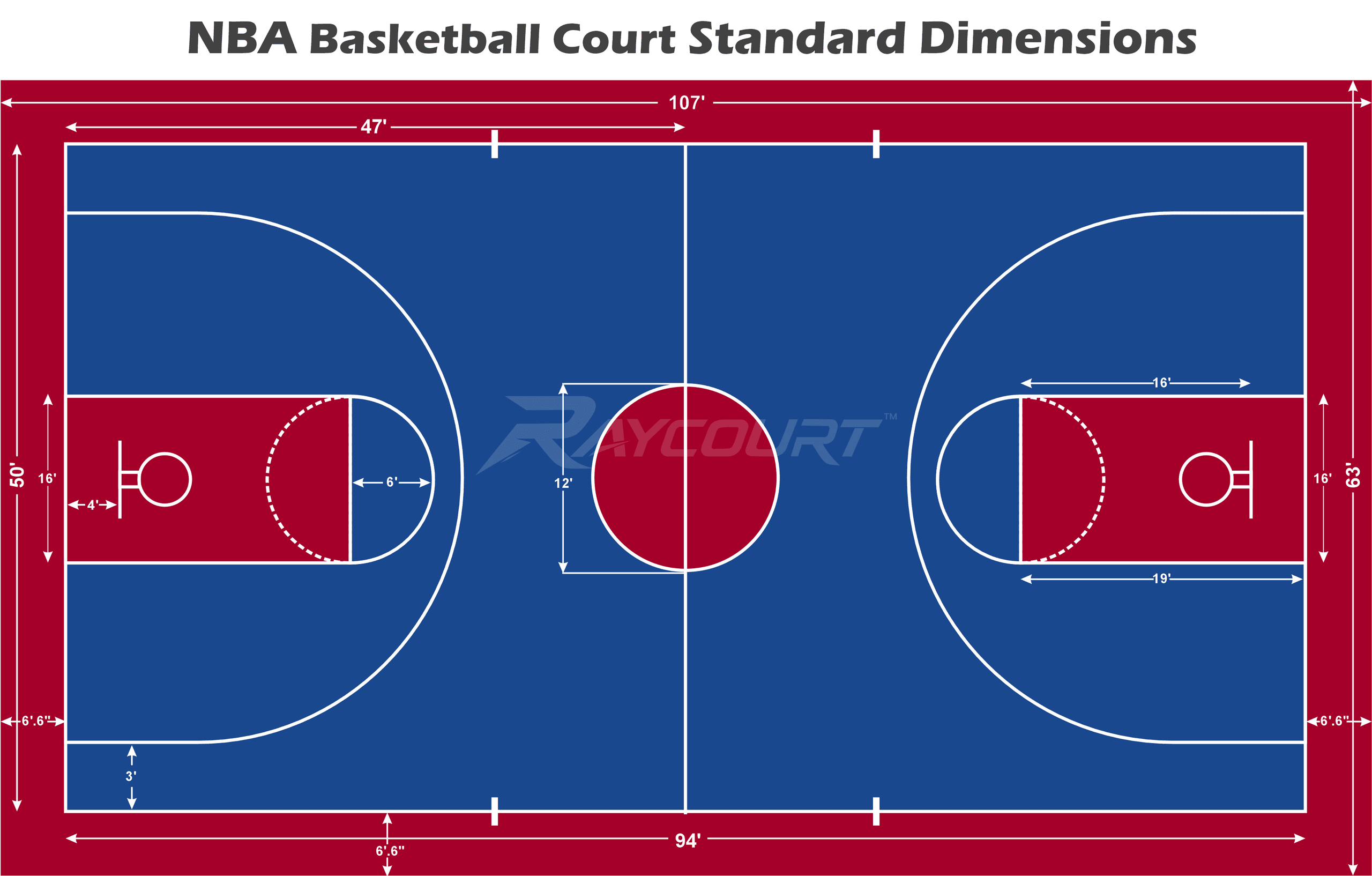
An official NBA court measures 94 feet in length and 50 feet in width. This creates a total playing surface of roughly 4,700 square feet. This generous footprint supports the speed and athleticism of professional players. Fast breaks, full-court presses, and long outlet passes all rely on this extended length. The extra space also gives broadcast cameras and floor-side seating enough clearance.
The NBA positions each basket 4 feet inside the baseline. This placement leaves room behind the hoop for dunks and defensive recoveries. Ceiling height in most professional arenas reaches around 30 feet. That clearance ensures high-arcing shots never risk hitting overhead structures.
NBA Court Markings and Zones
Beyond the outer boundary, several interior markings define the 94-by-50-foot space. Each marking serves a specific rule or gameplay function.
Free-Throw Line and Key
The free-throw line sits 15 feet from the backboard’s face. The key, often called “the paint,” spans 16 feet wide in NBA play. This width exceeds the college or high school key by a noticeable margin. A restricted-area arc carries a 4-foot radius directly under the basket. This arc stops defenders from drawing certain charging fouls too close to the rim.
Three-Point Line
NBA shooters launch from 23 feet 9 inches at the top of the arc. That distance shortens to 22 feet in the corners on each side. This variable arc rewards accurate corner shooting from a shorter range. It still challenges players who shoot from the top of the key. Few other leagues use this exact corner-shortening arc design.
Center Circle and Half-Court Line
A center circle with a 12-foot diameter marks the middle of the court. This circle often displays the home team’s logo at center court. The half-court line splits the 94-foot length into two equal 47-foot halves. This line also defines backcourt versus frontcourt during possession changes.
Backboard, Rim, and Basket Position
The rim sits exactly 10 feet above the playing surface at both ends. Backboards measure 6 feet wide and hang above the baseline structure. These specifications stay identical across NBA, FIBA, NCAA, and high school levels. Only the surrounding floor markings change between these different governing bodies.
| NBA Court Element | Measurement in Feet |
|---|---|
| Court Length | 94 ft |
| Court Width | 50 ft |
| Free-Throw Line Distance | 15 ft |
| Key Width | 16 ft |
| Restricted Area Radius | 4 ft |
| Three-Point Line (Top) | 23 ft 9 in |
| Three-Point Line (Corners) | 22 ft |
| Center Circle Diameter | 12 ft |
| Rim Height | 10 ft |
Expert Tip: When planning flooring for an NBA-style court, account for extra clearance around the boundary lines. Most professional venues add several feet of buffer space beyond the 94-by-50-foot playing surface.
Most NBA arenas use polished hardwood as their primary playing surface. Outdoor and multi-use facilities, however, rarely have that option available. Synthetic acrylic coatings give these facilities a durable alternative that mimics hardwood performance. Raycourt engineers its acrylic systems to deliver consistent traction across the full 94-foot length.
FIBA Basketball Court Dimensions in Feet
FIBA governs basketball at the international level, including the Olympics. It also oversees most national leagues outside the United States. Its basketball court size in feet differs slightly from the NBA. This gap surprises many first-time facility planners.
Overall FIBA Court Size
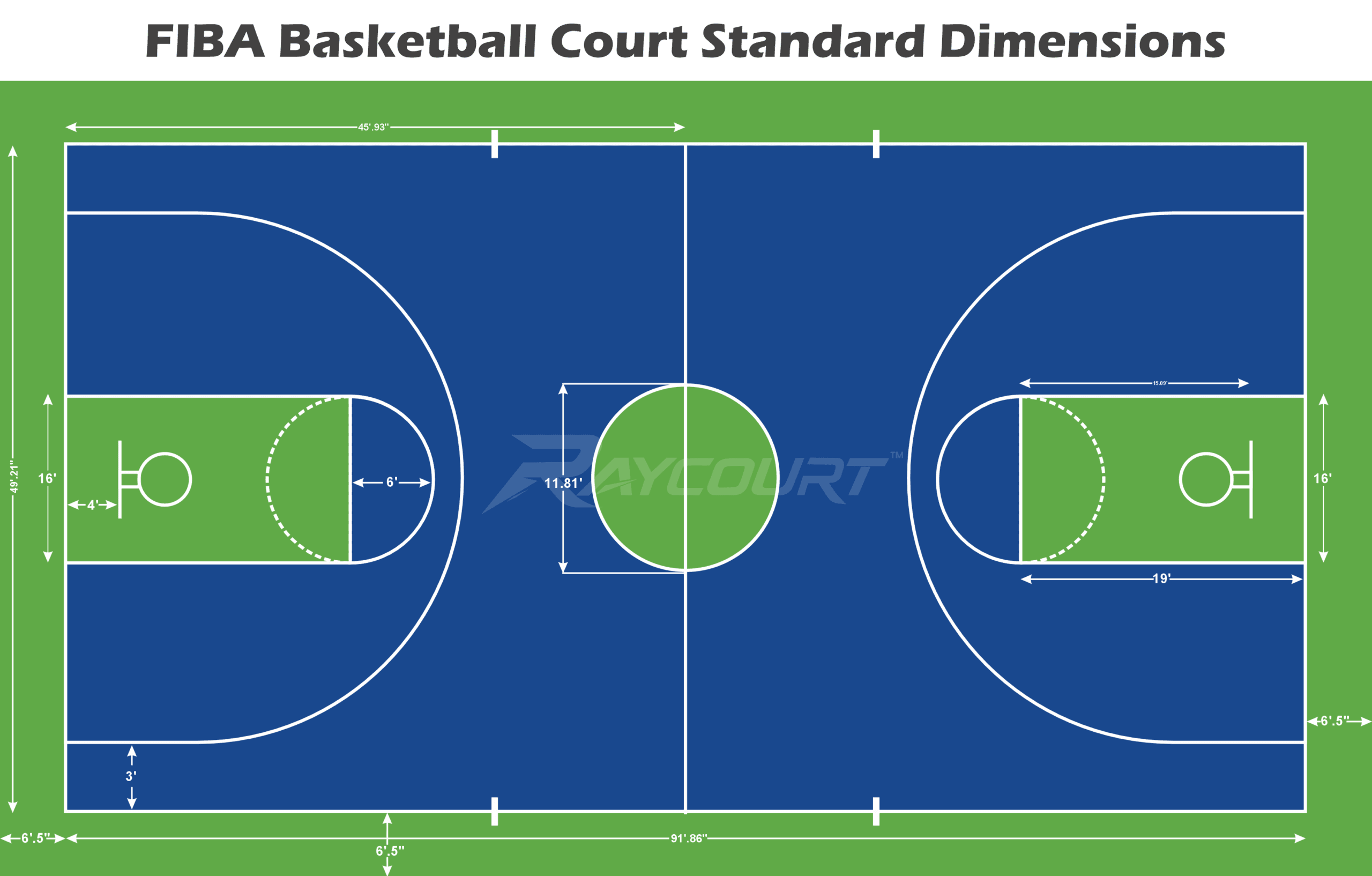
An official FIBA court measures 28 meters by 15 meters. That distance converts to approximately 91.9 feet long and 49.2 feet wide. This creates a total surface area of roughly 4,520 square feet. FIBA sets rim height at the same 10 feet used in the NBA. This shared measurement keeps the scoring target identical across both systems.
FIBA also requires a minimum surrounding clearance zone beyond the boundary lines. The official FIBA basketball rules outline this buffer clearly. A fully compliant facility should provide a floor area of at least 32 meters by 19 meters. This total includes the extra clearance lane around the playing surface itself.
FIBA Court Markings and Zones
FIBA’s interior markings share similarities with the NBA. Yet they also include a few structural differences worth understanding before ordering flooring materials.
The Rectangular Key
FIBA switched to a rectangular key back in 2010. Before that change, the international key used a trapezoid shape instead. The current key matches the NBA’s straight-sided lane fairly closely. It measures roughly 16 feet wide, close to the NBA standard. This adjustment simplified transitions for players moving between international and professional leagues.
Three-Point Arc
FIBA places its three-point line at 6.75 meters from the basket’s center. That distance equals roughly 22 feet 2 inches in imperial measurement. FIBA keeps this distance fairly consistent around most of the arc. The NBA, by contrast, shortens its arc noticeably near the corners. This design creates a more uniform shooting challenge from every angle on FIBA courts.
Center Circle
FIBA’s center circle carries a radius of 1.8 meters. That figure converts to about 5.9 feet, giving a diameter near 11.8 feet. This sits just slightly smaller than the NBA’s 12-foot circle. The difference rarely stands out to casual viewers watching a broadcast.
Boundary Lines and Clearance Zones
FIBA requires all boundary lines to measure 5 centimeters wide. Officials must also keep obstructions at least 2 meters from the playing court. This rule protects players who chase loose balls near the sideline. Coaches, substitutes, and staff must also respect this clearance distance during games.
| FIBA Court Element | Measurement (Meters) | Measurement (Feet) |
|---|---|---|
| Court Length | 28 m | 91.9 ft |
| Court Width | 15 m | 49.2 ft |
| Free-Throw Line Distance | 5.8 m | 15 ft |
| Key Width | 4.9 m | ~16 ft |
| Three-Point Arc | 6.75 m | ~22 ft 2 in |
| Center Circle Radius | 1.8 m | ~5.9 ft |
| Rim Height | 3.05 m | 10 ft |
Expert Tip: Facilities hosting both FIBA and NBA-style games rarely fit both marking sets cleanly on one court. Most multi-purpose venues choose one primary marking system. They then add secondary lines in a contrasting color for the other format.
FIBA facilities often use synthetic surfacing rather than traditional hardwood. This choice suits the wide range of climates where international basketball takes place. Raycourt’s acrylic systems adapt to both indoor arenas and outdoor community courts. This flexibility matters greatly for federations building courts across different countries and conditions.
NBA vs FIBA Basketball Court Size: Key Differences
Comparing NBA and FIBA basketball court size in feet reveals a pattern many fans miss. The NBA court runs about 2 feet longer than its FIBA counterpart. It also measures nearly 1 foot wider than the international standard. That might sound minor, yet it changes spacing during fast breaks and rotations.
The three-point distance shows an even larger gap between the two systems. NBA shooters face a 23-foot-9-inch arc at the top of the key. FIBA shooters, by comparison, shoot from roughly 22 feet 2 inches away. This 19-inch difference explains why some players adjust their shooting mechanics. Athletes moving between leagues often need weeks to recalibrate their shot timing.
Key width stays fairly similar between both systems today. This similarity grew stronger once FIBA adopted its rectangular lane design in 2010. Before that change, players faced very different spacing near the basket internationally.
| Comparison Point | NBA | FIBA |
|---|---|---|
| Court Length | 94 ft | 91.9 ft |
| Court Width | 50 ft | 49.2 ft |
| Three-Point Line (Top) | 23 ft 9 in | ~22 ft 2 in |
| Key Shape | Rectangular | Rectangular (since 2010) |
| Rim Height | 10 ft | 10 ft |
Despite these differences, both systems share the same 10-foot rim height. They also use similar free-throw distances from the backboard. This overlap allows players to transition between leagues without relearning the entire game. Still, facility planners must choose one system as the primary layout. Mixing both sets of lines confuses officials and players during actual gameplay.
International players joining NBA teams often mention the length adjustment first. A slightly longer floor changes conditioning demands over an 82-game season. College players heading overseas notice the opposite effect near the three-point arc. These small shifts show why basketball court size in feet matters beyond simple geometry.
Ready to build a court that performs for years to come?
Connect with Raycourt for sports flooring systems built for your project.
Court Orientation, Clearance, and Surrounding Space
Basketball court size in feet only tells part of the planning story. The space surrounding the playing surface matters just as much for safety and function. Governing bodies set clear rules for benches, scorer’s tables, and out-of-bounds clearance.
Sideline and Baseline Clearance
Most rulebooks recommend several feet of clear, obstruction-free space beyond every boundary line. This buffer protects players who dive for loose balls near the sideline. It also gives officials room to move freely while tracking play. Facilities that skip this clearance often see more injuries during fast-paced games. Raycourt recommends planning this buffer zone before finalizing total flooring coverage.
Team Benches and Scorer’s Table Placement
FIBA rules place the scorer’s table and team benches along one sideline. This placement keeps officials, coaches, and substitutes close to the action. NBA arenas follow a similar layout, though seating details vary by venue. Consistent placement across venues helps traveling teams settle in quickly before games. Coaches appreciate knowing exactly where their bench sits, regardless of the city.
Multi-Court Facilities and Shared Walls
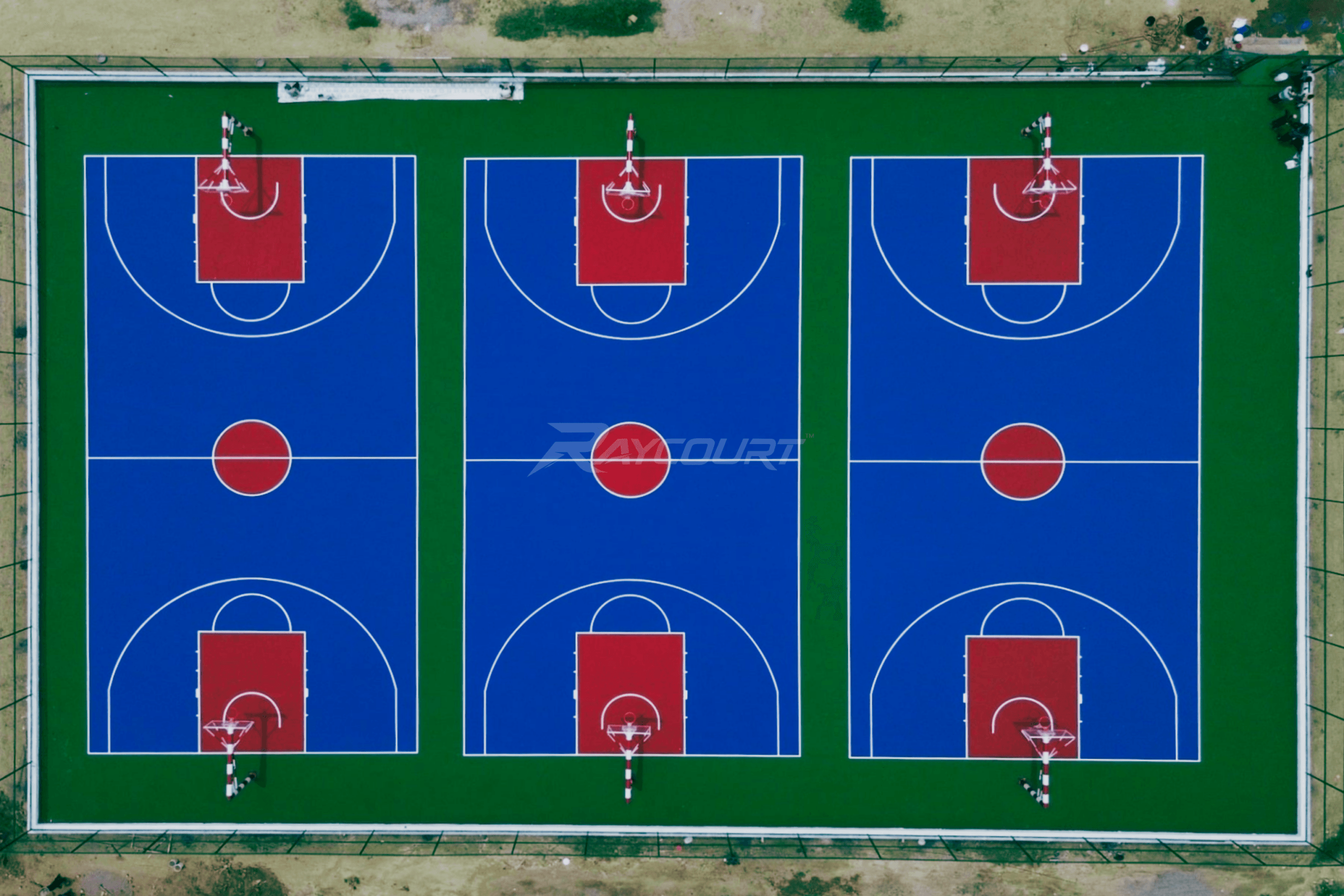
Larger sports complexes often place several basketball courts side by side. Shared walls or dividing nets separate these courts during simultaneous games or practices. Planners still need to preserve full basketball court size in feet on each side. Cutting corners on one court to fit another rarely satisfies any official rulebook. Raycourt supports these multi-court layouts with flooring that reads clearly across divided sections. Consistent color and line marking help players stay oriented, even in a busy, shared facility.
Court Orientation Within a Building
Architects also consider court orientation relative to windows, doors, and lighting fixtures. Glare from natural light can interfere with shooting accuracy near certain angles. Many facilities orient courts north-south to minimize this kind of visual interference. Ceiling height and support beams also factor into safe court placement. These structural details work alongside basketball court size in feet during the design phase.
Basketball Court Size in Feet Around the World
Basketball court size in feet stays fairly consistent across most countries today. Facilities everywhere generally follow either NBA-style or FIBA-style specifications. Regional climate, however, still shapes many material and construction decisions. Outdoor courts in hot, humid regions need coatings that resist heat and moisture. Indoor arenas in cooler climates focus more on consistent indoor traction and color stability.
Community and school courts across many countries often favor synthetic acrylic surfacing over hardwood. This choice reflects durability needs across a wide range of climates and facility types. Raycourt manufactures acrylic flooring systems that perform reliably across these different conditions. The company builds every batch with the same attention to consistency and durability. This approach works whether a court sits in a covered gymnasium or an open-air facility.
International federations continue to standardize rules across different regions and skill levels. This standardization makes basketball court size in feet a genuinely global reference point. A facility planner in one country can trust the same FIBA numbers used elsewhere. That shared standard simplifies planning, material ordering, and long-term maintenance everywhere.
Other Basketball Court Sizes Worth Knowing
NBA and FIBA dominate most conversations about basketball court size in feet. Plenty of other levels, however, follow their own distinct standards. Understanding these sizes helps schools, clubs, and community centers plan appropriately.
NCAA Basketball Court Size in Feet
NCAA courts match the NBA at 94 feet long by 50 feet wide. This standard applies to both men’s and women’s competition equally. The markings inside that footprint, however, differ in a few noticeable ways. Men’s NCAA basketball uses a three-point line at 22 feet 1.75 inches. Recent rule changes have moved women’s three-point distances closer to that same figure. The key width in NCAA play measures 12 feet, narrower than the NBA’s 16-foot lane. College athletic departments generally follow NCAA specifications closely when building new practice facilities. This consistency helps players transition smoothly from high school into college-level competition.
High School Basketball Court Size in Feet
The NFHS governs high school basketball across the United States. High school courts under this system typically measure 84 feet long by 50 feet wide. This shorter length suits the pace and stamina levels of younger athletes. It also helps prepare students for the larger courts they may face later. The three-point line sits at 19 feet 9 inches, noticeably closer than NBA or FIBA distances. Many high school gyms double as community venues during evenings and weekends. This dual purpose makes durable, low-maintenance flooring an especially practical choice for these facilities.
Junior and Youth Court Sizes
Many junior high and youth programs use even smaller footprints than high school. These courts often measure around 74 feet long by 42 feet wide. Younger players simply cannot cover the same ground as older athletes. Shrinking the court keeps gameplay fast, engaging, and appropriately challenging. Some youth facilities also lower the basket height alongside these smaller dimensions. The floor length adjustment, though, matters most for accurate flooring planning.
Wheelchair Basketball Court Dimensions
Wheelchair basketball follows the same court size as standard FIBA competition. The IWBF sets its official court at 28 meters by 15 meters, matching the international able-bodied standard exactly. That figure converts to the same 91.9 feet by 49.2 feet used in FIBA play. Rim height also stays identical at 10 feet above the playing surface. This shared standard lets venues host both formats without changing the court itself. Only the wheelchair specifications and a few gameplay rules differ between the two versions.
3×3 and Streetball Court Sizes
FIBA also governs the increasingly popular 3×3 basketball format. A regulation 3×3 court measures 15 meters wide by 11 meters long. That converts to roughly 49 feet wide by 36 feet long in imperial units. This half-court style format fits neatly into smaller urban spaces. Many cities now build dedicated 3×3 courts using durable outdoor synthetic surfacing. Raycourt’s weather-resistant acrylic systems suit this fast-growing court format well.
Expert Tip: Multi-sport facilities serving several age groups benefit from adjustable or overlaid court markings. Committing to one fixed youth size permanently can limit future flexibility.
Half-Court and Practice Space Dimensions
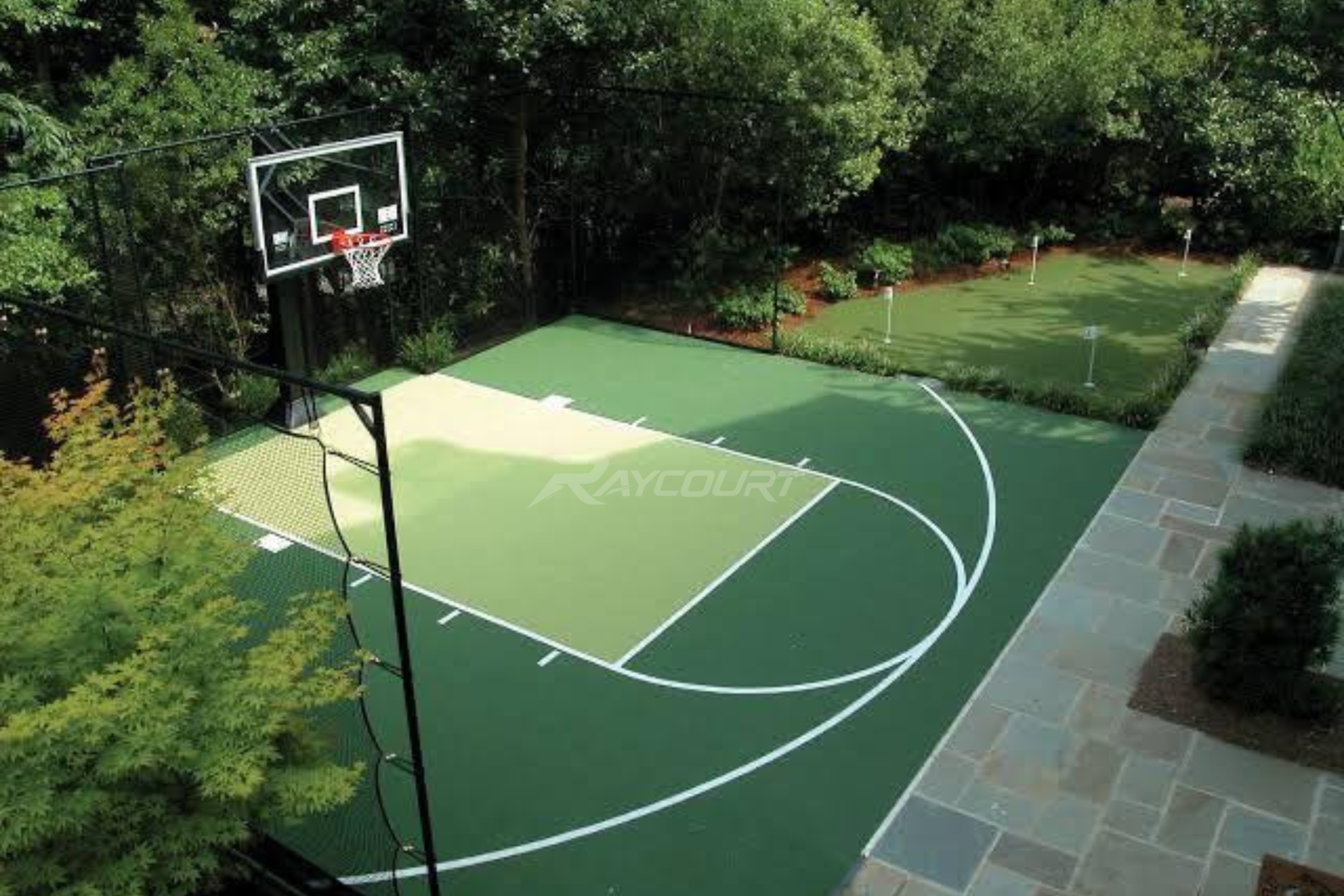
Not every basketball facility needs a full 94-foot or 91.9-foot court. Many gyms, community centers, and home installations opt for half-court dimensions instead. A standard half-court measures roughly 47 feet long by 50 feet wide. This layout still supports shooting drills, small-sided games, and individual skill training. It accomplishes all of this without demanding the full square footage of a regulation court.
Half-court spaces work particularly well for facilities with limited real estate. A single full-size court often splits functionally into two half-courts. This split allows simultaneous practice sessions for different teams or age groups. Coaches appreciate this flexibility when managing multiple squads within one gym.
Half-court dimensions suit several common facility scenarios, including:
- Community centers with limited available floor space
- School gyms that host multiple teams throughout the day
- Home installations for shooting practice and small-sided games
- Youth programs that do not yet need full-length training
Each of these settings still benefits from precise, regulation-consistent flooring underneath.
Portable and Modular Court Considerations
Some facilities install modular or portable court sections instead of fixed layouts. These systems allow venues to reconfigure space for different events quickly. Modular courts still need consistent, durable flooring across every panel or section. Raycourt formulates material that performs reliably across modular and fixed installations alike.
Backyard and Recreational Layouts
For truly compact spaces, some facilities scale down even further. A popular backyard size measures around 30 feet by 30 feet. This footprint skips official markings but still supports casual shooting and small games. These mini-courts still benefit from durable, weather-resistant flooring underneath. That flooring should match the performance expectations set by larger regulation courts. Raycourt’s synthetic acrylic systems adapt to these varied footprints just as effectively.
How Basketball Court Size in Feet Shapes Flooring Choices
Basketball court size in feet directly influences flooring material decisions. Larger courts naturally demand more material coverage overall. Size also affects drainage planning, expansion joints, and coating consistency. Every square foot of the surface needs the same performance standard.
Surface Demands of a Full Regulation Court
A 94-foot NBA-style court and a 91.9-foot FIBA court share similar surface demands. Both require consistent traction across thousands of square feet. Both also need reliable shock absorption and accurate color matching. Any variation in surface texture becomes obvious once players start cutting at speed. Raycourt formulates its synthetic acrylic coatings to maintain uniform performance end to end. This consistency matters on a compact junior court just as much as on an NBA layout.
Larger courts face greater exposure to temperature shifts and moisture over time. More surface area simply means more exposure to these environmental factors. Facility planners should weigh these variables long before construction begins. Choosing a proven synthetic acrylic system reduces the risk of cracking or fading. It also protects against premature texture loss across the playing surface.
Line Marking and Layout Precision
Every basketball court size in feet depends on precise, accurate line marking. A single misplaced line throws off free-throw distances or three-point accuracy. Manufacturers formulate line-marking paints to bond tightly with the acrylic surface beneath. This bond keeps lines crisp and visible through years of heavy foot traffic. Raycourt designs its coating systems with this layering process in mind from the start.
Coverage and Layer Planning
Synthetic acrylic court systems typically build up through several distinct layers. A base coat levels minor surface imperfections before the color layers go down. Textured coats follow, providing the grip players expect during quick direction changes. A final color and line-marking layer completes the system on top. Planning these layers around the exact court size in feet prevents material shortfalls mid-project.
Maintaining Consistent Court Size Over Time
Court lines can drift visually as coatings age and wear down. Faded or chipped lines make it harder to judge accurate court size in feet during play. Routine resurfacing restores both color and line accuracy across the full court. Facilities that plan for periodic maintenance protect their original investment in flooring materials. Raycourt’s acrylic systems support straightforward resurfacing without disturbing the underlying base layers. This approach helps courts maintain their true regulation dimensions for years of active use.
Working from Accurate Architectural Drawings
Flooring manufacturers rely on accurate architectural drawings before producing material for a project. These drawings should reflect the exact basketball court size in feet the client needs. Errors at this stage often trace back to unclear or outdated blueprints. A drawing that mixes NBA and FIBA figures can cause real confusion during production planning. Raycourt encourages facility planners to confirm final dimensions before placing a material order. This step keeps color batches, coverage estimates, and line-marking layouts aligned with the actual space. Clear communication between architects, planners, and the flooring manufacturer prevents costly mismatches later. It also keeps the entire project timeline moving smoothly from planning through final finishing.
Indoor vs Outdoor Material Considerations
Indoor courts generally face fewer weather-related stresses than outdoor facilities. This holds true whether the court follows NBA sizing or a smaller practice layout. Outdoor courts, however, need coatings that resist UV exposure and temperature swings. They also need protection against moisture infiltration across their full footprint. Outdoor courts often serve community or school programs rather than professional teams. These programs frequently choose high school or youth-sized dimensions over full NBA specifications.
Regardless of size, Raycourt manufactures synthetic acrylic flooring that handles both indoor and outdoor demands. The company designs its material systems around performance consistency rather than square footage alone. Every court size in feet, from a small backyard layout to a full NBA court, receives the same quality standard.
Glossary of Key Basketball Court Measurement Terms
A few recurring terms show up throughout any discussion of basketball court size in feet. Understanding them helps facility planners read rulebooks and blueprints with confidence.
The baseline marks the short boundary line behind each basket at either end. The sideline marks the long boundary line running the full length of the court. Together, these two lines form the outer rectangle that defines the entire playing surface. The key, also called the lane or the paint, sits directly beneath each basket. Its width changes between NBA, NCAA, and FIBA rules, as covered earlier in this guide.
The three-point arc curves out from each basket at a set radius from its center. Shots made from beyond this arc score three points instead of two. The center circle marks the middle of the court, where opening tip-offs typically begin. The backcourt refers to the half of the court a team defends. The frontcourt refers to the half where that same team attempts to score. Officials use the half-court line to judge violations related to these two zones.
Knowing these terms makes it easier to compare basketball court size in feet across different rulebooks. It also helps flooring buyers communicate clearly with manufacturers during the planning stage.
Ready to build a court that performs for years to come?
Connect with Raycourt for sports flooring systems built for your project.
Common Mistakes When Planning Basketball Court Size
Even experienced facility planners occasionally misjudge basketball court size in feet. This section highlights frequent missteps and simple ways to avoid them.
A short pre-planning checklist helps most projects avoid these issues entirely:
- Confirm which governing body’s rules apply to the project.
- Cross-check the architectural drawing against official specifications.
- Verify ceiling height clearance near the three-point line.
- Measure available boundary and clearance space on-site.
- Reconfirm all numbers before placing a flooring material order.
Q: What happens if a facility mixes NBA and FIBA markings on the same court? A: Mixing marking systems often confuses players and referees during gameplay. Most facilities choose one primary system for the main lines. They then add secondary lines in a contrasting color when dual-purpose use becomes necessary.
Q: Can a court be slightly smaller than regulation size and still function well? A: Yes, many community and practice courts intentionally use smaller dimensions. Problems only arise when a facility claims regulation compliance without meeting the actual measurements. Always match your marketing claims to your true court specifications.
Q: Does ceiling height matter as much as floor dimensions? A: Absolutely. A regulation-length court still fails safety standards if the ceiling sits too low. This risk grows near the three-point line, where shot arcs reach their highest point.
Q: How much clearance space should surround the court boundary? A: Most governing bodies recommend several feet of clear space beyond the sidelines. This buffer protects players during fast breaks and out-of-bounds recoveries.
Q: Is it a mistake to skip professional measurement verification? A: Yes, skipping this step often leads to costly rework later in a project. A quick verification against official rulebooks saves time and material during installation.
Q: Do older facilities sometimes fall short of current regulation sizes? A: Yes, many older gyms predate current NBA, NCAA, or FIBA specifications. Renovation projects should recheck basketball court size in feet against today’s rulebooks. This step avoids repeating outdated measurements during a facility upgrade.
Expert Tip: Before finalizing any court layout, measure the available space twice. Compare those measurements against your target governing body’s official specifications. Small early errors often become expensive corrections later in the project.
Basketball Court Size in Feet: Complete Reference Table
Here is a comprehensive reference table covering every major basketball court size in feet. Facility planners, coaches, and flooring buyers can use this table as a fast lookup tool.
| Court Type | Length | Width | Three-Point Line | Key Width |
|---|---|---|---|---|
| NBA | 94 ft | 50 ft | 23 ft 9 in | 16 ft |
| FIBA International | 91.9 ft | 49.2 ft | ~22 ft 2 in | ~16 ft |
| NCAA (Men) | 94 ft | 50 ft | 22 ft 1.75 in | 12 ft |
| High School (NFHS) | 84 ft | 50 ft | 19 ft 9 in | 12 ft |
| Junior High | 74 ft | 42 ft | Varies | Varies |
| Half-Court | 47 ft | 50 ft | Varies | Varies |
| FIBA 3×3 | 36 ft | 49 ft | ~22 ft (approx.) | Varies |
This table works well as a starting checklist for most projects. Every project still benefits from confirming exact specs with the relevant governing body. Rules occasionally shift, particularly around three-point distances across different leagues. Double-checking current standards protects against costly rework down the line.
Quick Answers: Basketball Court Size in Feet
How wide is a basketball court in feet?
Most basketball courts measure between 42 and 50 feet wide, depending on the level.
What is the longest basketball court size in feet?
The NBA and NCAA use the longest common regulation size, at 94 feet.
Is a FIBA court smaller than an NBA court?
Yes, a FIBA court measures 91.9 feet long, about 2 feet shorter than an NBA court.
What size court works for backyard practice?
Many backyard setups use compact layouts around 30 feet by 30 feet for casual practice.
Do all basketball courts share the same rim height?
Yes, every major level sets the rim at exactly 10 feet above the floor.
Frequently Asked Questions
The standard basketball court size in feet depends on the governing league. The NBA and NCAA both use 94 feet long by 50 feet wide. FIBA, the international federation, sets its court at 91.9 feet long by 49.2 feet wide. High school courts typically measure 84 feet long by 50 feet wide.
An NBA basketball court measures exactly 94 feet from baseline to baseline. This length stays consistent across every NBA arena in the league. The same 94-foot length also applies to NCAA college basketball courts.
A FIBA basketball court measures 49.2 feet wide. That figure converts from the official metric measurement of 15 meters. This width sits just under one foot narrower than the NBA’s 50-foot standard.
A half-court basketball layout typically measures 47 feet long by 50 feet wide. This size works well for practice sessions and small-sided games. It also suits facilities with limited available space.
The NBA and FIBA developed their rules independently over many decades. The NBA uses imperial measurements as its baseline for court specifications. FIBA, meanwhile, works from metric standards across all its facilities. When converted, these systems produce close but not identical court dimensions.
Final Thoughts on Basketball Court Size in Feet
Basketball court size in feet shapes everything from player safety to flooring planning. A project might follow NBA specifications, FIBA international standards, or a compact practice layout. Accurate measurements always come first, regardless of the chosen format. Raycourt understands how these dimensions connect directly to real-world flooring performance. The company manufactures synthetic acrylic surfacing that matches any regulation or custom court size.
Getting the numbers right early saves time and protects player safety. It also ensures long-term surface performance across every square foot of the court. Every project, from a small backyard layout to a full NBA arena, deserves this same careful attention to detail. Raycourt stands ready to support that process with reliable synthetic acrylic flooring that performs for the long run.
Ready to build a court that performs for years to come? Connect with Raycourt for sports flooring systems built for your project.
Ready to build a court that performs for years to come?
Connect with Raycourt for sports flooring systems built for your project.