
What Is the Best Basketball Court Flooring Material?
The best basketball court flooring material depends on where you build the court and how often people play on it. For outdoor and semi-outdoor courts, synthetic acrylic flooring offers the strongest balance of ball response, traction, weather resistance, and low maintenance. For premium indoor halls, hardwood and polyurethane-based systems also perform well. Each option serves a different need, so you should match the material to your climate, your players, and your base.
This guide explains every major option in plain language. First, you will learn what basketball court flooring material actually includes. Next, you will compare the common surface types. Then you will see how a synthetic acrylic system works layer by layer. Finally, you will learn how to maintain the surface and choose a reliable manufacturer.
Raycourt manufactures the flooring material itself. We do not install it. Trained applicators and contractors handle installation, and we support them with quality material and clear technical guidance.
Understanding Basketball Court Flooring Material
What does the term really mean?
Many people hear “basketball court flooring material” and picture a single product. In reality, the term covers a complete surface system. That system includes the base, the primer, the resurfacing or cushion layers, the color coats, and the line markings. Each layer performs a specific job. Together, they create the surface that players run, jump, pivot, and dribble on.
A good material does more than look attractive. It controls how the ball bounces, how the shoe grips, and how the court absorbs impact. Consequently, the material directly shapes the quality of the game.
Why does the surface matter so much in basketball?
Basketball demands rapid movement. Players sprint, stop suddenly, cut sideways, and land from jumps hundreds of times in a single session. Because of these demands, the surface takes constant punishment. A poor surface increases fatigue and raises the risk of slips and joint stress. A well-built surface, on the other hand, helps players move confidently and keeps the game fast and fair.
Ball behavior also depends heavily on the surface. A true, even bounce rewards skill. An uneven or dead surface frustrates players and hides their ability. Therefore, serious programs treat the surface as a core part of the facility, not an afterthought.
Expert Tip: Always evaluate basketball court flooring material as a full system. A great top coat cannot rescue a weak base, and a great base cannot rescue poor coatings.
Why Your Choice of Basketball Court Flooring Material Matters
Player safety comes first
Safety sits at the center of every flooring decision. Traction must stay high enough to prevent slips, yet low enough to let the foot pivot naturally. When traction runs too high, the shoe sticks and the knee absorbs the twisting force. When traction runs too low, players slide and lose control. Quality material finds the middle ground.
Shock absorption also protects the body. Hard surfaces send impact energy straight into the ankles, knees, and lower back. Cushioned systems soften that impact. Over months and years, this difference matters for both young athletes and veteran players.
Game quality depends on consistency
Consistency separates a good court from a frustrating one. Players want the ball to bounce the same way at the baseline, at the free throw line, and under the rim. They also want the same traction everywhere. Quality material delivers uniform performance across the whole court, and it keeps that performance for years.
Durability protects your investment of time and effort
Courts face sun, rain, heat, dust, and heavy foot traffic. Durable material resists cracking, peeling, fading, and surface wear. As a result, the court stays playable longer, and you spend less time on repairs and more time on the game.
Appearance shapes the player experience
A bright, clean, well-marked court motivates players. It also signals professionalism to visitors, parents, and officials. Consistent color and sharp line work make the facility feel organized and welcoming. Good material holds its color and its edges far longer than low-grade alternatives.
The Main Types of Basketball Court Flooring Material
Several surface types compete for basketball courts. Each one has strengths and trade-offs. Understanding them helps you decide with confidence.
Hardwood flooring
Hardwood remains the traditional choice for indoor professional arenas. Maple boards sit on a sprung subfloor that flexes slightly under load. This flex delivers excellent shock absorption and a lively bounce. Players love the feel, and the look carries a classic sporting prestige.
However, hardwood demands a climate-controlled indoor space. Moisture and humidity swings cause boards to swell, cup, or warp. Therefore, hardwood suits indoor halls only. It also requires regular refinishing and careful moisture control. Outdoor use is simply not realistic.
Polyurethane and rubber-based systems
Polyurethane (PU) and rubber-based surfaces work well in indoor multipurpose halls. They provide cushioning and a smooth finish, and they tolerate multiple sports. Some systems use poured layers, while others use rolled sheets.
These systems perform well in controlled environments. They can struggle, however, under intense outdoor sunlight and heavy rain unless the formulation targets outdoor exposure. Always check the manufacturer’s intended use before choosing one.
Modular interlocking tiles
Modular polypropylene tiles snap together without adhesive. Many people choose them for quick, flexible setups. They drain water well, and they suit patios, backyards, and temporary courts.
On the downside, tiles can shift or separate under heavy, repeated lateral loads. The ball may also bounce slightly differently along tile joints. For competitive play, many facility owners prefer a seamless surface.
Vinyl sports flooring
Vinyl sports flooring comes in rolls or planks with a cushioned backing. It suits indoor halls, school gyms, and community centers. It cleans easily and looks neat.
Like PU, vinyl belongs indoors. Sunlight, moisture, and temperature extremes can reduce its performance outdoors. Therefore, indoor facilities benefit most from this option.
Concrete and asphalt (uncoated)
Many outdoor courts begin as bare concrete or asphalt. These bases are hard, abrasive, and unforgiving. Bare surfaces wear shoes quickly, and they send heavy impact into players’ joints. They also develop cracks and uneven wear over time.
Importantly, concrete and asphalt work best as bases, not as finished playing surfaces. A synthetic coating system turns them into proper basketball courts.
Synthetic acrylic flooring
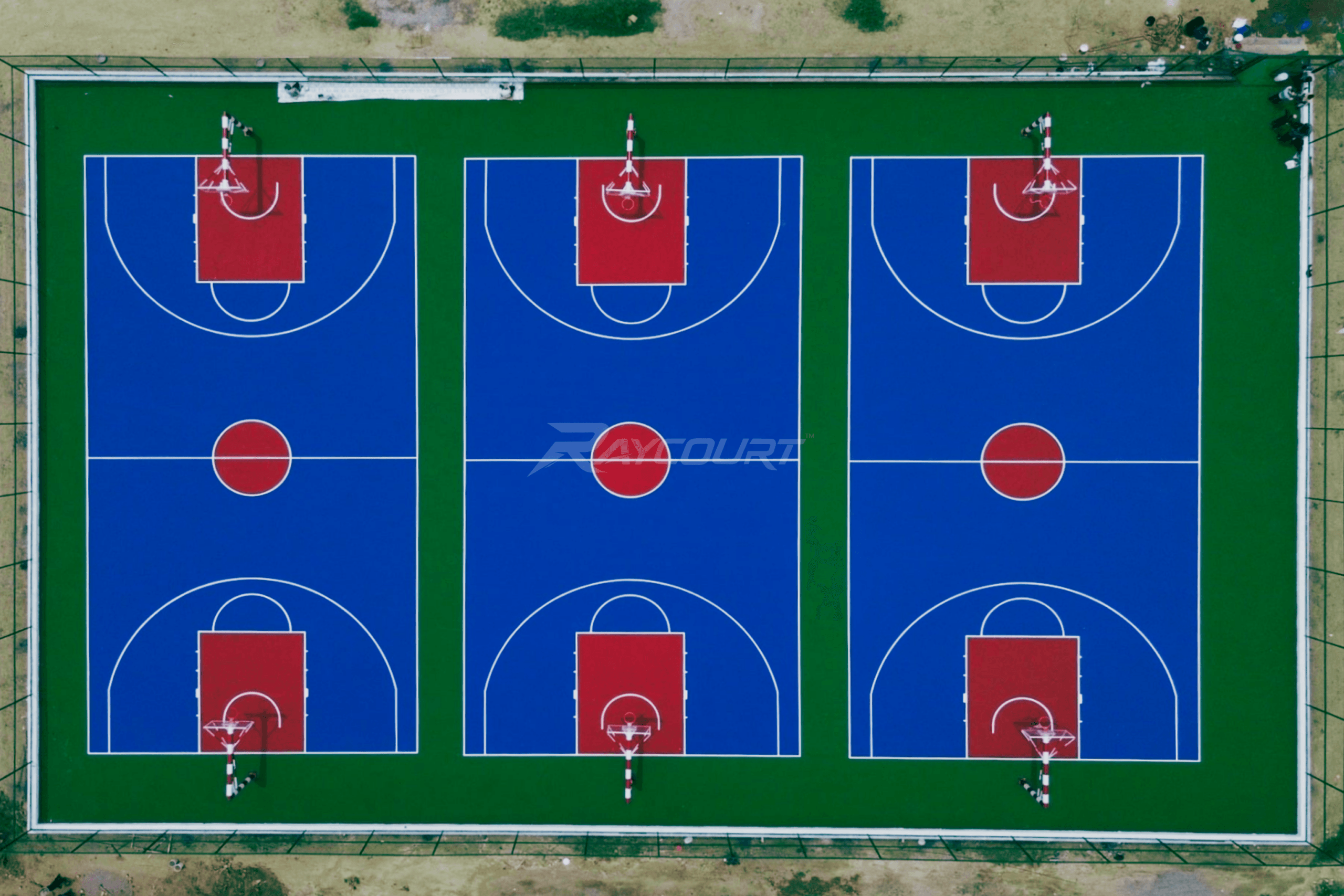
Synthetic acrylic flooring applies layers of acrylic-based coatings over a prepared concrete or asphalt base. The system builds a seamless, textured, color-rich playing surface. Raycourt manufactures this category of material, and we know it deeply.
Acrylic systems handle sun, rain, and heat extremely well. They deliver a consistent bounce and predictable traction. They also accept crisp line markings and a wide color range. For outdoor and semi-outdoor basketball courts, this material stands out.
Comparison of common basketball court flooring material
| Material | Best Environment | Key Strength | Main Limitation |
|---|---|---|---|
| Hardwood | Indoor arenas | Lively bounce, prestige look | Needs climate control, needs refinishing |
| PU / rubber systems | Indoor multipurpose halls | Cushioning, smooth finish | Needs formulation suited to the setting |
| Modular tiles | Backyards, temporary setups | Quick assembly, drainage | Joints can shift under heavy load |
| Vinyl flooring | School gyms, indoor halls | Easy cleaning, neat look | Not designed for outdoor exposure |
| Bare concrete / asphalt | Base layer only | Strong foundation | Hard, abrasive, wears shoes fast |
| Synthetic acrylic | Outdoor and semi-outdoor courts | Weather resistance, consistent play | Needs a sound, well-prepared base |
Why Synthetic Acrylic Is a Leading Basketball Court Flooring Material
A seamless playing surface
Acrylic coatings form one continuous surface. There are no joints, no gaps, and no loose edges. Because of this seamless build, the ball bounces predictably from one side to the other. Players also move without catching a toe on a seam.
Strong weather resistance
Outdoor courts battle the elements every day. Ultraviolet radiation fades weak coatings. Rain and humidity attack poorly bonded layers. Heat expands and contracts the surface. Quality synthetic acrylic material resists these stresses. It holds color, keeps its bond, and maintains its texture across seasons.
Dependable traction
Traction matters in every basketball movement. Acrylic systems use fine textured aggregates in the coating to create controlled grip. The grip lets players plant, cut, and stop with confidence. At the same time, the surface still permits a natural pivot. This balance protects joints while supporting quick play.
Color flexibility
Acrylic systems accept a wide range of colors. Clubs can match team colors, schools can match school branding, and facilities can create distinct zones. Contrasting colors in the key area and the court border also help players read the court quickly. Furthermore, high-quality pigments resist fading under strong sunlight.
Easy upkeep
A well-built acrylic surface needs only routine care. Regular sweeping and occasional washing keep it clean. Periodic inspection catches small issues early. We explain full maintenance habits later in this guide.
Strong compatibility with multiple bases
Acrylic systems bond to properly cured concrete and well-prepared asphalt (bitumen) bases. This flexibility lets facility owners build on the base that suits their site. Importantly, the base must meet quality standards first. We cover base requirements in a dedicated section below.
Multi-sport adaptability
Many facilities share one court among several sports. Acrylic surfaces support basketball, tennis, pickleball, volleyball, and more. Different line colors allow clear markings for each game on the same surface. Consequently, a single court can serve a whole community.
Expert Tip: If you plan a multi-sport court, confirm the line colors and layout early. Clear planning prevents visual clutter and keeps each game easy to read.
Ready to build a court that performs for years to come?
Connect with Raycourt for sports flooring systems built for your project.
Anatomy of a Synthetic Acrylic Basketball Court System
A finished acrylic court looks simple, yet it contains several deliberate layers. Each layer solves a specific problem. Understanding the layers helps you appreciate why quality material matters at every step.
Layer 1: The base
The base forms the foundation. It can be concrete or asphalt. Everything above it depends on its quality. A weak base leads to cracks, bumps, or poor drainage, and those flaws show through the coatings.
A good base has these characteristics:
- Flat and even, with only the slight slope needed for drainage
- Fully cured, so moisture and gases do not disturb the coatings
- Clean and free of dust, oil, and loose particles
- Structurally sound, without active cracks or soft spots
Concrete bases
Concrete offers a hard, stable, long-lasting foundation. It needs adequate curing time before any coating work begins. Fresh concrete holds moisture and alkalinity, and both can damage coatings. Patience here pays off for years.
Asphalt (bitumen) bases
Asphalt offers a slightly more forgiving base. It also needs proper curing so oils and volatile compounds settle. Contractors typically fill low spots and cracks before coating. A smooth, stable asphalt surface accepts acrylic layers very well.
Layer 2: Primer and surface preparation
Before the coatings go on, applicators clean and prepare the base. They remove dust, grease, and loose material. They also repair cracks and fill depressions. Then they apply a primer that improves adhesion between the base and the acrylic layers.
Skipping or rushing this stage causes later problems. Poor adhesion leads to peeling and blistering. For this reason, professional applicators treat preparation as a critical step.
Layer 3: Resurfacer or filler coats
Resurfacer coats smooth out minor irregularities. They fill pores, level small imperfections, and build a uniform texture. This stage creates the even foundation that the color coats need.
Applicators usually apply several thin coats rather than one thick coat. Thin layers cure evenly and bond more reliably. As a result, the surface gains strength and consistency.
Layer 4: Cushion layers (where used)
Some systems include cushion layers that add resilience. These layers contain rubber granules or similar elastic components. They absorb part of the impact energy and reduce stress on the body. Cushioned systems feel softer underfoot, and many players prefer them for long sessions.
Cushion layers also change how the surface plays. Therefore, designers balance cushioning with ball response. Too much softness deadens the bounce, while too little feels harsh.
Layer 5: Color coats
Color coats provide the visible, wear-resistant playing surface. They contain pigments and fine aggregates that create grip. Applicators usually apply two or more coats for uniform color and strength.
Quality pigments matter greatly here. Strong, UV-stable pigments keep the court looking fresh. Weak pigments fade and chalk, which makes the court look tired within a short time.
Layer 6: Line marking
The final stage adds line markings. Crisp, correctly placed lines define the playing area, the key, the free throw line, and the three-point arc. Specialized line paint bonds well to the acrylic surface and lasts through heavy play.
Accuracy matters enormously. Officials and players rely on correct lines, and competitive events require precise dimensions.
Summary of the layer system
| Layer | Primary Purpose | Why It Matters |
|---|---|---|
| Base | Structural foundation | Controls flatness and long-term stability |
| Primer | Adhesion | Prevents peeling and blistering |
| Resurfacer | Smoothing and leveling | Creates an even, uniform playing texture |
| Cushion (optional) | Impact absorption | Reduces joint stress and fatigue |
| Color coats | Wear layer and grip | Delivers color, traction, and durability |
| Line marking | Court definition | Ensures accurate, visible boundaries |
Key Performance Properties of Basketball Court Flooring Material
Great flooring material balances several performance traits. Let’s explore the most important ones.
Ball bounce and ball response
The ball must bounce true and consistent. A true bounce means the ball returns at a predictable height and angle. Dribblers depend on this predictability to control the ball without looking down. Shooters rely on consistent rebounds as well.
Surface hardness, texture, and layer composition all influence ball response. Smooth, dense, even coatings give the most reliable bounce. Cushioned systems can reduce bounce slightly, so careful system design keeps the response lively.
Traction and slip resistance
Traction determines how well the shoe grips. The right level supports sharp cuts and fast stops. Too much grip strains the knees. Too little grip causes sliding. Quality acrylic material uses controlled aggregate texture to hit the middle ground.
Texture also affects the ball and the hands. An overly rough surface scuffs the ball and scrapes skin during falls. Therefore, manufacturers aim for a fine, uniform texture.
Shock absorption and player comfort
Shock absorption reduces the force players feel on landing. Softer, cushioned systems protect the joints, especially during long sessions. Meanwhile, firmer systems return more energy to the ball and the foot. Good design blends both qualities.
Surface pace and consistency
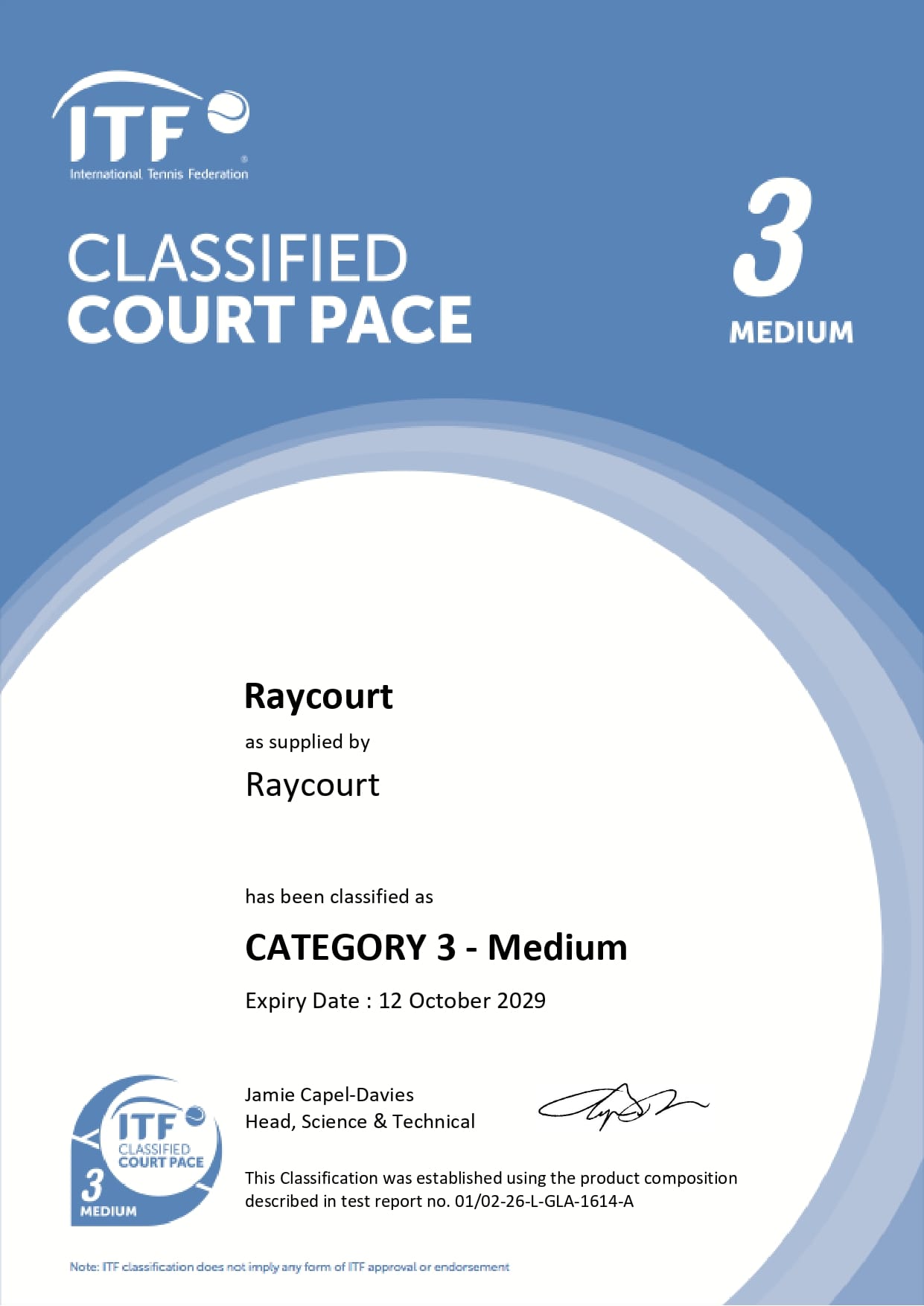
Surface pace describes how fast the ball and the player move across the surface. Raycourt holds ITF Court Pace Classified status, which reflects our commitment to measured, consistent surface performance. Although ITF classification focuses on tennis, the same discipline guides our approach to every sports surface we manufacture.
UV and color stability
Sunlight degrades many materials. UV-stable pigments and resins resist this damage. They keep colors vivid and protect the coating’s structure. Strong UV resistance proves especially valuable in sunny regions.
Water and moisture behavior
Water should drain from the court quickly. A properly sloped base and a well-bonded surface prevent puddles. Puddles create slip hazards, interrupt play, and accelerate wear. Therefore, base design and coating quality work together to manage water.
Abrasion and wear resistance
Basketball players drag their shoes, slide on their knees, and pivot repeatedly. The wear layer must tolerate this abuse. High-quality coatings resist abrasion and keep their texture over time. Weaker coatings smooth out or flake.
Quick Answers on Basketball Court Flooring Material
The following sections answer common questions in a direct, scannable format.
Which basketball court flooring material works best outdoors?
Synthetic acrylic flooring works best for most outdoor courts. It resists ultraviolet radiation, rain, and heat. It also provides consistent bounce and controlled traction. Meanwhile, materials like hardwood and standard vinyl cannot handle outdoor exposure. If you build outdoors, choose a material that targets outdoor performance.
Which basketball court flooring material suits indoor courts?
Indoor courts offer more choices. Hardwood suits premium arenas. Vinyl and PU systems suit school gyms and multipurpose halls. Acrylic systems also work well indoors, especially in facilities that host several sports. Your decision depends on how the space gets used and how much maintenance you want to handle.
Can one court serve basketball and other sports?
Yes, many courts do. Acrylic surfaces support basketball, tennis, pickleball, volleyball, and badminton-style layouts when planners add the right lines. Different line colors keep each sport’s markings distinct. However, you should plan the layout carefully, because the rim posts and net posts also need proper positions.
Does a cushioned system change how the ball bounces?
Slightly, yes. Cushion layers absorb some energy, so the ball may bounce a little lower than on a firm surface. Good system design offsets this effect and keeps ball response lively. If competitive play matters most, ask your applicator how the cushion balances comfort and bounce.
How important is texture on a basketball court?
Texture matters a great deal. It controls grip, wear, and comfort. A texture that feels too coarse scuffs shoes and skin. A texture that feels too smooth causes slips. Quality acrylic material uses fine, uniform aggregate to strike the right balance.
Ready to build a court that performs for years to come?
Connect with Raycourt for sports flooring systems built for your project.
Base Preparation: The Foundation of Every Great Court
Even the finest basketball court flooring material fails on a poor base. Therefore, base quality deserves serious attention before any coating work begins.
Flatness and drainage
A court needs a flat playing surface with a gentle slope for water runoff. Too much slope affects play. Too little slope lets water pool. Designers typically aim for a subtle, even gradient that drains water without players noticing it.
Flatness also affects ball behavior. Dips and bumps change the bounce unpredictably. Straightedge checks and water tests help contractors find low spots before coating begins.
Curing time
Fresh concrete and fresh asphalt both need time to cure. Concrete releases moisture and alkalinity as it hardens. Asphalt releases oils and volatile compounds. Coating too early traps these substances under the surface. The trapped substances then cause blisters, bubbles, and adhesion failures.
Expert Tip: Never rush the curing stage. Patience at the start prevents most coating problems later.
Cracks and surface defects
Cracks in the base often telegraph through thin coatings. Contractors should repair cracks properly before applying any material. They should also fill low spots and remove loose fragments. A clean, sound base gives the coatings a reliable foundation.
Cleanliness
Dust, oil, grease, and loose debris weaken adhesion. Applicators clean the base thoroughly before priming. They often wash and dry the surface completely. This step may seem simple, yet it protects the whole system.
Practical base checklist
Before coating begins, confirm these points:
- The base has cured fully according to material guidelines.
- The surface is flat, with controlled drainage slope.
- The base has no active cracks or soft areas.
- The surface is clean, dry, and free of contaminants.
- The site has proper drainage around the court perimeter.
Climate and Environment: Matching Material to Conditions
Climate strongly influences how a court performs. Smart owners consider local weather before they choose a material.
Hot and sunny regions
Strong sunlight challenges every coating. Heat softens some materials and fades some pigments. In hot regions, choose UV-stable acrylic systems with high-quality pigments. These systems keep color and structure through intense summers.
Humid and rainy regions
Moisture creates slip risks and attacks weak bonds. In wet climates, prioritize excellent drainage and strong adhesion. A properly prepared base and a well-bonded system resist moisture damage effectively.
Dry and dusty regions
Dust settles on the court and acts like fine sandpaper under shoes. It also dulls the surface. In dusty regions, routine sweeping and washing become especially important. A durable wear layer also helps.
Temperature swings
Day-to-night temperature changes make surfaces expand and contract. Flexible, well-formulated coatings tolerate this movement. Rigid or low-quality coatings can crack under repeated cycles. Therefore, formulation quality matters in regions with big swings.
Semi-outdoor and covered courts
Covered courts shield players from rain and direct sun. Even so, they still see humidity, dust, and temperature changes. Acrylic systems perform well here, and they let owners enjoy outdoor-style durability with partial protection.
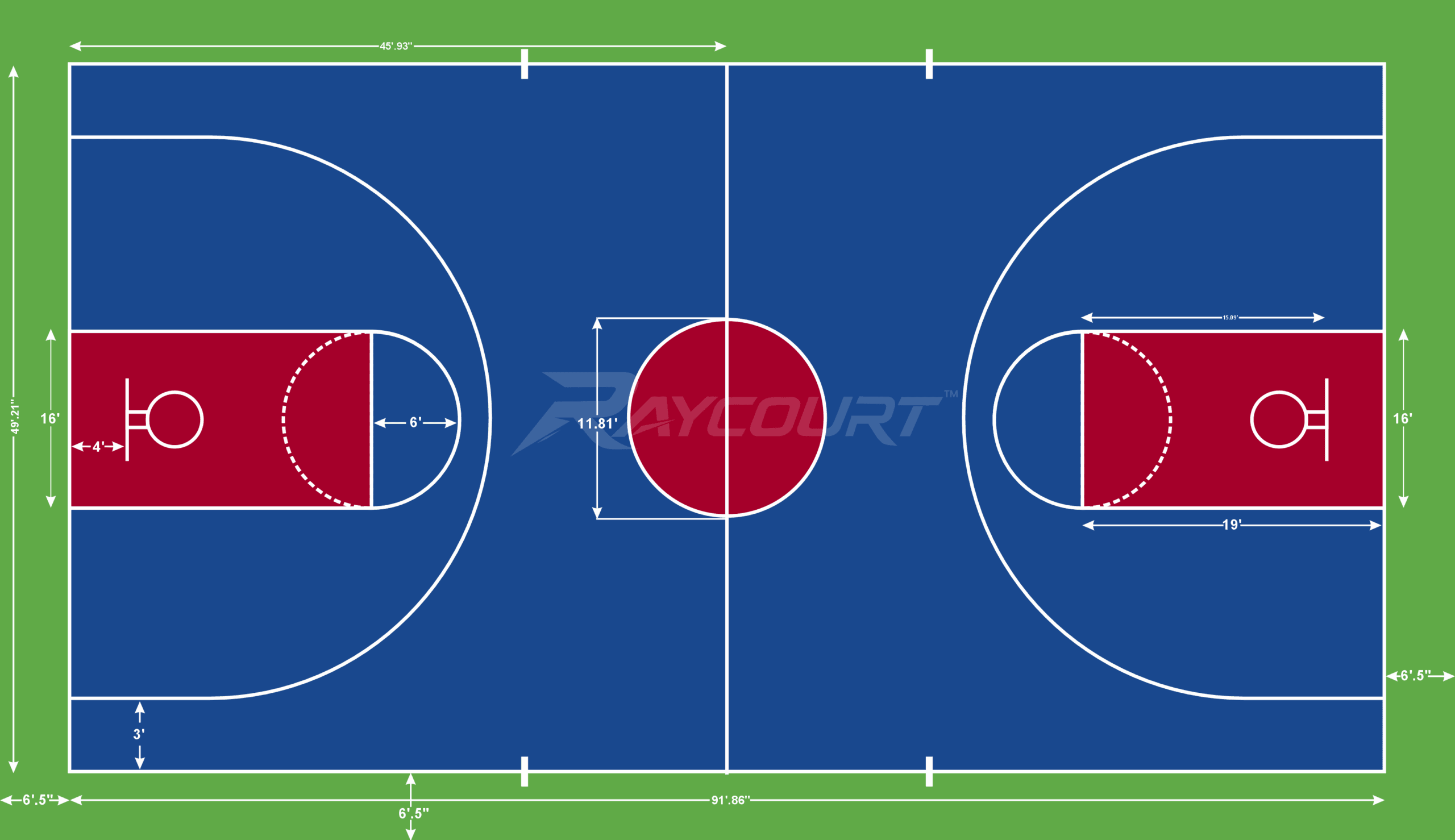
Court Dimensions and Line Markings for Basketball
Flooring material works together with correct court layout. Accurate dimensions and lines complete the surface.
Standard FIBA court dimensions
The International Basketball Federation (FIBA) sets widely recognized standards for competitive courts. You can review official equipment and court information on the FIBA official website. Key dimensions for a full-size FIBA court include:
| Element | Standard Measurement |
|---|---|
| Court length | 28 meters |
| Court width | 15 meters |
| Free throw line distance | 5.80 meters from the backboard’s projection |
| Three-point line distance | 6.75 meters from the basket center |
| Key (restricted area) width | 4.9 meters |
Recreational courts, school courts, and half-courts often use smaller dimensions. Even so, many facilities follow the standard layout as closely as the space permits.
Why line quality matters
Lines must stay clear, sharp, and durable. Faded lines confuse players and officials. Worn lines also give the court a neglected look. High-quality line paint bonds to the acrylic surface and resists wear. Periodic touch-ups keep the lines vivid.
Color contrast and visibility
Smart color planning improves play. A contrasting key area helps players see the paint at a glance. A distinct border color defines out-of-bounds clearly. Strong contrast between the lines and the court color boosts visibility for players and spectators alike.
Run-off area
A good court includes a safe run-off area around the boundary lines. Players often chase loose balls beyond the sideline. A clear, smooth, hazard-free border reduces the chance of collisions and falls. Planners should reserve this space from the start.
Maintenance: Protecting Your Basketball Court Flooring Material
Quality material lasts longer with proper care. Fortunately, acrylic courts need only simple routines.
Daily and weekly care
Regular sweeping removes dust, leaves, and loose debris. Use a soft broom or a leaf blower. This simple habit prevents abrasive particles from grinding into the surface. It also keeps the court safe and tidy.
Weekly or periodic washing removes stubborn dirt. Use clean water and a soft brush or mop. Avoid harsh chemicals unless the manufacturer approves them.
Drainage checks
Inspect drains and runoff channels regularly. Clogged drains create puddles, and puddles speed up wear. Clear leaves and silt promptly, especially before the rainy season.
Early repair of small damage
Small chips, cracks, or worn spots grow quickly if you ignore them. Repair them early with suitable patching materials and techniques. Prompt attention prevents minor issues from becoming major ones.
Avoiding damaging items
Keep sharp, heavy, or abrasive objects off the court. Avoid dragging furniture or equipment across the surface. Likewise, avoid wearing spiked shoes or cleats. These simple rules protect the surface from avoidable damage.
Seasonal inspection
Walk the court at the change of each season. Look for fading, wear patterns, and edge issues. Note any areas that need attention. A short inspection takes little time and delivers great value.
Recoating and refreshing
Eventually, even the best surfaces benefit from a refresh coat. A fresh color coat restores appearance and renews the wear layer. Contractors apply it after cleaning and light preparation. The timing depends on usage, climate, and surface condition.
Expert Tip: Create a simple maintenance calendar. Assign sweeping, washing, drain checks, and inspections to specific dates. Consistency beats occasional heroic cleanups.
Ready to build a court that performs for years to come?
Connect with Raycourt for sports flooring systems built for your project.
Maintenance at a glance
| Task | Suggested Frequency | Benefit |
|---|---|---|
| Sweeping | Daily or after heavy use | Removes abrasive dust and debris |
| Washing | Periodically, as needed | Restores cleanliness and traction |
| Drain inspection | Monthly and before rains | Prevents standing water |
| Surface inspection | Each season | Catches small damage early |
| Line touch-ups | When fading appears | Keeps boundaries sharp |
| Refresh coat | When wear and fading appear | Renews appearance and wear layer |
Common Problems and How to Prevent Them
Knowing common problems helps you avoid them. Most issues trace back to a few root causes.
Peeling and delamination
Peeling usually points to poor adhesion. Dirty bases, moisture, and rushed curing cause it most often. To prevent peeling, ensure thorough cleaning, proper curing, and correct primer use.
Blistering and bubbling
Blisters appear when trapped moisture or gases push the coating upward. Coating over a damp or uncured base produces them. Therefore, let the base cure and dry completely first.
Cracking
Cracks in the base often reflect through the coating. Surface cracks also appear when coatings lack flexibility or when the base moves. Repair base cracks properly and choose flexible, well-formulated coatings.
Fading and chalking
Sunlight breaks down weak pigments and resins. The color fades, and a powdery film develops on the surface. UV-stable pigments and quality resins reduce this problem significantly.
Puddling and ponding
Water that stays on the court usually signals a drainage or flatness issue. Correct slope and a smooth base solve it. Regular drain cleaning helps too.
Uneven wear
High-traffic zones, such as the key and baseline, wear faster. Regular inspection helps you spot these zones early. Targeted repairs and timely refresh coats keep wear under control.
How to Choose the Right Basketball Court Flooring Material
Choosing well takes careful thought. Work through the following steps to reach a confident decision.
Step 1: Define how you will use the court
Start with the basics. Ask whether the court is indoor, outdoor, or semi-outdoor. Next, identify who plays on it, such as children, students, or competitive athletes. Then estimate how many hours of play the surface will see each week. These answers shape every later choice.
Step 2: Consider your climate
Think about sun, rain, humidity, and temperature swings. A court in a sunny, rainy region needs strong UV and moisture resistance. A court in a mild, covered setting has more flexibility.
Step 3: Inspect your base
Check whether you have concrete or asphalt. Evaluate its flatness, cracks, and curing status. A strong base opens more options and lowers long-term risk.
Step 4: Define your performance priorities
Decide what matters most. Competitive players may prioritize ball response and traction. Youth programs may prioritize cushioning and safety. Multi-sport facilities may prioritize versatility. Clear priorities simplify the decision.
Step 5: Evaluate the manufacturer
Material quality starts with the manufacturer. Look for a producer with proven experience, consistent quality control, and transparent technical support. Ask about testing, raw materials, and performance standards. A trustworthy manufacturer answers these questions openly.
Step 6: Work with experienced applicators
Even the best material needs skilled application. Experienced applicators follow correct procedures for preparation, mixing, and coating. They also understand local climate challenges. Raycourt manufactures material only, so we encourage owners to partner with qualified applicators who know our systems.
Selection checklist
- Is the court indoor, outdoor, or semi-outdoor?
- Does the material resist UV, moisture, and temperature swings?
- Does the system deliver consistent ball response?
- Does it provide controlled traction?
- Does it offer the right level of cushioning?
- Does the manufacturer provide clear technical guidance?
- Does a qualified applicator support the installation?
Expert Tip: Request surface samples whenever possible. Touch the texture, check the color, and test the feel before you commit.
What Makes a Quality Manufacturer of Basketball Court Flooring Material?
Not all manufacturers deliver the same quality. The best ones share several traits.
Consistent raw materials
Quality begins with raw materials. Reliable manufacturers source resins, pigments, and aggregates carefully. They test incoming materials and reject inconsistent batches. This discipline produces coatings that behave predictably from one batch to the next.
Rigorous testing
Good manufacturers test their products for adhesion, UV stability, wear resistance, and performance. Testing proves that the material works as promised. It also helps the manufacturer improve formulations over time.
Technical support
Strong manufacturers do not simply ship material. They explain application procedures, curing times, and best practices. They also help applicators solve site-specific challenges. This support makes every project smoother.
Recognized performance credentials
Credentials show commitment to quality. Raycourt holds ITF Court Pace Classified status, which demonstrates our dedication to measured and consistent surface performance. Credentials like this give facility owners extra confidence.
Commitment to long-term reliability
A trustworthy manufacturer stands behind its material. It continues to refine products and support customers long after delivery. Reliability, not hype, builds a lasting reputation.
Ready to build a court that performs for years to come?
Connect with Raycourt for sports flooring systems built for your project.
The Raycourt Approach to Basketball Court Flooring Material
At Raycourt, we focus on one mission: manufacturing high-quality synthetic acrylic sports court flooring material. We do not install courts. Instead, we concentrate on producing material that applicators trust and players enjoy.
Formulation focus
Our team develops coatings that balance traction, ball response, and durability. We pay special attention to UV stability, because sunlight is the greatest enemy of outdoor courts. Our pigments resist fading, and our resins maintain their strength under heat and moisture.
Consistency from batch to batch
Applicators need predictable material. Consistent texture, color, and curing behavior make their work easier and the final court better. We maintain strict quality control to deliver that consistency.
Support for applicators and owners
We share technical knowledge freely. We explain how to prepare bases, how to apply layers, and how to care for finished courts. Consequently, applicators gain confidence, and owners gain better results.
Multi-sport expertise
Our material supports basketball, tennis, pickleball, volleyball, and other sports. This broad experience helps us understand how different games stress a surface. We apply that insight to every formulation, including our basketball systems.
Sustainability and Responsible Surface Choices
Modern facilities increasingly care about environmental impact. Flooring decisions play a role, too.
Long service life reduces waste
Durable material needs fewer full replacements. A court that lasts longer produces less waste over time. Therefore, choosing high-quality material supports sustainability.
Refreshing instead of rebuilding
A well-maintained acrylic court often needs only a refresh coat instead of a complete rebuild. This approach saves materials and reduces disruption. It also keeps the base and structure in service.
Responsible handling
Applicators should follow safe handling and disposal practices for all coatings and cleaning products. They should also protect nearby drains and vegetation during application. Responsible habits protect the environment and the community.
Frequently Asked Questions
Synthetic acrylic flooring is the best choice for most outdoor basketball courts. It resists sun, rain, and heat, and it delivers consistent bounce and controlled traction. Its seamless surface also supports smooth, predictable play across the whole court.
Acrylic systems work in both settings, but many other materials do not. Hardwood and standard vinyl suit indoor use only, because moisture and sunlight damage them. If you want one flexible option, acrylic offers the widest range of use.
Lifespan depends on base quality, material quality, climate, usage, and maintenance. A well-prepared base, quality coatings, and regular care extend service life significantly. Periodic refresh coats also renew the surface and keep it performing well.
You need a cured, flat, clean, and structurally sound base, usually concrete or asphalt. The base must also drain water properly. A strong base protects the coatings and prevents peeling, cracking, and blistering.
No, Raycourt manufactures the synthetic acrylic flooring material only. Qualified applicators and contractors handle installation. We support them with quality products and clear technical guidance, so owners receive a well-built court.
Final Thoughts on Basketball Court Flooring Material
The right basketball court flooring material shapes every part of the game. It affects safety, ball response, comfort, durability, and appearance. Hardwood shines in premium indoor arenas. Vinyl and PU systems serve indoor halls well. Meanwhile, synthetic acrylic flooring leads the way for outdoor and semi-outdoor courts, thanks to its weather resistance, seamless finish, and consistent performance.
Remember that material quality works hand in hand with base quality and skilled application. A great system fails on a weak base, and a great base needs great material. Therefore, plan the whole system, choose a trustworthy manufacturer, and commit to simple maintenance.
Raycourt stands ready to support your project with high-quality synthetic acrylic sports court flooring material. Reach out to our team to discuss the right material system for your basketball court.
Ready to build a court that performs for years to come?
Connect with Raycourt for sports flooring systems built for your project.