
Introduction: What Makes an Indoor Tennis Court Floor Work
An indoor tennis court needs flooring that controls ball bounce, protects players, and resists wear for years. Synthetic acrylic coatings meet all three goals better than most alternatives. They deliver a consistent playing surface, cushion joints during long rallies, and stand up to constant indoor use.
Facility owners often ask the same question first: which flooring actually performs best indoors? The short answer is a multi-layer acrylic system engineered specifically for climate-controlled spaces. This article explains why, and it walks through every factor that shapes that decision.
Indoor courts face different stresses than outdoor courts. They avoid rain and UV damage, but they deal with constant foot traffic, stable humidity, and artificial lighting. Consequently, the flooring choice depends on different priorities. We cover material types, performance metrics, construction steps, maintenance routines, and long-term value throughout this guide. Along the way, we highlight the technical details that separate a professional-grade indoor tennis court from an average one.
Furthermore, this guide speaks to a wide audience. Club owners, school administrators, architects, and contractors all make flooring decisions at some point. Each group asks slightly different questions, yet the underlying science stays the same. We translate that science into practical guidance you can apply immediately. This guidance works whether you plan a single court or an entire multi-court facility.
What Is an Indoor Tennis Court and Why Flooring Matters So Much
An indoor tennis court sits inside a climate-controlled building instead of an open-air space. Clubs, universities, and private facilities build these courts to guarantee year-round play. Weather never interrupts a match, and players enjoy stable conditions every single session.
However, that controlled environment raises the stakes for flooring performance. Outdoor courts get a break from rain and temperature swings. Indoor courts do not get that break. They absorb constant footfall, day after day, without any downtime for natural recovery.
The flooring therefore becomes the single most important performance variable in the entire facility. It determines how the ball bounces off the surface. It also shapes how a player’s knees feel after two hours of play, and how long the surface stays safe. A poor surface causes uneven bounce, sluggish footing, or early cracking. A well-engineered surface delivers predictable play and protects the people using it.
Beyond performance, flooring also shapes the character of the club itself. Members judge a facility by how the court feels underfoot. Consistent ball response and a comfortable surface keep players coming back and support the reputation of the venue. Flooring is not a cosmetic detail; it is the foundation of the entire tennis experience.
The Core Functions of Indoor Tennis Court Flooring
Every indoor tennis court surface needs to perform several jobs at once. Understanding these functions helps facility owners evaluate flooring options with more confidence.
- Ball response control: The surface must produce a predictable, repeatable bounce for every shot.
- Shock absorption: The coating should cushion impact and reduce strain on ankles, knees, and hips.
- Traction management: Players need enough grip to change direction quickly without slipping.
- Surface durability: The flooring must resist scuffing, cracking, and wear from daily play.
- Aesthetic consistency: Clean lines and stable color keep the court looking professional for years.
Each of these functions connects directly to the material science behind the coating system. We explore that science in the next sections.
Who Builds and Uses Indoor Tennis Courts
A wide range of organizations invest in indoor tennis court construction. Private country clubs build these courts to offer members year-round access. Universities and schools add them to support athletic programs and physical education classes. Meanwhile, dedicated training academies rely on indoor courts to run consistent coaching sessions regardless of season.
Municipal recreation departments also invest in indoor tennis court facilities for their communities. These public venues often serve players of every skill level, from beginners to competitive juniors. Consequently, flooring must handle a broad mix of playing styles and traffic patterns.
Private homeowners occasionally build indoor courts as well, particularly in regions with harsh winters. These smaller projects still demand the same performance standards as larger commercial facilities. Regardless of scale, every project benefits from the same core principles: consistent bounce, dependable traction, and long-term durability.
Each of these user groups brings different priorities to the table. A junior academy might emphasize safety and shock absorption above all else. A competitive club might prioritize speed and responsiveness instead. Manufacturers like Raycourt work with facility planners to translate these priorities into a specific acrylic formulation.
Types of Indoor Tennis Court Flooring Materials
Facility owners generally choose between four main flooring categories for an indoor tennis court. Each option carries distinct advantages and trade-offs. We break down all four below so you can compare them clearly.
Synthetic Acrylic Coatings
Synthetic acrylic systems combine a resilient cushion layer with a textured acrylic topcoat. Manufacturers apply these coatings over asphalt or concrete bases in multiple layers. This layered approach lets engineers fine-tune bounce, texture, and color in one integrated system.
Acrylic flooring dominates the modern indoor tennis court market for good reason. It offers a uniform ball bounce, a durable wear layer, and a huge range of color and pace options. Contractors can also customize the cushion thickness to match the venue’s needs, from recreational clubs to competitive training centers.
Wood Flooring
Wood surfaces appear mainly in older indoor facilities and some premium clubs. They offer a fast, responsive playing surface with excellent shock absorption. Wood also demands careful climate control, since humidity changes can warp the boards over time.
Maintenance crews must sand and refinish wood courts periodically to keep the surface smooth. This process interrupts court availability and requires specialized labor. As a result, many modern facilities move away from wood in favor of synthetic systems.
Rubber and Modular Tile Systems
Interlocking rubber tiles offer another indoor option, particularly for multi-sport facilities. These modular systems install quickly and allow easy replacement of damaged sections. However, tile seams can affect ball roll and footwork consistency during fast rallies.
Modular systems also tend to feel different underfoot compared to a monolithic acrylic surface. Players who compete at higher levels often notice this difference immediately. For dedicated, single-purpose tennis venues, most facility planners still prefer a continuous acrylic surface.
Carpet and Textile Surfaces
Carpet surfaces use a woven or tufted fabric, sometimes filled with sand for stability. This flooring type offers a softer, slower playing experience with good traction. Carpet courts remain popular in parts of Europe, though they see less use in newer North American facilities.
Carpet requires regular vacuuming and periodic sand replenishment to maintain consistent play. Over time, high-traffic areas can compress and change the surface’s pace. Facility owners should weigh this ongoing upkeep against the surface’s initial comfort and affordability.
Comparing Indoor Tennis Court Flooring Options
The table below summarizes how each material performs across the factors that matter most for an indoor tennis court.
| Flooring Type | Ball Bounce Consistency | Shock Absorption | Maintenance Needs | Typical Lifespan |
|---|---|---|---|---|
| Synthetic Acrylic | Excellent | Good to Excellent (with cushion layer) | Low to Moderate | Long-lasting with resurfacing |
| Wood | Excellent | Excellent | High (sanding, refinishing) | Long-lasting with upkeep |
| Rubber/Modular Tile | Good | Good | Low | Moderate |
| Carpet/Textile | Fair to Good | Fair | Moderate to High | Moderate |
Expert Tip: Always match the flooring type to how often players use the court. High-traffic clubs benefit most from acrylic systems because they resist wear without constant resurfacing.
Beyond the table above, facility planners should also weigh how each material handles a busy indoor schedule. Acrylic surfaces tolerate back-to-back bookings well, since they don’t need daily conditioning like wood floors do. This resilience makes acrylic an especially practical choice for clubs that run lessons, leagues, and open play throughout the week.
Multi-purpose venues face an additional consideration. Many facilities now share their indoor tennis court with pickleball, badminton, or youth training programs during off-peak hours. Acrylic flooring adapts easily to this kind of shared use. Manufacturers can incorporate multiple line sets without compromising the primary tennis layout.
Ready to build a court that performs for years to come?
Connect with Raycourt for sports flooring systems built for your project.
Why Synthetic Acrylic Flooring Leads for Indoor Tennis Courts
Synthetic acrylic coatings earn their popularity through a combination of performance, longevity, and flexibility. Let’s examine the specific reasons facility owners and builders keep choosing this system for indoor applications.
Consistent Ball Bounce Across the Entire Surface
A tennis match depends on predictable ball behavior. Players adjust their footwork and swing timing based on how the ball reacts off the court. Acrylic coatings create a uniform texture across the entire surface. As a result, the ball bounces the same way in every corner of the court.
This consistency matters even more indoors, where players expect stable conditions every time they step onto the surface. Manufacturers control the texture through the sand content and topcoat formulation. As a result, facilities can specify a faster or slower court depending on their players’ preferences.
Player Safety and Joint Protection
Long rallies place repeated stress on ankles, knees, and hips. A cushioned acrylic system absorbs some of that impact with every step. This cushioning reduces fatigue during extended play sessions and helps protect players from overuse injuries.
Textured acrylic topcoats also provide reliable traction. Players can plant, pivot, and sprint without excessive slipping. At the same time, the surface avoids being so grippy that it catches shoes and causes falls. This balance between grip and slide protects players during fast lateral movement.
Durability Under Constant Indoor Use
Indoor courts see near-constant traffic throughout the year. Acrylic coatings resist abrasion from shoe soles and stay stable under repeated foot traffic. The material also resists cracking better than untreated asphalt because the flexible layers absorb minor substrate movement.
Facility managers appreciate that acrylic systems allow periodic resurfacing instead of full replacement. Crews can recoat the top layer after years of use, restoring color and texture without tearing out the entire court. This approach extends the useful life of the investment considerably.
Design Flexibility and Customization
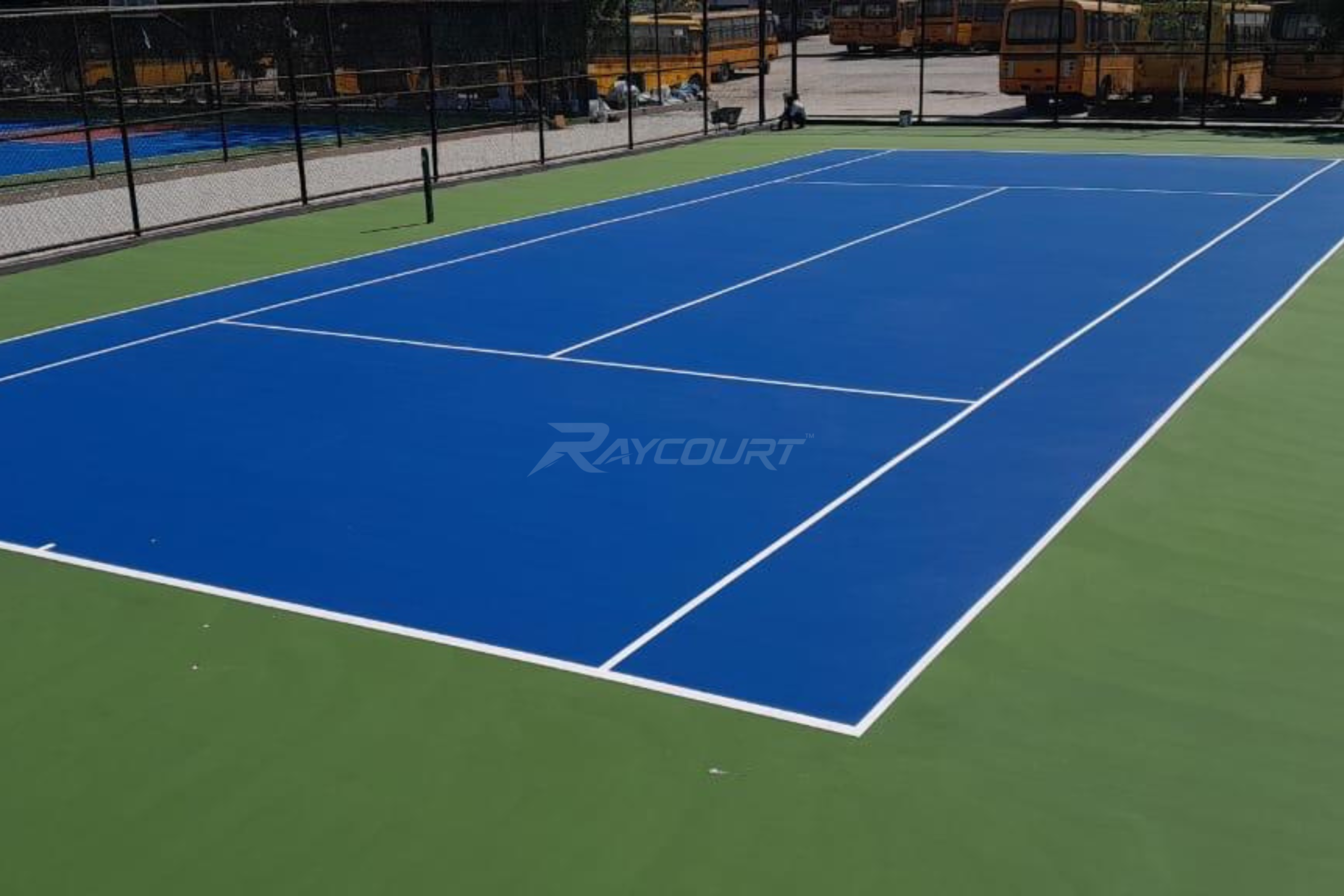
Acrylic coatings come in a wide range of colors. Facilities can match their branding, or simply create a visually appealing space. Contractors can also paint crisp, durable line markings directly into the surface. This flexibility lets every indoor tennis court reflect the personality of its facility.
Color choice also affects playability. Darker colors can absorb more heat and glare under artificial lighting, while lighter tones improve ball visibility. Facility planners often test sample colors under actual court lighting before finalizing their selection.
Key Performance Factors for Indoor Tennis Court Surfaces
Choosing the right flooring goes beyond material type alone. Several measurable performance factors determine how a surface actually plays. Understanding these factors helps facility owners make informed decisions and communicate clearly with contractors.
Shock Absorption
Shock absorption measures how much impact energy the surface absorbs instead of transferring to a player’s joints. Cushioned acrylic systems use a resilient underlayment beneath the acrylic topcoat to increase this absorption. Higher shock absorption generally means more comfort during long training sessions.
However, too much cushioning can slow player movement and affect footwork responsiveness. Manufacturers balance cushioning against stability, since courts still need a firm base for quick direction changes. This balance depends on the intended use of the facility, whether recreational, competitive, or professional training.
Surface Friction and Grip
Friction determines how well a player’s shoes grip the court during acceleration, stopping, and pivoting. Acrylic coatings achieve their texture through fine sand particles mixed into the topcoat layer. More sand generally increases grip, while a smoother finish increases speed of play.
Too little friction creates a slippery, unpredictable surface that raises injury risk. Too much friction can strain knees and ankles during sudden stops. Manufacturers test and calibrate this balance carefully before recommending a system for any given facility.
Pace Rating and the ITF Court Pace Classification
Tennis surfaces also carry a pace rating, meaning how fast or slow the ball travels after it bounces. The International Tennis Federation’s Court Pace Classification Programme sorts surfaces into five categories. These range from slow to fast, based on standardized testing methods. This classification helps facility owners and players understand exactly how a surface will behave before they ever step onto it.
Rougher, higher-bounce surfaces generally play slower, since they give players more time to reach each shot. Smoother, lower-bounce surfaces play faster, favoring quick, aggressive strokes. Facility owners can request a specific pace category from their flooring manufacturer. This choice should match their players’ style of play and training goals.
The Five ITF Pace Categories at a Glance
- Category 1 – Slow: High friction, favoring long rallies and control-based play.
- Category 2 – Medium-Slow: A balanced option suited to all-around play.
- Category 3 – Medium: The most common category for general club and tournament use.
- Category 4 – Medium-Fast: Quicker play that rewards offensive strategies.
- Category 5 – Fast: Low friction and rapid rallies, favoring aggressive, attacking players.
Raycourt’s own formulation is ITF Court Pace Classified with Category 3 – Medium. This classification gives facility owners confidence that the surface meets a recognized, standardized benchmark for play.
Surface Flatness and Drainage Design
Even though indoor courts don’t face rainfall, proper base preparation still matters enormously. A flat, evenly sloped substrate prevents uneven bounce and puddling from cleaning water. Contractors check flatness carefully before applying any acrylic coating, since even small dips can affect play quality for years.
How Indoor Tennis Court Flooring Supports Training and Performance Goals
Coaches design training programs around predictable court behavior. When the surface performs consistently, players can focus entirely on technique instead of adjusting to unexpected bounce. This predictability becomes especially important for junior athletes who are still developing their footwork and timing.
High-performance training also demands a surface that supports repetitive, high-intensity movement. Players sprint, stop, and change direction hundreds of times during a single session. A well-calibrated acrylic surface distributes that stress evenly, which helps reduce fatigue-related mistakes late in practice.
Supporting Different Skill Levels on the Same Court
Many facilities host players across a wide skill spectrum, from beginners to advanced competitors. A medium-pace acrylic surface often works well for this mixed-use scenario. It gives beginners enough time to react while still rewarding strong technique from advanced players.
Some academies choose to install courts with different pace ratings for different training goals. A slower court might suit early-stage skill development, while a faster court sharpens reaction time for advanced athletes. Acrylic systems make this kind of tailored planning realistic, since manufacturers can adjust texture within tight tolerances.
Reducing Injury Risk During Intensive Training
Overuse injuries remain a common concern in competitive tennis programs. Coaches and trainers pay close attention to how the court surface affects joint stress over time. Cushioned acrylic systems help address this concern by absorbing impact during repetitive drills.
Consistent traction also plays a major role in injury prevention. A surface that grips predictably lets players trust their footing during explosive movements. This trust allows athletes to commit fully to each shot, which ultimately supports better performance and fewer hesitation-related injuries.
Expert Tip: Ask your flooring manufacturer about pace and cushioning options before finalizing a training facility design. Matching the surface to your program’s specific training goals pays off for years.
Quick Answers: Indoor Tennis Court Flooring Essentials
This section tackles some of the fastest, most common questions facility owners ask before starting a project.
Does an indoor tennis court need a cushioned surface?
Not always. Cushioned systems suit clubs with heavy daily use and recreational or youth programs. Competitive training centers sometimes prefer a firmer, more responsive surface for faster footwork.
How thick should acrylic coating layers be for indoor use?
Thickness varies based on the base condition and desired cushioning level. Manufacturers specify layer counts and thickness based on substrate testing and the facility’s performance goals.
Can facilities change the color of an indoor tennis court later?
Yes. Acrylic systems allow full or partial recoating, which lets facilities refresh color and even adjust texture during future resurfacing projects.
Do indoor courts need different acrylic formulas than outdoor courts?
Indoor formulas skip UV-resistant additives since sunlight exposure isn’t a factor. Instead, manufacturers focus on texture consistency and wear resistance for constant foot traffic.
Is an acrylic indoor tennis court suitable for pickleball or multi-sport use?
Yes. Acrylic systems handle multi-sport line markings well. They also support the traction needs of several racquet and paddle sports on one surface.
Indoor Tennis Court Construction Considerations
Building an indoor tennis court involves far more than choosing a coating. The surrounding environment, base structure, and building conditions all shape the final playing experience. Contractors and facility planners need to address each of these elements before installation begins.
Subfloor Preparation and Base Selection
The base beneath the acrylic coating determines the long-term stability of the entire court. Concrete and asphalt both work as suitable substrates, though each requires different preparation techniques. Contractors must cure concrete fully and ensure asphalt compaction meets strict tolerances before coating begins.
Cracks or unevenness in the base will eventually show through the acrylic layers. Therefore, thorough substrate inspection and repair always precede coating installation. Skipping this step risks premature failure and uneven play, regardless of how good the topcoat product is.
Concrete vs. Asphalt Substrates
Concrete substrates offer excellent long-term stability and resist substrate movement well. Asphalt substrates install faster and flex slightly under temperature changes. Both options work well for an indoor tennis court, provided contractors prepare and cure them correctly before coating application.
Climate Control and Ventilation
Indoor facilities need stable temperature and humidity levels to protect both players and flooring materials. Extreme humidity swings can affect acrylic curing during installation and application of future recoats. Good ventilation also improves air quality during long training sessions.
Building designers should coordinate HVAC planning with the flooring installation timeline. Coatings generally cure best within specific temperature ranges, so scheduling matters as much as material selection. Contractors typically consult manufacturer guidelines to confirm ideal curing conditions before application.
Lighting and Surface Color Coordination
Artificial lighting interacts differently with court surfaces than natural sunlight does. Glare and shadow patterns change under overhead lighting, which can affect visibility during fast rallies. Facility planners should test surface color samples under the actual lighting fixtures planned for the space.
Darker surface colors reduce glare but can make the court feel warmer under bright lighting. Lighter colors improve ball visibility but may increase reflected glare from certain fixture types. This coordination between lighting design and surface color deserves careful attention during planning.
Ceiling Height and Player Safety Clearance
Indoor tennis facilities require generous ceiling clearance to accommodate high lobs and overhead serves safely. While this factor relates to the building structure rather than flooring, it directly affects how the court plays. Facility planners should confirm clearance requirements early, since flooring decisions won’t compensate for a cramped structure.
Ready to build a court that performs for years to come?
Connect with Raycourt for sports flooring systems built for your project.
Common Mistakes That Shorten the Life of an Indoor Tennis Court
Even well-planned projects run into avoidable problems. Understanding these common mistakes helps facility owners and contractors sidestep major setbacks before they happen.
Rushing Substrate Preparation
Contractors sometimes feel pressure to finish a project quickly, especially when a facility wants to open on schedule. However, rushing substrate preparation almost always backfires. Trapped moisture beneath a coating can cause bubbling. An improperly cured base can lead to cracking within just a year or two.
Patience during this early phase pays dividends later. A properly cured, tested substrate provides the stable foundation that acrylic coatings need to perform correctly. Skipping this step to save time ultimately leads to more repairs and lost court availability.
Choosing the Wrong Pace for the Facility’s Purpose
Facility owners sometimes select a surface pace based on personal preference rather than the court’s actual purpose. A club that primarily serves beginners might unintentionally choose a fast, low-friction surface designed for advanced players. This mismatch can frustrate members and increase injury risk.
Working closely with a knowledgeable manufacturer helps avoid this mistake. A good manufacturer asks detailed questions about the facility’s typical users before recommending a specific formulation.
Neglecting Climate Control Coordination
Some projects finalize flooring plans before finishing HVAC design, which creates coordination problems during installation. Acrylic coatings need specific temperature and humidity ranges to cure properly. When climate control isn’t ready during installation, the coating can cure unevenly and develop texture inconsistencies.
Early coordination between the flooring contractor and the building’s mechanical engineer solves this problem. Both teams should align their schedules well before coating application begins.
Skipping Routine Inspections
Facility managers sometimes assume that a durable acrylic surface needs no attention until problems become obvious. Unfortunately, small issues like hairline cracks or minor texture wear can worsen quickly under constant indoor traffic. Regular inspection catches these problems while repairs remain simple and inexpensive.
Maintenance Best Practices for Indoor Tennis Court Flooring
Proper maintenance protects the performance and appearance of any indoor tennis court for years. Facility managers who follow a consistent routine avoid major problems and extend the life of their flooring investment.
- Sweep the court regularly to remove dust, dirt, and debris that can affect traction and appearance.
- Inspect the surface monthly for cracks, bubbling, or texture changes that might signal underlying issues.
- Clean stains promptly using manufacturer-approved cleaning products to avoid damaging the acrylic topcoat.
- Monitor humidity and temperature inside the facility to protect both the flooring and the building structure.
- Schedule professional resurfacing every several years, depending on usage levels and visible wear patterns.
- Repair minor cracks quickly before moisture or debris can worsen the damage underneath the topcoat.
- Avoid heavy equipment or sharp objects that could gouge or puncture the acrylic surface.
Consistent maintenance keeps ball bounce and traction predictable across the entire life of the court. Neglecting small issues almost always leads to bigger, more disruptive repairs later.
Expert Tip: Walk the entire court surface once a month with a simple visual checklist. Early detection of small cracks prevents much larger resurfacing projects down the road.
Choosing the Right Acrylic System for Your Indoor Tennis Court
Selecting an acrylic system involves several technical decisions beyond just picking a color. Facility owners should work closely with their flooring manufacturer to match the system to their specific needs and usage patterns.
Cushioned vs. Non-Cushioned Systems
Cushioned systems add a resilient layer beneath the textured topcoat to increase shock absorption. These systems suit recreational clubs, schools, and facilities with high player volume. Non-cushioned systems offer a firmer, faster surface that many competitive players prefer for quick footwork.
Neither option is universally better; the right choice depends entirely on the facility’s primary use case. A training academy focused on junior development might prioritize comfort and injury prevention. A competitive club hosting tournaments might prioritize speed and surface responsiveness instead.
Color and Line Marking Options
Facility owners can select from a wide range of standard and custom acrylic colors. Popular choices include shades of green, blue, and terracotta, though many facilities now request custom branded colors. Crews paint line markings directly into the surface using durable, high-contrast acrylic paint.
Multi-sport facilities often request additional line sets for pickleball, badminton, or futsal on the same court. Manufacturers can accommodate these combined layouts while keeping every line crisp and clearly distinguishable. This flexibility makes acrylic flooring especially practical for shared community spaces.
Texture and Pace Customization
As covered earlier, sand content in the topcoat controls surface texture and pace. Facility owners should discuss their preferred pace category with their manufacturer early in the planning process. This conversation ensures the finished court matches the playing style the facility wants to support.
Some facilities request different pace levels across multiple courts within the same building. This approach lets one venue serve recreational players, junior athletes, and competitive teams simultaneously. Acrylic systems make this kind of customization straightforward compared to fixed materials like wood.
Ready to build a court that performs for years to come?
Connect with Raycourt for sports flooring systems built for your project.
Indoor vs. Outdoor Tennis Court Flooring: Key Differences
Many facility owners manage both indoor and outdoor courts, so understanding the differences matters. While the core acrylic technology stays similar, several important distinctions separate the two applications.
Outdoor courts require UV-stabilized formulations to prevent color fading and surface degradation from sun exposure. Indoor courts skip this requirement entirely, since artificial lighting doesn’t degrade acrylic coatings the way sunlight does. Manufacturers can therefore focus indoor formulas purely on texture, durability, and wear resistance.
Drainage also plays a much smaller role indoors. Outdoor courts need precise slope calculations to shed rainwater quickly and avoid standing puddles. Indoor courts only need to manage cleaning water and general moisture control, which simplifies base design considerably.
Temperature stability differs significantly between the two environments as well. Outdoor courts expand and contract with seasonal temperature swings, which can stress the coating over time. Indoor courts maintain much more stable conditions, reducing this particular source of long-term wear.
Finally, usage patterns tend to differ between indoor and outdoor facilities. Indoor courts often see more consistent, year-round bookings since weather never interrupts play. This constant use means indoor flooring needs excellent abrasion resistance, even without the added stress of weather exposure.
Lighting design also separates the two environments in an important way. Outdoor courts rely on natural daylight, which changes throughout the day and across seasons. Indoor courts depend entirely on fixed artificial lighting. Facility planners must test surface color and glare under those exact conditions before finalizing a coating choice.
Sustainability and Long-Term Performance
Facility owners increasingly consider environmental impact alongside performance when selecting flooring materials. Synthetic acrylic systems offer several advantages in this area worth highlighting.
Acrylic resurfacing allows facilities to renew a court’s playing surface without demolishing and replacing the entire structure. This resurfacing approach reduces material waste significantly compared to full replacement projects. It also minimizes disruption to the facility’s operating schedule.
Water-based acrylic formulations have become increasingly common across the flooring industry. These formulations reduce volatile organic compound emissions compared to older solvent-based systems. Facility owners can factor this into their broader sustainability goals when planning new construction or renovations.
Long-term performance also connects directly to sustainability. A durable surface lasts many years with periodic resurfacing instead of full replacement. That approach ultimately consumes fewer raw materials over its lifetime. This durability makes acrylic flooring a practical choice for facilities focused on responsible, long-term facility management.
Facility owners can also extend a court’s usable life through simple operational choices. Scheduling regular cleaning, controlling indoor humidity, and addressing minor repairs quickly all reduce the need for major resurfacing. These small, consistent habits protect the original investment and support a facility’s broader sustainability goals over time.
Innovations Shaping Indoor Tennis Court Flooring Technology
Acrylic flooring technology continues to evolve alongside advances in polymer science and application methods. Manufacturers now formulate coatings with improved flexibility, which helps surfaces resist cracking from minor substrate movement. This flexibility extends usable court life without sacrificing the firm, responsive feel players expect.
Application techniques have also advanced significantly in recent years. Modern spraying and rolling equipment creates more uniform texture across large court surfaces. This consistency reduces the subtle bounce variations that older, hand-applied coatings sometimes produced.
Advanced Cushioning Technologies
Newer cushion layer designs balance shock absorption with surface stability more effectively than earlier generations of products. Engineers test these layers under simulated match conditions to fine-tune their performance before bringing them to market. As a result, today’s cushioned systems protect players without feeling soft or unstable underfoot.
Smarter Pace and Texture Control
Manufacturers now use more precise sand grading techniques to control surface texture. This precision allows facilities to specify pace ratings with greater accuracy than older acrylic formulations allowed. Consequently, a facility can request a very specific playing feel and receive a surface that matches that request closely.
These ongoing innovations benefit every indoor tennis court, whether it serves recreational players or elite competitors. As formulation science improves, facility owners gain more precise control over how their courts perform, year after year.
Why Facility Owners Choose Raycourt for Indoor Tennis Court Projects
Raycourt formulates synthetic acrylic flooring systems specifically engineered for demanding indoor tennis applications. Our team focuses on consistent ball response, reliable texture control, and coatings that hold up under constant indoor traffic. We work with architects, contractors, and facility owners who need dependable technical guidance throughout their planning process.
As a manufacturer, Raycourt does not handle installation directly. Instead, we partner with a network of qualified contractors who apply our systems correctly on every project. This focus lets us concentrate entirely on formulation quality and consistent product performance. It also frees us to provide responsive technical support for every indoor tennis court that uses our materials.
Our product range covers cushioned and non-cushioned systems, multiple pace categories, and a wide selection of colors. Our indoor tennis court formulation is ITF Court Pace Classified. This classification confirms the surface meets a recognized, standardized benchmark for play. A facility might need a recreational community court, or a demanding training venue. Either way, Raycourt provides formulations that meet the ITF’s performance expectations for modern tennis surfaces. We stand behind every batch with rigorous quality control before it ever reaches a job site.
Ready to build a court that performs for years to come?
Connect with Raycourt for sports flooring systems built for your project.
Frequently Asked Questions
Synthetic acrylic flooring generally performs best for most indoor tennis court applications. It delivers consistent ball bounce, reliable traction, and strong durability under constant indoor use. Facilities that need faster, more responsive play sometimes choose wood, but acrylic systems require far less ongoing maintenance overall.
A well-maintained acrylic system can remain functional for many years before requiring full replacement. Periodic resurfacing every several years restores color, texture, and traction without tearing out the base layers. Actual lifespan always depends on usage intensity, maintenance routine, and the quality of the original installation.
Yes, proper ventilation supports even curing and reduces odors during acrylic application. Facility managers should coordinate installation timing with their HVAC systems to maintain ideal temperature and humidity levels. Manufacturers typically provide specific curing guidelines that installers should follow closely for best results.
Yes, many facilities add extra line markings to support pickleball, badminton, or futsal on the same acrylic surface. Manufacturers can adjust texture and color contrast to keep every sport’s lines clearly visible. This flexibility makes acrylic flooring a practical choice for community centers and multi-purpose facilities.
Cracking usually stems from substrate movement, moisture trapped beneath the coating, or inadequate base preparation before installation. Bubbling often indicates trapped moisture or air pockets that formed during the coating application process. Regular inspection helps facility managers catch these issues early, before they spread across the surface.
Final Thoughts on Building a High-Performing Indoor Tennis Court
Choosing the right flooring shapes every match played on an indoor tennis court for years to come. Synthetic acrylic systems consistently deliver the performance, safety, and durability that modern facilities demand. From ball bounce consistency to long-term maintenance ease, this material addresses nearly every priority facility owners care about.
Careful planning around subfloor preparation, climate control, and pace selection ensures the finished court performs exactly as intended. Facility owners who partner with experienced manufacturers gain access to technical guidance throughout this entire process. That guidance turns a complex construction project into a smooth, confident decision.
Raycourt continues developing acrylic formulations that meet the evolving needs of indoor tennis facilities worldwide. We help architects, contractors, and facility owners select the right system for their specific goals. A well-built indoor tennis court rewards everyone who steps onto it, match after match, for years to come.
Every successful project starts with a clear understanding of the facility’s goals, users, and long-term maintenance plans. From there, the right acrylic formulation follows naturally. Thoughtful planning today translates directly into safer, more consistent play for the players who use the court tomorrow.