
Introduction: Understanding Indoor Tennis Courts
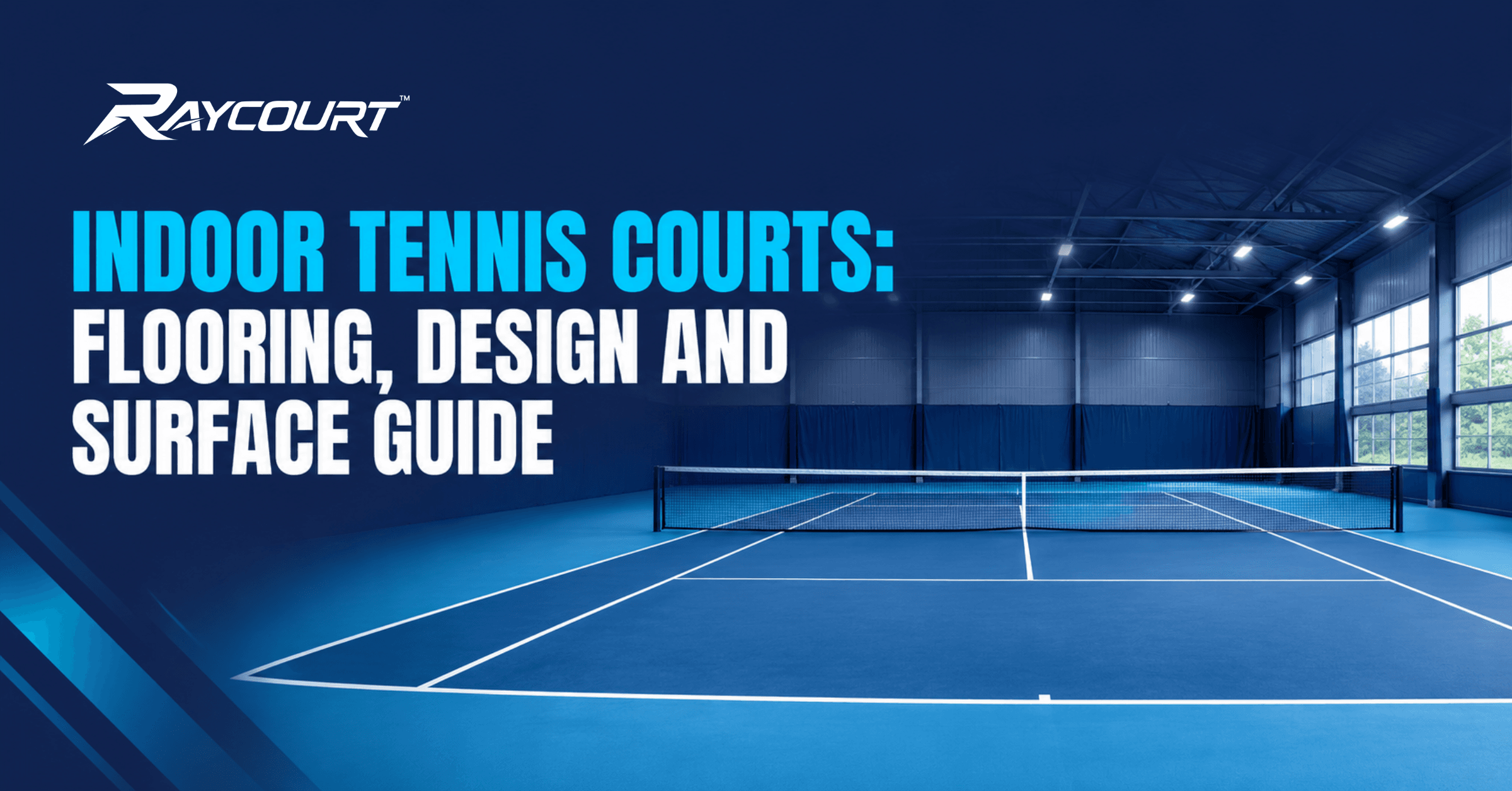
Indoor tennis courts provide a covered playing environment for year-round tennis practice, coaching, and recreational activities. They protect players from rain, direct sunlight, and strong winds. However, a successful indoor facility requires suitable flooring, proper lighting, effective ventilation, and adequate playing space.
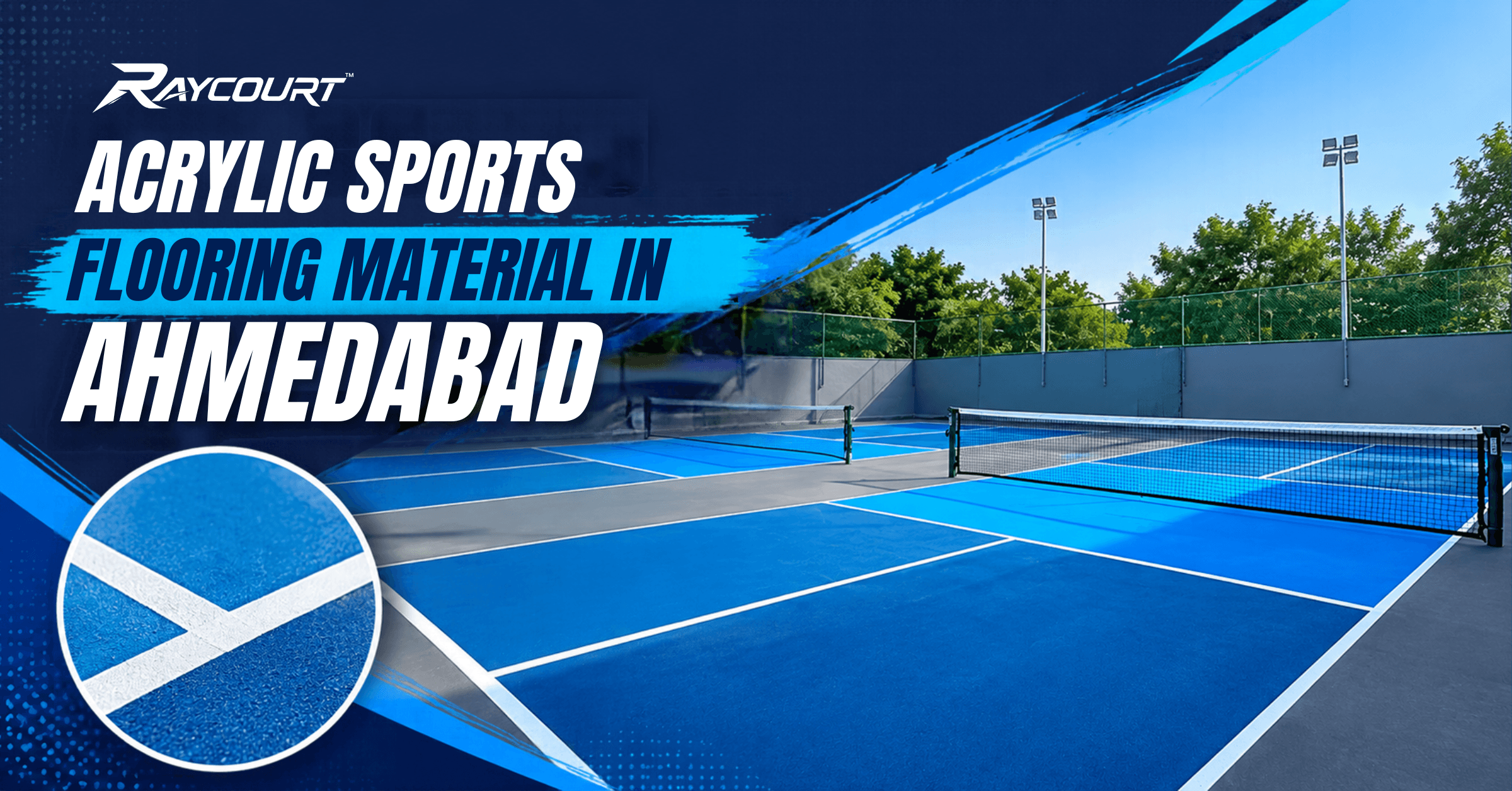
Synthetic acrylic sports flooring offers a practical option for suitable indoor tennis courts. It provides a textured playing surface, colour flexibility, and consistent playing characteristics when the system meets technical requirements. Therefore, facility owners should evaluate the flooring materials alongside the building design and intended use.
Raycourt manufactures synthetic acrylic sports court flooring materials for tennis facilities, sports academies, educational institutions, and recreational venues. With years of experience in sports surface solutions, Raycourt focuses on dependable materials and technical product guidance. The company supplies flooring materials but does not undertake court installation.
Choosing the right flooring system requires careful consideration of the substrate, surface texture, ball response, and maintenance requirements. Additionally, indoor facilities need sufficient overhead clearance and consistent lighting for comfortable play. Proper ventilation also helps manage humidity and indoor air quality.
This guide explores indoor tennis courts, including flooring options, dimensions, design considerations, surface performance, and maintenance practices. It also explains how Raycourt’s synthetic acrylic flooring materials can support suitable tennis court projects.
What Are Indoor Tennis Courts?
Indoor tennis courts provide a dedicated playing area inside a covered or enclosed sports facility. The building protects the court from direct rainfall and reduces exposure to external weather conditions. Depending on the facility design, the structure may feature a full enclosure, a large-span roof, or a sports hall configuration.
The court itself follows tennis layout requirements, including the playing rectangle, service boxes, baselines, sidelines, centre marks, and net. Beyond these markings, players also need sufficient space for movement and recovery. Therefore, planners must consider the entire playing envelope rather than the marked rectangle alone.
Indoor tennis courts differ from outdoor facilities in several important ways. The roof and surrounding structure influence lighting, air circulation, sound, humidity, and temperature. Furthermore, indoor conditions can affect surface drying, dust accumulation, and the way players experience the court.
The flooring system must suit the underlying base and the building environment. For example, an acrylic surface requires a compatible, stable substrate and appropriate moisture conditions. A poorly prepared base can compromise surface uniformity, regardless of the quality of the coating materials.
Why Indoor Tennis Courts Continue to Attract Interest
Many organisations want dependable access to tennis throughout the year. Outdoor courts can face interruptions from rain, excessive heat, strong winds, and seasonal weather changes. Indoor tennis courts reduce several of these challenges by providing a controlled playing environment.
This advantage supports more predictable coaching schedules and structured practice sessions. Players can also focus on technique without the same exposure to outdoor weather. Additionally, indoor facilities can support group coaching, fitness programmes, and organised tennis activities.
Sports academies often value reliable court access because regular practice supports player development. Educational institutions may also benefit from indoor facilities during unpredictable weather. Similarly, private clubs can offer members more consistent opportunities to play.
However, indoor construction alone does not guarantee excellent playing conditions. The court still needs appropriate dimensions, a suitable surface, good lighting, and sufficient overhead clearance. Consequently, planners should treat the building and playing surface as connected parts of one sporting facility.
Benefits of Indoor Tennis Courts
Indoor tennis courts provide practical benefits for players, coaches, facility operators, and sports organisations. Their value extends beyond weather protection because the surrounding environment can support more structured sports activities.
More Consistent Playing Opportunities
Rain can interrupt outdoor tennis sessions and disrupt coaching schedules. Indoor facilities reduce this particular source of interruption. As a result, academies and clubs can plan regular training sessions with greater confidence.
The roof also protects players from direct rainfall during ordinary play. However, operators must still manage indoor humidity, condensation, and water brought inside by footwear. These factors can affect safety and surface condition.
Reduced Exposure to Wind
Wind can change the flight of a tennis ball and complicate shot placement. An enclosed indoor court greatly reduces direct wind interference. Therefore, players can concentrate more closely on technique, timing, and tactical decisions.
The building design still requires appropriate ventilation. Poorly planned air movement can create uncomfortable conditions, even inside a covered facility. Designers should balance fresh-air requirements with stable playing conditions.
Better Support for Structured Training
Indoor tennis courts help academies establish regular training timetables. Coaches can organise individual sessions, group lessons, drills, and match practice. Moreover, reliable court availability helps players follow consistent development programmes.
Facilities can also plan indoor tournaments and recreational events. Nevertheless, organisers should confirm that the venue meets the relevant requirements for their intended activities. Competitive events may require additional checks involving court dimensions, lighting, and surface characteristics.
Greater Protection from Direct Sunlight
A roof shields players from direct sunlight across much of the playing area. This arrangement can improve visual comfort during daytime sessions. However, lighting design remains essential because shadows, glare, and uneven illumination can affect visibility.
A suitable lighting layout should illuminate the entire court consistently. Designers should also consider the ball’s trajectory and players’ upward field of vision. Consequently, fixture placement matters as much as overall brightness.
More Controlled Facility Management
An indoor environment gives operators greater control over several playing conditions. For example, they can manage lighting schedules, ventilation, access, and cleaning routines. These measures help maintain a more organised sporting environment.
Nevertheless, enclosed buildings can trap dust and moisture without adequate ventilation. Operators should establish regular inspection and cleaning procedures. They should also monitor the surface for wear, contamination, and localised damage.
Better Use of Sports Infrastructure
A well-planned indoor tennis facility can support coaching, recreational play, and organised sports programmes. Educational institutions can integrate tennis into their physical education activities. Sports clubs can also schedule different sessions throughout the day.
Some facilities combine tennis courts with fitness areas or spectator spaces. However, planners must protect the tennis playing envelope and maintain suitable separation from neighbouring activities. Every additional facility feature should support, rather than compromise, safe tennis play.
Ready to build a court that performs for years to come?
Connect with Raycourt for sports flooring systems built for your project.
Choosing the Right Flooring for Indoor Tennis Courts
Flooring selection directly influences how players experience indoor tennis courts. The surface affects traction, ball response, movement, and maintenance requirements. Therefore, buyers should evaluate the intended playing experience before selecting a flooring system.
Common tennis surfaces include hard courts, clay courts, grass courts, and certain synthetic systems. Each surface offers different characteristics and maintenance demands. Indoor facilities often consider hard-court systems because they can provide a consistent playing platform when the base and surface meet the relevant requirements.
Synthetic acrylic sports flooring offers one option for suitable indoor tennis courts. Manufacturers formulate acrylic systems with specific surface characteristics and application requirements. The finished surface can provide a uniform texture and defined playing response when the project team follows the appropriate specification.
However, not every acrylic product suits every indoor environment. Buyers should examine the manufacturer’s technical information and confirm compatibility with the proposed substrate. They should also assess moisture conditions, indoor ventilation, curing requirements, and the intended level of play.
Synthetic Acrylic Sports Flooring
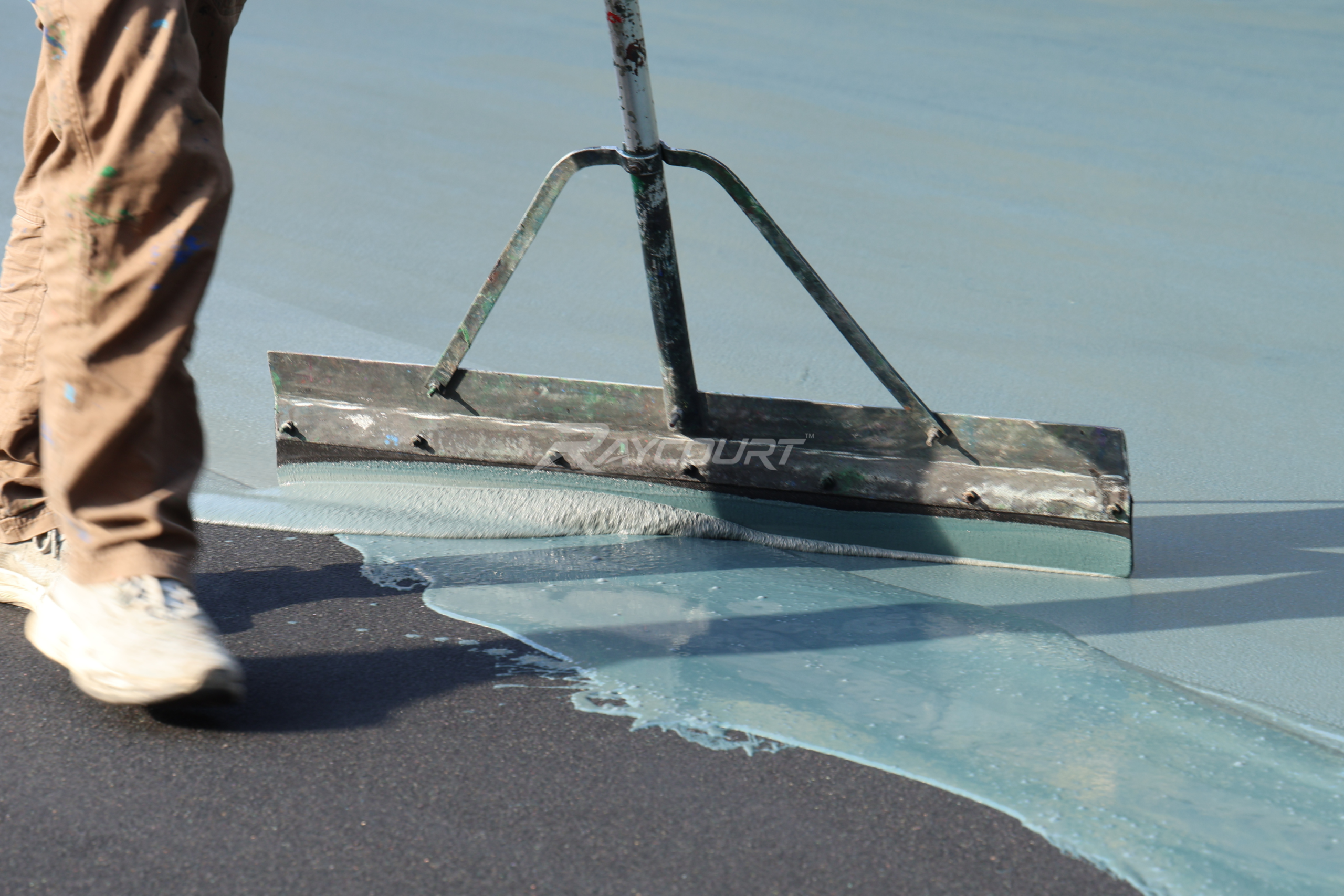
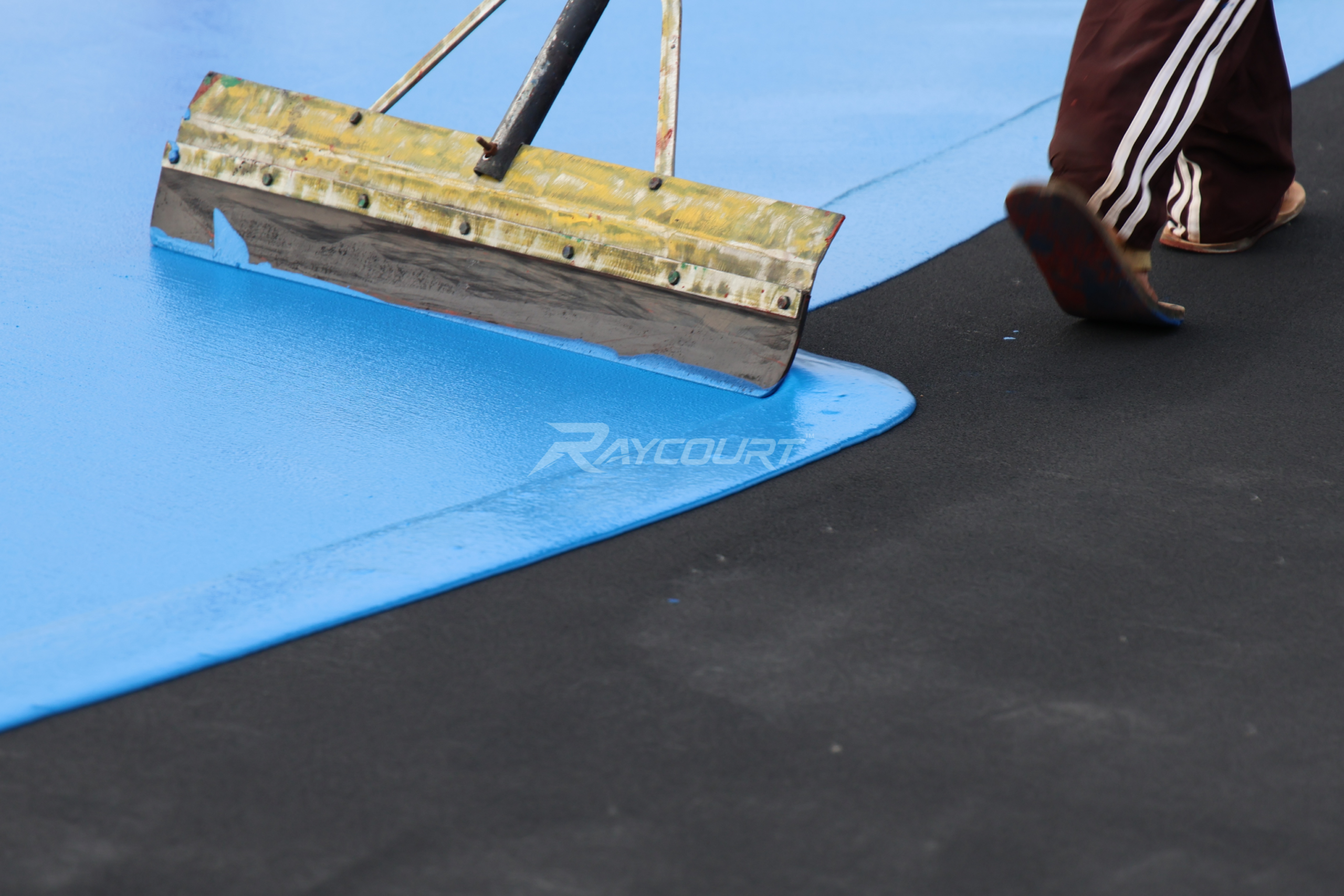
Synthetic acrylic sports flooring uses acrylic-based materials to create a sports surface over a suitable prepared base. Depending on the system, the specification may include primers, resurfacing materials, acrylic layers, textured finishes, and optional cushioning components.
Each layer serves a particular purpose within the complete system. Primers support compatibility and adhesion where the specification requires them. Resurfacing materials help address suitable minor surface irregularities. Meanwhile, coloured acrylic layers establish the playing finish and court appearance.
Textured finish layers help create the intended surface feel and traction characteristics. Optional cushion layers may provide additional underfoot comfort, depending on the system design. However, buyers should not assume that every acrylic system includes cushioning or delivers identical performance.
Raycourt manufactures synthetic acrylic sports court flooring materials for appropriate sports surface applications. Its product range supports project teams that need to evaluate acrylic systems for tennis and other sports. Buyers should discuss their substrate, playing requirements, and environmental conditions before selecting a specific product configuration.
Why Acrylic Flooring Can Suit Indoor Tennis Courts
Acrylic sports flooring offers several characteristics that can support indoor tennis activities. A properly specified system can provide a consistent playing texture and a clean, professional appearance. Additionally, the surface can support regular sports use when the substrate and application meet the product requirements.
Acrylic surfaces also offer flexibility in court colour selection. Facility owners can choose suitable combinations that distinguish the playing area from the surrounding space. Clear visual contrast can help players identify boundaries and track the ball.
Another advantage involves maintenance planning. Operators can follow a defined cleaning and inspection routine to protect the playing surface. Moreover, a compatible acrylic system can simplify routine surface care compared with some more demanding surface types.
However, the material alone cannot guarantee a particular level of performance. Base flatness, drainage design, material selection, application quality, and curing conditions all influence the result. Therefore, project teams should assess the complete system rather than comparing coating materials in isolation.
Hard Courts and Acrylic Surface Systems
Hard courts generally use a firm, stable base beneath the playing surface. Concrete and asphalt can serve as bases for suitable acrylic court systems. The project team must select the base according to structural, environmental, and technical requirements.
Concrete offers a rigid substrate when the design, preparation, and moisture conditions suit the intended application. Asphalt provides another option for suitable sports court construction. However, each substrate presents different preparation and movement considerations.
Acrylic coatings do not replace the structural base. Instead, they form the playing surface above a compatible substrate. Therefore, the quality of the underlying construction remains essential for long-term performance.
Indoor facilities also need to consider slab movement, cracks, moisture migration, and joint details. A contractor should assess these conditions before applying the specified surface system. Meanwhile, the flooring manufacturer can provide relevant product guidance and substrate compatibility information.
Acrylic Flooring Versus Other Indoor Court Surfaces
The most suitable surface depends on playing requirements, building conditions, maintenance practices, and the intended users. Facility owners should compare the characteristics of different systems before making a decision.
| Flooring consideration | Synthetic acrylic sports flooring | Other surface systems |
|---|---|---|
| Surface texture | Supports a specified textured finish | Texture varies by material |
| Colour options | Offers multiple suitable colour combinations | Options depend on the system |
| Playing response | Depends on the complete specification | Depends on the selected surface |
| Cushioning | Optional in compatible system designs | Depends on the construction |
| Base requirements | Requires a compatible, prepared substrate | Requirements vary by system |
| Maintenance | Requires routine cleaning and inspections | Maintenance needs vary |
| Indoor suitability | Depends on product and environmental compatibility | Depends on the selected system |
This comparison provides a starting point rather than a universal ranking. For example, a facility focused on a particular competitive surface may require a specific playing response. Meanwhile, a recreational venue may prioritise straightforward upkeep and consistent everyday use.
Consequently, buyers should identify their priorities before comparing products. They should also request technical documentation and confirm whether the proposed system meets their requirements.
How Should You Evaluate an Acrylic Flooring System?
Start by defining the intended users and expected playing conditions. Then, review the substrate, indoor environment, and performance requirements. Finally, compare compatible products using clear technical criteria.
Consider these questions during product selection:
- Does the system suit the proposed concrete or asphalt base?
- What preparation does the substrate require?
- Does the specification include a cushion layer?
- What surface texture does the system provide?
- How does the product address indoor moisture conditions?
- What curing conditions does the manufacturer recommend?
- What cleaning practices support the finished surface?
- Does the product have relevant independent classification or test documentation?
Expert tip: Request the product specification before finalising the court design. This step helps the architect, contractor, and facility owner coordinate their requirements early.
Raycourt can provide information about its synthetic acrylic sports flooring materials. The appointed project team must handle building design, base construction, and installation. This clear division of responsibilities helps everyone understand their role.
Indoor Tennis Court Dimensions and Layout
Correct dimensions support fair play, safe movement, and an effective training environment. Indoor tennis courts need the standard playing rectangle and adequate surrounding space. Designers must also account for walls, columns, doors, seating, equipment, and circulation routes.
The International Tennis Federation provides recognised tennis rules and technical resources. Facility planners should consult the relevant official guidance when developing courts for organised competition. Recreational facilities should also establish a layout that suits their users and available building space.
Standard Tennis Court Playing Dimensions
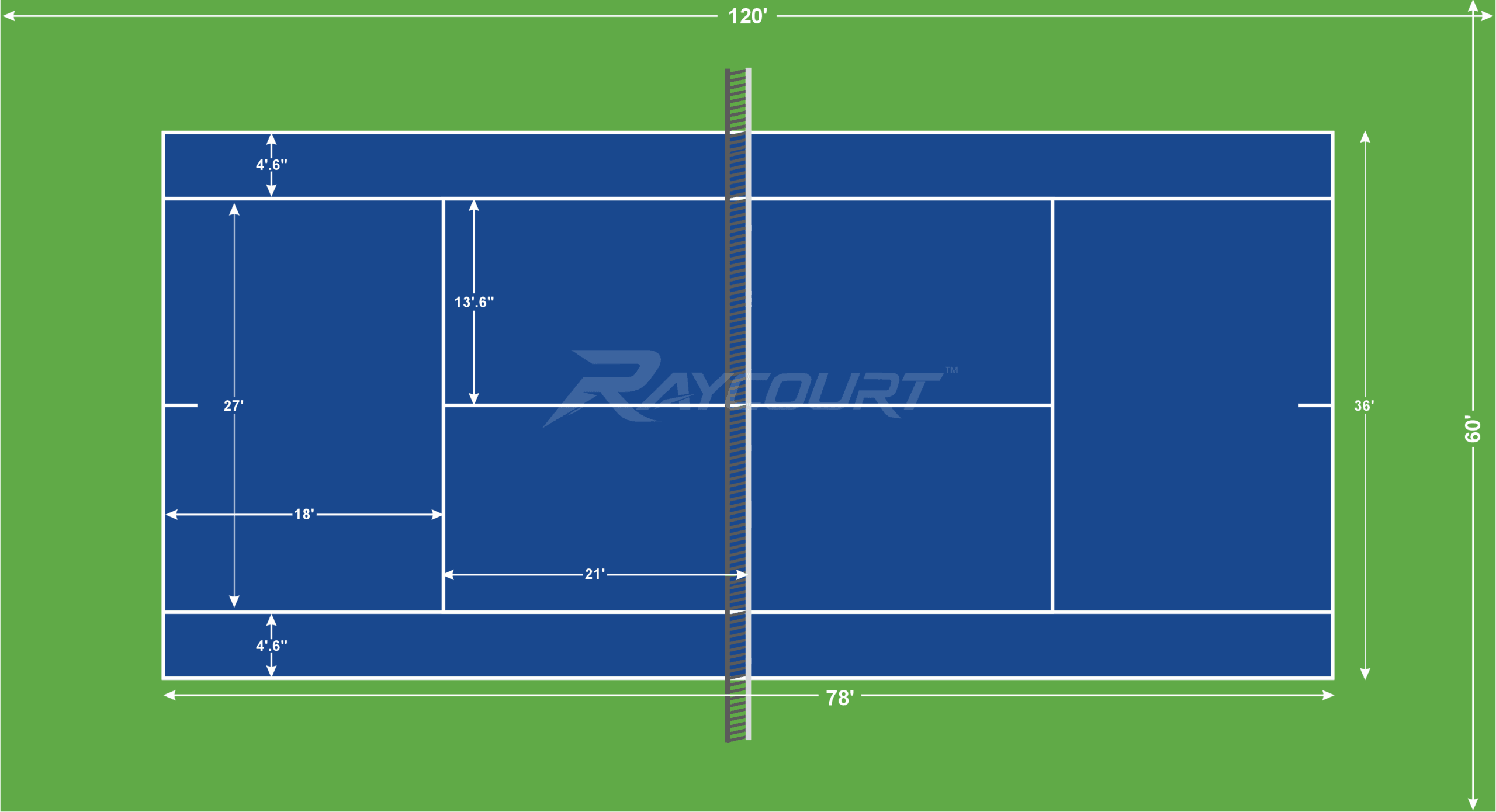
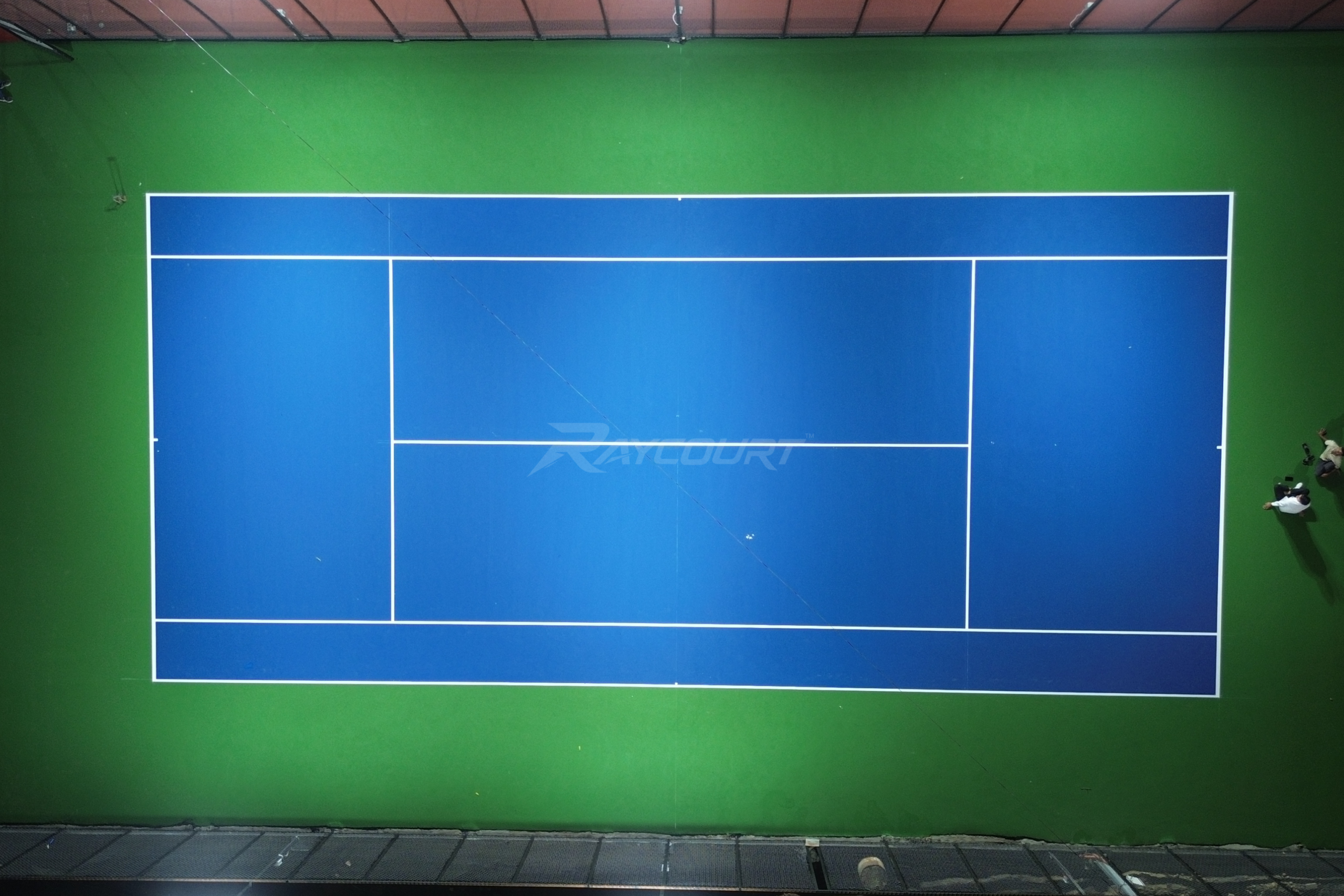
A standard tennis court measures 23.77 metres long. Its width measures 8.23 metres for singles and 10.97 metres for doubles. These dimensions describe the marked playing rectangle, not the complete building footprint.
The court includes several important markings. Baselines define the ends of the playing area. Singles and doubles sidelines establish the relevant width for each format. The service lines and centre service line define the service boxes.
The net crosses the court at its midpoint. The centre mark helps players position themselves for service. Every line should follow the applicable rules and layout specifications.
| Court component | Standard dimension |
|---|---|
| Court length | 23.77 m |
| Singles court width | 8.23 m |
| Doubles court width | 10.97 m |
| Service line distance from the net | 6.40 m |
| Net height at the centre | 0.914 m |
| Net height at the posts | 1.07 m |
These measurements provide a useful reference for initial planning. Designers should verify all dimensions against current rules before construction. They should also confirm line widths and net positioning with the appointed court specialist.
Why Run-Off Space Matters
Players regularly move beyond the baselines and sidelines during rallies. Therefore, the marked rectangle alone cannot provide a complete playing environment. Additional space allows players to chase shots, decelerate, and recover safely.
Indoor tennis court planning should consider both end run-off and side run-off. The required clearances depend on the intended level of play and the applicable facility guidelines. Competitive facilities may need more generous clearances than restricted recreational spaces.
Designers should measure from the court lines to the nearest obstruction. Walls, columns, benches, equipment, and doors can all create hazards. Consequently, the building layout should protect the full playing envelope.
Overhead clearance also deserves careful attention. Players frequently hit high lobs and overhead shots. A low roof, hanging fixture, beam, or ventilation duct can interfere with these shots.
Expert tip: Review the complete court footprint before fixing structural columns or installing overhead equipment. Early coordination can prevent expensive design compromises and protect playing quality.
Court Orientation Inside an Indoor Building
Outdoor court orientation often addresses sunlight and wind. Indoor facilities reduce these influences, but building orientation still affects several design decisions. For example, roof structures, windows, lighting, and ventilation openings can influence player comfort.
Designers should prevent direct glare from windows and reflective surfaces. They should also consider how daylight changes throughout the day. A bright window behind a player can make the ball difficult to track.
Artificial lighting should provide consistent illumination across the playing area. The design should also minimise shadows and glare during serves and overhead shots. Therefore, designers should assess the actual playing environment rather than relying only on fixture specifications.
Planning Multiple Indoor Tennis Courts
Facilities with multiple courts need clear separation between playing areas. Players should not enter adjacent courts during rallies. Likewise, loose equipment should not obstruct shared movement routes.
The layout should provide enough room for coaches, players, and authorised staff. Storage areas can keep baskets, training aids, and maintenance equipment away from playing zones. Spectator areas should also remain outside the active court envelope.
Where possible, planners should arrange access routes that avoid crossing active courts. This layout improves movement around the facility and reduces unnecessary interruptions. It also helps staff manage busy coaching schedules.
Net Systems, Posts, and Court Markings
The net and posts form essential parts of a tennis court. The net should meet the applicable height and positioning requirements. Posts should sit outside the relevant playing lines and must not create unnecessary hazards.
Court markings should provide clear visual contrast against the surrounding surface. Designers often select contrasting colours for the main court and outer playing area. However, the final combination should preserve visibility under the building’s lighting.
The line-marking materials must suit the chosen surface system. The appointed contractor should follow the manufacturer’s instructions for compatible materials and application methods. Poor line adhesion or unclear markings can affect both appearance and usability.
Ready to build a court that performs for years to come?
Connect with Raycourt for sports flooring systems built for your project.
Designing the Indoor Environment Around the Court
Indoor tennis courts depend on more than the flooring material. The building envelope, ventilation, lighting, acoustics, and access arrangements all contribute to the playing experience. Therefore, successful planning requires coordination between the facility owner and the relevant design professionals.
Roof Height and Clear Span
A suitable roof protects the playing area while maintaining enough overhead clearance. Designers should consider lobs, serves, overhead shots, and ball retrieval. They must also account for beams, suspended lights, and other ceiling equipment.
A clear-span structure can reduce obstructions inside the playing area. However, the structural solution must suit the building requirements and local regulations. Engineers should assess loads, stability, fire safety, and other relevant factors.
Roof materials can also influence indoor temperature and acoustic behaviour. Some designs retain more heat than others. Therefore, building teams should consider thermal performance alongside structural requirements.
Ventilation and Indoor Air Quality
Ventilation helps maintain comfortable conditions for players and staff. It also supports the management of indoor humidity and air quality. However, airflow should not create disruptive movement across the court.
Acrylic flooring products may have specific application and curing requirements. The appointed contractor must follow the manufacturer’s technical instructions. Adequate ventilation can also support appropriate working conditions during surface application.
After the court opens, operators should continue to monitor the indoor environment. Excessive humidity can contribute to condensation on some surfaces. Poor ventilation may also encourage musty odours and moisture-related problems.
Lighting for Indoor Tennis Courts
Tennis requires players to track a small, fast-moving ball. Therefore, lighting should support clear visibility throughout rallies. Poor lighting can create glare, shadows, and visual fatigue.
A lighting designer should consider the following factors:
- Consistent illumination across the entire court.
- Suitable lighting levels for the intended activity.
- Glare control during serves and overhead shots.
- Minimal shadows across the playing surface.
- Appropriate fixture placement above and beside the court.
- Easy maintenance access for lighting equipment.
- Compliance with relevant sporting and building requirements.
Recreational training may have different lighting requirements from competitive events. Consequently, designers should define the intended use before selecting fixtures. They should also check the applicable guidance from relevant sporting organisations.
LED lighting can offer practical benefits when the system suits the building. However, fixture quality, optics, placement, and control settings remain important. A suitable design should prioritise playing visibility rather than brightness alone.
Acoustic Planning
Indoor tennis can generate significant sound from ball impacts, player movement, and conversation. Large hard surfaces may also create echoes. Therefore, acoustics deserve attention during building design.
Suitable acoustic treatments can help control reverberation. Designers should select materials that meet the building’s safety and performance requirements. They must also protect the playing area from loose or projecting components.
A quieter environment can support coaching communication. It may also improve comfort for spectators and staff. However, acoustic solutions should not interfere with ventilation or overhead clearance.
Temperature and Humidity Management
Indoor facilities can experience temperature changes throughout the day. Occupancy, sunlight, ventilation, and roof materials all influence the indoor environment. Therefore, operators should monitor conditions during regular use.
The flooring specification must suit the expected environmental conditions. Some products require specific temperature and humidity ranges during application. The appointed contractor should confirm these requirements before work begins.
Facility managers should also prevent condensation and unnecessary moisture exposure. They can inspect the building envelope, ventilation system, and floor condition regularly. Prompt attention helps protect the playing environment and the flooring system.
Safety and Emergency Access
Every indoor tennis facility needs a clear safety plan. Emergency exits should remain accessible at all times. Electrical equipment, fire systems, and access routes must follow applicable regulations.
The court layout should also provide safe separation between active play and spectator areas. Storage spaces should keep loose equipment away from circulation routes. Furthermore, facility staff should establish clear rules for entering and leaving courts.
The flooring surface should remain clean and free from loose objects. Operators should address spills and contamination promptly. They should also inspect damaged areas before allowing normal play to continue.
How Acrylic Sports Flooring Supports Tennis Performance
Players experience a court through movement, traction, ball response, and surface consistency. These characteristics depend on the complete court system. The substrate, surface materials, texture, and application quality all contribute to the result.
Synthetic acrylic sports flooring can provide a defined playing finish for suitable indoor tennis courts. However, the system specification should match the intended playing characteristics. Buyers should review technical information rather than assume every acrylic surface performs identically.
Ball Bounce Consistency
Players rely on predictable ball bounce to judge timing and shot placement. Localised irregularities can disrupt rallies and reduce confidence. Therefore, a suitable base and uniform surface finish matter.
The substrate should provide the required stability and surface regularity. The contractor must prepare it according to the project specification. The flooring system should then follow the manufacturer’s application requirements.
Acrylic materials alone cannot correct every structural defect. Significant cracks, uneven areas, or movement may require separate assessment. The project team should address these issues before applying the playing surface.
Traction and Player Movement
Players accelerate, stop, pivot, and change direction throughout a tennis match. The surface needs suitable traction for these movements. However, excessive grip or inconsistent texture can also affect movement.
Acrylic systems can incorporate a textured finish that supports the intended surface characteristics. The precise feel depends on the formulation, aggregate, application, and final system design. Therefore, the project team should select a compatible specification.
The surface must also remain clean. Dust, moisture, and contamination can change traction. Regular cleaning and inspection help maintain consistent playing conditions.
Cushioning and Underfoot Comfort
Some acrylic tennis systems include optional cushion layers. These layers can change the underfoot response compared with a rigid acrylic system. However, cushioning levels vary by product and design.
Facility owners should identify their comfort and performance priorities before selecting a cushioned system. They should also confirm compatibility with the base and other system layers. The manufacturer’s technical documentation should guide the final decision.
A cushioned surface does not automatically eliminate injury risk. Player technique, footwear, training loads, and general fitness also influence injury outcomes. Therefore, operators should avoid unsupported claims about injury prevention.
Surface Texture and Visual Contrast
Texture contributes to the way players interact with the surface. It also affects the appearance of the finished court. A consistent finish can help create a professional playing environment.
Colour selection should support visibility and clear court boundaries. Many facilities use different colours for the main court and surrounding areas. However, the final choice should work with the building’s lighting.
The finish should follow the manufacturer’s instructions. Excessive material variation can affect both texture and appearance. The contractor should maintain suitable application practices throughout the court.
Surface Pace and Playing Style
Court pace influences how quickly the ball travels and responds after bouncing. Players often adjust their movement and tactics to different surface characteristics. Therefore, pace matters when a facility supports structured training or competitive play.
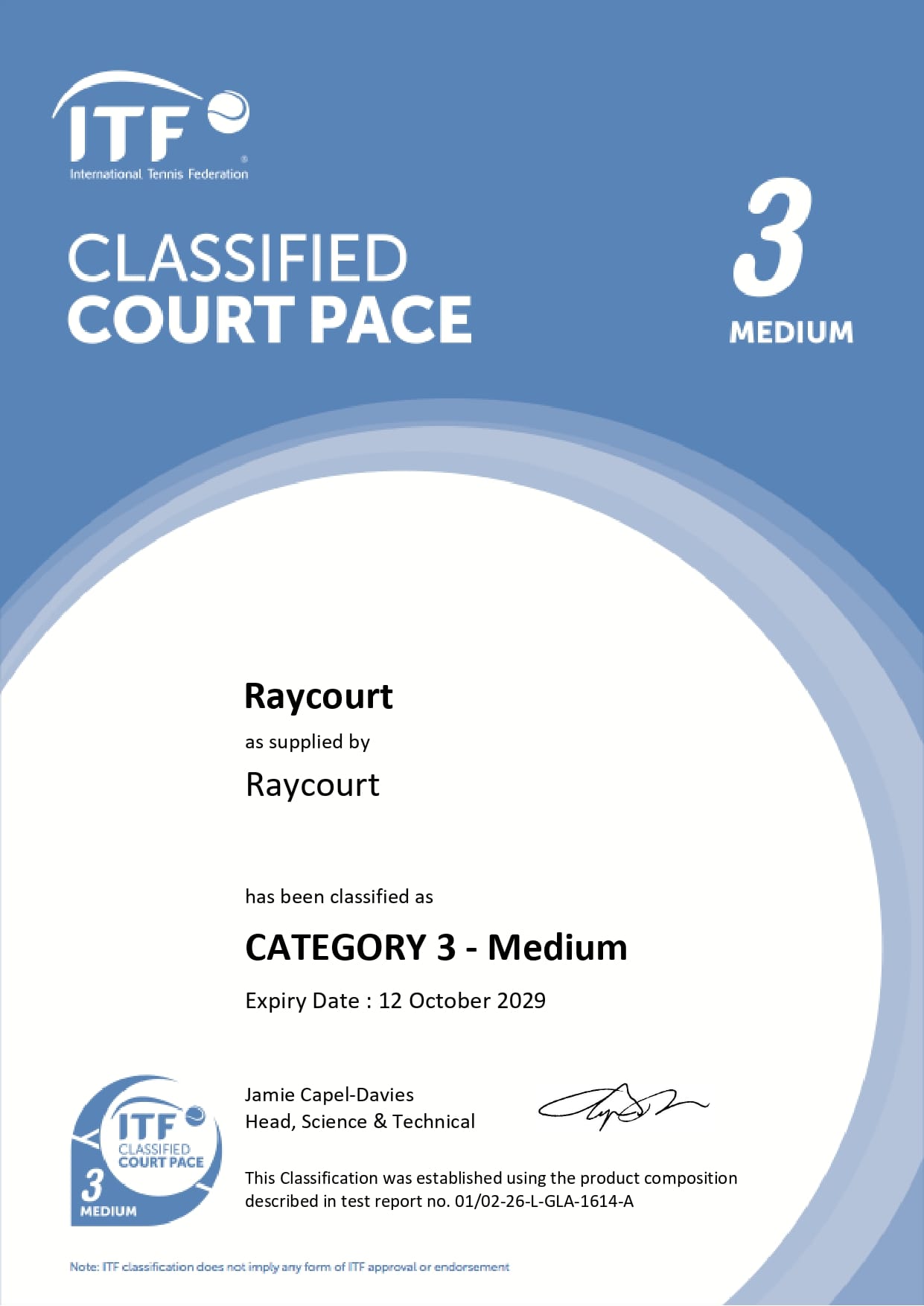
The International Tennis Federation operates a Court Pace Classification Programme. It classifies tested surface products into five categories, from slow to fast. Buyers can review the official ITF Classified Surfaces resource when evaluating relevant products.
Important: Do not assume that every acrylic surface has the same pace classification. The actual result depends on the tested product and its characteristics. Buyers should verify current classification details directly with the ITF.
A surface classification also does not automatically establish the status of a finished court. The ITF distinguishes product classification from court recognition. Therefore, facilities pursuing formal recognition should review the applicable requirements carefully.
Consistency Across the Entire Court
Players expect the court to behave consistently from one area to another. Variations in texture, flatness, or surface condition can affect movement and ball response. Consequently, the project team should pay attention to the complete playing area.
Correct base preparation supports a more uniform finish. Consistent material application also helps reduce visible variation. Finally, regular inspections help operators identify localised problems before they become more disruptive.
Ready to build a court that performs for years to come?
Connect with Raycourt for sports flooring systems built for your project.
Understanding the Layers of an Acrylic Tennis Court
A synthetic acrylic sports flooring system can contain several coordinated layers. Each layer contributes to the final surface, depending on the product specification. However, the exact system varies by manufacturer and application.
Prepared Base
The base provides the foundation for the playing surface. Suitable projects may use concrete or asphalt, depending on the design. The base must meet the relevant requirements for stability, surface regularity, and moisture.
The project team should assess cracks, joints, drainage, and other substrate conditions. Any necessary repairs must follow the appropriate technical approach. Applying a coating over an unsuitable base can compromise the finished system.
Primer Layer
Some acrylic systems require a primer to support compatibility and adhesion. The primer specification depends on the substrate and selected product. Contractors should follow the manufacturer’s instructions for preparation and application.
The primer cannot compensate for every surface defect. Therefore, the base must meet the required conditions before this stage. The project team should also observe the product’s drying and curing requirements.
Resurfacing or Levelling Materials
Some systems use compatible resurfacing materials to address suitable minor irregularities. These materials can help prepare the surface for subsequent layers. However, they cannot replace necessary structural repairs.
The contractor should assess the base before selecting the appropriate preparation method. Product compatibility also matters. Therefore, the project team should follow the complete system specification rather than mixing materials without confirmation.
Cushion Layer, Where Required
A cushion layer may form part of selected acrylic sports flooring systems. It can alter the surface’s underfoot response. However, not every indoor tennis court needs or includes this component.
Facility owners should compare the intended playing characteristics before choosing a cushioned design. They should also confirm the system’s substrate requirements. The final specification should match the building environment and intended use.
Acrylic Colour Layers
Acrylic colour layers establish much of the finished court’s appearance. They also contribute to the surface characteristics defined by the selected system. Contractors must apply these layers according to the manufacturer’s requirements.
The colour scheme should support ball visibility and clear court markings. The project team should also consider lighting and surrounding colours. A well-coordinated finish can improve the visual clarity of the playing area.
Textured Finish
The final texture helps establish the intended playing feel. It may also influence traction and maintenance requirements. The selected product specification determines the suitable finish.
Contractors should maintain consistent application across the playing surface. They should avoid unnecessary material variation between adjacent areas. Finally, they should protect the surface during curing.
Court Markings
The final layout includes the lines required for tennis. Marking materials should suit the acrylic system. Their colours should provide clear contrast without confusing the playing boundaries.
The contractor should follow the specified dimensions and application method. The finished markings should remain clear and consistent. Facility staff should inspect them during routine maintenance.
Expert tip: Ask for the complete system specification, not only the topcoat details. The performance of an acrylic court depends on how the selected layers work together.
Planning Indoor Tennis Courts for Different Facilities
Indoor tennis courts serve different audiences and operating models. Therefore, project requirements should reflect the facility’s purpose. A school court may have different priorities from a high-performance training venue.
Tennis Academies
Tennis academies need courts that support repeated practice and structured coaching. Players may spend long sessions working on footwork, serves, groundstrokes, and match tactics. Therefore, surface consistency and predictable playing characteristics matter.
Academy planners should also consider court availability and training schedules. Lighting must support sessions throughout the day. Storage areas should keep training aids organised and away from active playing zones.
The flooring specification should reflect the academy’s intended standard of play. Buyers should also assess whether the selected surface supports their preferred training conditions. Technical documentation can help the academy make an informed choice.
Schools and Colleges
Educational institutions often need flexible facilities for different age groups and abilities. Indoor courts can support lessons, sports clubs, and organised competitions. However, the design must accommodate supervision and safe circulation.
Schools should prioritise clear markings and appropriate access. They should also establish cleaning routines that fit their daily schedules. Furthermore, staff need clear procedures for reporting surface defects.
The flooring should suit the intended use and building conditions. A suitable acrylic system may support regular activity when the substrate and application meet requirements. Facility managers should confirm the relevant technical details before selection.
Sports Clubs and Recreation Centres
Sports clubs often accommodate beginners, experienced players, and casual users. Therefore, their courts need a consistent and understandable playing environment. Good lighting and clear markings help players use the facility confidently.
Club operators should also plan for frequent court turnover. Cleaning procedures should remove dust and debris without damaging the surface. Regular inspections can help identify wear or localised damage.
The building should provide suitable access for players and staff. Seating and waiting areas should remain outside the active playing envelope. These arrangements can support smoother operations during busy periods.
Residential Communities and Private Facilities
Residential communities may want indoor courts to support recreation and member engagement. Private facilities may prioritise convenience, appearance, and regular personal use. In both cases, the surface should suit the intended playing conditions.
Designers should consider available space and overhead clearance early. They should also plan access, ventilation, and lighting. The court layout must protect players from nearby walls and other obstructions.
Facility managers should establish a straightforward maintenance schedule. They should also provide clear rules for footwear, equipment, and court use. These steps help maintain the surface and support safe play.
Hotels, Resorts, and Multipurpose Sports Facilities
Hospitality venues may include tennis within a broader recreational offering. Indoor courts can support scheduled activities even during unfavourable weather. However, the facility needs to balance tennis requirements with other building functions.
The design should separate the playing area from unrelated activities. Noise, lighting, and ventilation can affect nearby spaces. Therefore, planners should coordinate the court with the wider building layout.
The flooring system should suit the intended level of use. Buyers should also consider cleaning access and routine maintenance. A clear operating plan helps staff keep the facility ready for play.
Indoor Tennis Courts in India: Key Planning Considerations
India’s climate varies considerably across regions. Some locations experience heavy monsoon rainfall, while others face high temperatures and dry conditions. Indoor tennis courts can reduce direct weather exposure, but the building still needs appropriate environmental management.
Monsoon Conditions and Moisture Control
Monsoon weather can increase moisture around buildings. Indoor facilities should manage roof leakage, water entry, condensation, and damp substrates. These factors matter because acrylic flooring requires a suitable base and application environment.
Designers should address roof drainage and external water management. Contractors should assess substrate moisture before applying the flooring system. Facility managers should investigate damp patches promptly rather than covering them with additional coatings.
Hot Weather and Indoor Comfort
High outdoor temperatures can affect indoor comfort, especially in buildings with limited ventilation. Roof insulation, airflow, and building design influence the internal environment. Therefore, planners should consider heat management from the start.
The flooring specification must also suit the anticipated application conditions. Contractors should follow product guidance for temperature and curing. They should avoid applying materials outside the manufacturer’s recommended limits.
Dust and Air Quality
Dust can enter indoor facilities through doors, footwear, ventilation openings, and nearby activity. Over time, its accumulation can affect the surface and alter traction. It can also reduce the visual clarity of court markings.
Operators should establish regular cleaning routines. Entrance mats and appropriate footwear rules can help limit contamination. Ventilation maintenance also supports a cleaner indoor environment.
Regional Building Requirements
Indoor sports facilities must follow applicable building, fire, electrical, and accessibility regulations. Requirements may differ according to location and facility type. Therefore, project teams should consult the relevant local authorities and qualified professionals.
The court surface must fit within the approved building design. Designers should also confirm that the finished layout preserves emergency access and safe movement. Coordination early in the project helps prevent avoidable conflicts.
Selecting Materials for Long-Term Use
Buyers should evaluate product documentation and compatibility before selecting a flooring system. They should ask about substrate preparation, application conditions, curing, and maintenance. This information supports better coordination between the manufacturer and contractor.
Raycourt manufactures synthetic acrylic sports court flooring materials for appropriate sports surface applications. It can help buyers understand its product specifications and relevant material considerations. The project owner should appoint suitable professionals for design, base preparation, and installation.
Ready to build a court that performs for years to come?
Connect with Raycourt for sports flooring systems built for your project.
How to Maintain Indoor Tennis Courts
Regular maintenance helps protect the playing surface and preserve a clean court environment. Indoor courts avoid some outdoor contaminants, but they still accumulate dust, shoe marks, and debris. Therefore, operators should create a maintenance routine that suits the facility’s usage.
Daily Cleaning
Staff should remove loose debris before it accumulates. They can use cleaning tools that suit the surface and manufacturer guidance. The cleaning process should avoid abrasive equipment or chemicals that may damage the finish.
Operators should also inspect the court before sessions begin. They should look for moisture, loose objects, visible damage, and unusual surface changes. Any immediate safety concern should receive attention before play continues.
A daily checklist can help staff maintain consistency:
- Remove dust, loose debris, and other contaminants.
- Check the surface for moisture or slippery areas.
- Inspect visible lines and playing boundaries.
- Look for cracks, peeling, or unusual wear.
- Keep access routes and emergency exits clear.
- Report defects to the facility manager.
Weekly Inspection
A weekly inspection should examine the surface more closely. Staff should check high-use areas, service boxes, baselines, and movement zones. They should also look for localised changes in texture or appearance.
Cleaning frequency may need adjustment during busy periods. Facilities with heavy foot traffic can accumulate more dust and debris. Therefore, operators should adapt their routines to actual usage.
Maintenance staff should record recurring problems. For example, repeated moisture in one location may indicate a building or ventilation issue. Early investigation can help identify the underlying cause.
Periodic Technical Assessment
A qualified professional should assess significant surface defects. Cracks, peeling, blistering, and uneven areas may indicate different underlying problems. The correct repair method depends on the cause and the flooring specification.
Operators should not apply random coatings over damaged areas. Incompatible materials can create additional problems. Instead, they should consult the original product documentation and seek suitable technical guidance.
The assessment should also consider the substrate. A surface defect may reflect movement or moisture beneath the coating. Addressing the underlying issue helps the project team select a more appropriate repair approach.
Managing Moisture and Condensation
Indoor courts can develop condensation under certain environmental conditions. Water on the playing surface can reduce traction and create safety concerns. Therefore, staff should address wet areas before allowing play.
Operators should identify the source of recurring moisture. Potential causes include roof leaks, ventilation problems, and damp substrates. The building team should investigate persistent issues and correct the underlying condition.
Cleaning staff should use suitable methods for moisture removal. They should also follow the flooring manufacturer’s maintenance guidance. Improvised chemicals or harsh tools may damage the finish.
Protecting Court Markings
Clear court lines help players judge boundaries and position themselves correctly. Dust, wear, and incompatible cleaning products can affect their appearance. Therefore, staff should include markings in routine inspections.
When markings show damage, the operator should consult the relevant flooring professional. The repair materials must suit the existing surface system. Correct preparation helps preserve a consistent appearance.
Creating a Maintenance Record
A maintenance log helps facility managers track the court’s condition. Staff can record cleaning, inspections, defects, and corrective actions. This information also helps identify recurring problems.
A practical record should include:
| Record item | Information to capture |
|---|---|
| Inspection date | Date and time of the check |
| Surface condition | General appearance and observed changes |
| Cleaning activity | Methods and products used |
| Defects | Location, type, and visible severity |
| Corrective action | Steps taken or recommended |
| Follow-up | Responsible person and next review |
A clear record supports more consistent facility management. It can also help contractors understand the history of a surface issue. Consequently, maintenance documentation forms a useful part of long-term court care.
Common Indoor Tennis Court Planning Mistakes
Some indoor court problems begin during the planning stage. Teams may focus on the building while overlooking the playing surface. Others may choose flooring without checking substrate compatibility.
Mistake 1: Planning Only the Marked Court Area
The playing rectangle does not represent the entire space requirement. Players need room beyond the lines for safe movement. Designers must also account for walls, columns, doors, and equipment.
The building layout should protect the complete playing envelope. Overhead clearance matters just as much as floor space. Therefore, the team should review the full three-dimensional court environment.
Mistake 2: Ignoring Base Preparation
Acrylic flooring needs a compatible, suitably prepared substrate. Cracks, moisture, and uneven areas can affect the finished system. Applying materials without addressing these conditions can create future problems.
The project team should inspect the base before selecting the application method. It should also follow the manufacturer’s preparation requirements. Structural or moisture-related concerns may require separate professional assessment.
Mistake 3: Assuming All Acrylic Systems Perform Identically
Acrylic products can differ in formulation, texture, layering, and intended use. Therefore, buyers should not assume that every system offers the same playing response. Product documentation helps clarify the relevant characteristics.
The facility owner should define the desired playing conditions first. Then, the project team can compare suitable specifications. This approach supports more informed product selection.
Mistake 4: Overlooking Lighting Glare
Bright lighting does not automatically provide good tennis visibility. Poor fixture placement can create glare and distracting shadows. Windows may also affect the ball’s visibility during play.
Designers should evaluate the court from different player positions. They should consider serves, overhead shots, and movement near the baselines. A coordinated lighting design can support clearer vision throughout the court.
Mistake 5: Neglecting Ventilation
Poor ventilation can create uncomfortable indoor conditions. It can also complicate moisture management and surface application. Therefore, ventilation needs attention during both building design and facility operation.
The design should balance fresh-air requirements with stable playing conditions. Operators should also maintain ventilation equipment regularly. Persistent humidity or condensation deserves prompt investigation.
Mistake 6: Using Incompatible Cleaning Products
Harsh chemicals and abrasive tools can damage some acrylic finishes. Incorrect cleaning practices may also alter surface appearance or texture. Consequently, operators should follow the manufacturer’s guidance.
Staff should receive clear cleaning instructions. They should also understand which products suit the installed system. A simple approved cleaning procedure can reduce avoidable maintenance problems.
Mistake 7: Confusing Product Classification With Court Recognition
A product classification and a completed court’s recognition represent different assessments. The ITF explains its surface classification programme through its technical resources. Buyers should review the relevant requirements before making claims about compliance.
A facility should not assume that selecting an acrylic product guarantees formal recognition. The completed court may need separate evaluation. Therefore, project teams should confirm the applicable rules directly with the relevant organisation.
Mistake 8: Failing to Define Responsibilities
Court projects involve several different responsibilities. Architects plan the building, engineers address structural matters, and contractors prepare and install the court system. Manufacturers provide product information and material specifications.
Clear responsibility helps teams coordinate decisions. It also prevents confusion about who handles installation or building work. Raycourt’s role focuses on manufacturing synthetic acrylic sports court flooring materials and supporting product-related understanding.
Ready to build a court that performs for years to come?
Connect with Raycourt for sports flooring systems built for your project.
How to Evaluate a Tennis Court Flooring Manufacturer
Selecting a suitable manufacturer helps buyers understand the materials behind their court. However, they should assess the supplier using documented information rather than broad marketing promises. A careful review can clarify product suitability and technical support.
Review Product Specifications
A product specification should explain the system’s intended application and relevant requirements. It should also identify substrate compatibility and application conditions. Buyers should request current documentation before finalising their selection.
They should pay attention to the complete system. Individual layers must work together according to the manufacturer’s instructions. Therefore, the team should avoid combining products without confirming compatibility.
Ask About Technical Support
Technical guidance helps project teams understand material requirements. Buyers should ask about substrate preparation, application conditions, curing, and maintenance. They should also clarify any limitations relevant to indoor use.
Manufacturers can explain their products, but they do not replace the appointed contractor. The contractor remains responsible for following the specification and completing the work. Meanwhile, qualified design professionals should address building and structural matters.
Check Relevant Testing and Classification
Testing can help buyers compare specific surface characteristics. The appropriate tests depend on the project requirements and product type. Where formal classification matters, buyers should verify the current status through the relevant organisation.
For tennis surfaces, the ITF provides information about court pace classification. Buyers can consult its official resource for current listings and programme details. They should avoid assuming that an unverified product holds a particular classification.
Confirm Intended Use
A surface designed for one application may not suit every facility. Buyers should explain whether the court will support recreation, coaching, or competition. They should also describe the substrate and indoor conditions.
This information helps the manufacturer identify relevant product options. The project team can then confirm compatibility and technical requirements. A clearly defined brief reduces uncertainty during product selection.
Understand the Manufacturer’s Role
A flooring material manufacturer supplies the specified products and relevant technical information. The appointed contractor handles preparation and installation. Other professionals manage building design, engineering, and regulatory compliance.
This distinction matters because flooring performance depends on several connected activities. A high-quality material still requires a suitable base and correct application. Therefore, the project owner should coordinate the responsibilities of every project participant.
How Raycourt Supports Indoor Tennis Court Projects
Raycourt focuses on synthetic acrylic sports court flooring materials. Its role supports buyers who need to understand suitable surface options for tennis facilities. The company also works within the broader sports flooring sector, where product selection and technical compatibility matter.
Synthetic Acrylic Flooring Materials
Acrylic sports flooring systems use coordinated materials to create the intended playing surface. Depending on the specification, these systems may include primers, resurfacing compounds, coloured layers, and textured finishes. Some compatible designs also incorporate cushion layers.
The exact product configuration should match the project requirements. Buyers should explain the intended use, substrate, and indoor conditions. Raycourt can help them understand its available materials and relevant product information.
Supporting Informed Material Selection
Facility owners may need help comparing different surface requirements. For example, an academy may prioritise consistent playing characteristics. A recreational facility may place greater emphasis on routine upkeep and visual appearance.
Raycourt can provide product-related information to support these discussions. The project team should then confirm the complete specification with the appointed professionals. This process helps align material selection with the intended facility.
Coordinating With the Project Team
Indoor tennis court projects involve several specialists. The manufacturer supplies flooring materials, while the contractor handles installation. Architects and engineers manage the building design and relevant technical requirements.
Early communication helps each participant understand the project scope. It also allows the team to identify substrate or environmental concerns before application. Consequently, clear coordination supports better planning.
A Practical Approach to Product Enquiries
When contacting Raycourt, buyers should prepare a brief describing their project. The following details can help clarify their requirements:
- Facility type and intended users.
- Number of tennis courts planned.
- Proposed concrete or asphalt base.
- Indoor temperature and moisture considerations.
- Desired playing characteristics.
- Preference for a cushioned or non-cushioned system.
- Relevant technical or classification requirements.
- Expected maintenance practices and operating conditions.
This information helps the team understand the application. It also supports a more focused discussion about suitable materials. The appointed contractor should confirm the installation method and site conditions before work begins.
Raycourt’s focus remains on manufacturing sports court flooring materials. It does not undertake court installation. Buyers should therefore appoint a suitable contractor for base preparation, application, and finishing.
Indoor Tennis Court Construction: What Happens Before Flooring Application?
Indoor tennis court construction requires coordination between building design, structural work, base preparation, and flooring materials. Each stage contributes to the finished playing environment. Therefore, project teams should establish technical requirements before purchasing the final flooring system.
Building Design and Structural Preparation
The building structure protects the playing area and supports the court’s environmental requirements. Architects and engineers must consider roof height, structural spans, ventilation, lighting, drainage, and access. They should also ensure that the design meets applicable building regulations.
The court layout should guide the placement of columns and permanent equipment. Otherwise, structural elements may obstruct movement or interfere with ball trajectories. A coordinated design helps preserve the playing envelope.
Designers should also consider future maintenance access. Lighting fixtures, ventilation equipment, and roof components need suitable access arrangements. These provisions can simplify routine facility management without disrupting tennis activities.
Base Preparation Before Acrylic Flooring
The base provides the foundation for the acrylic playing surface. Therefore, the contractor must confirm its suitability before beginning surface application. Concrete and asphalt can support appropriate systems when they meet the relevant specifications.
The contractor should inspect surface regularity, cracks, joints, and moisture conditions. Any necessary repairs should follow a suitable technical approach. Furthermore, the substrate must meet the flooring manufacturer’s preparation requirements.
Moisture deserves particular attention in enclosed buildings. A roof does not eliminate moisture problems within the ground or concrete slab. Consequently, the project team should investigate dampness before applying the acrylic materials.
The contractor should also confirm that the base provides suitable drainage where the design requires it. Standing water can create operational and maintenance concerns. Although indoor courts receive less direct rainfall, leaks and cleaning water still require proper management.
Material Application and Curing
Once the base meets the required conditions, the contractor can follow the specified flooring application process. The precise sequence depends on the selected acrylic system. Therefore, the contractor should follow the manufacturer’s current technical documentation.
Each layer requires suitable preparation and application conditions. Temperature, humidity, substrate condition, and drying intervals can influence the process. The contractor should observe the specified curing requirements before allowing normal play.
Facility owners should avoid rushing the final inspection or opening schedule. Premature use can interfere with the intended surface finish. Instead, the contractor should confirm that the system meets the manufacturer’s completion requirements.
Expert tip: Confirm the substrate, environmental conditions, application sequence, and curing requirements before scheduling the court opening. This coordination helps reduce avoidable delays and surface problems.
Indoor Tennis Court Safety: Flooring and Facility Management
Safety depends on the complete playing environment rather than one material alone. The flooring surface, court layout, lighting, equipment, and operating procedures all contribute. Therefore, facility managers should combine suitable design with regular inspections.
Maintain Suitable Playing Conditions
Players need a clean surface that supports predictable movement. Dust, water, loose objects, and unsuitable footwear can affect traction. Staff should therefore inspect the court before sessions begin.
Operators should establish clear procedures for reporting spills and surface defects. Staff should also restrict access when conditions create an immediate hazard. Prompt action helps protect players and employees.
The flooring specification should match the intended activity. However, no surface can eliminate every risk associated with tennis. Footwear, technique, fitness, and playing behaviour also influence safety.
Keep Equipment Outside the Playing Area
Tennis facilities often use ball baskets, training cones, benches, and coaching equipment. These items should remain outside active movement zones. Otherwise, players may encounter avoidable obstacles during rallies.
Designers should provide suitable storage areas near the courts. Coaches should return equipment to these locations after each session. Facility staff should also keep emergency routes clear.
Monitor Lighting and Visibility
Poor visibility can affect a player’s ability to track the ball. Glare, shadows, and uneven illumination can create difficulties during serves and overhead shots. Consequently, operators should inspect lighting performance regularly.
Staff should report failed fixtures and unexpected changes in illumination. The facility team should also check for reflections from windows or glossy surfaces. A suitable lighting design supports clearer vision across the entire playing area.
Establish Clear Operating Procedures
Written procedures help staff manage the facility consistently. These procedures should cover cleaning, access, equipment storage, surface inspections, and incident reporting. They should also explain how staff handle wet or damaged areas.
Operators should review these procedures as facility use changes. For example, a busy academy may require more frequent inspections than an occasionally used private court. A practical schedule should reflect actual usage and environmental conditions.
Ready to build a court that performs for years to come?
Connect with Raycourt for sports flooring systems built for your project.
Indoor Tennis Courts and Sustainable Facility Management
Facility owners increasingly consider maintenance practices alongside performance and durability. Sustainable management involves using materials appropriately, controlling unnecessary waste, and maintaining equipment efficiently. However, environmental claims should rely on verified product information rather than assumptions.
Choose Materials With Clear Technical Documentation
Product documentation helps buyers understand the intended application and maintenance requirements. It can also clarify storage, handling, and curing conditions. These details support responsible material management throughout the project.
Buyers should ask manufacturers for relevant technical and safety documentation. They should also confirm the correct storage conditions for unopened materials. Proper handling can help preserve product quality and reduce avoidable waste.
Reduce Unnecessary Material Waste
Careful planning helps the project team estimate material quantities more accurately. The contractor should follow the manufacturer’s guidance for mixing, application, and storage. These practices can reduce avoidable material loss.
The team should also manage packaging and leftover materials responsibly. Applicable disposal requirements may vary by product and location. Therefore, contractors should follow the relevant safety instructions and local regulations.
Maintain the Court Instead of Ignoring Early Defects
Routine inspections can identify minor problems before they spread. Staff should record cracks, peeling, moisture, and unusual surface changes. The project team can then investigate the underlying causes.
Early assessment may help prevent unnecessary repairs or premature surface replacement. However, the correct response depends on the defect and installed system. Qualified professionals should recommend suitable corrective measures.
Consider the Entire Facility Lifecycle
The playing surface forms one part of a larger building system. Lighting, ventilation, roof drainage, access routes, and structural elements also require maintenance. Facility managers should coordinate these activities through a practical maintenance plan.
A complete plan should include regular inspections and clear responsibilities. It should also record corrective work and recurring concerns. This approach helps operators understand the facility’s condition over time.
Final Checklist Before Selecting Indoor Tennis Court Flooring
Before finalising an indoor tennis court flooring specification, review the following requirements. This checklist helps facility owners organise the main decisions and discuss them with relevant professionals.
- Intended use: Define whether the facility supports recreation, coaching, or competition.
- Court dimensions: Confirm the playing rectangle and appropriate surrounding clearances.
- Overhead clearance: Check roof height, beams, lighting, and ventilation equipment.
- Base suitability: Confirm whether the proposed concrete or asphalt base meets the system requirements.
- Moisture management: Investigate dampness, condensation, leaks, and relevant drainage concerns.
- Surface characteristics: Define the required texture, playing response, and cushioning preferences.
- Product documentation: Review technical specifications and application requirements.
- Classification requirements: Verify any relevant ITF product classification or court recognition requirements.
- Indoor environment: Assess ventilation, temperature, lighting, and humidity.
- Installation responsibilities: Appoint a suitable contractor for preparation and application.
- Maintenance planning: Establish cleaning routines, inspections, and defect reporting.
- Facility safety: Confirm access arrangements, emergency routes, and equipment storage.
These checks help the project team approach material selection with greater clarity. They also encourage early coordination between the flooring manufacturer, contractor, architect, and facility owner.
Raycourt can discuss its synthetic acrylic sports court flooring materials and relevant product information. The project team should use that information alongside its site assessment and technical requirements. This approach supports informed decisions about suitable indoor tennis court surfaces.
Frequently Asked Questions
Indoor tennis courts provide a covered playing area protected from rain and direct wind. They support regular tennis practice, coaching, and recreational activities throughout the year.
Synthetic acrylic sports flooring offers a suitable option for many indoor tennis courts. It provides a textured playing surface, colour flexibility, and consistent playing characteristics when the system meets technical requirements.
A standard tennis court measures 23.77 metres long. Its width measures 8.23 metres for singles and 10.97 metres for doubles. Additional space allows players to move safely beyond the court lines.
Yes, Raycourt manufactures synthetic acrylic sports court flooring materials. Buyers can explore suitable flooring options and request product information. Raycourt focuses on material manufacturing and does not provide court installation.
Regularly remove dust, debris, and moisture from the playing surface. Inspect the court for cracks, peeling, and surface wear. Follow the manufacturer’s cleaning guidelines to maintain surface quality and playing consistency.
Conclusion: Plan Better Indoor Tennis Courts With the Right Flooring
Indoor tennis courts create opportunities for regular practice, structured coaching, and organised sports activities. However, the quality of the playing environment depends on several connected decisions. These include court dimensions, run-off space, roof clearance, lighting, ventilation, flooring selection, and maintenance.
Synthetic acrylic sports flooring offers a practical option for suitable indoor tennis facilities. A compatible system can provide a consistent texture, a professional appearance, and defined playing characteristics. Nevertheless, the finished result depends on substrate quality, product selection, environmental conditions, and correct application.
Facility owners should evaluate the complete court system rather than focusing only on the surface coating. They should also review technical documentation and confirm any relevant classification requirements. Regular maintenance helps protect the playing surface and identify potential problems early.
Raycourt manufactures synthetic acrylic sports court flooring materials for appropriate tennis and sports surface applications. Its product-related guidance can help buyers understand material options and technical considerations. For indoor tennis court projects, contact Raycourt to discuss your flooring material requirements and explore suitable acrylic surface solutions.
Choose flooring materials with a clear understanding of your court’s requirements. A well-coordinated approach helps create an indoor tennis environment that supports consistent play, practical maintenance, and long-term facility use.
Ready to build a court that performs for years to come?
Connect with Raycourt for sports flooring systems built for your project.